A chart shows that the Baltic Dry Index rose slightly, with all ship types showing a synchronized increase.
2026-04-29 00:27:49
Latest data shows that the Baltic Dry Index (BDI) reached 2677 points on April 28, 2026, a new high since December 8, 2025, up 0.41% month-on-month, marking the largest increase in four days and the second consecutive day of increase (including zero growth). Looking at the short-term charts, the recent 11 BDI data points show: 9 positive increases, 2 negative increases, and 0 zero increases. Specifically, the Panamax Freight Index (BPI) was 1966 points, up 0.46% from the previous value; the Capesize Freight Index (BCI) was 4303 points, up 0.49%; and the Supramax Freight Index (BSI) was 1542 points, up 0.13%. For detailed 720-day and 10-year trend charts of the Baltic Dry Index and its three main sub-indices, please refer to the specially designed charts.
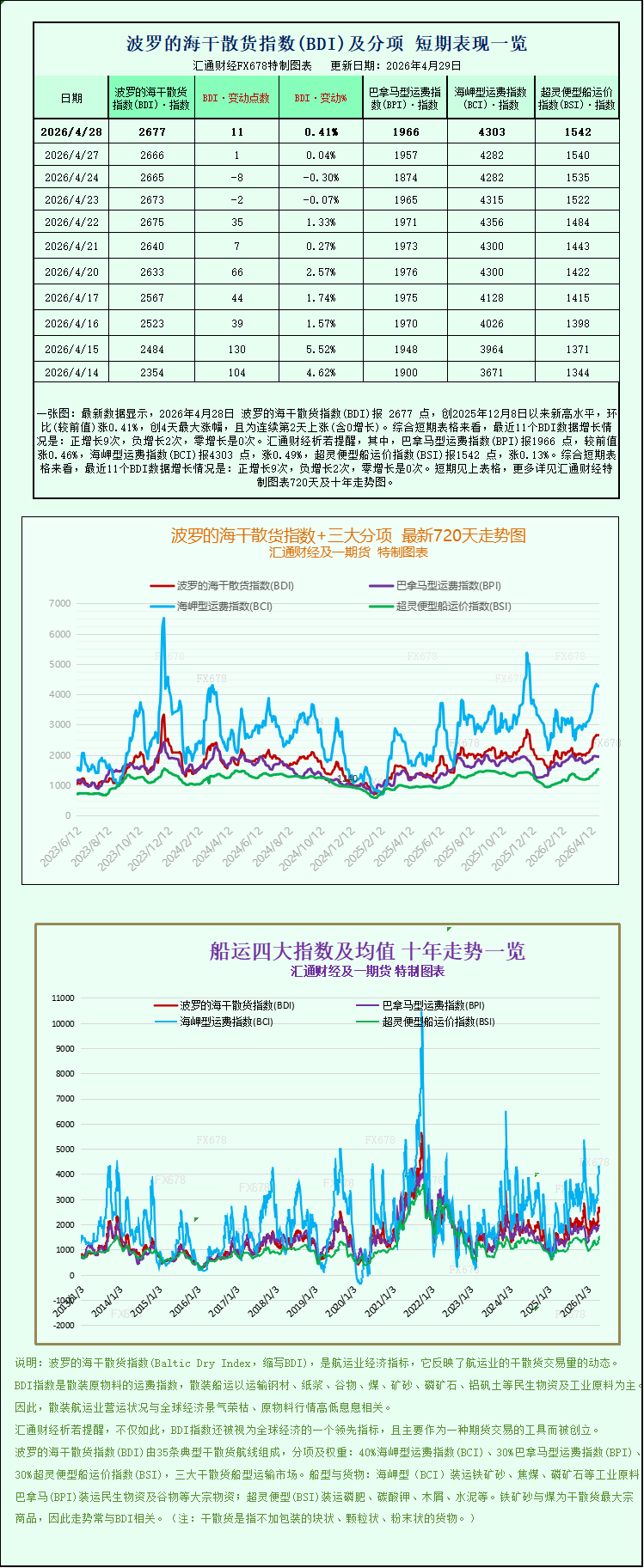
The Baltic Dry Index (BDI), a leading global indicator for measuring international dry bulk shipping prices, primarily monitors freight rates for vessels transporting essential goods such as grains, coal, ore, and bauxite, as well as industrial raw materials. It serves as a barometer of the international dry bulk shipping market and a leading indicator of global trade. The index rose slightly on Tuesday, driven primarily by simultaneous increases in major vessel types, including Capesize, Panamax, and Supramax. Overall market trading activity moderately improved, continuing the recent upward trend.
As a core indicator comprehensively reflecting the global dry bulk shipping market's health, the Baltic Dry Index, which tracks freight rates for the three major vessel types—Capesize, Panamax, and Supramax—showed steady performance, rising slightly by 11 points to close at 2,677 points, an increase of approximately 0.41%. While this increase is not significant, it highlights the coordinated efforts across various segments of the current dry bulk shipping market, breaking the previous pattern of differentiated fluctuations among individual vessel types and demonstrating the overall recovery momentum of the market.
Specifically, all sub-ship type indices showed varying degrees of increase, with the Capesize sector performing particularly well. The Capesize index rose 22 points to close at 4304 points, an increase of approximately 0.51%, becoming a significant force driving the overall index upward. Capesize vessels, as the backbone of long-distance bulk dry cargo transportation, typically have a deadweight tonnage of over 160,000 tons and mainly transport core industrial raw materials such as iron ore and coal. Their freight rate fluctuations are closely related to global industrial demand.
In terms of actual operations, the average daily revenue of Capesize vessels carrying 150,000 tons of cargo (mainly including bulk industrial raw materials such as iron ore and coal) also increased, rising by $202 on the day, eventually reaching $35,536. This revenue growth directly reflects the moderate improvement in market demand for Capesize vessels. Although iron ore futures prices corrected on the day, it did not significantly affect the freight rate trend of this vessel type.
It is worth noting that iron ore futures, after rising slightly for two consecutive trading days, retreated on Tuesday. Market sources indicate that the main reason for this pullback was that Chinese state-owned purchasers recently allowed some domestic steel companies to buy BHP's iron ore cargoes, which had previously been banned from import and stockpiled at ports. This move effectively alleviated market concerns about iron ore supply shortages, leading to a temporary decline in futures prices. However, this fluctuation had a relatively limited impact on the dry bulk shipping market and did not hinder the upward trend in Capesize freight rates. Previously, BHP had completed iron ore sales contract negotiations with China Mineral Resources Group, laying the foundation for future cooperation and indirectly affecting the global iron ore supply landscape.
Besides the Capesize sector, the Panamax sector also saw steady gains. The Panamax index rose 9 points, or about 0.5%, to close at 1,966 points, showing a stable trend. Panamax vessels, with a deadweight tonnage of 50,000 to 80,000 tons, are the mainstay of global dry bulk long-haul transportation, typically carrying 60,000 to 70,000 tons of bulk commodities such as coal or grain. Their freight rates are closely related to global food trade and energy transportation demand.
Matching the index's rise, the average daily revenue of Panamax vessels also increased, rising by $78 to $17,695 on the same day. This growth indicates that global demand for the transportation of essential goods such as food and coal, as well as energy resources, remains stable, providing strong support for the Panamax vessel market and further confirming the overall recovery of the dry bulk shipping market.
In the smaller tonnage vessel sector, the Supramax index also saw a slight increase, rising 2 points, or approximately 0.1%, to close at 1,542 points. Supramax vessels, with a deadweight tonnage between 50,000 and 60,000 tons, are currently the core vessel type for medium-range dry bulk shipping globally. They possess good route adaptability and cargo compatibility, primarily carrying bulk commodities such as grains, coal, and phosphate fertilizers. The slight increase in freight rates reflects the gradual improvement in demand in the small-to-medium tonnage dry bulk shipping market, resulting in a positive trend of simultaneous increases across all vessel types.
Overall, the slight increase in the Baltic Dry Index on April 28 was attributed to the coordinated efforts of various ship types, reflecting a moderate recovery in global dry bulk trade demand. Although iron ore futures experienced a short-term correction, it did not significantly impact the dry bulk shipping market. With the gradual recovery of global industrial production and trade activities, the dry bulk shipping market is expected to maintain stable operation going forward.
The Baltic Dry Index (BDI), a leading global indicator for measuring international dry bulk shipping prices, primarily monitors freight rates for vessels transporting essential goods such as grains, coal, ore, and bauxite, as well as industrial raw materials. It serves as a barometer of the international dry bulk shipping market and a leading indicator of global trade. The index rose slightly on Tuesday, driven primarily by simultaneous increases in major vessel types, including Capesize, Panamax, and Supramax. Overall market trading activity moderately improved, continuing the recent upward trend.
As a core indicator comprehensively reflecting the global dry bulk shipping market's health, the Baltic Dry Index, which tracks freight rates for the three major vessel types—Capesize, Panamax, and Supramax—showed steady performance, rising slightly by 11 points to close at 2,677 points, an increase of approximately 0.41%. While this increase is not significant, it highlights the coordinated efforts across various segments of the current dry bulk shipping market, breaking the previous pattern of differentiated fluctuations among individual vessel types and demonstrating the overall recovery momentum of the market.
Specifically, all sub-ship type indices showed varying degrees of increase, with the Capesize sector performing particularly well. The Capesize index rose 22 points to close at 4304 points, an increase of approximately 0.51%, becoming a significant force driving the overall index upward. Capesize vessels, as the backbone of long-distance bulk dry cargo transportation, typically have a deadweight tonnage of over 160,000 tons and mainly transport core industrial raw materials such as iron ore and coal. Their freight rate fluctuations are closely related to global industrial demand.
In terms of actual operations, the average daily revenue of Capesize vessels carrying 150,000 tons of cargo (mainly including bulk industrial raw materials such as iron ore and coal) also increased, rising by $202 on the day, eventually reaching $35,536. This revenue growth directly reflects the moderate improvement in market demand for Capesize vessels. Although iron ore futures prices corrected on the day, it did not significantly affect the freight rate trend of this vessel type.
It is worth noting that iron ore futures, after rising slightly for two consecutive trading days, retreated on Tuesday. Market sources indicate that the main reason for this pullback was that Chinese state-owned purchasers recently allowed some domestic steel companies to buy BHP's iron ore cargoes, which had previously been banned from import and stockpiled at ports. This move effectively alleviated market concerns about iron ore supply shortages, leading to a temporary decline in futures prices. However, this fluctuation had a relatively limited impact on the dry bulk shipping market and did not hinder the upward trend in Capesize freight rates. Previously, BHP had completed iron ore sales contract negotiations with China Mineral Resources Group, laying the foundation for future cooperation and indirectly affecting the global iron ore supply landscape.
Besides the Capesize sector, the Panamax sector also saw steady gains. The Panamax index rose 9 points, or about 0.5%, to close at 1,966 points, showing a stable trend. Panamax vessels, with a deadweight tonnage of 50,000 to 80,000 tons, are the mainstay of global dry bulk long-haul transportation, typically carrying 60,000 to 70,000 tons of bulk commodities such as coal or grain. Their freight rates are closely related to global food trade and energy transportation demand.
Matching the index's rise, the average daily revenue of Panamax vessels also increased, rising by $78 to $17,695 on the same day. This growth indicates that global demand for the transportation of essential goods such as food and coal, as well as energy resources, remains stable, providing strong support for the Panamax vessel market and further confirming the overall recovery of the dry bulk shipping market.
In the smaller tonnage vessel sector, the Supramax index also saw a slight increase, rising 2 points, or approximately 0.1%, to close at 1,542 points. Supramax vessels, with a deadweight tonnage between 50,000 and 60,000 tons, are currently the core vessel type for medium-range dry bulk shipping globally. They possess good route adaptability and cargo compatibility, primarily carrying bulk commodities such as grains, coal, and phosphate fertilizers. The slight increase in freight rates reflects the gradual improvement in demand in the small-to-medium tonnage dry bulk shipping market, resulting in a positive trend of simultaneous increases across all vessel types.
Overall, the slight increase in the Baltic Dry Index on April 28 was attributed to the coordinated efforts of various ship types, reflecting a moderate recovery in global dry bulk trade demand. Although iron ore futures experienced a short-term correction, it did not significantly impact the dry bulk shipping market. With the gradual recovery of global industrial production and trade activities, the dry bulk shipping market is expected to maintain stable operation going forward.
- Risk Warning and Disclaimer
- The market involves risk, and trading may not be suitable for all investors. This article is for reference only and does not constitute personal investment advice, nor does it take into account certain users’ specific investment objectives, financial situation, or other needs. Any investment decisions made based on this information are at your own risk.