Gold Trading Alert: Resurgence of Middle East Conflicts and Inflationary Anxiety Cause Gold Prices to Plunge Nearly 2% to a Four-Week Low; Fed Decision Becomes a Matter of Life or Death
2026-04-29 07:51:18
On Tuesday (April 28), spot gold fell sharply by 1.8%, closing at around $4,597 per ounce, touching a near four-week low of around $4,554. U.S. gold futures also retreated to around $4,608. This drop stands out starkly in a gold market that has been consolidating at recent high levels, driven by the combined pressures of ongoing tensions in the Middle East and the upcoming Federal Reserve monetary policy meeting.
Despite the near-blockade of the Strait of Hormuz due to the Iranian conflict and oil prices surging above $111 per barrel, which should theoretically benefit gold's safe-haven appeal, gold prices have instead chosen to adjust downwards. The continued rise in oil prices has directly ignited global inflation concerns, dampened expectations of a Federal Reserve rate cut this year, helped the US dollar index rise, and put downward pressure on gold prices. On Wednesday (April 29) in early Asian trading, spot gold hovered at low levels, currently trading around $4590 per ounce.
The US-Iran conflict has now lasted for over two months, and since its outbreak in late February, the Strait of Hormuz, a vital global energy artery, has been virtually closed. Iran's restrictions on passage and demands for tolls have further exacerbated concerns about supply disruptions. Ship tracking data shows that several Iranian oil tankers have been forced to turn back due to the US blockade, and even the few Saudi or UAE vessels that have successfully traversed the strait have failed to alleviate the overall tension.
The Trump administration's dissatisfaction with Iran's latest peace proposal became a key turning point in market sentiment. Iran proposed a phased negotiation plan: first ending the war, lifting the blockade, and reopening the Strait of Hormuz, then discussing its nuclear program and hoping the US would recognize its uranium enrichment rights. However, Trump clearly expressed his dissatisfaction, believing the nuclear issue must be included in negotiations from the outset. His comments on social media that Iran was in a "state of collapse" and needed to straighten out its leadership further diminished hopes for a short-term ceasefire.
Meanwhile, the UAE announced its withdrawal from OPEC and OPEC+ on May 1st, a move that exposed the divisions among Gulf states over the Iran issue. What should have been major negative news for the oil market was largely priced in by the market's digestion of the Strait of Hormuz blockade, which left oil with nowhere to go. Brent crude still rose nearly 3%, marking its seventh consecutive day of gains, while US crude briefly broke through the $100 mark. The World Bank even predicted that if the worst supply disruptions end in May, energy prices could still surge by 24% by 2026, reaching a new high since the Russia-Ukraine conflict.
The continued rise in oil prices has directly ignited global inflation concerns. Rising energy costs will be passed on to all stages of production, transportation, and consumption, especially given the current signs of weakness in the labor market, leading investors to question the scope for central bank easing policies. As a non-interest-bearing asset, the opportunity cost of holding gold increases with rising real interest rates, resulting in safe-haven buying being suppressed by inflation trades and a stronger dollar. The market is exhibiting a "traditional safe-haven linkage": rising oil prices, a stronger dollar, rising US Treasury yields, but falling gold prices.
This week, investors are focused on the Federal Reserve's two-day FOMC meeting. The market widely expects the Fed to keep interest rates unchanged on Wednesday (2:00 AM Thursday Beijing time), which may be Powell's last meeting as chairman. Senate procedures are underway, and former governor Warsh's nomination is expected to succeed him, but the inflationary risks from soaring energy prices may keep policymakers cautious.
Federal funds futures indicate that the market has priced in only around 20% of the probability of an interest rate cut before the end of the year, a significant drop from previous levels. The two-year Treasury yield rose to 3.844%, and the 10-year yield touched above 4.35%, with the yield curve flattening, reflecting a mix of short-term inflationary pressures and long-term growth concerns. While the Bank of Japan maintained its interest rate at 0.75%, the rare 6-3 split and statements from some members supporting a rate hike to 1.0% further strengthened global tightening expectations.
The US dollar index rebounded 0.15% to around 98.63. Analysts pointed out that since the Iran war, the market is exhibiting a classic correlation: the energy crisis has driven up inflation expectations, delayed the Fed's rate cut path, supported the dollar, and put pressure on gold prices. The policy decisions of the European Central Bank, the Bank of England, and the Bank of Canada will also be closely watched, as their statements could further influence global liquidity expectations.
In this environment, gold's safe-haven appeal has been temporarily overshadowed by "inflation trading." Investors are more inclined to hold dollar assets or focus on higher-yielding instruments rather than gold. The slight decline in the S&P 500 also reflects a cautious risk appetite.
Despite short-term downward pressure on gold prices, signals from the physical demand side remain worth noting. As the world's largest gold consumer, China's net gold imports from Hong Kong in March reached 47.866 tons, a slight increase from 46.249 tons in February. This data reflects that driven by domestic economic recovery and the demand for wealth preservation, Chinese buyers are still steadily accumulating gold, often demonstrating strong buying support, especially when international gold prices experience corrections.
This figure from the Hong Kong Census and Statistics Department has injected a glimmer of hope into the gold market. In the long term, central bank gold purchases, geopolitical uncertainties, and the global trend towards de-dollarization continue to provide structural support for gold. However, in the short term, these positive factors are unlikely to counteract the combined impact of oil price-driven inflation and a strong US dollar.
The gold market is at a critical crossroads. Chairman Powell's speech at the close of the Federal Reserve meeting on Wednesday will be the focus. If his remarks are cautious, acknowledging rising inflation risks while simultaneously hinting at continued concern about a weak labor market, the market may maintain its high-level consolidation; however, if he releases a more hawkish signal, emphasizing the need to observe the impact of energy prices over a longer period, gold may face further downward pressure.
In the medium to long term, once substantial progress is made in US-Iran negotiations, the Strait of Hormuz reopens, oil prices fall, inflation expectations cool, and the Federal Reserve resumes its interest rate cuts, gold's dual attributes of being a safe haven and a hedge against inflation will regain their dominance. Analysts have already raised their 2026 gold price forecasts, the core logic being that continued central bank gold purchases and economic uncertainty will offset the negative impact of short-term inflation.
In addition, Trump's approval rating has fallen to a low point in his term (34% in polls), and his disagreements with European allies over Iran have increased policy uncertainty, providing a potential buffer for gold.
The recent decline in gold prices is essentially a market repricing result as the Middle East conflict shifts from being "safe-haven driven" to "inflation driven." Rising oil prices have pushed up real interest rate expectations, reducing gold's appeal, but this doesn't signify a failure of its safe-haven properties; rather, it's a cumulative effect of short-term macroeconomic factors. China's robust import demand and global central banks' strategic allocation of gold are still laying the groundwork for a market bottom.
Investors should closely monitor the Federal Reserve meeting minutes and Powell's speech, while also paying attention to the progress of indirect negotiations between the US and Iran through channels such as Pakistan. Amidst the dual uncertainties of geopolitics and monetary policy, gold will remain an indispensable part of a diversified portfolio. Short-term volatility is possible, but from a medium- to long-term perspective, when inflationary pressures ease and the interest rate cut cycle resumes, gold is expected to regain its upward momentum and continue its historical role as a wealth preservation tool.
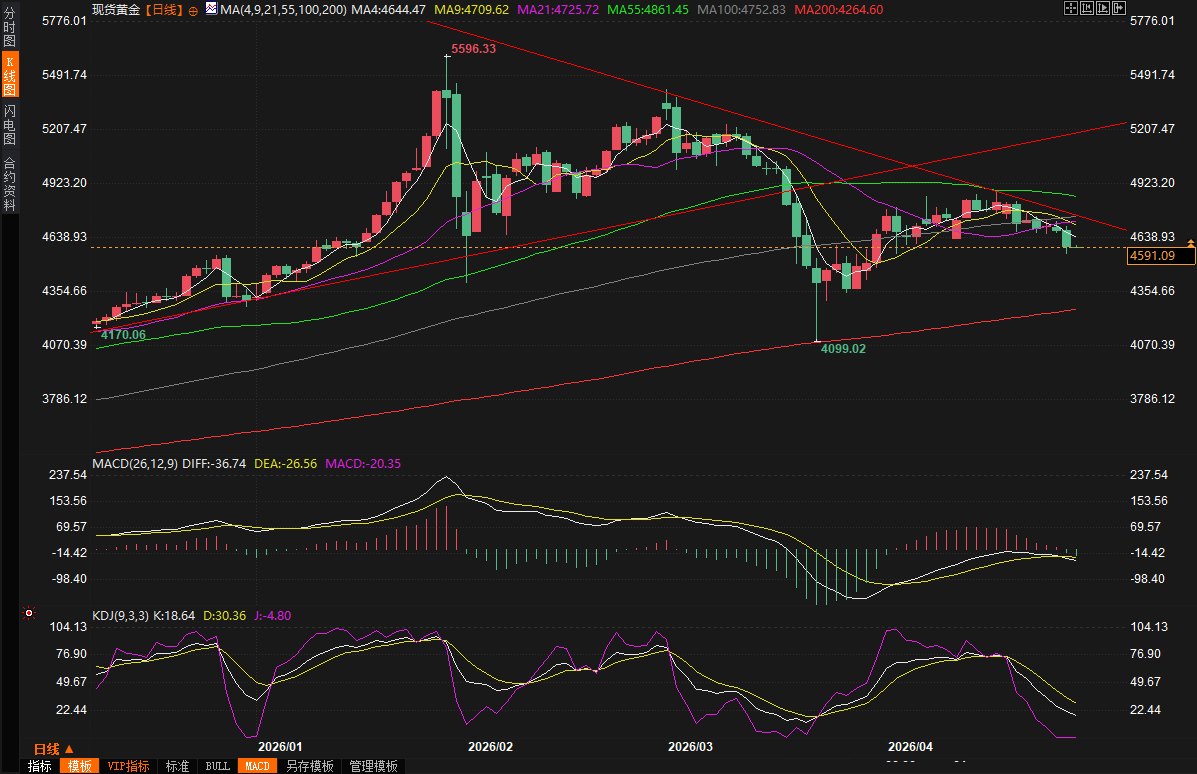
(Spot gold daily chart, source: FX678)
At 07:48 Beijing time, spot gold was trading at $4,591.42 per ounce.
Despite the near-blockade of the Strait of Hormuz due to the Iranian conflict and oil prices surging above $111 per barrel, which should theoretically benefit gold's safe-haven appeal, gold prices have instead chosen to adjust downwards. The continued rise in oil prices has directly ignited global inflation concerns, dampened expectations of a Federal Reserve rate cut this year, helped the US dollar index rise, and put downward pressure on gold prices. On Wednesday (April 29) in early Asian trading, spot gold hovered at low levels, currently trading around $4590 per ounce.
Middle East peace efforts have stalled, and rising oil prices have undermined gold's safe-haven appeal.
The US-Iran conflict has now lasted for over two months, and since its outbreak in late February, the Strait of Hormuz, a vital global energy artery, has been virtually closed. Iran's restrictions on passage and demands for tolls have further exacerbated concerns about supply disruptions. Ship tracking data shows that several Iranian oil tankers have been forced to turn back due to the US blockade, and even the few Saudi or UAE vessels that have successfully traversed the strait have failed to alleviate the overall tension.
The Trump administration's dissatisfaction with Iran's latest peace proposal became a key turning point in market sentiment. Iran proposed a phased negotiation plan: first ending the war, lifting the blockade, and reopening the Strait of Hormuz, then discussing its nuclear program and hoping the US would recognize its uranium enrichment rights. However, Trump clearly expressed his dissatisfaction, believing the nuclear issue must be included in negotiations from the outset. His comments on social media that Iran was in a "state of collapse" and needed to straighten out its leadership further diminished hopes for a short-term ceasefire.
Meanwhile, the UAE announced its withdrawal from OPEC and OPEC+ on May 1st, a move that exposed the divisions among Gulf states over the Iran issue. What should have been major negative news for the oil market was largely priced in by the market's digestion of the Strait of Hormuz blockade, which left oil with nowhere to go. Brent crude still rose nearly 3%, marking its seventh consecutive day of gains, while US crude briefly broke through the $100 mark. The World Bank even predicted that if the worst supply disruptions end in May, energy prices could still surge by 24% by 2026, reaching a new high since the Russia-Ukraine conflict.
The continued rise in oil prices has directly ignited global inflation concerns. Rising energy costs will be passed on to all stages of production, transportation, and consumption, especially given the current signs of weakness in the labor market, leading investors to question the scope for central bank easing policies. As a non-interest-bearing asset, the opportunity cost of holding gold increases with rising real interest rates, resulting in safe-haven buying being suppressed by inflation trades and a stronger dollar. The market is exhibiting a "traditional safe-haven linkage": rising oil prices, a stronger dollar, rising US Treasury yields, but falling gold prices.
Inflation looms over the Federal Reserve meeting, significantly cooling expectations for interest rate cuts.
This week, investors are focused on the Federal Reserve's two-day FOMC meeting. The market widely expects the Fed to keep interest rates unchanged on Wednesday (2:00 AM Thursday Beijing time), which may be Powell's last meeting as chairman. Senate procedures are underway, and former governor Warsh's nomination is expected to succeed him, but the inflationary risks from soaring energy prices may keep policymakers cautious.
Federal funds futures indicate that the market has priced in only around 20% of the probability of an interest rate cut before the end of the year, a significant drop from previous levels. The two-year Treasury yield rose to 3.844%, and the 10-year yield touched above 4.35%, with the yield curve flattening, reflecting a mix of short-term inflationary pressures and long-term growth concerns. While the Bank of Japan maintained its interest rate at 0.75%, the rare 6-3 split and statements from some members supporting a rate hike to 1.0% further strengthened global tightening expectations.
The US dollar index rebounded 0.15% to around 98.63. Analysts pointed out that since the Iran war, the market is exhibiting a classic correlation: the energy crisis has driven up inflation expectations, delayed the Fed's rate cut path, supported the dollar, and put pressure on gold prices. The policy decisions of the European Central Bank, the Bank of England, and the Bank of Canada will also be closely watched, as their statements could further influence global liquidity expectations.
In this environment, gold's safe-haven appeal has been temporarily overshadowed by "inflation trading." Investors are more inclined to hold dollar assets or focus on higher-yielding instruments rather than gold. The slight decline in the S&P 500 also reflects a cautious risk appetite.
Chinese demand is steadily rising, with long-term support remaining.
Despite short-term downward pressure on gold prices, signals from the physical demand side remain worth noting. As the world's largest gold consumer, China's net gold imports from Hong Kong in March reached 47.866 tons, a slight increase from 46.249 tons in February. This data reflects that driven by domestic economic recovery and the demand for wealth preservation, Chinese buyers are still steadily accumulating gold, often demonstrating strong buying support, especially when international gold prices experience corrections.
This figure from the Hong Kong Census and Statistics Department has injected a glimmer of hope into the gold market. In the long term, central bank gold purchases, geopolitical uncertainties, and the global trend towards de-dollarization continue to provide structural support for gold. However, in the short term, these positive factors are unlikely to counteract the combined impact of oil price-driven inflation and a strong US dollar.
Market Outlook: The Fed's statement will determine the short-term direction; geopolitical easing may be a turning point.
The gold market is at a critical crossroads. Chairman Powell's speech at the close of the Federal Reserve meeting on Wednesday will be the focus. If his remarks are cautious, acknowledging rising inflation risks while simultaneously hinting at continued concern about a weak labor market, the market may maintain its high-level consolidation; however, if he releases a more hawkish signal, emphasizing the need to observe the impact of energy prices over a longer period, gold may face further downward pressure.
In the medium to long term, once substantial progress is made in US-Iran negotiations, the Strait of Hormuz reopens, oil prices fall, inflation expectations cool, and the Federal Reserve resumes its interest rate cuts, gold's dual attributes of being a safe haven and a hedge against inflation will regain their dominance. Analysts have already raised their 2026 gold price forecasts, the core logic being that continued central bank gold purchases and economic uncertainty will offset the negative impact of short-term inflation.
In addition, Trump's approval rating has fallen to a low point in his term (34% in polls), and his disagreements with European allies over Iran have increased policy uncertainty, providing a potential buffer for gold.
In conclusion: Short-term pain does not change the long-term value of gold.
The recent decline in gold prices is essentially a market repricing result as the Middle East conflict shifts from being "safe-haven driven" to "inflation driven." Rising oil prices have pushed up real interest rate expectations, reducing gold's appeal, but this doesn't signify a failure of its safe-haven properties; rather, it's a cumulative effect of short-term macroeconomic factors. China's robust import demand and global central banks' strategic allocation of gold are still laying the groundwork for a market bottom.
Investors should closely monitor the Federal Reserve meeting minutes and Powell's speech, while also paying attention to the progress of indirect negotiations between the US and Iran through channels such as Pakistan. Amidst the dual uncertainties of geopolitics and monetary policy, gold will remain an indispensable part of a diversified portfolio. Short-term volatility is possible, but from a medium- to long-term perspective, when inflationary pressures ease and the interest rate cut cycle resumes, gold is expected to regain its upward momentum and continue its historical role as a wealth preservation tool.
(Spot gold daily chart, source: FX678)
At 07:48 Beijing time, spot gold was trading at $4,591.42 per ounce.
- Risk Warning and Disclaimer
- The market involves risk, and trading may not be suitable for all investors. This article is for reference only and does not constitute personal investment advice, nor does it take into account certain users’ specific investment objectives, financial situation, or other needs. Any investment decisions made based on this information are at your own risk.