Trump's dissatisfaction with the Iran proposal could push oil prices to test a $120 high.
2026-04-30 01:30:16
Recently, news circulating online that "Trump rejected Iran's proposal" has quickly gained traction. According to media reports, the Trump administration expressed strong dissatisfaction with Iran's latest ceasefire proposal. The core of the proposal is to reopen the Strait of Hormuz, end the current conflict, and lift the US naval blockade, but it postpones the Iranian nuclear issue to a later negotiation. This proposal fails to meet the core US demand—a complete resolution of Iran's nuclear program from the outset. In a meeting with his national security team, Trump explicitly stated that he "didn't like the proposal" and implied that Iran lacked sincerity in negotiations and could not commit to stopping uranium enrichment or abandoning its nuclear weapons ambitions.
This statement quickly increased market expectations for a prolonged conflict. Iran, on the other hand, attempted to alleviate economic pressure through the proposal: the obstruction of the Strait of Hormuz limited its oil exports, its domestic crude oil storage capacity was nearing saturation, and its economy faced the risk of collapse. Trump even claimed on social media that Iran had informed the US that it was in a state of "collapse" and was eager to reopen the strait to stabilize the leadership situation. However, the US insisted that the nuclear issue was indivisible, and Secretary of State Rubio clearly stated that nuclear ambitions were a core issue and could not be used to "buy time."
Meanwhile, U.S. Defense Secretary Peter Hegses adopted a tough stance. In a Pentagon briefing, he emphasized that the U.S. military had achieved a "historic battlefield victory," but warned of "maximum violence" against Iran and stated that the U.S. military "has ample time" to achieve its objectives and will not withdraw from the region. Hegses criticized the media for focusing only on negative narratives while declaring that the U.S. military is ready to resume large-scale combat operations. The U.S. military buildup in the region is the largest since the 2003 Iraq War, including multiple carrier strike groups, additional fighter jets, and missile defense systems. The naval blockade of Iranian ports is also ongoing or in preparation for extension.
Bas van Heffin, senior macro strategist at Rabobank, pointed out that Brent crude futures prices have surged above $112 due to the continued closure of the Strait of Hormuz and the lack of progress in negotiations between Iran and the United States. He emphasized that futures prices are converging with actual spot prices. He believes that the supply and demand situation will not change until the war with Iran ends and the Strait of Hormuz reopens, which also limits the possibility of the UAE increasing oil production.
Experts have differing opinions.
Against this backdrop, opinions among market experts have become significantly divided.
Optimists believe that although current negotiations have stalled, communication channels still exist between the two sides. Iran's economy has been severely damaged and it may be forced to make concessions under pressure.
Some analysts point out that while the Trump administration has taken a hard line, its ultimate goal is to reach a "non-nuclear agreement" or force Iran to completely abandon its nuclear capabilities, rather than an indefinite war. Recent ceasefire extensions and mediation by third parties (such as Pakistan or Oman) indicate that the diplomatic window is not completely closed. If further divisions emerge within Iran's leadership, the probability of compromise may increase.
Optimists predict that if new proposals or concessions are made in the short term, oil price volatility will gradually subside, and the global energy market can alleviate pressure through inventory releases and increased production from other oil-producing countries.
Cautious observers warn that the situation is highly fragile. The hardline US stance, coupled with Hegses's statement of "being prepared for maximum violence," means that the conflict could escalate rapidly if Iran continues to delay or take provocative actions (such as further mine-laying or attacking ships). The US has already instructed preparations to extend the blockade of Iranian ports, which will further squeeze Iranian oil exports. The Strait of Hormuz, a vital waterway for approximately 20% of the world's oil and a significant amount of LNG, is at risk of triggering a chain reaction if any continued disruption occurs.
The US military's current posture has shifted from "declaration of victory" to "maintaining pressure," and coupled with potential Israeli cooperation, the risk of regional escalation should not be underestimated. Global supply chains have already been affected, and inflationary pressures may be transmitted to major energy-importing countries, especially in Asia and Europe.
Overall, the geopolitical situation is indeed tense. Since the joint US-Israeli strike on Iran in late February 2026, the conflict has lasted for nearly two months, resulting in thousands of deaths, infrastructure damage, and the largest disruption to regional energy supplies in history. The de facto blockade of the Strait of Hormuz, coupled with the US naval blockade, has led to a significant reduction in exports from major Middle Eastern oil-producing countries (such as Saudi Arabia, the UAE, Iraq, and Kuwait), resulting in a tight global oil market supply.
Technical Analysis: Oil prices may retest the highs near $120.
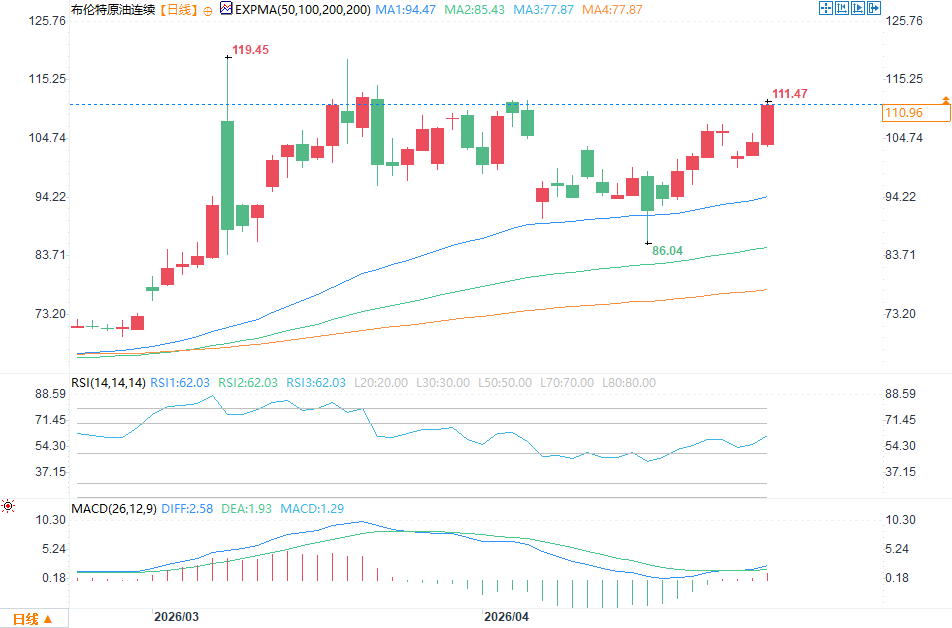
(Brent crude oil daily chart source: EasyForex)
From a technical perspective, crude oil prices (based on Brent crude) experienced significant volatility in the early stages of the conflict: rising rapidly from around $72 per barrel before the war, reaching or approaching $120 per barrel in early March, before subsequently declining due to expectations of a short-term ceasefire. Currently, prices are hovering in the $100-$110 range (Brent crude is currently trading around $105-$109, and WTI around $94-$97), but upward pressure is significant.
The key technical level lies near the resistance zone around $120, which was tested twice previously. The candlestick chart shows significant selling pressure in this area, but if geopolitical risks continue to escalate, bulls could push prices to challenge that high again.
On the support level, the $100 psychological level and the recent low (around $94-95) provide initial protection. RSI and MACD indicators suggest a potential rebound after a short-term oversold condition, while trading volume tends to increase in response to risk events.
Fundamentals support higher oil prices
The International Energy Agency (IEA) has described this disruption as "the largest supply disruption in the history of the global oil market." If the Strait of Hormuz remains restricted, it is equivalent to millions of barrels of supply disappearing from the market every day, which other oil-producing countries will find difficult to fully compensate for in the short term (although Saudi Arabia and others have spare capacity, logistical and geopolitical risks limit their ability to respond quickly).
Goldman Sachs, JPMorgan Chase and other institutions have previously warned that if a full-blown conflict leads to a prolonged disruption of the Strait of Hormuz, Brent crude oil could rise to $120 or even higher; even under the baseline scenario, the price center in the second half of 2026 may remain at a high level (Goldman Sachs raised its fourth-quarter forecast).
Investors should pay attention to the following triggering factors: new statements from Trump or Hergé, Iran's response, actual shipping data (insurance rates, vessel detours), and OPEC+ developments.
In the short term, any diplomatic progress would be beneficial for a decline in oil prices, while an escalation of hardline stances could push prices to test previous highs. Risks and Impacts Outlook: Under the current circumstances, a retest of $120 for oil prices is not impossible, but uncertainties remain.
The global economy is already feeling the pressure: energy-importing countries face higher inflation and cost pass-through, putting pressure on corporate profits, with industries such as aviation and chemicals being particularly sensitive. While the US, as a net exporter, has some buffer, the risk of a global recession will still indirectly affect demand. In the long term, a prolonged conflict could accelerate discussions on energy transition, but in the short term, traditional oil and gas will remain dominant.
Overall, the geopolitical tensions between the US and Iran have shifted from the military phase to a "pressure + negotiation" game. The hardline stance of Trump and the Secretary of Defense, along with the US military's readiness for war, contrasts sharply with Iran's economic predicament. The market is currently in a highly uncertain environment: a diplomatic breakthrough could quickly cool oil prices, while any unexpected escalation could lead to a repeat of the March peak. Investors should remain cautious, closely monitor the latest negotiation developments and technical breakout signals, and prepare for risk hedging.
At 01:26 Beijing time, WTI crude oil was trading at $107.11 per barrel, up 7.19%. Brent crude oil was trading at $110.94 per barrel, up 6.40%.
This statement quickly increased market expectations for a prolonged conflict. Iran, on the other hand, attempted to alleviate economic pressure through the proposal: the obstruction of the Strait of Hormuz limited its oil exports, its domestic crude oil storage capacity was nearing saturation, and its economy faced the risk of collapse. Trump even claimed on social media that Iran had informed the US that it was in a state of "collapse" and was eager to reopen the strait to stabilize the leadership situation. However, the US insisted that the nuclear issue was indivisible, and Secretary of State Rubio clearly stated that nuclear ambitions were a core issue and could not be used to "buy time."
Meanwhile, U.S. Defense Secretary Peter Hegses adopted a tough stance. In a Pentagon briefing, he emphasized that the U.S. military had achieved a "historic battlefield victory," but warned of "maximum violence" against Iran and stated that the U.S. military "has ample time" to achieve its objectives and will not withdraw from the region. Hegses criticized the media for focusing only on negative narratives while declaring that the U.S. military is ready to resume large-scale combat operations. The U.S. military buildup in the region is the largest since the 2003 Iraq War, including multiple carrier strike groups, additional fighter jets, and missile defense systems. The naval blockade of Iranian ports is also ongoing or in preparation for extension.
Bas van Heffin, senior macro strategist at Rabobank, pointed out that Brent crude futures prices have surged above $112 due to the continued closure of the Strait of Hormuz and the lack of progress in negotiations between Iran and the United States. He emphasized that futures prices are converging with actual spot prices. He believes that the supply and demand situation will not change until the war with Iran ends and the Strait of Hormuz reopens, which also limits the possibility of the UAE increasing oil production.
Experts have differing opinions.
Against this backdrop, opinions among market experts have become significantly divided.
Optimists believe that although current negotiations have stalled, communication channels still exist between the two sides. Iran's economy has been severely damaged and it may be forced to make concessions under pressure.
Some analysts point out that while the Trump administration has taken a hard line, its ultimate goal is to reach a "non-nuclear agreement" or force Iran to completely abandon its nuclear capabilities, rather than an indefinite war. Recent ceasefire extensions and mediation by third parties (such as Pakistan or Oman) indicate that the diplomatic window is not completely closed. If further divisions emerge within Iran's leadership, the probability of compromise may increase.
Optimists predict that if new proposals or concessions are made in the short term, oil price volatility will gradually subside, and the global energy market can alleviate pressure through inventory releases and increased production from other oil-producing countries.
Cautious observers warn that the situation is highly fragile. The hardline US stance, coupled with Hegses's statement of "being prepared for maximum violence," means that the conflict could escalate rapidly if Iran continues to delay or take provocative actions (such as further mine-laying or attacking ships). The US has already instructed preparations to extend the blockade of Iranian ports, which will further squeeze Iranian oil exports. The Strait of Hormuz, a vital waterway for approximately 20% of the world's oil and a significant amount of LNG, is at risk of triggering a chain reaction if any continued disruption occurs.
The US military's current posture has shifted from "declaration of victory" to "maintaining pressure," and coupled with potential Israeli cooperation, the risk of regional escalation should not be underestimated. Global supply chains have already been affected, and inflationary pressures may be transmitted to major energy-importing countries, especially in Asia and Europe.
Overall, the geopolitical situation is indeed tense. Since the joint US-Israeli strike on Iran in late February 2026, the conflict has lasted for nearly two months, resulting in thousands of deaths, infrastructure damage, and the largest disruption to regional energy supplies in history. The de facto blockade of the Strait of Hormuz, coupled with the US naval blockade, has led to a significant reduction in exports from major Middle Eastern oil-producing countries (such as Saudi Arabia, the UAE, Iraq, and Kuwait), resulting in a tight global oil market supply.
Technical Analysis: Oil prices may retest the highs near $120.
(Brent crude oil daily chart source: EasyForex)
From a technical perspective, crude oil prices (based on Brent crude) experienced significant volatility in the early stages of the conflict: rising rapidly from around $72 per barrel before the war, reaching or approaching $120 per barrel in early March, before subsequently declining due to expectations of a short-term ceasefire. Currently, prices are hovering in the $100-$110 range (Brent crude is currently trading around $105-$109, and WTI around $94-$97), but upward pressure is significant.
The key technical level lies near the resistance zone around $120, which was tested twice previously. The candlestick chart shows significant selling pressure in this area, but if geopolitical risks continue to escalate, bulls could push prices to challenge that high again.
On the support level, the $100 psychological level and the recent low (around $94-95) provide initial protection. RSI and MACD indicators suggest a potential rebound after a short-term oversold condition, while trading volume tends to increase in response to risk events.
Fundamentals support higher oil prices
The International Energy Agency (IEA) has described this disruption as "the largest supply disruption in the history of the global oil market." If the Strait of Hormuz remains restricted, it is equivalent to millions of barrels of supply disappearing from the market every day, which other oil-producing countries will find difficult to fully compensate for in the short term (although Saudi Arabia and others have spare capacity, logistical and geopolitical risks limit their ability to respond quickly).
Goldman Sachs, JPMorgan Chase and other institutions have previously warned that if a full-blown conflict leads to a prolonged disruption of the Strait of Hormuz, Brent crude oil could rise to $120 or even higher; even under the baseline scenario, the price center in the second half of 2026 may remain at a high level (Goldman Sachs raised its fourth-quarter forecast).
Investors should pay attention to the following triggering factors: new statements from Trump or Hergé, Iran's response, actual shipping data (insurance rates, vessel detours), and OPEC+ developments.
In the short term, any diplomatic progress would be beneficial for a decline in oil prices, while an escalation of hardline stances could push prices to test previous highs. Risks and Impacts Outlook: Under the current circumstances, a retest of $120 for oil prices is not impossible, but uncertainties remain.
The global economy is already feeling the pressure: energy-importing countries face higher inflation and cost pass-through, putting pressure on corporate profits, with industries such as aviation and chemicals being particularly sensitive. While the US, as a net exporter, has some buffer, the risk of a global recession will still indirectly affect demand. In the long term, a prolonged conflict could accelerate discussions on energy transition, but in the short term, traditional oil and gas will remain dominant.
Overall, the geopolitical tensions between the US and Iran have shifted from the military phase to a "pressure + negotiation" game. The hardline stance of Trump and the Secretary of Defense, along with the US military's readiness for war, contrasts sharply with Iran's economic predicament. The market is currently in a highly uncertain environment: a diplomatic breakthrough could quickly cool oil prices, while any unexpected escalation could lead to a repeat of the March peak. Investors should remain cautious, closely monitor the latest negotiation developments and technical breakout signals, and prepare for risk hedging.
At 01:26 Beijing time, WTI crude oil was trading at $107.11 per barrel, up 7.19%. Brent crude oil was trading at $110.94 per barrel, up 6.40%.
- Risk Warning and Disclaimer
- The market involves risk, and trading may not be suitable for all investors. This article is for reference only and does not constitute personal investment advice, nor does it take into account certain users’ specific investment objectives, financial situation, or other needs. Any investment decisions made based on this information are at your own risk.