Gold Trading Alert: A hawkish move by the Federal Reserve and escalating conflict in the Middle East have pushed gold prices to a one-month low, with the $4,500 level now in serious danger!
2026-04-30 07:45:07
On Wednesday (April 29), spot gold prices continued their recent downward trend, falling as much as 1.17% to close at $4,543 per ounce. During the session, it even touched a low of $4,510.21, the lowest point in a month since late March. Meanwhile, US gold futures also suffered, settling down 1% at $4,561.50. This marks the fourth consecutive trading day of declines for gold, with market sentiment shifting abruptly from relative optimism a few weeks ago to caution and even pessimism. The Federal Reserve's hawkish interest rate decision, ongoing conflicts in the Middle East, a sharp rise in oil prices, and renewed inflation concerns have largely eliminated market expectations for a Fed rate cut this year, while expectations for a rate hike have increased, providing upward momentum for the dollar and significantly pressuring gold prices.
On Thursday (April 30) in early Asian trading, spot gold fluctuated slightly higher and is currently trading around $4,555 per ounce. Investors are awaiting the Bank of England and European Central Bank interest rate decisions to be released later in the day, as well as several key economic data releases and further news on the Middle East geopolitical situation.
Undercurrents are brewing behind the unchanged interest rates.
As expected, the Federal Reserve announced at its April policy meeting that it would maintain interest rates unchanged, keeping the target range for the federal funds rate at 3.5% to 3.75%. This decision itself was not surprising; what truly shocked the market was the intense internal division hidden behind the rate decision. The vote was eight to four, which is not a typical disagreement, but rather the most severe internal rift within the Fed since 1992. Normally, the Fed's policy statements are passed almost unanimously, but this time, four policymakers voted against it. Three of them believed the Fed should no longer signal a preference for lowering borrowing costs, the so-called "easing bias," and one even advocated for a direct 25 basis point rate cut.
Subtle shifts in inflation rhetoric
A careful comparison of the latest policy statement with previous documents reveals a key wording shift. The Federal Reserve explicitly stated in its statement that "inflation remains elevated, partly reflecting recent increases in global energy prices." In previous statements, the Fed characterized inflation as "slightly elevated." This change from "slightly elevated" to "elevated" reflects a significant increase in the Fed's vigilance regarding price pressures. More importantly, the statement included, for the first time, the sentence: "Evolution in the Middle East is one of the factors contributing to the high degree of uncertainty in the economic outlook." This is almost tantamount to an open admission that the spillover effects of the Iran war have become an undeniable variable in the Fed's monetary policy decisions.
Faced with this hawkish policy statement, independent metals trader Tai Wong pointed out that three dissenting lawmakers wanted to remove the dovish bias from the statement, which put some pressure on gold. This statement reveals the core logic behind the decline in gold prices. As a non-interest-bearing asset, gold is extremely sensitive to interest rate expectations. When the market believes that the likelihood of future interest rate cuts by the Federal Reserve has decreased, or even that the risk of rate hikes has increased, the opportunity cost of holding gold increases, and funds naturally flow from gold to assets that can generate returns.
The power of oil prices breaking $10
If the Federal Reserve's decision was the final straw that broke the camel's back for gold, then the continued deterioration of the situation in the Middle East was a powder keg buried underground. Global oil prices have broken through the $100 per barrel mark due to the US-backed military action against Iran and are rising for the eighth consecutive trading day. This is the longest rally in the oil market since Russia's invasion of Ukraine in February 2022. The expiring June contract surged by 6%, closing at $118.03 per barrel. The soaring oil prices have directly exacerbated market concerns about inflation, which is gold's long-standing adversary. Theoretically, inflation should benefit gold, as it is seen as a hedge against inflation. However, the reality is much more complex. When inflation spirals out of control, central banks are forced to take more aggressive interest rate hikes, which can significantly push up real interest rates, thus severely impacting gold prices.
The Game of Blockade and Counter-Blockade
US President Trump's latest remarks have further heightened tensions. In an interview, he stated explicitly that the naval blockade against Iran will continue until Iran agrees to an agreement that alleviates US concerns about its nuclear program. Trump even described the current strategy as "more effective than bombing in some ways," and warned that Iran's oil storage facilities and pipelines are "on the verge of exploding" due to the inability to export oil. However, Tehran's response has been equally strong. Iran's Press TV quoted a senior security official as saying that if the US continues its naval blockade of the Strait of Hormuz, Iran will respond with "real and unprecedented military action." The Strait of Hormuz is a strategic chokepoint for global oil transportation; any escalation of military conflict could lead to a further surge in oil prices, pushing the global economy into a stagflationary spiral.
The shadow of military threat
More worryingly, the U.S. Central Command has requested the Army to deploy the Dark Hawk hypersonic missile to the Middle East. This extremely long-range weapon system targets deep within Iranian territory, especially ballistic missile launchers beyond the range of existing precision-strike missiles. While Trump declined to disclose specific military plans in a phone interview, he clearly stated that he would consider military action if Iran did not yield. This tense atmosphere has kept traders on their toes; while risk aversion exists, it manifests more as a rush towards the dollar and U.S. Treasury bonds than gold.
"Only Trump and Iran can save the market," said Fawad Razaqzada, market analyst at City Index and FOREX, "but there's been no progress on reaching an agreement, and oil prices reflect that." He went on to point out that the outlook for gold is currently not optimistic. This means that a rapid de-escalation of the Middle East situation is needed to alleviate current inflationary pressures, but the reality is that negotiations are deadlocked, with both sides increasing their bargaining chips, keeping oil prices high. Gold is caught in an awkward position: it cannot receive sustained safe-haven buying from geopolitical risks due to the stronger appeal of the US dollar, and it must also withstand rising interest rate pressures due to inflation concerns.
The US dollar index climbed sharply.
The Federal Reserve's decision to maintain interest rates triggered a chain reaction in the foreign exchange market. The US dollar strengthened against most major currencies, with the dollar index rising 0.35% to 98.938. The euro fell 0.35% against the dollar, the pound fell 0.36%, while the dollar rose 0.23% against the Swiss franc. Juan Perez, head of trading at Monex USA in Washington, offered a succinct analysis: the most important point is that the statement shows three policymakers believe we should consider raising interest rates, or at least not maintain an accommodative stance. He further pointed out that incoming Fed Chairman Warsh's position seems very close to Powell's, and he is unlikely to be a "dovish" figure; he is taking over a Fed with a hawkish approach. From a global perspective, the lack of consensus among central banks is actually beneficial to the dollar. When the monetary policies of major global economies are inconsistent, the relative advantage of the dollar becomes apparent, attracting global capital inflows.
US Treasury yields rise to one-month high
The bond market reacted equally strongly. U.S. Treasury yields rose to a one-month high following the Federal Reserve's decision. The yield on the two-year Treasury note, most sensitive to interest rate expectations, rose 8.4 basis points to 3.928%, a new high since late March. The yield on the ten-year Treasury note, a long-term barometer of the economy, also rose 5.4 basis points to 4.408%, having touched 4.432% intraday. The spread between the two-year and ten-year Treasury yields narrowed to 47.5 basis points. Rising bond yields imply falling bond prices, and bonds are generally seen as a major competitor to gold for safe-haven assets. When investors can obtain yields close to four percent or even higher from risk-free U.S. Treasuries, the incentive to hold zero-yield gold diminishes significantly.
The fatal blow of rising real interest rates
Axel Merk, President and Chief Investment Officer of Merk Investments, provided a more systematic analytical framework. He pointed out that recent developments in the Middle East have led to higher oil prices, which tend to push up bond yields, while long-term inflation expectations have not changed significantly. Taken together, this means tighter financial conditions and rising real interest rates, which supports the US dollar and, all else being equal, weakens other currencies, including gold. Real interest rates represent the opportunity cost of holding gold; when real interest rates rise, gold's attractiveness systematically decreases. This is precisely the current market environment: nominal yields are rising, but inflation expectations have not risen in tandem, leading to a rapid increase in real interest rates, thus putting significant selling pressure on gold.
An extraordinary council re-election
Beyond the policy itself, the leadership change at the Federal Reserve has added new uncertainty to the gold market. Following his final policy meeting as chairman, current Chairman Jerome Powell announced that he will remain as a member of the Federal Reserve Board of Governors for an unspecified period after his term as chairman ends on May 15th. Powell made it clear that "I have no intention of becoming a high-profile dissident or anything like that," and that he hopes to see the political attacks against the central bank subside. This decision is unprecedented in modern central bank history. Typically, outgoing chairs leave the Fed entirely, but Powell has chosen to remain, and his term as a governor will continue until January 2028.
Checks and balances on the Warsh rate cut plan
This decision presents a delicate check on incoming Chairman Kevin Warsh. Warsh, nominated by Trump and confirmed through the crucial Senate confirmation process, has been critical of the Federal Reserve and, under Trump's influence, has shifted his stance to support interest rate cuts. However, Powell's continued tenure as a governor means Warsh will face a formidable and experienced internal opponent in pushing for any aggressive monetary policy shift. Thomas Ryan, a North American economist at Capital Economics, points out that Powell's continued tenure shifts the composition of the Federal Open Market Committee towards a more hawkish stance, further complicating Warsh's already difficult task of short-term interest rate cuts. For gold, this means the future policy path of the Federal Reserve will be fraught with internal disagreements and power struggles, and such uncertainty is generally detrimental to gold price stability.
Finance Minister Bessant's dissatisfaction
Treasury Secretary Scott Bessant expressed clear dissatisfaction with Powell's decision. In an interview with Fox Business, he stated, "This violates all the established practices of the Federal Reserve," and considered Powell's continued tenure an insult to Warsh and other current officials. This public criticism from the executive branch indicates that the political struggle surrounding the Federal Reserve is far from over, and Powell's continued tenure is likely to remain a point of contention in future monetary policy decisions.
Bright spots revealed by first quarter demand data
Amidst a generally bleak price trend, the World Gold Council's first-quarter global gold demand data offered a glimmer of hope to the market. The data showed that global gold demand increased by 2% year-on-year in the first quarter of 2026. This growth was primarily driven by two factors. First, there was a surge in purchases of gold bars and coins, indicating continued strong physical demand for gold from retail investors and private collectors. Second, central bank purchases increased by 3%, continuing the trend of central banks increasing their gold reserves in recent years. Central bank gold purchases are typically long-term and strategic, less affected by short-term price fluctuations, thus forming a relatively stable supporting force in the gold demand structure.
The precipitous drop in jewelry demand
However, the demand data also hides some concerns that cannot be ignored. Jewelry demand has fallen sharply by 23% year-on-year. Jewelry demand is highly sensitive to price; when gold prices are at historical highs, consumers tend to postpone purchases or turn to other alternatives. A 23% drop is a rather staggering figure, indicating that current gold price levels have significantly suppressed end-consumer demand. This structural contradiction means that the gold market is currently overly reliant on strategic purchases by central banks and safe-haven investments by retail investors, while lacking stable support from the consumer side.
In summary, the gold market is currently facing headwinds from multiple directions. Hawkish voices within the Federal Reserve are growing louder; the 8-4 vote and adjustments to inflation language indicate that not only are rate cuts unlikely in the short term, but even rate hikes are now on the table. The situation in the Middle East, particularly the war with Iran, continues to exert inflationary pressure globally through oil prices, forcing central banks to maintain a tight stance. Meanwhile, the strengthening of the US dollar and US Treasury yields provides investors with attractive alternatives, diverting funds that might otherwise flow into the gold market. Powell's continued tenure as a governor at the Federal Reserve adds further political uncertainty and complexity to future policy directions.
Of course, gold is not entirely without support. Continued gold purchases by global central banks, strong retail demand for gold bars and coins, and the potential for extreme risk aversion should the situation in the Middle East spiral out of control are all potential bullish factors. However, currently, bearish forces clearly dominate. As market analysts have stated, unless Trump and Iran achieve a breakthrough at the negotiating table, thereby quickly quelling the upward trend in oil prices, the outlook for gold is unlikely to be optimistic in the short term.
Investors now need to closely monitor two key variables: first, whether the situation in the Strait of Hormuz will escalate from a blockade to a military conflict; and second, whether the Federal Reserve will formally remove the "dodging bias" wording from its statement in its upcoming meeting. The direction of these two factors will determine whether gold continues to seek support downwards or finds a respite amidst the chaos.
Today's trading session will see the release of key US economic data, including the March PCE and Q1 GDP figures, as well as interest rate decisions from the European Central Bank and the Bank of England. Investors should pay close attention to these developments. Additionally, they should keep an eye on speeches by other Federal Reserve officials and further developments in geopolitical situations.
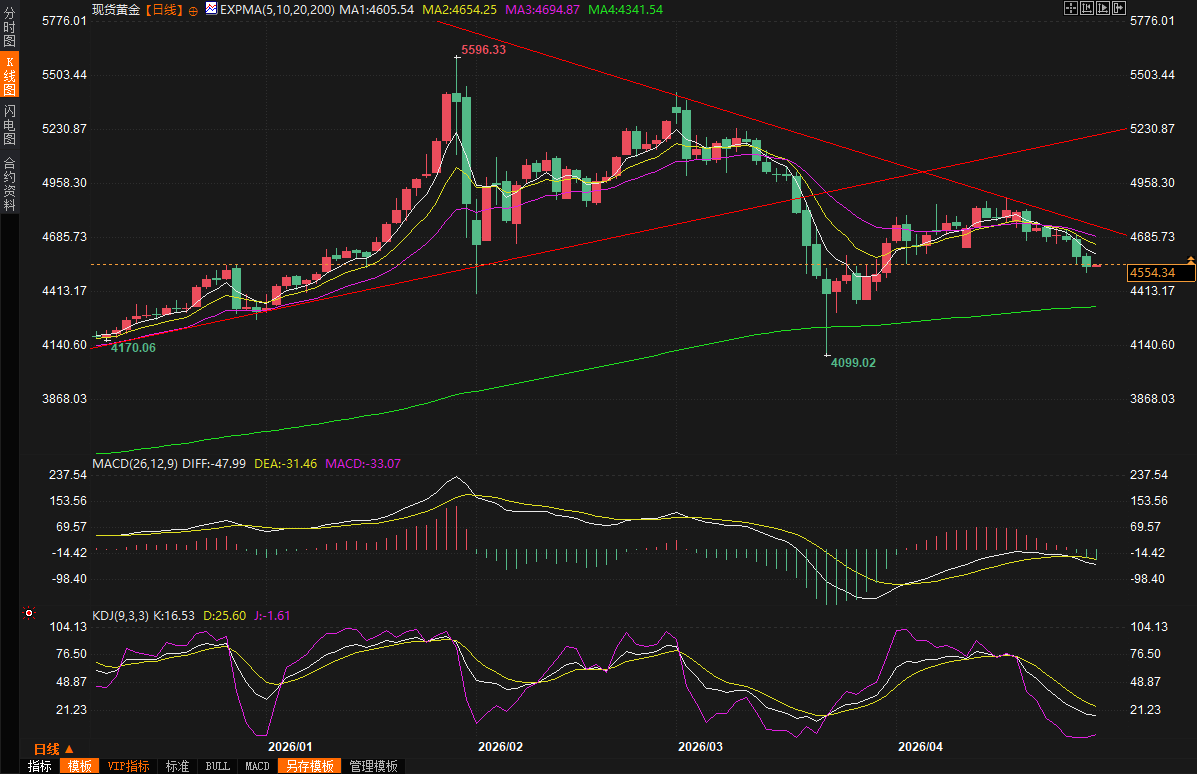
(Spot gold daily chart, source: FX678)
At 07:40 Beijing time, spot gold was trading at $4,554.50 per ounce.
On Thursday (April 30) in early Asian trading, spot gold fluctuated slightly higher and is currently trading around $4,555 per ounce. Investors are awaiting the Bank of England and European Central Bank interest rate decisions to be released later in the day, as well as several key economic data releases and further news on the Middle East geopolitical situation.
I. The Fed's Hawkish Surprise: The Biggest Divergence Since 1992
Undercurrents are brewing behind the unchanged interest rates.
As expected, the Federal Reserve announced at its April policy meeting that it would maintain interest rates unchanged, keeping the target range for the federal funds rate at 3.5% to 3.75%. This decision itself was not surprising; what truly shocked the market was the intense internal division hidden behind the rate decision. The vote was eight to four, which is not a typical disagreement, but rather the most severe internal rift within the Fed since 1992. Normally, the Fed's policy statements are passed almost unanimously, but this time, four policymakers voted against it. Three of them believed the Fed should no longer signal a preference for lowering borrowing costs, the so-called "easing bias," and one even advocated for a direct 25 basis point rate cut.
Subtle shifts in inflation rhetoric
A careful comparison of the latest policy statement with previous documents reveals a key wording shift. The Federal Reserve explicitly stated in its statement that "inflation remains elevated, partly reflecting recent increases in global energy prices." In previous statements, the Fed characterized inflation as "slightly elevated." This change from "slightly elevated" to "elevated" reflects a significant increase in the Fed's vigilance regarding price pressures. More importantly, the statement included, for the first time, the sentence: "Evolution in the Middle East is one of the factors contributing to the high degree of uncertainty in the economic outlook." This is almost tantamount to an open admission that the spillover effects of the Iran war have become an undeniable variable in the Fed's monetary policy decisions.
Faced with this hawkish policy statement, independent metals trader Tai Wong pointed out that three dissenting lawmakers wanted to remove the dovish bias from the statement, which put some pressure on gold. This statement reveals the core logic behind the decline in gold prices. As a non-interest-bearing asset, gold is extremely sensitive to interest rate expectations. When the market believes that the likelihood of future interest rate cuts by the Federal Reserve has decreased, or even that the risk of rate hikes has increased, the opportunity cost of holding gold increases, and funds naturally flow from gold to assets that can generate returns.
II. The Middle East Conflict: The Trigger for Inflation and the Shackles on Gold
The power of oil prices breaking $10
If the Federal Reserve's decision was the final straw that broke the camel's back for gold, then the continued deterioration of the situation in the Middle East was a powder keg buried underground. Global oil prices have broken through the $100 per barrel mark due to the US-backed military action against Iran and are rising for the eighth consecutive trading day. This is the longest rally in the oil market since Russia's invasion of Ukraine in February 2022. The expiring June contract surged by 6%, closing at $118.03 per barrel. The soaring oil prices have directly exacerbated market concerns about inflation, which is gold's long-standing adversary. Theoretically, inflation should benefit gold, as it is seen as a hedge against inflation. However, the reality is much more complex. When inflation spirals out of control, central banks are forced to take more aggressive interest rate hikes, which can significantly push up real interest rates, thus severely impacting gold prices.
The Game of Blockade and Counter-Blockade
US President Trump's latest remarks have further heightened tensions. In an interview, he stated explicitly that the naval blockade against Iran will continue until Iran agrees to an agreement that alleviates US concerns about its nuclear program. Trump even described the current strategy as "more effective than bombing in some ways," and warned that Iran's oil storage facilities and pipelines are "on the verge of exploding" due to the inability to export oil. However, Tehran's response has been equally strong. Iran's Press TV quoted a senior security official as saying that if the US continues its naval blockade of the Strait of Hormuz, Iran will respond with "real and unprecedented military action." The Strait of Hormuz is a strategic chokepoint for global oil transportation; any escalation of military conflict could lead to a further surge in oil prices, pushing the global economy into a stagflationary spiral.
The shadow of military threat
More worryingly, the U.S. Central Command has requested the Army to deploy the Dark Hawk hypersonic missile to the Middle East. This extremely long-range weapon system targets deep within Iranian territory, especially ballistic missile launchers beyond the range of existing precision-strike missiles. While Trump declined to disclose specific military plans in a phone interview, he clearly stated that he would consider military action if Iran did not yield. This tense atmosphere has kept traders on their toes; while risk aversion exists, it manifests more as a rush towards the dollar and U.S. Treasury bonds than gold.
"Only Trump and Iran can save the market," said Fawad Razaqzada, market analyst at City Index and FOREX, "but there's been no progress on reaching an agreement, and oil prices reflect that." He went on to point out that the outlook for gold is currently not optimistic. This means that a rapid de-escalation of the Middle East situation is needed to alleviate current inflationary pressures, but the reality is that negotiations are deadlocked, with both sides increasing their bargaining chips, keeping oil prices high. Gold is caught in an awkward position: it cannot receive sustained safe-haven buying from geopolitical risks due to the stronger appeal of the US dollar, and it must also withstand rising interest rate pressures due to inflation concerns.
III. The Siphoning Effect of the US Dollar and US Treasury Bonds: Gold's Competitors Are Too Strong
The US dollar index climbed sharply.
The Federal Reserve's decision to maintain interest rates triggered a chain reaction in the foreign exchange market. The US dollar strengthened against most major currencies, with the dollar index rising 0.35% to 98.938. The euro fell 0.35% against the dollar, the pound fell 0.36%, while the dollar rose 0.23% against the Swiss franc. Juan Perez, head of trading at Monex USA in Washington, offered a succinct analysis: the most important point is that the statement shows three policymakers believe we should consider raising interest rates, or at least not maintain an accommodative stance. He further pointed out that incoming Fed Chairman Warsh's position seems very close to Powell's, and he is unlikely to be a "dovish" figure; he is taking over a Fed with a hawkish approach. From a global perspective, the lack of consensus among central banks is actually beneficial to the dollar. When the monetary policies of major global economies are inconsistent, the relative advantage of the dollar becomes apparent, attracting global capital inflows.
US Treasury yields rise to one-month high
The bond market reacted equally strongly. U.S. Treasury yields rose to a one-month high following the Federal Reserve's decision. The yield on the two-year Treasury note, most sensitive to interest rate expectations, rose 8.4 basis points to 3.928%, a new high since late March. The yield on the ten-year Treasury note, a long-term barometer of the economy, also rose 5.4 basis points to 4.408%, having touched 4.432% intraday. The spread between the two-year and ten-year Treasury yields narrowed to 47.5 basis points. Rising bond yields imply falling bond prices, and bonds are generally seen as a major competitor to gold for safe-haven assets. When investors can obtain yields close to four percent or even higher from risk-free U.S. Treasuries, the incentive to hold zero-yield gold diminishes significantly.
The fatal blow of rising real interest rates
Axel Merk, President and Chief Investment Officer of Merk Investments, provided a more systematic analytical framework. He pointed out that recent developments in the Middle East have led to higher oil prices, which tend to push up bond yields, while long-term inflation expectations have not changed significantly. Taken together, this means tighter financial conditions and rising real interest rates, which supports the US dollar and, all else being equal, weakens other currencies, including gold. Real interest rates represent the opportunity cost of holding gold; when real interest rates rise, gold's attractiveness systematically decreases. This is precisely the current market environment: nominal yields are rising, but inflation expectations have not risen in tandem, leading to a rapid increase in real interest rates, thus putting significant selling pressure on gold.
IV. The Transition of Power at the Federal Reserve: Powell's Remaining in Office and Warsh's Challenge
An extraordinary council re-election
Beyond the policy itself, the leadership change at the Federal Reserve has added new uncertainty to the gold market. Following his final policy meeting as chairman, current Chairman Jerome Powell announced that he will remain as a member of the Federal Reserve Board of Governors for an unspecified period after his term as chairman ends on May 15th. Powell made it clear that "I have no intention of becoming a high-profile dissident or anything like that," and that he hopes to see the political attacks against the central bank subside. This decision is unprecedented in modern central bank history. Typically, outgoing chairs leave the Fed entirely, but Powell has chosen to remain, and his term as a governor will continue until January 2028.
Checks and balances on the Warsh rate cut plan
This decision presents a delicate check on incoming Chairman Kevin Warsh. Warsh, nominated by Trump and confirmed through the crucial Senate confirmation process, has been critical of the Federal Reserve and, under Trump's influence, has shifted his stance to support interest rate cuts. However, Powell's continued tenure as a governor means Warsh will face a formidable and experienced internal opponent in pushing for any aggressive monetary policy shift. Thomas Ryan, a North American economist at Capital Economics, points out that Powell's continued tenure shifts the composition of the Federal Open Market Committee towards a more hawkish stance, further complicating Warsh's already difficult task of short-term interest rate cuts. For gold, this means the future policy path of the Federal Reserve will be fraught with internal disagreements and power struggles, and such uncertainty is generally detrimental to gold price stability.
Finance Minister Bessant's dissatisfaction
Treasury Secretary Scott Bessant expressed clear dissatisfaction with Powell's decision. In an interview with Fox Business, he stated, "This violates all the established practices of the Federal Reserve," and considered Powell's continued tenure an insult to Warsh and other current officials. This public criticism from the executive branch indicates that the political struggle surrounding the Federal Reserve is far from over, and Powell's continued tenure is likely to remain a point of contention in future monetary policy decisions.
V. The Real Demand for Gold: Not All Bad News
Bright spots revealed by first quarter demand data
Amidst a generally bleak price trend, the World Gold Council's first-quarter global gold demand data offered a glimmer of hope to the market. The data showed that global gold demand increased by 2% year-on-year in the first quarter of 2026. This growth was primarily driven by two factors. First, there was a surge in purchases of gold bars and coins, indicating continued strong physical demand for gold from retail investors and private collectors. Second, central bank purchases increased by 3%, continuing the trend of central banks increasing their gold reserves in recent years. Central bank gold purchases are typically long-term and strategic, less affected by short-term price fluctuations, thus forming a relatively stable supporting force in the gold demand structure.
The precipitous drop in jewelry demand
However, the demand data also hides some concerns that cannot be ignored. Jewelry demand has fallen sharply by 23% year-on-year. Jewelry demand is highly sensitive to price; when gold prices are at historical highs, consumers tend to postpone purchases or turn to other alternatives. A 23% drop is a rather staggering figure, indicating that current gold price levels have significantly suppressed end-consumer demand. This structural contradiction means that the gold market is currently overly reliant on strategic purchases by central banks and safe-haven investments by retail investors, while lacking stable support from the consumer side.
Conclusion
In summary, the gold market is currently facing headwinds from multiple directions. Hawkish voices within the Federal Reserve are growing louder; the 8-4 vote and adjustments to inflation language indicate that not only are rate cuts unlikely in the short term, but even rate hikes are now on the table. The situation in the Middle East, particularly the war with Iran, continues to exert inflationary pressure globally through oil prices, forcing central banks to maintain a tight stance. Meanwhile, the strengthening of the US dollar and US Treasury yields provides investors with attractive alternatives, diverting funds that might otherwise flow into the gold market. Powell's continued tenure as a governor at the Federal Reserve adds further political uncertainty and complexity to future policy directions.
Of course, gold is not entirely without support. Continued gold purchases by global central banks, strong retail demand for gold bars and coins, and the potential for extreme risk aversion should the situation in the Middle East spiral out of control are all potential bullish factors. However, currently, bearish forces clearly dominate. As market analysts have stated, unless Trump and Iran achieve a breakthrough at the negotiating table, thereby quickly quelling the upward trend in oil prices, the outlook for gold is unlikely to be optimistic in the short term.
Investors now need to closely monitor two key variables: first, whether the situation in the Strait of Hormuz will escalate from a blockade to a military conflict; and second, whether the Federal Reserve will formally remove the "dodging bias" wording from its statement in its upcoming meeting. The direction of these two factors will determine whether gold continues to seek support downwards or finds a respite amidst the chaos.
Today's trading session will see the release of key US economic data, including the March PCE and Q1 GDP figures, as well as interest rate decisions from the European Central Bank and the Bank of England. Investors should pay close attention to these developments. Additionally, they should keep an eye on speeches by other Federal Reserve officials and further developments in geopolitical situations.
(Spot gold daily chart, source: FX678)
At 07:40 Beijing time, spot gold was trading at $4,554.50 per ounce.
- Risk Warning and Disclaimer
- The market involves risk, and trading may not be suitable for all investors. This article is for reference only and does not constitute personal investment advice, nor does it take into account certain users’ specific investment objectives, financial situation, or other needs. Any investment decisions made based on this information are at your own risk.