Gold prices fell for the third consecutive day, pressured by soaring oil prices and the Federal Reserve maintaining high interest rates.
2026-04-30 13:40:26
Gold prices fell for the third consecutive trading day on Wednesday, with gold futures dropping $52.30, or 1.13%, to settle at $4,557.30 an ounce, marking the weakest closing price in April. Spot gold closed at $4,543.41 an ounce, making this week the worst for gold since March.
The direct cause of the gold price drop is both familiar and ironic: what drove the price down was precisely the inflationary shock that textbooks should have predicted would benefit gold.
On Wednesday, U.S. crude oil prices surged $8.87, or 8.9%, marking the third consecutive trading day of gains, primarily due to the stalemate in peace talks between the United States and Iran. President Trump has made it clear that any reconciliation agreement must include Iran's formal agreement to dismantle its nuclear program, a demand Iran has firmly rejected.
With the Strait of Hormuz remaining largely closed to commercial energy transport, the supply shock is intensifying. West Texas Intermediate (WTI) crude has broken above $100 a barrel again for the first time since mid-April; Brent crude closed near $111 a barrel. The World Bank's Commodity Markets Outlook, released this week, predicts that global energy prices will rise sharply by 24% in 2026, the largest annual increase since the Russia-Ukraine conflict in 2022.
For gold investors, the current arithmetic logic is quite harsh: the higher the oil price, the greater the inflationary pressure; and the longer inflation lasts, the more likely interest rates are to remain high, which is the key condition for suppressing demand for gold, a non-yielding asset.
The Federal Reserve's decision on Wednesday further solidified this interest rate outlook. The Federal Open Market Committee (FOMC) voted 8-4 to maintain the target range for the federal funds rate at 3.50%-3.75%. The four dissenting members were not objecting to maintaining the rate itself, but rather to the continued use of an "accommodative bias" in the policy statement, indicating that a significant portion of the committee members now favor a more restrictive policy stance.
In his final press conference as Federal Reserve Chairman, Jerome Powell acknowledged internal divisions but denied that officials were shifting toward a path of interest rate hikes. He also congratulated incoming Chairman Kevin Warsh on his progress in the Senate Banking Committee nomination process, calling the transfer of power a "normal, standard" transition.
Since no economic forecasts were updated at this meeting, the market focused entirely on Powell's every word. The signal the market heard was that the Federal Reserve is currently in a stalemate: unwilling to cut rates in the face of energy-driven inflation, yet unwilling to raise rates given the continued risks to economic growth.
The Federal Reserve's decision to keep interest rates unchanged and Powell's cautious tone immediately boosted the dollar. The dollar index rose 0.35% to close at 98.95, continuing its rebound against major currencies. For dollar-denominated gold, a stronger dollar is a direct negative: it increases the real cost for international buyers to purchase gold, while also reinforcing the opportunity cost of high US Treasury yields. The 10-year US Treasury yield hovered around 4.4% on the day.
The simultaneous strengthening of the US dollar and rising real yields represent the classic double pressure faced by precious metals, both of which manifested on Wednesday.
Despite short-term pressure, analysts from multiple institutions have not abandoned their structurally bullish view on gold, but the divergence in forecasts also reflects the real uncertainty in the market regarding the future path.
Goldman Sachs maintains its year-end 2026 gold price target of $5,400, the most conservative among major banks. The bank believes the current correction is primarily due to position liquidation rather than a fundamental collapse, and points out that central bank gold purchases and long-term institutional allocators, which drove gold prices higher in 2025, are not the current sellers.
JPMorgan Chase maintained its higher year-end target price of $6,300, based on the annual purchase of approximately 800 tons of gold by central banks and the ongoing "paradigm shift in reserve currencies," namely a gradual move away from the dollar.
Wells Fargo and Deutsche Bank have price targets between $6,000 and $6,300. Meanwhile, the median consensus forecast from a panel of 30 analysts is $4,746, close to current prices, suggesting the market may have already priced in expectations of persistently high interest rates.
Goldman Sachs' quantitative analysis points out that every 50 basis point rate cut by the Federal Reserve could provide approximately $120 per ounce of support for gold prices. However, since the current interest rate path cannot provide such easing in the short term, this positive factor remains theoretical.
From a technical perspective, investors should pay close attention to the $4300-$4400/ounce area. Several strategists, including Sean Lusk of Walsh Trading, believe this range will be a re-entry point for patient buyers. The 200-day exponential moving average, currently around $4200, has served as a key support/resistance level since gold first broke through $4000 last October. A weekly close below $4300 would test this important support level and could trigger a reassessment of the current rally's foundation.
Currently, gold is hovering between two narratives: the long-term structural narrative includes factors such as widening fiscal deficits, de-dollarization, and central bank reserve diversification, which support gold prices; the short-term macroeconomic environment is that gold, which was originally used as an inflation hedge, has now lost its appeal due to inflation itself pushing up interest rates.
The most likely solution to this contradiction is a drop in oil prices or a diplomatic breakthrough in the Strait of Hormuz. This will ultimately determine whether $4,557 is the bottom of this round of adjustment or a continuation point for the downward trend.
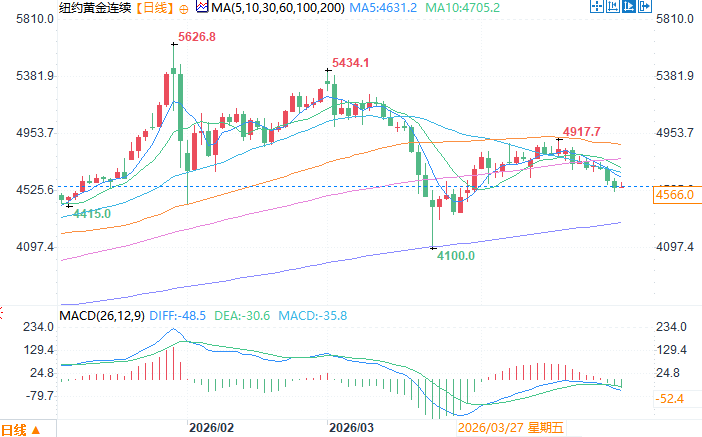
New York Gold Daily Chart Source: EasyTrade
At 13:38 Beijing time on April 30, New York gold futures were trading at $4576 per ounce.
The direct cause of the gold price drop is both familiar and ironic: what drove the price down was precisely the inflationary shock that textbooks should have predicted would benefit gold.
On Wednesday, U.S. crude oil prices surged $8.87, or 8.9%, marking the third consecutive trading day of gains, primarily due to the stalemate in peace talks between the United States and Iran. President Trump has made it clear that any reconciliation agreement must include Iran's formal agreement to dismantle its nuclear program, a demand Iran has firmly rejected.
With the Strait of Hormuz remaining largely closed to commercial energy transport, the supply shock is intensifying. West Texas Intermediate (WTI) crude has broken above $100 a barrel again for the first time since mid-April; Brent crude closed near $111 a barrel. The World Bank's Commodity Markets Outlook, released this week, predicts that global energy prices will rise sharply by 24% in 2026, the largest annual increase since the Russia-Ukraine conflict in 2022.
For gold investors, the current arithmetic logic is quite harsh: the higher the oil price, the greater the inflationary pressure; and the longer inflation lasts, the more likely interest rates are to remain high, which is the key condition for suppressing demand for gold, a non-yielding asset.
The Fed's decision reinforced expectations of high interest rates.
The Federal Reserve's decision on Wednesday further solidified this interest rate outlook. The Federal Open Market Committee (FOMC) voted 8-4 to maintain the target range for the federal funds rate at 3.50%-3.75%. The four dissenting members were not objecting to maintaining the rate itself, but rather to the continued use of an "accommodative bias" in the policy statement, indicating that a significant portion of the committee members now favor a more restrictive policy stance.
In his final press conference as Federal Reserve Chairman, Jerome Powell acknowledged internal divisions but denied that officials were shifting toward a path of interest rate hikes. He also congratulated incoming Chairman Kevin Warsh on his progress in the Senate Banking Committee nomination process, calling the transfer of power a "normal, standard" transition.
Since no economic forecasts were updated at this meeting, the market focused entirely on Powell's every word. The signal the market heard was that the Federal Reserve is currently in a stalemate: unwilling to cut rates in the face of energy-driven inflation, yet unwilling to raise rates given the continued risks to economic growth.
The Federal Reserve's decision to keep interest rates unchanged and Powell's cautious tone immediately boosted the dollar. The dollar index rose 0.35% to close at 98.95, continuing its rebound against major currencies. For dollar-denominated gold, a stronger dollar is a direct negative: it increases the real cost for international buyers to purchase gold, while also reinforcing the opportunity cost of high US Treasury yields. The 10-year US Treasury yield hovered around 4.4% on the day.
The simultaneous strengthening of the US dollar and rising real yields represent the classic double pressure faced by precious metals, both of which manifested on Wednesday.
Institutions still maintain a long-term bullish target price range, but there is a clear divergence of opinions.
Despite short-term pressure, analysts from multiple institutions have not abandoned their structurally bullish view on gold, but the divergence in forecasts also reflects the real uncertainty in the market regarding the future path.
Goldman Sachs maintains its year-end 2026 gold price target of $5,400, the most conservative among major banks. The bank believes the current correction is primarily due to position liquidation rather than a fundamental collapse, and points out that central bank gold purchases and long-term institutional allocators, which drove gold prices higher in 2025, are not the current sellers.
JPMorgan Chase maintained its higher year-end target price of $6,300, based on the annual purchase of approximately 800 tons of gold by central banks and the ongoing "paradigm shift in reserve currencies," namely a gradual move away from the dollar.
Wells Fargo and Deutsche Bank have price targets between $6,000 and $6,300. Meanwhile, the median consensus forecast from a panel of 30 analysts is $4,746, close to current prices, suggesting the market may have already priced in expectations of persistently high interest rates.
Goldman Sachs' quantitative analysis points out that every 50 basis point rate cut by the Federal Reserve could provide approximately $120 per ounce of support for gold prices. However, since the current interest rate path cannot provide such easing in the short term, this positive factor remains theoretical.
From a technical perspective, pay attention to key support levels.
From a technical perspective, investors should pay close attention to the $4300-$4400/ounce area. Several strategists, including Sean Lusk of Walsh Trading, believe this range will be a re-entry point for patient buyers. The 200-day exponential moving average, currently around $4200, has served as a key support/resistance level since gold first broke through $4000 last October. A weekly close below $4300 would test this important support level and could trigger a reassessment of the current rally's foundation.
Currently, gold is hovering between two narratives: the long-term structural narrative includes factors such as widening fiscal deficits, de-dollarization, and central bank reserve diversification, which support gold prices; the short-term macroeconomic environment is that gold, which was originally used as an inflation hedge, has now lost its appeal due to inflation itself pushing up interest rates.
The most likely solution to this contradiction is a drop in oil prices or a diplomatic breakthrough in the Strait of Hormuz. This will ultimately determine whether $4,557 is the bottom of this round of adjustment or a continuation point for the downward trend.
New York Gold Daily Chart Source: EasyTrade
At 13:38 Beijing time on April 30, New York gold futures were trading at $4576 per ounce.
- Risk Warning and Disclaimer
- The market involves risk, and trading may not be suitable for all investors. This article is for reference only and does not constitute personal investment advice, nor does it take into account certain users’ specific investment objectives, financial situation, or other needs. Any investment decisions made based on this information are at your own risk.