The short-term surge in the yen does not change its long-term downward trend.
2026-04-30 19:30:29
In late April 2026, the USD/JPY exchange rate briefly broke through the 160 mark, hitting a 21-month low. Amidst strong bearish sentiment in the market, Japanese Finance Minister Satsuki Katayama repeatedly released strong signals. She clearly stated that the Japanese government "has the freedom to take bold action against speculative exchange rate fluctuations that are not consistent with fundamentals," and emphasized that it would maintain close coordination with the United States to "take decisive and forceful measures against speculative activities."
These warnings quickly triggered a risk-averse reaction in the market, causing a sharp correction in the USD/JPY exchange rate. The yen surged nearly 300 points in a short period, temporarily easing depreciation pressure. However, this short-term rebound triggered by verbal intervention did not fundamentally change the structural predicament facing the yen. Against the backdrop of high global oil prices, the battle to defend the yen remains in a stage of intense competition.
The Yen's Dilemma: Pressure at the 160 Level Due to Multiple Factors
The USD/JPY exchange rate is currently under triple pressure from high oil prices, widening interest rate differentials between the US and Japan, and the Bank of Japan's cautious monetary policy. Despite repeated warnings of strong intervention from the Japanese government, the exchange rate has shown strong upward resilience, with the 160 level becoming a psychological and policy red line closely watched by the market.
As a major global energy importer, Japan's economy is extremely sensitive to oil price fluctuations. High oil prices directly increase energy import costs, worsen the trade balance, and further transmit to domestic prices through increased business costs, exacerbating imported inflation. Meanwhile, the persistent interest rate differential between the US and Japan continues to attract capital flows to dollar assets, putting downward pressure on the yen.
High oil prices are the main source of the impact.
Recent geopolitical tensions in the Middle East have driven a significant rise in international oil prices, with Brent crude oil prices briefly exceeding $110 per barrel. High oil prices show a clear positive correlation with the USD/JPY exchange rate, further amplifying the downside risk for the yen.
Even though Japanese Finance Minister Satsuki Katayama's tough stance led to a short-term surge in the yen, the long-term drag of high oil prices on Japan's terms of trade and balance of payments remains significant. As long as oil prices remain high and the Federal Reserve's policy remains relatively strong, the USD/JPY exchange rate will continue to face upward pressure to test higher levels. While Japanese intervention can create sharp short-term fluctuations, the market believes it is unlikely to completely reverse the yen's depreciation trend driven by high oil prices. Currently, holding the $160 level is becoming increasingly difficult as oil prices rise.
The Bank of Japan's policy dilemma
Faced with the dual challenges of yen depreciation and imported inflation, the Bank of Japan decided at its monetary policy meeting on April 28, 2026, to maintain the policy rate at around 0.75%. However, a rare 6-3 split emerged within the decision-making body, with three members (Junko Nakagawa, Hajime Takada, and Naoki Tamura) proposing to raise the interest rate directly to 1.0%.
During the meeting, the Bank of Japan significantly raised its core CPI forecast for fiscal year 2026, while lowering its economic growth expectations. It also explicitly identified high oil prices (especially supply-side risks stemming from the Middle East situation) as the primary concern. This risk could push up broad-based domestic price levels through cost transmission mechanisms, creating more persistent inflationary pressures.
Bank of Japan Governor Kazuo Ueda stated at the post-meeting press conference that the upside risks to prices outweigh the downside risks to the economy this year, but emphasized the need for further assessment of the impact of the Middle East conflict. He did not provide a clear timetable for a June rate hike, instead adopting a more cautious stance. This statement disappointed some markets, causing the yen to come under renewed pressure after a brief rebound.
Kazuo Ueda's core concerns focus on three points: first, the oil price shock could trigger runaway inflation expectations and a second round of effects; second, while high oil prices push up prices, they will also inhibit economic growth, squeeze corporate profits and household income; and third, Japan's heavy government debt burden and the financial vulnerabilities left over from the long-term low-interest-rate environment mean that policy adjustments need to be made with caution and balance.
FOREX market analyst Fawad Razaqzada previously stated, "With the Bank of Japan refusing to raise interest rates and international oil prices remaining high, the pressure on the USD/JPY exchange rate to break through the 160 level is rapidly accumulating. Any slightly positive signal from the Federal Reserve's policy, combined with the boost from high oil prices, could push the exchange rate through the key resistance zone of 159.50-160.00, and even back to this year's high of 160.46, extending to higher levels. Although the risk of intervention could trigger sharp market fluctuations, it has not changed the overall upward risk appetite for the exchange rate."
Interest Rate Hike Prospects and Domestic Challenges
The market currently expects the Bank of Japan's next interest rate hike to take place as early as June or July 2026, with an increase of 25 basis points, and the final interest rate may reach around 1.5% by mid-2027.
This gradual interest rate hike path will steepen the Japanese government bond yield curve, potentially benefiting the banking and insurance sectors. However, for highly leveraged companies and some growth-oriented export enterprises, rising financing costs will create operational pressure. Japan's long-term reliance on low interest rates is changing; the policy normalization process will bring both short-term pain and will drive improvements in capital allocation efficiency and structural adjustments.
After decades of ultra-low interest rates and quantitative easing, the Japanese economy has developed a pattern of low-cost financing for businesses, a high preference for household savings, and a stock market highly dependent on liquidity. With the normalization of policies, structural adjustments are inevitable.
In the short term, high oil prices coupled with potential interest rate hikes will put a double squeeze on corporate profits and household consumption, particularly posing significant challenges to small and medium-sized enterprises and the real estate sector. However, in the medium to long term, a higher interest rate environment will help curb asset bubbles, improve capital allocation efficiency, and provide more stable returns for the pension system.
At the financial market level, Japanese government bond yields will face upward pressure, and the stock market structure will diverge: financial stocks may receive support, while highly valued technology and growth stocks will face the risk of valuation correction. While a weak yen will increase exchange rate losses for overseas investors, it will also enhance the international competitiveness of Japanese export companies.
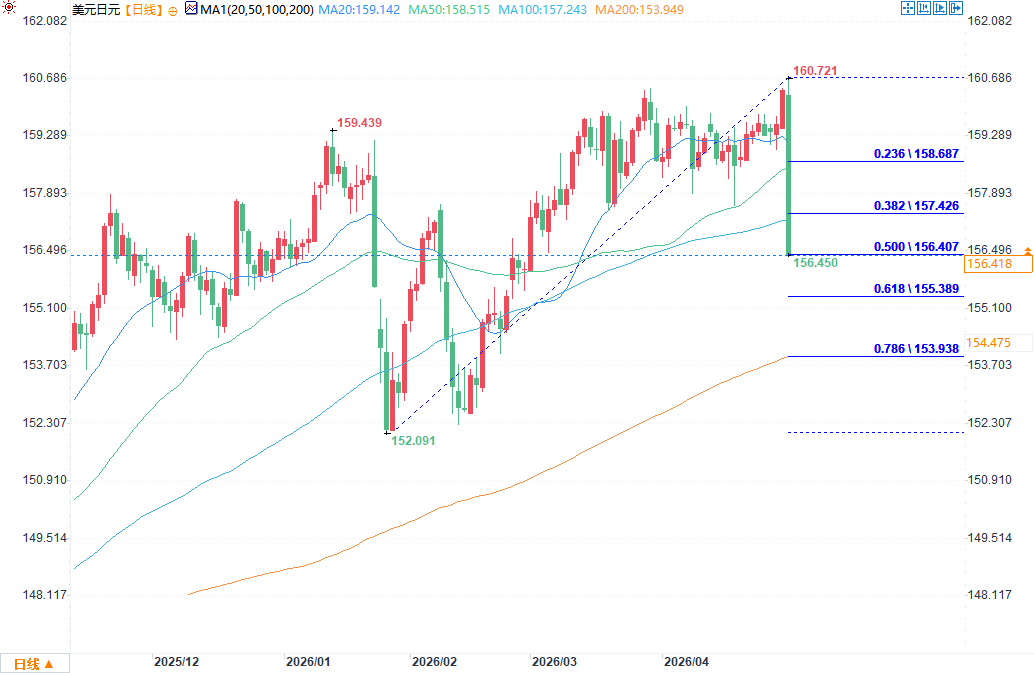
(USD/JPY daily chart source: EasyForex)
Summarize
Overall, the battle to defend the 160 yen level remains fraught with uncertainty amid a complex environment of intertwined high oil prices, geopolitical risks, and monetary policy maneuvering. While Finance Minister Satsuki Katayama's hawkish stance triggered a short-term surge, the structural pressures from high oil prices and Kazuo Ueda's relatively cautious comments mean the yen's trajectory will continue to face challenges.
In the coming weeks, international oil price movements, Federal Reserve policy signals, and the Bank of Japan's actions will collectively determine the yen's next move. Investors should maintain a flexible strategy, closely monitoring core inflation data, the outcome of the Shunto wage negotiations, and oil price dynamics, guided by actual data rather than over-betting on a single direction.
Analysts believe that if oil prices remain high for an extended period and the Bank of Japan fails to send sufficiently strong tightening signals, the risk of the exchange rate testing higher levels will continue to rise. Furthermore, intervention by the Japanese authorities will likely only bring about a temporary rebound and will not change the long-term trend of yen depreciation.
These warnings quickly triggered a risk-averse reaction in the market, causing a sharp correction in the USD/JPY exchange rate. The yen surged nearly 300 points in a short period, temporarily easing depreciation pressure. However, this short-term rebound triggered by verbal intervention did not fundamentally change the structural predicament facing the yen. Against the backdrop of high global oil prices, the battle to defend the yen remains in a stage of intense competition.
The Yen's Dilemma: Pressure at the 160 Level Due to Multiple Factors
The USD/JPY exchange rate is currently under triple pressure from high oil prices, widening interest rate differentials between the US and Japan, and the Bank of Japan's cautious monetary policy. Despite repeated warnings of strong intervention from the Japanese government, the exchange rate has shown strong upward resilience, with the 160 level becoming a psychological and policy red line closely watched by the market.
As a major global energy importer, Japan's economy is extremely sensitive to oil price fluctuations. High oil prices directly increase energy import costs, worsen the trade balance, and further transmit to domestic prices through increased business costs, exacerbating imported inflation. Meanwhile, the persistent interest rate differential between the US and Japan continues to attract capital flows to dollar assets, putting downward pressure on the yen.
High oil prices are the main source of the impact.
Recent geopolitical tensions in the Middle East have driven a significant rise in international oil prices, with Brent crude oil prices briefly exceeding $110 per barrel. High oil prices show a clear positive correlation with the USD/JPY exchange rate, further amplifying the downside risk for the yen.
Even though Japanese Finance Minister Satsuki Katayama's tough stance led to a short-term surge in the yen, the long-term drag of high oil prices on Japan's terms of trade and balance of payments remains significant. As long as oil prices remain high and the Federal Reserve's policy remains relatively strong, the USD/JPY exchange rate will continue to face upward pressure to test higher levels. While Japanese intervention can create sharp short-term fluctuations, the market believes it is unlikely to completely reverse the yen's depreciation trend driven by high oil prices. Currently, holding the $160 level is becoming increasingly difficult as oil prices rise.
The Bank of Japan's policy dilemma
Faced with the dual challenges of yen depreciation and imported inflation, the Bank of Japan decided at its monetary policy meeting on April 28, 2026, to maintain the policy rate at around 0.75%. However, a rare 6-3 split emerged within the decision-making body, with three members (Junko Nakagawa, Hajime Takada, and Naoki Tamura) proposing to raise the interest rate directly to 1.0%.
During the meeting, the Bank of Japan significantly raised its core CPI forecast for fiscal year 2026, while lowering its economic growth expectations. It also explicitly identified high oil prices (especially supply-side risks stemming from the Middle East situation) as the primary concern. This risk could push up broad-based domestic price levels through cost transmission mechanisms, creating more persistent inflationary pressures.
Bank of Japan Governor Kazuo Ueda stated at the post-meeting press conference that the upside risks to prices outweigh the downside risks to the economy this year, but emphasized the need for further assessment of the impact of the Middle East conflict. He did not provide a clear timetable for a June rate hike, instead adopting a more cautious stance. This statement disappointed some markets, causing the yen to come under renewed pressure after a brief rebound.
Kazuo Ueda's core concerns focus on three points: first, the oil price shock could trigger runaway inflation expectations and a second round of effects; second, while high oil prices push up prices, they will also inhibit economic growth, squeeze corporate profits and household income; and third, Japan's heavy government debt burden and the financial vulnerabilities left over from the long-term low-interest-rate environment mean that policy adjustments need to be made with caution and balance.
FOREX market analyst Fawad Razaqzada previously stated, "With the Bank of Japan refusing to raise interest rates and international oil prices remaining high, the pressure on the USD/JPY exchange rate to break through the 160 level is rapidly accumulating. Any slightly positive signal from the Federal Reserve's policy, combined with the boost from high oil prices, could push the exchange rate through the key resistance zone of 159.50-160.00, and even back to this year's high of 160.46, extending to higher levels. Although the risk of intervention could trigger sharp market fluctuations, it has not changed the overall upward risk appetite for the exchange rate."
Interest Rate Hike Prospects and Domestic Challenges
The market currently expects the Bank of Japan's next interest rate hike to take place as early as June or July 2026, with an increase of 25 basis points, and the final interest rate may reach around 1.5% by mid-2027.
This gradual interest rate hike path will steepen the Japanese government bond yield curve, potentially benefiting the banking and insurance sectors. However, for highly leveraged companies and some growth-oriented export enterprises, rising financing costs will create operational pressure. Japan's long-term reliance on low interest rates is changing; the policy normalization process will bring both short-term pain and will drive improvements in capital allocation efficiency and structural adjustments.
After decades of ultra-low interest rates and quantitative easing, the Japanese economy has developed a pattern of low-cost financing for businesses, a high preference for household savings, and a stock market highly dependent on liquidity. With the normalization of policies, structural adjustments are inevitable.
In the short term, high oil prices coupled with potential interest rate hikes will put a double squeeze on corporate profits and household consumption, particularly posing significant challenges to small and medium-sized enterprises and the real estate sector. However, in the medium to long term, a higher interest rate environment will help curb asset bubbles, improve capital allocation efficiency, and provide more stable returns for the pension system.
At the financial market level, Japanese government bond yields will face upward pressure, and the stock market structure will diverge: financial stocks may receive support, while highly valued technology and growth stocks will face the risk of valuation correction. While a weak yen will increase exchange rate losses for overseas investors, it will also enhance the international competitiveness of Japanese export companies.
(USD/JPY daily chart source: EasyForex)
Summarize
Overall, the battle to defend the 160 yen level remains fraught with uncertainty amid a complex environment of intertwined high oil prices, geopolitical risks, and monetary policy maneuvering. While Finance Minister Satsuki Katayama's hawkish stance triggered a short-term surge, the structural pressures from high oil prices and Kazuo Ueda's relatively cautious comments mean the yen's trajectory will continue to face challenges.
In the coming weeks, international oil price movements, Federal Reserve policy signals, and the Bank of Japan's actions will collectively determine the yen's next move. Investors should maintain a flexible strategy, closely monitoring core inflation data, the outcome of the Shunto wage negotiations, and oil price dynamics, guided by actual data rather than over-betting on a single direction.
Analysts believe that if oil prices remain high for an extended period and the Bank of Japan fails to send sufficiently strong tightening signals, the risk of the exchange rate testing higher levels will continue to rise. Furthermore, intervention by the Japanese authorities will likely only bring about a temporary rebound and will not change the long-term trend of yen depreciation.
- Risk Warning and Disclaimer
- The market involves risk, and trading may not be suitable for all investors. This article is for reference only and does not constitute personal investment advice, nor does it take into account certain users’ specific investment objectives, financial situation, or other needs. Any investment decisions made based on this information are at your own risk.