Gold Trading Alert: A pullback in both the US dollar and oil prices helped gold prices rebound, but the monthly chart still shows two consecutive months of declines; the situation in the Middle East remains the biggest variable.
2026-05-01 07:40:07
Spot gold rebounded sharply by 1.7% on Thursday (April 30), closing at $4,621.61 per ounce, after hitting a high of $4,646.74 during the session. U.S. gold futures also rose 1.5% to $4,629.60. The previous day, gold prices had fallen to a one-month low near $4,510. This dramatic fluctuation is a true reflection of the current complex geopolitical and macroeconomic situation: on the one hand, a weaker dollar and a pullback in oil prices from four-year highs provided gold with a short-term respite; on the other hand, persistent inflation concerns stemming from the Iranian conflict, along with hawkish signals from the Federal Reserve and other major central banks maintaining high interest rates, suppressed gold's appeal as a safe-haven asset, ultimately resulting in a second consecutive monthly decline of approximately 1%.
On Friday (May 1) in early Asian trading, spot gold traded in a narrow range, currently at $4,633.07 per ounce.

Thursday's strong rebound in gold prices was mainly due to the easing of two major external factors. First, the US dollar index fell sharply by 0.87%, closing at 98.09, ending a two-day winning streak. The intervention of Japanese authorities played a crucial role in this. Japanese Finance Minister Satsuki Katayama released strong signals, hinting at possible "decisive" action to support the yen. After the yen fell to its lowest level against the dollar since July 2024, Japanese officials intervened to buy yen, causing the dollar to plunge 3% against the yen to 155.5 at one point, before recovering to 156.52, a single-day drop of 2.33%. A weaker dollar makes dollar-denominated gold more attractive to investors holding other currencies, indirectly boosting gold prices.
Secondly, global oil prices retreated significantly after hitting a four-year high in early trading. Brent crude briefly surged above $126 a barrel due to concerns about supply disruptions in the Middle East, but ultimately closed at $114.01, down 3.41%. The slowdown in energy price increases eased immediate fears of further runaway inflation. David Meger, director of precious metals trading at Ridge Futures, noted that the easing of both energy prices and the dollar provided a breather for the gold market, with market focus quickly shifting to the Federal Reserve's interest rate path.
These short-term factors combined to drive a rapid rebound in gold prices from their lows. However, this rebound is more of a technical correction than a trend reversal, as deep-seated uncertainties still loom over the market.
While the pullback in oil prices provided a temporary buffer, the ongoing conflict in the Middle East, particularly tensions between the US and Iran, continues to push up inflation expectations, posing the biggest pressure on gold. The Bank of England, while maintaining interest rates, explicitly outlined multiple scenarios for the economic impact of a war with Iran, one extreme scenario potentially requiring a "significant" increase in borrowing costs to cope with a potential inflationary shock. This directly reflects market concerns about persistently high energy prices.
The Federal Reserve's latest statement also leans hawkish. On Wednesday, the Fed kept interest rates unchanged as expected, but a clear division emerged within the policy-making body: one member opposed an immediate rate cut, while three others opposed the continued indication of easing in the policy statement. Fed Chairman Powell indicated that the Fed might abandon dovish language as early as its next meeting. Coupled with the US first-quarter GDP growth of 2.0% annualized (slightly lower than the expected 2.3%, but a significant rebound from the previous quarter's 0.5%), and the March PCE price index jumping 0.7% month-on-month and rising to 3.5% year-on-year (the largest increase since June 2022), these data further reinforced the Fed's cautious stance. In a high-inflation environment, the longer interest rates remain high, the higher the opportunity cost of holding non-interest-bearing gold, thus suppressing its price performance.
The US bond market also confirms this logic: as oil prices retreated from their highs, the yields on 2-year and 10-year Treasury bonds fell from their intraday highs, but remained at relatively high levels overall, reflecting investors' weighing of inflation and economic growth uncertainties. Michael Lorizio of Manulife Investment Management believes that regardless of whether the situation eases or drags on, Treasury bonds have investment value, but gold, as a non-interest-bearing asset, will inevitably face short-term pressure in this context.
Despite short-term selling pressure, institutions remain bullish on gold's medium-term outlook. Citigroup analysts point out that while gold may continue to face selling pressure in the short term due to uncertainty in the Middle East, it will eventually regain its appeal as a safe-haven asset. The bank maintains its price targets: $4,300 for the next three months and $5,000 for the six to twelve months. This forecast is based on the premise that a prolonged conflict could further boost safe-haven demand, while also considering the support from central bank gold purchases amid the global trend of de-dollarization.
The actions of the Reserve Bank of India (RBI) are a vivid example. By the end of March, gold accounted for 16.7% of its foreign exchange reserves, demonstrating that emerging market central banks are increasing their gold holdings to diversify risk and hedge against geopolitical and currency volatility. This structural demand provides a solid floor for gold prices, especially against the backdrop of high global debt and increasing fiscal pressure.
Furthermore, the US economic recovery in the first quarter benefited from a rebound in AI investment and government spending, but personal consumption expenditure was eroded by high oil prices, and the savings rate fell to a low of 3.6%, indicating pressure on household purchasing power. If the Middle East conflict drags on, persistently high oil prices will further suppress economic growth and push up inflation, which may actually strengthen gold's safe-haven appeal in the medium term.
The core variable in the current gold market is undoubtedly the trajectory of the US-Iran conflict. Two months after the conflict erupted, the Strait of Hormuz, a crucial passage for 20% of the world's oil and gas supply, remains closed or restricted, causing dramatic fluctuations in energy prices. The US is attempting to exert pressure by blockading Iranian oil exports at sea and is considering a new round of military action, while Iran has threatened a "lasting and painful strike" and reaffirmed its sovereignty over the strait. The UN Secretary-General has warned that if the blockade continues until mid-year, global economic growth will slow, inflation will worsen, and tens of millions will fall into poverty.
The Trump administration faces pressure to end the war by a deadline, while also pushing for a "freedom of seas" coalition to reopen shipping lanes. However, allies like France and the UK have stated they will only participate if the conflict truly ends. This makes the situation highly uncertain: if the conflict de-escalates quickly, oil prices will fall, inflationary pressures will ease, and gold's safe-haven premium may diminish, leading to a price correction; if the conflict is prolonged or escalates, oil prices will remain high or even rise further, coupled with higher inflation expectations, significantly enhancing gold's appeal as the ultimate safe-haven asset, and it may even return to or break through previous highs.
The UAE's ban on its citizens traveling to Iran, Lebanon, and Iraq further highlights regional tensions. While Trump stated that gasoline prices would "plummet like rocks" once the war ends, the market still needs to digest these uncertainties in the short term.
In summary, the gold market currently presents a complex picture of a short-term technical rebound and a medium-term structural bullish outlook, both suppressed in the short term by the shadow of high interest rates and inflation. Dollar intervention and oil price corrections provided immediate support for gold prices, but the hawkish stances of the Federal Reserve and the Bank of England, along with the persistent inflationary risks stemming from the Iranian conflict, have made it difficult for gold to escape its second consecutive month of decline. Forecasts from institutions such as Citigroup indicate that the $4300-$5000 range remains a reasonable expectation, while the trend of central banks like India increasing their gold holdings will provide long-term support for prices.
In the coming weeks, investors should closely monitor the progress of US-Iran negotiations, oil price movements, dollar index fluctuations, and signals from the next Federal Reserve meeting. If geopolitical risks ease and economic data stabilizes, gold may face further consolidation; conversely, if the conflict escalates or inflation data exceeds expectations, gold is expected to regain its strength. As a traditional safe-haven asset, gold will continue to play an important role in the current turmoil, but its performance is highly dependent on the evolution of both macroeconomic and geopolitical variables.
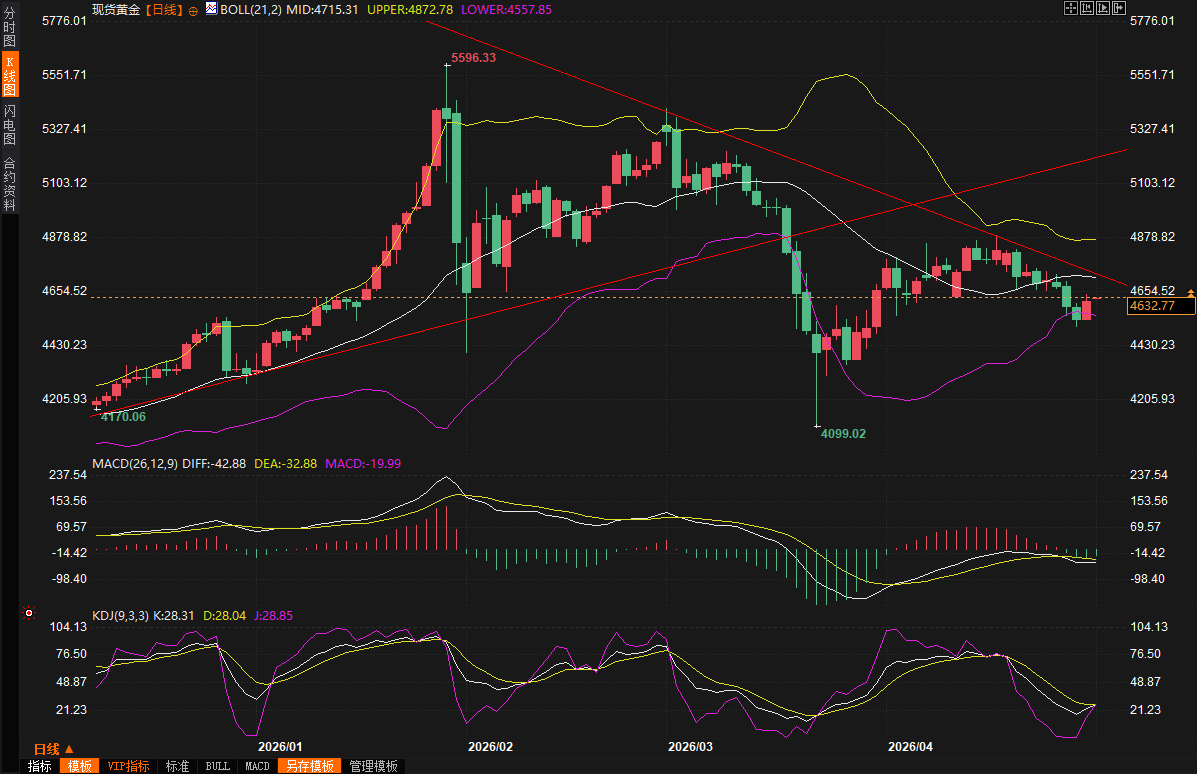
(Spot gold daily chart, source: FX678)
At 07:35 Beijing time, spot gold was trading at $4633.07 per ounce.
On Friday (May 1) in early Asian trading, spot gold traded in a narrow range, currently at $4,633.07 per ounce.
The short-term rebound is driven by a combination of a weaker dollar and a pullback in oil prices.
Thursday's strong rebound in gold prices was mainly due to the easing of two major external factors. First, the US dollar index fell sharply by 0.87%, closing at 98.09, ending a two-day winning streak. The intervention of Japanese authorities played a crucial role in this. Japanese Finance Minister Satsuki Katayama released strong signals, hinting at possible "decisive" action to support the yen. After the yen fell to its lowest level against the dollar since July 2024, Japanese officials intervened to buy yen, causing the dollar to plunge 3% against the yen to 155.5 at one point, before recovering to 156.52, a single-day drop of 2.33%. A weaker dollar makes dollar-denominated gold more attractive to investors holding other currencies, indirectly boosting gold prices.
Secondly, global oil prices retreated significantly after hitting a four-year high in early trading. Brent crude briefly surged above $126 a barrel due to concerns about supply disruptions in the Middle East, but ultimately closed at $114.01, down 3.41%. The slowdown in energy price increases eased immediate fears of further runaway inflation. David Meger, director of precious metals trading at Ridge Futures, noted that the easing of both energy prices and the dollar provided a breather for the gold market, with market focus quickly shifting to the Federal Reserve's interest rate path.
These short-term factors combined to drive a rapid rebound in gold prices from their lows. However, this rebound is more of a technical correction than a trend reversal, as deep-seated uncertainties still loom over the market.
Interest Rate Dilemma Under the Shadow of Inflation: Hawkish Signals from the Federal Reserve and the Bank of England
While the pullback in oil prices provided a temporary buffer, the ongoing conflict in the Middle East, particularly tensions between the US and Iran, continues to push up inflation expectations, posing the biggest pressure on gold. The Bank of England, while maintaining interest rates, explicitly outlined multiple scenarios for the economic impact of a war with Iran, one extreme scenario potentially requiring a "significant" increase in borrowing costs to cope with a potential inflationary shock. This directly reflects market concerns about persistently high energy prices.
The Federal Reserve's latest statement also leans hawkish. On Wednesday, the Fed kept interest rates unchanged as expected, but a clear division emerged within the policy-making body: one member opposed an immediate rate cut, while three others opposed the continued indication of easing in the policy statement. Fed Chairman Powell indicated that the Fed might abandon dovish language as early as its next meeting. Coupled with the US first-quarter GDP growth of 2.0% annualized (slightly lower than the expected 2.3%, but a significant rebound from the previous quarter's 0.5%), and the March PCE price index jumping 0.7% month-on-month and rising to 3.5% year-on-year (the largest increase since June 2022), these data further reinforced the Fed's cautious stance. In a high-inflation environment, the longer interest rates remain high, the higher the opportunity cost of holding non-interest-bearing gold, thus suppressing its price performance.
The US bond market also confirms this logic: as oil prices retreated from their highs, the yields on 2-year and 10-year Treasury bonds fell from their intraday highs, but remained at relatively high levels overall, reflecting investors' weighing of inflation and economic growth uncertainties. Michael Lorizio of Manulife Investment Management believes that regardless of whether the situation eases or drags on, Treasury bonds have investment value, but gold, as a non-interest-bearing asset, will inevitably face short-term pressure in this context.
Medium-term optimistic outlook: Citi's view and structural support from central bank gold purchases
Despite short-term selling pressure, institutions remain bullish on gold's medium-term outlook. Citigroup analysts point out that while gold may continue to face selling pressure in the short term due to uncertainty in the Middle East, it will eventually regain its appeal as a safe-haven asset. The bank maintains its price targets: $4,300 for the next three months and $5,000 for the six to twelve months. This forecast is based on the premise that a prolonged conflict could further boost safe-haven demand, while also considering the support from central bank gold purchases amid the global trend of de-dollarization.
The actions of the Reserve Bank of India (RBI) are a vivid example. By the end of March, gold accounted for 16.7% of its foreign exchange reserves, demonstrating that emerging market central banks are increasing their gold holdings to diversify risk and hedge against geopolitical and currency volatility. This structural demand provides a solid floor for gold prices, especially against the backdrop of high global debt and increasing fiscal pressure.
Furthermore, the US economic recovery in the first quarter benefited from a rebound in AI investment and government spending, but personal consumption expenditure was eroded by high oil prices, and the savings rate fell to a low of 3.6%, indicating pressure on household purchasing power. If the Middle East conflict drags on, persistently high oil prices will further suppress economic growth and push up inflation, which may actually strengthen gold's safe-haven appeal in the medium term.
Geopolitical uncertainty: The conflict with Iran is the biggest variable.
The core variable in the current gold market is undoubtedly the trajectory of the US-Iran conflict. Two months after the conflict erupted, the Strait of Hormuz, a crucial passage for 20% of the world's oil and gas supply, remains closed or restricted, causing dramatic fluctuations in energy prices. The US is attempting to exert pressure by blockading Iranian oil exports at sea and is considering a new round of military action, while Iran has threatened a "lasting and painful strike" and reaffirmed its sovereignty over the strait. The UN Secretary-General has warned that if the blockade continues until mid-year, global economic growth will slow, inflation will worsen, and tens of millions will fall into poverty.
The Trump administration faces pressure to end the war by a deadline, while also pushing for a "freedom of seas" coalition to reopen shipping lanes. However, allies like France and the UK have stated they will only participate if the conflict truly ends. This makes the situation highly uncertain: if the conflict de-escalates quickly, oil prices will fall, inflationary pressures will ease, and gold's safe-haven premium may diminish, leading to a price correction; if the conflict is prolonged or escalates, oil prices will remain high or even rise further, coupled with higher inflation expectations, significantly enhancing gold's appeal as the ultimate safe-haven asset, and it may even return to or break through previous highs.
The UAE's ban on its citizens traveling to Iran, Lebanon, and Iraq further highlights regional tensions. While Trump stated that gasoline prices would "plummet like rocks" once the war ends, the market still needs to digest these uncertainties in the short term.
Outlook: Gold seeks direction amid volatility
In summary, the gold market currently presents a complex picture of a short-term technical rebound and a medium-term structural bullish outlook, both suppressed in the short term by the shadow of high interest rates and inflation. Dollar intervention and oil price corrections provided immediate support for gold prices, but the hawkish stances of the Federal Reserve and the Bank of England, along with the persistent inflationary risks stemming from the Iranian conflict, have made it difficult for gold to escape its second consecutive month of decline. Forecasts from institutions such as Citigroup indicate that the $4300-$5000 range remains a reasonable expectation, while the trend of central banks like India increasing their gold holdings will provide long-term support for prices.
In the coming weeks, investors should closely monitor the progress of US-Iran negotiations, oil price movements, dollar index fluctuations, and signals from the next Federal Reserve meeting. If geopolitical risks ease and economic data stabilizes, gold may face further consolidation; conversely, if the conflict escalates or inflation data exceeds expectations, gold is expected to regain its strength. As a traditional safe-haven asset, gold will continue to play an important role in the current turmoil, but its performance is highly dependent on the evolution of both macroeconomic and geopolitical variables.
(Spot gold daily chart, source: FX678)
At 07:35 Beijing time, spot gold was trading at $4633.07 per ounce.
- Risk Warning and Disclaimer
- The market involves risk, and trading may not be suitable for all investors. This article is for reference only and does not constitute personal investment advice, nor does it take into account certain users’ specific investment objectives, financial situation, or other needs. Any investment decisions made based on this information are at your own risk.