AUD/USD rally stalls: Japanese intervention in the currency market unlikely to change short-term volatile pattern.
2026-05-01 19:52:12
On Friday (May 1st) during the European session, the Australian dollar (AUD/USD) was trading at 0.7190, a slight decrease of 0.0005 from the previous trading day, a drop of 0.1250%, showing a volatile trend of rising but encountering resistance. Previously, on Thursday, influenced by Japanese intervention in the foreign exchange market, the US dollar index weakened in the short term, and the Australian dollar surged accordingly, briefly approaching the high of its recent trading range. However, this rebound failed to hold, and the exchange rate fluctuated and fell back during Friday's session, reaching a high of 0.7205 and a low of 0.7182, failing to hold onto Thursday's gains, highlighting the current market's cautious expectations regarding the effectiveness of Japanese intervention.

The Bank of Japan has officially intervened in the foreign exchange market, temporarily eliminating a key macroeconomic headwind affecting the Australian dollar's exchange rate. This not only triggered a general weakening of the US dollar but also reignited market risk appetite, pushing the Australian dollar against the US dollar back to near the high of its recent trading range on Thursday. However, by Friday, the Australian dollar had failed to maintain its upward momentum and experienced a significant pullback. Given the Australian dollar's extreme sensitivity to market volatility, bond yields, and energy price changes, its short-term trajectory is increasingly uncertain. Despite Japan's confirmed intervention, it failed to sustain the Australian dollar's upward movement.
From a technical perspective, the Australian dollar broke through the key level of 0.7188 against the US dollar on Thursday and found support from the upward trend line formed since the end of March. This allowed the bullish pattern to be maintained and opened up room for the exchange rate to challenge the two key resistance levels of 0.7222 and 0.7283. However, Friday's pullback put this pattern to the test.
With macroeconomic pressures eased, the Australian dollar rebounded strongly.
Markets widely believe that Japan's Ministry of Finance instructed the Bank of Japan on Thursday to intervene in the yen's exchange rate. There is also speculation that Japanese authorities may have taken similar action in the crude oil futures market. Unlike previous foreign exchange interventions by Japan, this time the Japanese government officially acknowledged the intervention after it was implemented. According to Wall Street foreign exchange strategists' analysis of the Bank of Japan's accounts, the intervention amounted to approximately $34.5 billion, marking Japan's latest intervention in the foreign exchange market to support the yen's exchange rate since July 2024. Previously, as the USD/JPY exchange rate reached its highest level since mid-2024, Japanese Finance Minister Satsuki Katayama warned of "bold action," hinting at foreign exchange intervention, clearly indicating that his patience with the yen's continued weakness was wearing thin.
The impact of this event on the financial markets is undeniable. Since the outbreak of the Iran-Iraq War, the combined effects of soaring oil prices, rising bond yields, and a stronger US dollar have acted as a "shackle" suppressing the performance of risk assets—even though risk assets had been in a generally bullish market environment for the previous month. When this suppressive shackle was suddenly removed, risk assets experienced a comprehensive surge, with the Australian dollar, which is highly sensitive to risk sentiment, performing particularly well, directly pushing the Australian dollar against the US dollar exchange rate back close to the top of the trading range it had been operating within for the past two weeks.
The Australian dollar has recently shown extremely high sensitivity to fluctuations in multiple asset classes. Specifically, it exhibits a strong positive correlation with the AUD/USD interest rate differential and the S&P 500 index (a proxy for risk assets), while showing a similarly significant negative correlation with energy prices and implied volatility. Given this market backdrop, the recent surge in the Australian dollar is not surprising; it's almost a "perfect storm" driving its exchange rate upward.
From a longer-term perspective, the Australian dollar's movements are clearly still driven by overall market risk appetite. This means that market risk appetite may be a more reliable indicator when assessing the future direction of the Australian dollar. Considering the current market situation, Thursday's surge failed to hold, and the Australian dollar retreated on Friday. The core issue of market focus has shifted to: whether the weakness of the US dollar can continue after Japan's official confirmation of intervention, and whether the Australian dollar can regain support. Furthermore, can Thursday's rise still act as a catalyst for a bullish breakout in the Australian dollar against the US dollar?
The high point of the trading range has returned to market focus.
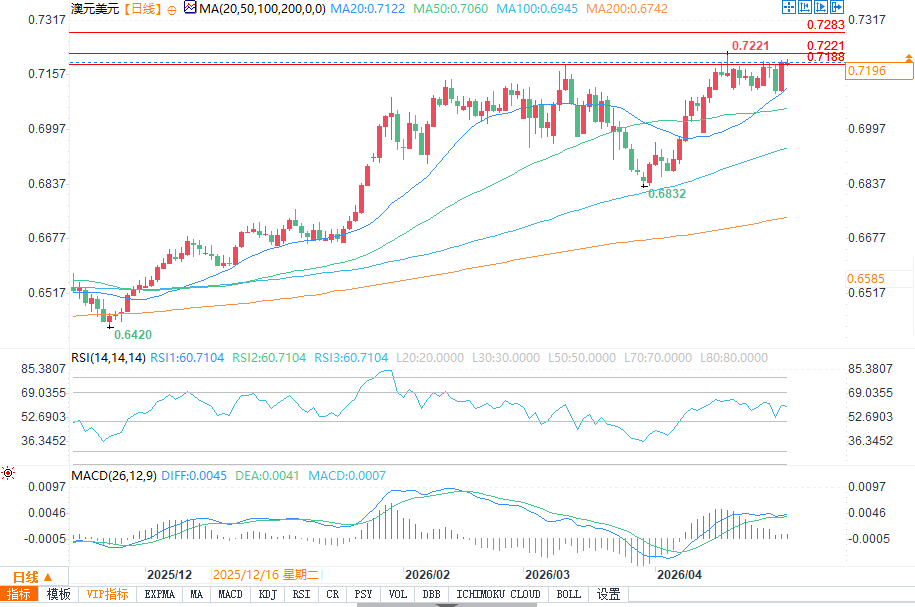
(AUD/USD daily chart source: FX678)
As seen on the daily chart, although the Australian dollar is currently below the high reached on April 17th, it's noteworthy that Thursday's closing price broke through the early March high of 0.7188. This breakout contrasts sharply with previous attempts to hold key levels, ultimately triggering pullbacks, and carries significant signaling importance. While this isn't a textbook perfect breakout pattern, it's equally noteworthy that yesterday's rebound began near the upward trendline formed since the late March lows, continuing the market pattern where the exchange rate found buying support near the 0.7100 level.
Despite a bearish divergence between price action and the Relative Strength Index (RSI, 14-day), the RSI remains in strong territory above 50, while the Moving Average Convergence Divergence (MACD) continues to trade above the signal line in positive territory. This indicates that while upward momentum has weakened, the bullish momentum has not completely dissipated in the short term; however, Friday's pullback in the Australian dollar did somewhat dampen the bullish stance. Currently, the AUD/USD exchange rate remains above key short-term and long-term moving averages, and all moving averages are showing a positive slope, which still provides some basis for the continuation of the bullish trend. However, uncertainty has increased, and the possibility of a renewed bullish trend requires further observation based on subsequent market movements.
I am not in a hurry to establish long positions, especially considering that many Asian markets are closed for the Labor Day holiday, resulting in relatively thin market liquidity, and the Australian dollar already retreated on Friday, failing to continue Thursday's strength. However, if the Australian dollar can regain and stabilize above the key level of 0.7188 during the subsequent European trading session with increased capital flows, then establishing long positions above this level, while setting tight stop-loss orders below, would still be a reasonable trading strategy, with a target of 0.7283, the high reached in June 2022. The high of 0.7222 reached on April 17th is the most direct resistance level in the near term. If the exchange rate hesitates near this level, it may indicate that market bulls will choose to take some or all profits, especially given that bullish sentiment has been somewhat affected by Friday's decline.
Risk appetite is key; closely monitor news from the Strait of Hormuz.
As for potential catalysts for market volatility before the weekend, if the yen weakens again in early Asian trading, Japanese authorities are likely to intervene further. Japanese Finance Minister Satsuki Katayama has clearly stated that even during the Japanese holiday, officials will continue to closely monitor the foreign exchange market and remain on standby, suggesting that currency intervention may still be implemented in overseas markets during the holiday period. Since Japan has officially acknowledged its previous intervention, a resumption of intervention would send a stronger signal to the market—the Ministry of Finance is determined to curb the yen's weakness, which would likely lead to further weakening of the US dollar, thus providing additional support for the Australian dollar's recovery and easing the pressure of Friday's decline.
Meanwhile, news developments related to the Strait of Hormuz are crucial, both today and in the long term. The market has largely priced in optimistic expectations for corporate earnings reports, and the market's expectation of a rate hike by the Reserve Bank of Australia (RBA) next week is nearly fully priced in. Therefore, developments in the Persian Gulf region will be a key volatility factor influencing the performance of cyclical risk assets. Subsequent changes may determine whether this attempt to break through the US dollar will successfully trigger a rally or weaken further after Friday's decline, ending in a disappointing close.
The Bank of Japan has officially intervened in the foreign exchange market, temporarily eliminating a key macroeconomic headwind affecting the Australian dollar's exchange rate. This not only triggered a general weakening of the US dollar but also reignited market risk appetite, pushing the Australian dollar against the US dollar back to near the high of its recent trading range on Thursday. However, by Friday, the Australian dollar had failed to maintain its upward momentum and experienced a significant pullback. Given the Australian dollar's extreme sensitivity to market volatility, bond yields, and energy price changes, its short-term trajectory is increasingly uncertain. Despite Japan's confirmed intervention, it failed to sustain the Australian dollar's upward movement.
From a technical perspective, the Australian dollar broke through the key level of 0.7188 against the US dollar on Thursday and found support from the upward trend line formed since the end of March. This allowed the bullish pattern to be maintained and opened up room for the exchange rate to challenge the two key resistance levels of 0.7222 and 0.7283. However, Friday's pullback put this pattern to the test.
With macroeconomic pressures eased, the Australian dollar rebounded strongly.
Markets widely believe that Japan's Ministry of Finance instructed the Bank of Japan on Thursday to intervene in the yen's exchange rate. There is also speculation that Japanese authorities may have taken similar action in the crude oil futures market. Unlike previous foreign exchange interventions by Japan, this time the Japanese government officially acknowledged the intervention after it was implemented. According to Wall Street foreign exchange strategists' analysis of the Bank of Japan's accounts, the intervention amounted to approximately $34.5 billion, marking Japan's latest intervention in the foreign exchange market to support the yen's exchange rate since July 2024. Previously, as the USD/JPY exchange rate reached its highest level since mid-2024, Japanese Finance Minister Satsuki Katayama warned of "bold action," hinting at foreign exchange intervention, clearly indicating that his patience with the yen's continued weakness was wearing thin.
The impact of this event on the financial markets is undeniable. Since the outbreak of the Iran-Iraq War, the combined effects of soaring oil prices, rising bond yields, and a stronger US dollar have acted as a "shackle" suppressing the performance of risk assets—even though risk assets had been in a generally bullish market environment for the previous month. When this suppressive shackle was suddenly removed, risk assets experienced a comprehensive surge, with the Australian dollar, which is highly sensitive to risk sentiment, performing particularly well, directly pushing the Australian dollar against the US dollar exchange rate back close to the top of the trading range it had been operating within for the past two weeks.
The Australian dollar has recently shown extremely high sensitivity to fluctuations in multiple asset classes. Specifically, it exhibits a strong positive correlation with the AUD/USD interest rate differential and the S&P 500 index (a proxy for risk assets), while showing a similarly significant negative correlation with energy prices and implied volatility. Given this market backdrop, the recent surge in the Australian dollar is not surprising; it's almost a "perfect storm" driving its exchange rate upward.
From a longer-term perspective, the Australian dollar's movements are clearly still driven by overall market risk appetite. This means that market risk appetite may be a more reliable indicator when assessing the future direction of the Australian dollar. Considering the current market situation, Thursday's surge failed to hold, and the Australian dollar retreated on Friday. The core issue of market focus has shifted to: whether the weakness of the US dollar can continue after Japan's official confirmation of intervention, and whether the Australian dollar can regain support. Furthermore, can Thursday's rise still act as a catalyst for a bullish breakout in the Australian dollar against the US dollar?
The high point of the trading range has returned to market focus.
(AUD/USD daily chart source: FX678)
As seen on the daily chart, although the Australian dollar is currently below the high reached on April 17th, it's noteworthy that Thursday's closing price broke through the early March high of 0.7188. This breakout contrasts sharply with previous attempts to hold key levels, ultimately triggering pullbacks, and carries significant signaling importance. While this isn't a textbook perfect breakout pattern, it's equally noteworthy that yesterday's rebound began near the upward trendline formed since the late March lows, continuing the market pattern where the exchange rate found buying support near the 0.7100 level.
Despite a bearish divergence between price action and the Relative Strength Index (RSI, 14-day), the RSI remains in strong territory above 50, while the Moving Average Convergence Divergence (MACD) continues to trade above the signal line in positive territory. This indicates that while upward momentum has weakened, the bullish momentum has not completely dissipated in the short term; however, Friday's pullback in the Australian dollar did somewhat dampen the bullish stance. Currently, the AUD/USD exchange rate remains above key short-term and long-term moving averages, and all moving averages are showing a positive slope, which still provides some basis for the continuation of the bullish trend. However, uncertainty has increased, and the possibility of a renewed bullish trend requires further observation based on subsequent market movements.
I am not in a hurry to establish long positions, especially considering that many Asian markets are closed for the Labor Day holiday, resulting in relatively thin market liquidity, and the Australian dollar already retreated on Friday, failing to continue Thursday's strength. However, if the Australian dollar can regain and stabilize above the key level of 0.7188 during the subsequent European trading session with increased capital flows, then establishing long positions above this level, while setting tight stop-loss orders below, would still be a reasonable trading strategy, with a target of 0.7283, the high reached in June 2022. The high of 0.7222 reached on April 17th is the most direct resistance level in the near term. If the exchange rate hesitates near this level, it may indicate that market bulls will choose to take some or all profits, especially given that bullish sentiment has been somewhat affected by Friday's decline.
Risk appetite is key; closely monitor news from the Strait of Hormuz.
As for potential catalysts for market volatility before the weekend, if the yen weakens again in early Asian trading, Japanese authorities are likely to intervene further. Japanese Finance Minister Satsuki Katayama has clearly stated that even during the Japanese holiday, officials will continue to closely monitor the foreign exchange market and remain on standby, suggesting that currency intervention may still be implemented in overseas markets during the holiday period. Since Japan has officially acknowledged its previous intervention, a resumption of intervention would send a stronger signal to the market—the Ministry of Finance is determined to curb the yen's weakness, which would likely lead to further weakening of the US dollar, thus providing additional support for the Australian dollar's recovery and easing the pressure of Friday's decline.
Meanwhile, news developments related to the Strait of Hormuz are crucial, both today and in the long term. The market has largely priced in optimistic expectations for corporate earnings reports, and the market's expectation of a rate hike by the Reserve Bank of Australia (RBA) next week is nearly fully priced in. Therefore, developments in the Persian Gulf region will be a key volatility factor influencing the performance of cyclical risk assets. Subsequent changes may determine whether this attempt to break through the US dollar will successfully trigger a rally or weaken further after Friday's decline, ending in a disappointing close.
- Risk Warning and Disclaimer
- The market involves risk, and trading may not be suitable for all investors. This article is for reference only and does not constitute personal investment advice, nor does it take into account certain users’ specific investment objectives, financial situation, or other needs. Any investment decisions made based on this information are at your own risk.