Iran's strikes on a UAE oil port and blockade of the Strait of Hormuz sent international oil prices surging 6% in a single day.
2026-05-05 02:14:59
On Monday (May 4), international oil prices surged during the US trading session. Brent crude futures rose 6.3% to $114.96 per barrel, while West Texas Intermediate (WTI) crude rose 4.2% to $106.17 per barrel. The core reason driving this price increase was the escalation of the geopolitical conflict with Iran. Iran launched a series of strikes against the UAE and ships near the Strait of Hormuz in the past 24 hours, marking the most serious escalation of the conflict since the US-Iran ceasefire agreement took effect in early April.

The course of the conflict: drones, missiles, and the struggle for control of the Taiwan Strait.
On Monday, Iranian drones reportedly struck the Fujairah oil port in the United Arab Emirates, causing a fire. The UAE Ministry of Defense later confirmed on social media that Iran launched four cruise missiles at the country; three were successfully intercepted by the UAE's air defense system, and the fourth crashed into the sea.
Meanwhile, a South Korean vessel was attacked by an explosion in the Strait of Hormuz. The UAE also accused Iran of using a drone to strike an empty oil tanker belonging to the Abu Dhabi National Oil Company (ADNOC) as it attempted to pass through the Strait of Hormuz. The UK Maritime Trade Operations Office (UKMTO) also reported an incident involving a cargo ship approximately 36 nautical miles north of Dubai and confirmed another separate incident earlier that day near the UAE. Based on various sources, Iran is suspected of attacking at least four vessels in the Gulf region in the past 24 hours.
On the military front, Admiral Brad Cooper, commander of U.S. Central Command, announced that the U.S. military had destroyed six small Iranian vessels in the Strait of Hormuz and successfully intercepted Iranian cruise missiles and drones. Previously, President Trump announced Operation Freedom, a clearance operation involving guided-missile destroyers, over 100 aircraft, and unmanned platforms, aimed at guiding stranded merchant ships out of the strait. The U.S. military stated that two U.S. merchant ships had passed through the Strait of Hormuz that day, but Iran denied that any of its vessels had made the passage. Iranian military officials also denied that their small vessels had been sunk.
It is worth noting that the Iranian Revolutionary Guard Navy subsequently released a map, claiming to have expanded its control area near the Strait of Hormuz to include the ports of Fujairah and Horfakhan in the United Arab Emirates, as well as the coastline of the Emirate of Umm Al Quwain, further strengthening its posture of control over this key waterway.
The fragility of ceasefire agreements
The backdrop to this round of conflict is a ceasefire agreement that was already on the verge of collapse. On February 28th of this year, the United States and Israel launched a military strike against Iran, followed by a ceasefire in early April. However, since the agreement took effect, the volume of ships passing through the Strait of Hormuz has remained far below pre-war levels.
During the ceasefire, differences among the parties remained. Trump stated that the US might resume military action if Iran "misbehaved," raising doubts about the ceasefire's sustainability. Iranian media initially claimed that Iran had attacked a US ship, but according to Axios, citing US officials, no attack actually occurred. Reuters characterized Iran's renewed attack on the UAE as the "most serious escalation" since the ceasefire began, further straining the already fragile agreement.
The UAE's withdrawal from OPEC alters the supply landscape.
As geopolitical conflicts escalate, the Middle East's energy landscape is also undergoing structural changes. Last week, the United Arab Emirates officially withdrew from OPEC, becoming the first major member to leave this oil-producing group in recent years. The country's energy minister stated that the UAE will fulfill its responsibilities to its investment partners, producing oil according to global market demand without any restrictions, while continuing to cooperate with other oil-producing nations.
The UAE's withdrawal has not stopped OPEC+ from continuing its production increase plan. This week, OPEC+ announced that its seven major members will increase production by 188,000 barrels per day in June, marking the third consecutive month of increased production and the first decision since the UAE's withdrawal. Analysts point out that this increase is negligible compared to the current supply gap of over 9 million barrels per day.
Market Outlook
The rise in oil prices reflects the market's continued pricing in of supply disruption risks. Since the US-Israel strikes against Iran on February 28th, both Brent and WTI crude have risen by more than 60%.
UBS analyst Giovanni Stanovo stated, "As long as traffic in the Strait of Hormuz remains restricted, oil prices will continue to trend upwards." ING's head of commodities strategy, Warren Paterson, noted in a research report, "The oil market has shifted from excessive optimism to facing the reality of supply disruptions in the Persian Gulf. The longer this disruption lasts, the less sustainable the market's reliance on inventories becomes, and the greater the need for further demand disruption. The only way to drive this process is for oil prices to continue rising."
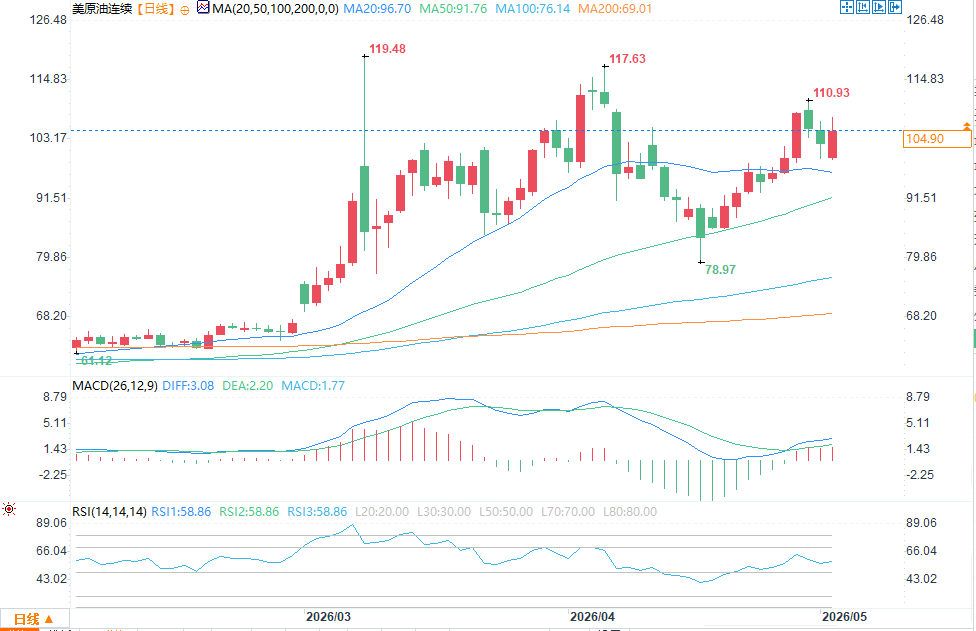
(WTI crude oil daily chart source: FX678)
From a technical perspective, WTI is currently in a neutral-to-bullish trend, with the Relative Strength Index (RSI) rising above 50 and recent price action showing a bullish engulfing pattern. If WTI breaks above the intraday high of $107.5, the next resistance level is $110.93 (the high on April 30), followed by the $120 mark. On the downside, if it falls below the psychological level of $100, the 50-day moving average at $89.65 will become a key support level.
The core contradiction in the current situation lies in the US's attempt to forcibly open the Strait of Hormuz through military action, while Iran responds by expanding its control over the strait and continuing to strike transit vessels. Neither side has shown any willingness to make substantial compromises. The ceasefire agreement is effectively dead, and the window of uncertainty in the energy market is far from closed. As ExxonMobil CEO Darren Woods previously warned, "The market has not yet fully absorbed the shock of this supply disruption, and if the strait remains blocked, there will be more consequences to come."
The course of the conflict: drones, missiles, and the struggle for control of the Taiwan Strait.
On Monday, Iranian drones reportedly struck the Fujairah oil port in the United Arab Emirates, causing a fire. The UAE Ministry of Defense later confirmed on social media that Iran launched four cruise missiles at the country; three were successfully intercepted by the UAE's air defense system, and the fourth crashed into the sea.
Meanwhile, a South Korean vessel was attacked by an explosion in the Strait of Hormuz. The UAE also accused Iran of using a drone to strike an empty oil tanker belonging to the Abu Dhabi National Oil Company (ADNOC) as it attempted to pass through the Strait of Hormuz. The UK Maritime Trade Operations Office (UKMTO) also reported an incident involving a cargo ship approximately 36 nautical miles north of Dubai and confirmed another separate incident earlier that day near the UAE. Based on various sources, Iran is suspected of attacking at least four vessels in the Gulf region in the past 24 hours.
On the military front, Admiral Brad Cooper, commander of U.S. Central Command, announced that the U.S. military had destroyed six small Iranian vessels in the Strait of Hormuz and successfully intercepted Iranian cruise missiles and drones. Previously, President Trump announced Operation Freedom, a clearance operation involving guided-missile destroyers, over 100 aircraft, and unmanned platforms, aimed at guiding stranded merchant ships out of the strait. The U.S. military stated that two U.S. merchant ships had passed through the Strait of Hormuz that day, but Iran denied that any of its vessels had made the passage. Iranian military officials also denied that their small vessels had been sunk.
It is worth noting that the Iranian Revolutionary Guard Navy subsequently released a map, claiming to have expanded its control area near the Strait of Hormuz to include the ports of Fujairah and Horfakhan in the United Arab Emirates, as well as the coastline of the Emirate of Umm Al Quwain, further strengthening its posture of control over this key waterway.
The fragility of ceasefire agreements
The backdrop to this round of conflict is a ceasefire agreement that was already on the verge of collapse. On February 28th of this year, the United States and Israel launched a military strike against Iran, followed by a ceasefire in early April. However, since the agreement took effect, the volume of ships passing through the Strait of Hormuz has remained far below pre-war levels.
During the ceasefire, differences among the parties remained. Trump stated that the US might resume military action if Iran "misbehaved," raising doubts about the ceasefire's sustainability. Iranian media initially claimed that Iran had attacked a US ship, but according to Axios, citing US officials, no attack actually occurred. Reuters characterized Iran's renewed attack on the UAE as the "most serious escalation" since the ceasefire began, further straining the already fragile agreement.
The UAE's withdrawal from OPEC alters the supply landscape.
As geopolitical conflicts escalate, the Middle East's energy landscape is also undergoing structural changes. Last week, the United Arab Emirates officially withdrew from OPEC, becoming the first major member to leave this oil-producing group in recent years. The country's energy minister stated that the UAE will fulfill its responsibilities to its investment partners, producing oil according to global market demand without any restrictions, while continuing to cooperate with other oil-producing nations.
The UAE's withdrawal has not stopped OPEC+ from continuing its production increase plan. This week, OPEC+ announced that its seven major members will increase production by 188,000 barrels per day in June, marking the third consecutive month of increased production and the first decision since the UAE's withdrawal. Analysts point out that this increase is negligible compared to the current supply gap of over 9 million barrels per day.
Market Outlook
The rise in oil prices reflects the market's continued pricing in of supply disruption risks. Since the US-Israel strikes against Iran on February 28th, both Brent and WTI crude have risen by more than 60%.
UBS analyst Giovanni Stanovo stated, "As long as traffic in the Strait of Hormuz remains restricted, oil prices will continue to trend upwards." ING's head of commodities strategy, Warren Paterson, noted in a research report, "The oil market has shifted from excessive optimism to facing the reality of supply disruptions in the Persian Gulf. The longer this disruption lasts, the less sustainable the market's reliance on inventories becomes, and the greater the need for further demand disruption. The only way to drive this process is for oil prices to continue rising."
(WTI crude oil daily chart source: FX678)
From a technical perspective, WTI is currently in a neutral-to-bullish trend, with the Relative Strength Index (RSI) rising above 50 and recent price action showing a bullish engulfing pattern. If WTI breaks above the intraday high of $107.5, the next resistance level is $110.93 (the high on April 30), followed by the $120 mark. On the downside, if it falls below the psychological level of $100, the 50-day moving average at $89.65 will become a key support level.
The core contradiction in the current situation lies in the US's attempt to forcibly open the Strait of Hormuz through military action, while Iran responds by expanding its control over the strait and continuing to strike transit vessels. Neither side has shown any willingness to make substantial compromises. The ceasefire agreement is effectively dead, and the window of uncertainty in the energy market is far from closed. As ExxonMobil CEO Darren Woods previously warned, "The market has not yet fully absorbed the shock of this supply disruption, and if the strait remains blocked, there will be more consequences to come."
- Risk Warning and Disclaimer
- The market involves risk, and trading may not be suitable for all investors. This article is for reference only and does not constitute personal investment advice, nor does it take into account certain users’ specific investment objectives, financial situation, or other needs. Any investment decisions made based on this information are at your own risk.