Pre-Non-Farm Payrolls Spoilers: Signals of a Dollar Turnaround Have Emerged?
2026-05-05 18:42:54
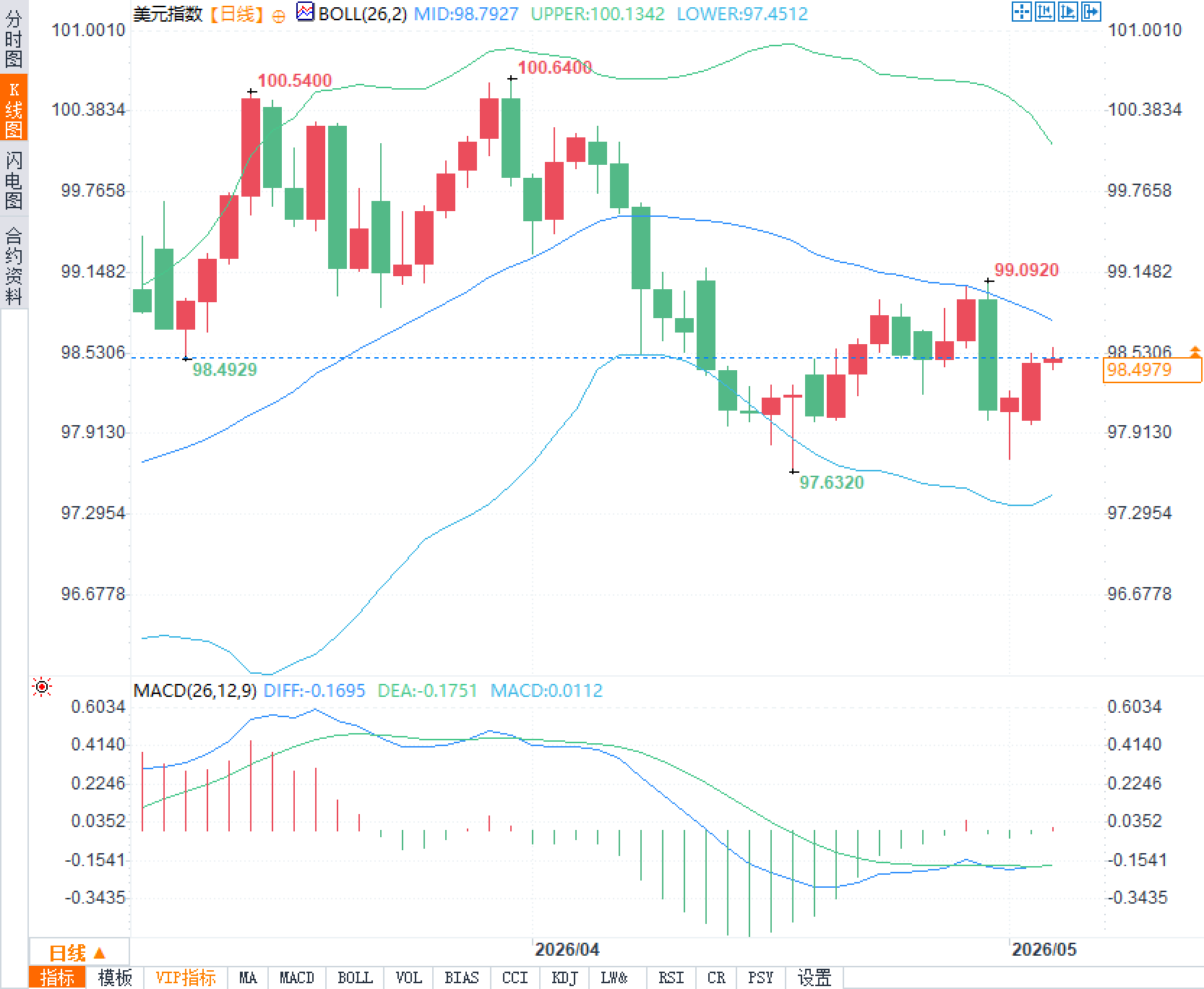
On Tuesday, May 5th, the US dollar index traded in a narrow range around 98.50 during the European session. This level is precisely below the Bollinger Band's middle line at 98.79. The candlestick chart shows a recent back-and-forth struggle between bulls and bears, with resistance near 99.09 and support around 97.63. On the fundamental front, the Federal Open Market Committee (FOMC) kept interest rates unchanged at the end of April, but the meeting minutes and officials' statements turned hawkish, causing the market to price in additional tightening in 2026 from zero to 6-7 basis points.
High oil prices continue to push up inflation expectations, further strengthening the short-term support for the US dollar. Traders are closely watching today's JOLTS job openings data, tomorrow's ADP employment report, and Friday's non-farm payroll data. These indicators will directly test whether the labor market remains resilient, thereby influencing the Federal Reserve's policy balance to tilt towards price stability.
From the daily chart, the US dollar index has entered a clear range-bound trading pattern since its high of 100.65. The upper Bollinger Band is at 100.13, and the lower band is at 97.45. The current price is between the middle and lower bands, indicating a narrowing bandwidth and suggesting potential increased volatility. The MACD indicator shows the DIFF line at -0.1695, the DEA line at -0.1751, and the MACD histogram at 0.0112. While there are signs of a short-term golden cross, the overall trend remains weak. In terms of candlestick patterns, the consecutive solid candlesticks with upper and lower shadows from late April to early May reflect bullish attempts to rebound but encountering resistance and falling back, while bears found some buying support around 98. This technical pattern resonates with the fundamentals, and the short-term direction depends on the upcoming macroeconomic data for confirmation.
ING analyst Chris Turner recently pointed out that the Federal Reserve's focus is shifting from easing to price stability, and the market has begun pricing in a possible small additional tightening in 2026. This shift stems from persistently high energy prices following last week's meeting, which has reignited inflation expectations. Turner emphasized, "The market is no longer just discussing delaying easing, but assessing whether the Fed will respond to inflation shocks with tighter policies." This has supported short-term Treasury yields, and consequently boosted the dollar index. Traders have noted that although the Fed has not yet explicitly raised interest rates, employment data has been highly volatile, and even a significant decline in non-farm payrolls may not be enough to reverse tightening expectations. This is highly consistent with the upward trend in market pricing based on inflation derivatives, highlighting the increasing weight of price stability in the Fed's dual mandate. Overall, this policy tilt provides a floor for the dollar.
Brent crude oil prices remained high at $113 per barrel, primarily driven by tensions in the Gulf region of the Middle East. Rising energy costs are directly impacting inflation expectations, forcing Federal Reserve policymakers to be more cautious. Turner believes that unless there are clear signs of easing geopolitical tensions, high oil prices will continue to support short-term US Treasury yields and maintain buying interest in the dollar. He expects this factor to push the dollar index towards the 99.00-99.50 range this week. A continued rise in the price component of the ISM Services PMI would further confirm inflationary pressures and reinforce market repricing of the Fed's policy path. This fundamental logic is clear and consistent, and is unlikely to be completely reversed by a single employment data point in the short term.
High oil prices continue to push up inflation expectations, further strengthening the short-term support for the US dollar. Traders are closely watching today's JOLTS job openings data, tomorrow's ADP employment report, and Friday's non-farm payroll data. These indicators will directly test whether the labor market remains resilient, thereby influencing the Federal Reserve's policy balance to tilt towards price stability.
Technical Characteristics and Recent Trends of the US Dollar Index
From the daily chart, the US dollar index has entered a clear range-bound trading pattern since its high of 100.65. The upper Bollinger Band is at 100.13, and the lower band is at 97.45. The current price is between the middle and lower bands, indicating a narrowing bandwidth and suggesting potential increased volatility. The MACD indicator shows the DIFF line at -0.1695, the DEA line at -0.1751, and the MACD histogram at 0.0112. While there are signs of a short-term golden cross, the overall trend remains weak. In terms of candlestick patterns, the consecutive solid candlesticks with upper and lower shadows from late April to early May reflect bullish attempts to rebound but encountering resistance and falling back, while bears found some buying support around 98. This technical pattern resonates with the fundamentals, and the short-term direction depends on the upcoming macroeconomic data for confirmation.
How does the Fed's hawkish narrative support the dollar exchange rate?
ING analyst Chris Turner recently pointed out that the Federal Reserve's focus is shifting from easing to price stability, and the market has begun pricing in a possible small additional tightening in 2026. This shift stems from persistently high energy prices following last week's meeting, which has reignited inflation expectations. Turner emphasized, "The market is no longer just discussing delaying easing, but assessing whether the Fed will respond to inflation shocks with tighter policies." This has supported short-term Treasury yields, and consequently boosted the dollar index. Traders have noted that although the Fed has not yet explicitly raised interest rates, employment data has been highly volatile, and even a significant decline in non-farm payrolls may not be enough to reverse tightening expectations. This is highly consistent with the upward trend in market pricing based on inflation derivatives, highlighting the increasing weight of price stability in the Fed's dual mandate. Overall, this policy tilt provides a floor for the dollar.
The impact of high oil prices and geopolitical factors on short-term interest rates
Brent crude oil prices remained high at $113 per barrel, primarily driven by tensions in the Gulf region of the Middle East. Rising energy costs are directly impacting inflation expectations, forcing Federal Reserve policymakers to be more cautious. Turner believes that unless there are clear signs of easing geopolitical tensions, high oil prices will continue to support short-term US Treasury yields and maintain buying interest in the dollar. He expects this factor to push the dollar index towards the 99.00-99.50 range this week. A continued rise in the price component of the ISM Services PMI would further confirm inflationary pressures and reinforce market repricing of the Fed's policy path. This fundamental logic is clear and consistent, and is unlikely to be completely reversed by a single employment data point in the short term.
Frequently Asked Questions
Question 1: Where is the US dollar index currently located, and what key factors are influencing it?
A: As of May 5, 2026, the US dollar index has been fluctuating steadily around 98.50. This level aligns with the technical equilibrium near the middle Bollinger Band and is also supported by two fundamental factors: first, the Federal Reserve's hawkish shift has priced in a slight tightening of 6 to 7 basis points in 2026; second, high oil prices, remaining around $113 per barrel, indirectly support short-term interest rates by pushing up inflation expectations. These two factors combined have enabled the dollar to demonstrate resilience in the recent tug-of-war between bulls and bears, avoiding the risk of a rapid decline.
Question 2: How do high oil prices specifically change the Federal Reserve's policy orientation and transmit to the US dollar?
A: High oil prices have directly increased market concerns about overall inflation, particularly the potential for accelerated increases in service sector prices. As a result, the Federal Reserve has shifted its policy focus towards price stability, reducing expectations of further easing and instead assessing the need for tighter policy to address shocks. This has led to higher short-term Treasury yields, providing support for the US dollar. Turner's analysis shows that unless geopolitical factors ease, this transmission chain will continue to function, providing upward momentum for the US dollar index.
- Risk Warning and Disclaimer
- The market involves risk, and trading may not be suitable for all investors. This article is for reference only and does not constitute personal investment advice, nor does it take into account certain users’ specific investment objectives, financial situation, or other needs. Any investment decisions made based on this information are at your own risk.