Gold prices rebounded after easing geopolitical tensions and a weakening dollar.
2026-05-06 10:01:03
Gold prices maintained a slightly bullish trend during Wednesday's Asian trading session, trading around $4,625. The core factors driving the price increase were the continued tensions in the Middle East and a temporary weakening of the US dollar. With the struggle between the US and Iran over control of key energy routes still ongoing, market demand for safe-haven assets remained relatively resilient.

U.S. Defense Secretary Peter Hegsays said the ceasefire with Iran "is not over."
This statement reinforced market expectations that the conflict might recur, and the dollar weakened after the announcement, providing support for dollar-denominated gold. Typically, a weaker dollar lowers the cost of holding gold, thereby attracting funds into the precious metals market.
However, despite support for gold prices, the upside potential has not fully materialized. The situation in the Middle East remains highly complex, with expectations of a ceasefire on one hand, while conflict continues on the other. Public information indicates that ship clashes occurred near the Strait of Hormuz, and the UAE was attacked by missiles and drones. The UAE stated that it successfully intercepted approximately 20 incoming targets, and regional security risks remain high .
The Strait of Hormuz handles approximately 20% of global seaborne crude oil transport , and its stability directly impacts the global energy market. Further escalation of the situation could push up inflation expectations, indirectly affecting gold prices. However, if the conflict eases, safe-haven demand may decrease, putting downward pressure on gold prices.
From a market structure perspective, the current gold price movement exhibits a coexistence of "safe-haven support and a tug-of-war between policy expectations." Investors are focused on geopolitical risks on one hand, and on the other hand, they are paying close attention to the impact of US macroeconomic data on interest rate paths. Market focus is gradually shifting to the upcoming employment data.
Market expectations suggest that the US will add approximately 60,000 jobs in April, with the unemployment rate projected to remain around 4.3%. Slower job growth could strengthen market expectations of a shift in interest rate policy, thus benefiting gold; conversely, strong data could put downward pressure on gold prices.
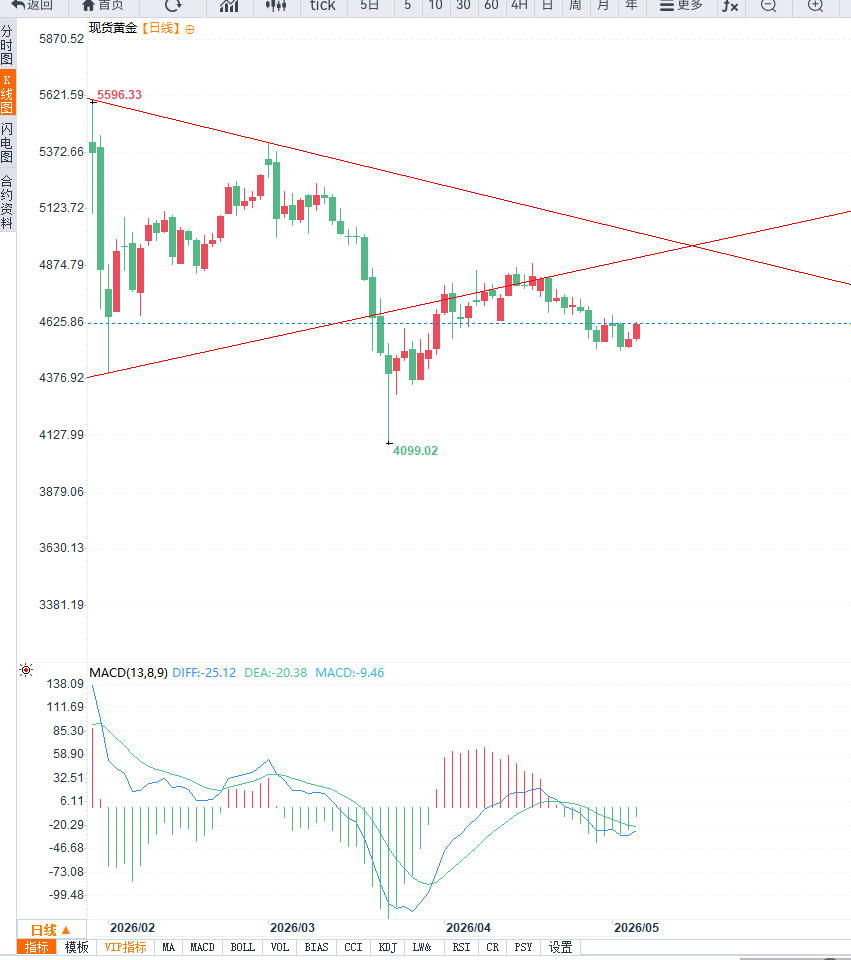
From a technical perspective, gold's daily chart maintains a high-level consolidation and upward trend, with an overall bullish bias, although upward momentum has weakened. Currently, the price is trading above the key psychological level of $4600, with short-term resistance levels at $4650 and $4700, and support concentrated in the $4550 and $4500 range. A sustained hold above $4600 could open up further upside potential, but a break below $4550 could trigger a period of consolidation.
On the 4-hour chart, gold is exhibiting an upward-trending pattern, but short-term momentum is diverging. The moving average system is converging, indicating that the market direction is still unclear. The MACD indicator is near the zero line, suggesting a relative balance between bullish and bearish forces. A short-term break above $4650 could trigger a new round of bullish momentum; conversely, a drop below $4500 could trigger a technical correction.
Editor's Summary:
The gold market is currently in a phase of intertwined factors. On the one hand, uncertainty surrounding the Middle East situation provides safe-haven support for gold prices; on the other hand, employment data and interest rate expectations are key factors determining the medium-term trend. The dollar's performance and interest rate expectations remain the core variables influencing gold prices. If weaker economic data prompts a policy shift, gold is likely to continue its strong performance; however, if risk sentiment cools and data is strong, gold prices may come under pressure. Overall, gold is expected to fluctuate with a slight upward bias in the short term, while its medium-term trend will still depend on the combined evolution of macroeconomic and geopolitical factors.
U.S. Defense Secretary Peter Hegsays said the ceasefire with Iran "is not over."
This statement reinforced market expectations that the conflict might recur, and the dollar weakened after the announcement, providing support for dollar-denominated gold. Typically, a weaker dollar lowers the cost of holding gold, thereby attracting funds into the precious metals market.
However, despite support for gold prices, the upside potential has not fully materialized. The situation in the Middle East remains highly complex, with expectations of a ceasefire on one hand, while conflict continues on the other. Public information indicates that ship clashes occurred near the Strait of Hormuz, and the UAE was attacked by missiles and drones. The UAE stated that it successfully intercepted approximately 20 incoming targets, and regional security risks remain high .
The Strait of Hormuz handles approximately 20% of global seaborne crude oil transport , and its stability directly impacts the global energy market. Further escalation of the situation could push up inflation expectations, indirectly affecting gold prices. However, if the conflict eases, safe-haven demand may decrease, putting downward pressure on gold prices.
From a market structure perspective, the current gold price movement exhibits a coexistence of "safe-haven support and a tug-of-war between policy expectations." Investors are focused on geopolitical risks on one hand, and on the other hand, they are paying close attention to the impact of US macroeconomic data on interest rate paths. Market focus is gradually shifting to the upcoming employment data.
Market expectations suggest that the US will add approximately 60,000 jobs in April, with the unemployment rate projected to remain around 4.3%. Slower job growth could strengthen market expectations of a shift in interest rate policy, thus benefiting gold; conversely, strong data could put downward pressure on gold prices.
From a technical perspective, gold's daily chart maintains a high-level consolidation and upward trend, with an overall bullish bias, although upward momentum has weakened. Currently, the price is trading above the key psychological level of $4600, with short-term resistance levels at $4650 and $4700, and support concentrated in the $4550 and $4500 range. A sustained hold above $4600 could open up further upside potential, but a break below $4550 could trigger a period of consolidation.
On the 4-hour chart, gold is exhibiting an upward-trending pattern, but short-term momentum is diverging. The moving average system is converging, indicating that the market direction is still unclear. The MACD indicator is near the zero line, suggesting a relative balance between bullish and bearish forces. A short-term break above $4650 could trigger a new round of bullish momentum; conversely, a drop below $4500 could trigger a technical correction.
Editor's Summary:
The gold market is currently in a phase of intertwined factors. On the one hand, uncertainty surrounding the Middle East situation provides safe-haven support for gold prices; on the other hand, employment data and interest rate expectations are key factors determining the medium-term trend. The dollar's performance and interest rate expectations remain the core variables influencing gold prices. If weaker economic data prompts a policy shift, gold is likely to continue its strong performance; however, if risk sentiment cools and data is strong, gold prices may come under pressure. Overall, gold is expected to fluctuate with a slight upward bias in the short term, while its medium-term trend will still depend on the combined evolution of macroeconomic and geopolitical factors.
- Risk Warning and Disclaimer
- The market involves risk, and trading may not be suitable for all investors. This article is for reference only and does not constitute personal investment advice, nor does it take into account certain users’ specific investment objectives, financial situation, or other needs. Any investment decisions made based on this information are at your own risk.