The Fed's dual mandate constrains the path of interest rate hikes, and the dollar index continues its correction.
2026-05-06 13:33:51
According to APP, Jim Smigel, chief investment officer of SEI, pointed out in a recent report that given the Federal Reserve's dual mandate of full employment and price stability, the likelihood of a direct and significant interest rate hike in the current economic environment is low, as such a move could have a significant negative impact on economic growth and the labor market.

Jim Smigel recently commented on the direction of global monetary policy, saying, "Our bias towards higher inflation remains, and the lasting effects of war are likely to persist, even if a ceasefire is implemented." He emphasized that the global economy faces challenges, but he still believes in its resilience. While the risk of recession is rising in 2026, a full-blown downturn is expected to be avoided, and he maintains a positive outlook on risk assets and commodities.
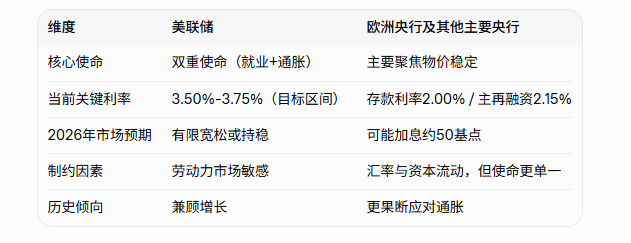
The Federal Reserve's dual mandate requires it to balance employment and inflation in its decision-making, which limits its room for aggressive rate hikes should any signs of weakness emerge in the labor market. Currently, the Fed's target federal funds rate remains stable at 3.50%-3.75%, unchanged since the end of 2025, and market expectations for further easing in 2026 have cooled significantly.
In contrast, other major central banks, such as the European Central Bank, have a more pronounced statutory objective focused on price stability, which provides them with greater policy flexibility in the face of persistent inflationary pressures. The ECB's deposit rate is currently 2.00%, and its main refinancing rate is 2.15%, both of which have remained unchanged recently. However, the market has begun pricing in a potential rate hike of around 50 basis points in 2026 to address a rebound in energy-driven inflation.
The following table compares the current policy frameworks and potential paths of the two central banks:
Despite differing missions, global central banks are unlikely to experience significant policy divergences from the Federal Reserve. Analysts such as Jim Smigel point out that substantial deviations in policy paths across other regions could trigger sharp fluctuations in exchange rates and instability in capital markets. Excessive appreciation of local currencies could weaken export competitiveness, while a reversal in capital flows could amplify financial risks.
In open economies, the US dollar's status as the benchmark currency means that the trends of US Treasury yields and the US dollar index remain important anchors for global policy. Historically, during the tightening cycle of 2022-2023, while major central banks took different steps, they generally followed the Federal Reserve's shift.
This policy divergence could have multiple impacts on global asset allocation. The Federal Reserve's cautious stance may support the short-term performance of risk assets, while potential interest rate hikes by other central banks could push up local bond yields and affect capital flows to emerging markets. Investors need to pay attention to how geopolitical factors (such as energy prices) amplify inflation differences, further testing central bank independence.
Editor's Summary:
The Federal Reserve's dual mandate makes it more cautious in its interest rate decisions, while other major central banks with relatively singular mandates have more room to maneuver under inflationary pressures. However, the interconnectedness of global finance necessitates policy coordination to avoid excessive volatility in exchange rates and capital markets. The path of monetary policy in 2026 will depend on the evolution of inflation data and the extent to which external shocks dissipate; market participants should maintain flexible asset allocation.
Jim Smigel recently commented on the direction of global monetary policy, saying, "Our bias towards higher inflation remains, and the lasting effects of war are likely to persist, even if a ceasefire is implemented." He emphasized that the global economy faces challenges, but he still believes in its resilience. While the risk of recession is rising in 2026, a full-blown downturn is expected to be avoided, and he maintains a positive outlook on risk assets and commodities.
The Federal Reserve's dual mandate requires it to balance employment and inflation in its decision-making, which limits its room for aggressive rate hikes should any signs of weakness emerge in the labor market. Currently, the Fed's target federal funds rate remains stable at 3.50%-3.75%, unchanged since the end of 2025, and market expectations for further easing in 2026 have cooled significantly.
In contrast, other major central banks, such as the European Central Bank, have a more pronounced statutory objective focused on price stability, which provides them with greater policy flexibility in the face of persistent inflationary pressures. The ECB's deposit rate is currently 2.00%, and its main refinancing rate is 2.15%, both of which have remained unchanged recently. However, the market has begun pricing in a potential rate hike of around 50 basis points in 2026 to address a rebound in energy-driven inflation.
The following table compares the current policy frameworks and potential paths of the two central banks:
Despite differing missions, global central banks are unlikely to experience significant policy divergences from the Federal Reserve. Analysts such as Jim Smigel point out that substantial deviations in policy paths across other regions could trigger sharp fluctuations in exchange rates and instability in capital markets. Excessive appreciation of local currencies could weaken export competitiveness, while a reversal in capital flows could amplify financial risks.
In open economies, the US dollar's status as the benchmark currency means that the trends of US Treasury yields and the US dollar index remain important anchors for global policy. Historically, during the tightening cycle of 2022-2023, while major central banks took different steps, they generally followed the Federal Reserve's shift.
This policy divergence could have multiple impacts on global asset allocation. The Federal Reserve's cautious stance may support the short-term performance of risk assets, while potential interest rate hikes by other central banks could push up local bond yields and affect capital flows to emerging markets. Investors need to pay attention to how geopolitical factors (such as energy prices) amplify inflation differences, further testing central bank independence.
Editor's Summary:
The Federal Reserve's dual mandate makes it more cautious in its interest rate decisions, while other major central banks with relatively singular mandates have more room to maneuver under inflationary pressures. However, the interconnectedness of global finance necessitates policy coordination to avoid excessive volatility in exchange rates and capital markets. The path of monetary policy in 2026 will depend on the evolution of inflation data and the extent to which external shocks dissipate; market participants should maintain flexible asset allocation.
- Risk Warning and Disclaimer
- The market involves risk, and trading may not be suitable for all investors. This article is for reference only and does not constitute personal investment advice, nor does it take into account certain users’ specific investment objectives, financial situation, or other needs. Any investment decisions made based on this information are at your own risk.