Oil prices plunge 8% in a single day! The US and Iran have reached 14 agreements; watch the next 48 hours.
2026-05-06 18:04:35
On Wednesday (May 6), news of significant progress in US-Iran negotiations caused international oil prices to plummet, and the geopolitical risk premium accumulated earlier due to tensions in the Strait of Hormuz quickly subsided.
As of the European trading session on May 6, Brent crude oil futures prices plummeted by more than 7%, falling to near the key psychological level of $102 at one point during the session, while WTI crude oil futures fell below $100, experiencing their largest drop in 8% in 2018, hitting a low of $94.32 per barrel.
According to an exclusive report by Axios on May 6, the United States and Iran are close to reaching a one-page ceasefire memorandum, the closest they have come to a peace agreement since the outbreak of hostilities.
Pakistani sources have confirmed the news.
The memorandum contains 14 core provisions, the core of which is that Iran will suspend its uranium enrichment activities, the United States will lift sanctions against Iran and unfreeze billions of dollars of its frozen assets, and both sides will lift the restrictions on passage through the Strait of Hormuz.
The report indicates that the memorandum was jointly negotiated by U.S. representatives Witkov and Kushner and Iranian officials through direct communication and mediation. It will announce a ceasefire and begin 30 days of in-depth negotiations to discuss key issues such as the opening of the Strait of Hormuz, the control of Iran's nuclear program, and the withdrawal of U.S. sanctions. The negotiation location is tentatively set in Islamabad or Geneva.
The US expects Iran to give a formal response on several key differences within the next 48 hours. Although no final agreement has been reached yet, the negotiations have entered a substantive phase.
It is worth noting that the memorandum clearly outlines a timetable for the two-way lifting of restrictions: both sides will gradually lift the restrictions on shipping across the Taiwan Strait and the US blockade during the negotiation period;
If negotiations fail, the U.S. military can reinstate the blockade or launch military operations. This "safety valve" clause provides necessary safeguards for negotiations and also provides the market with a clear risk expectation boundary.
The breakthrough in negotiations was not unexpected; both sides had previously released a series of conciliatory signals, laying the foundation for a final agreement.
On May 5, US President Trump announced on TruthSocial that, given the “significant progress” in the US-Iran agreement, the US would temporarily suspend the “Freedom Program,” but emphasized that the naval blockade would remain fully effective.
This move was interpreted by the market as an important diplomatic signal from the US – while maintaining maritime pressure on Iran, it suspended military escort operations aimed at guiding ships through the Strait of Hormuz, creating space for diplomatic negotiations.
Trump stated that the move was to observe whether an agreement could ultimately be reached and signed, while reiterating that Iran still had the desire to reach an agreement, but expressed dissatisfaction with its "two-faced approach" of inconsistent public statements and closed-door negotiations.
At the same time, Iran also took corresponding action, officially launching a new mechanism for managing maritime traffic in the Strait of Hormuz.
Under this mechanism, all vessels intending to pass through the strait will receive an email from the official email address info@PGSA.ir outlining the rules and regulations for passage. Vessels will need to adjust their operations and obtain a passage permit before passing through.
Iran has emphasized that this sovereign governance initiative has been put into operation in the Strait of Hormuz, which has been under Iranian control since the early stages of the war.
In addition, Haji Mirzai, chief of staff of the Iranian president, explicitly denied rumors on the 5th that there was a disagreement between President Pezechzian and the commander of the Iranian Islamic Revolutionary Guard Corps, saying that all decisions were made in unison, further alleviating market concerns about internal political instability in Iran.
In addition to the crude oil market, global financial markets also reacted strongly to the progress of the US-Iran negotiations:
In the stock market, the Stoxx Europe 600 index surged, closing up 2.2% on the day, with cyclical sectors such as banking and mining leading the gains, reflecting improved market expectations for global economic growth.
The oil and gas energy sector bucked the trend and closed lower, becoming one of the few sectors to decline in the market, in stark contrast to the trend of oil prices.
The bond market saw a broad-based bullish rally, with the benchmark 10-year US Treasury yield falling 6 basis points to 4.35%. European bonds, which had been weakening previously, led the global fixed-income market in this round of recovery, with the German 10-year bond yield falling 7.5 basis points to 2.99%, and the more interest-rate-sensitive two-year yield dropping 10 basis points to 2.658%. The market significantly reduced its bets on the European Central Bank's interest rate hike path and magnitude this year.
The yields on British and Italian bonds fell further, dropping 10 and 12.5 basis points respectively during the day, reflecting a significant increase in market risk appetite.
In the foreign exchange market, the US dollar came under pressure and fell across the board, while the euro and the pound sterling appreciated by 0.6% against the dollar, with their exchange rates stabilizing at 1.1762 and 1.3618 respectively.
The core reason for the weakening dollar lies in the rising market expectations for a Federal Reserve rate cut, as well as the outflow of safe-haven funds due to the easing of geopolitical risks.
Currently, neither the US nor Iran has officially disclosed the details of the matter. However, based on cross-verification, the market has chosen to believe it for now. Previous articles, starting from first principles, have pointed out the logic of easing geopolitical risks in advance. They mentioned that the risk of mines being removed, Israel's threat to help the US increase its leverage, and Iran's tough stance were all likely to serve the purpose of peace talks. Ultimately, the market revealed the news of peace talks.
After a short-term plunge, oil prices are likely to rebound once they stabilize. The current 48-hour period is a window for both sides to fill in the details, and it is also a window for significant oil price fluctuations.
From a technical perspective, the Brent July futures contract broke below the 5-day moving average and the key support level around 108.5, falling directly to the 0.768 Fibonacci retracement level of this recent rally. Current support is around 103, meaning the price is expected to fluctuate around this level in the short term. Resistance levels are around 108.5 and 105.
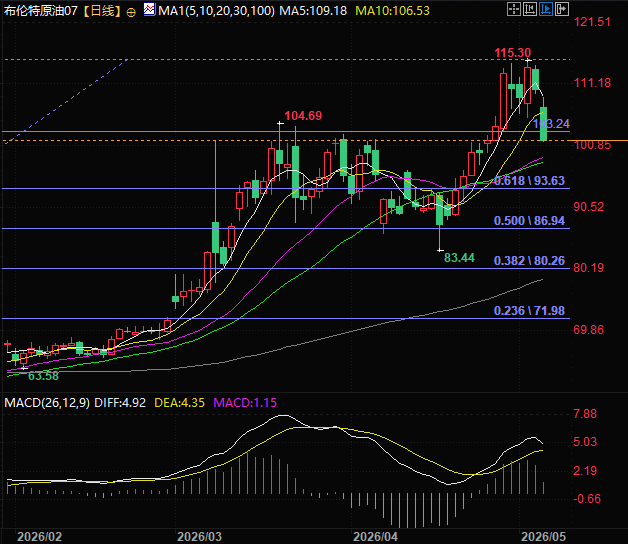
(Brent crude oil July contract daily chart, source: EasyForex)
At 17:58 Beijing time, the Brent crude oil July contract was trading at $102.44 per barrel.
As of the European trading session on May 6, Brent crude oil futures prices plummeted by more than 7%, falling to near the key psychological level of $102 at one point during the session, while WTI crude oil futures fell below $100, experiencing their largest drop in 8% in 2018, hitting a low of $94.32 per barrel.
According to an exclusive report by Axios on May 6, the United States and Iran are close to reaching a one-page ceasefire memorandum, the closest they have come to a peace agreement since the outbreak of hostilities.
Pakistani sources have confirmed the news.
The memorandum contains 14 core provisions, the core of which is that Iran will suspend its uranium enrichment activities, the United States will lift sanctions against Iran and unfreeze billions of dollars of its frozen assets, and both sides will lift the restrictions on passage through the Strait of Hormuz.
The report indicates that the memorandum was jointly negotiated by U.S. representatives Witkov and Kushner and Iranian officials through direct communication and mediation. It will announce a ceasefire and begin 30 days of in-depth negotiations to discuss key issues such as the opening of the Strait of Hormuz, the control of Iran's nuclear program, and the withdrawal of U.S. sanctions. The negotiation location is tentatively set in Islamabad or Geneva.
The US expects Iran to give a formal response on several key differences within the next 48 hours. Although no final agreement has been reached yet, the negotiations have entered a substantive phase.
It is worth noting that the memorandum clearly outlines a timetable for the two-way lifting of restrictions: both sides will gradually lift the restrictions on shipping across the Taiwan Strait and the US blockade during the negotiation period;
If negotiations fail, the U.S. military can reinstate the blockade or launch military operations. This "safety valve" clause provides necessary safeguards for negotiations and also provides the market with a clear risk expectation boundary.
Key groundwork laid before negotiations: US suspends "Freedom Project," Iran activates new Straits management mechanism.
The breakthrough in negotiations was not unexpected; both sides had previously released a series of conciliatory signals, laying the foundation for a final agreement.
On May 5, US President Trump announced on TruthSocial that, given the “significant progress” in the US-Iran agreement, the US would temporarily suspend the “Freedom Program,” but emphasized that the naval blockade would remain fully effective.
This move was interpreted by the market as an important diplomatic signal from the US – while maintaining maritime pressure on Iran, it suspended military escort operations aimed at guiding ships through the Strait of Hormuz, creating space for diplomatic negotiations.
Trump stated that the move was to observe whether an agreement could ultimately be reached and signed, while reiterating that Iran still had the desire to reach an agreement, but expressed dissatisfaction with its "two-faced approach" of inconsistent public statements and closed-door negotiations.
At the same time, Iran also took corresponding action, officially launching a new mechanism for managing maritime traffic in the Strait of Hormuz.
Under this mechanism, all vessels intending to pass through the strait will receive an email from the official email address info@PGSA.ir outlining the rules and regulations for passage. Vessels will need to adjust their operations and obtain a passage permit before passing through.
Iran has emphasized that this sovereign governance initiative has been put into operation in the Strait of Hormuz, which has been under Iranian control since the early stages of the war.
In addition, Haji Mirzai, chief of staff of the Iranian president, explicitly denied rumors on the 5th that there was a disagreement between President Pezechzian and the commander of the Iranian Islamic Revolutionary Guard Corps, saying that all decisions were made in unison, further alleviating market concerns about internal political instability in Iran.
Global financial markets: Stocks and bonds strengthened in tandem, while the US dollar index weakened.
In addition to the crude oil market, global financial markets also reacted strongly to the progress of the US-Iran negotiations:
In the stock market, the Stoxx Europe 600 index surged, closing up 2.2% on the day, with cyclical sectors such as banking and mining leading the gains, reflecting improved market expectations for global economic growth.
The oil and gas energy sector bucked the trend and closed lower, becoming one of the few sectors to decline in the market, in stark contrast to the trend of oil prices.
The bond market saw a broad-based bullish rally, with the benchmark 10-year US Treasury yield falling 6 basis points to 4.35%. European bonds, which had been weakening previously, led the global fixed-income market in this round of recovery, with the German 10-year bond yield falling 7.5 basis points to 2.99%, and the more interest-rate-sensitive two-year yield dropping 10 basis points to 2.658%. The market significantly reduced its bets on the European Central Bank's interest rate hike path and magnitude this year.
The yields on British and Italian bonds fell further, dropping 10 and 12.5 basis points respectively during the day, reflecting a significant increase in market risk appetite.
In the foreign exchange market, the US dollar came under pressure and fell across the board, while the euro and the pound sterling appreciated by 0.6% against the dollar, with their exchange rates stabilizing at 1.1762 and 1.3618 respectively.
The core reason for the weakening dollar lies in the rising market expectations for a Federal Reserve rate cut, as well as the outflow of safe-haven funds due to the easing of geopolitical risks.
Summary and Technical Analysis:
Currently, neither the US nor Iran has officially disclosed the details of the matter. However, based on cross-verification, the market has chosen to believe it for now. Previous articles, starting from first principles, have pointed out the logic of easing geopolitical risks in advance. They mentioned that the risk of mines being removed, Israel's threat to help the US increase its leverage, and Iran's tough stance were all likely to serve the purpose of peace talks. Ultimately, the market revealed the news of peace talks.
After a short-term plunge, oil prices are likely to rebound once they stabilize. The current 48-hour period is a window for both sides to fill in the details, and it is also a window for significant oil price fluctuations.
From a technical perspective, the Brent July futures contract broke below the 5-day moving average and the key support level around 108.5, falling directly to the 0.768 Fibonacci retracement level of this recent rally. Current support is around 103, meaning the price is expected to fluctuate around this level in the short term. Resistance levels are around 108.5 and 105.
(Brent crude oil July contract daily chart, source: EasyForex)
At 17:58 Beijing time, the Brent crude oil July contract was trading at $102.44 per barrel.
- Risk Warning and Disclaimer
- The market involves risk, and trading may not be suitable for all investors. This article is for reference only and does not constitute personal investment advice, nor does it take into account certain users’ specific investment objectives, financial situation, or other needs. Any investment decisions made based on this information are at your own risk.