A Framework for Analyzing Gold Prices Amid Rising Expectations of US-Iran Peace Talks
2026-05-06 18:51:29
On Wednesday (May 6), spot gold rebounded sharply during the Asian and European sessions, currently trading around 4698, up 3%, following confirmation from Pakistan that the US and Iran may sign a memorandum to end the war. Reports indicate that the memorandum explicitly resolves the issue of passage through the Strait of Hormuz.
The news continues the logic of smoother passage through the Strait of Hormuz recently. This article focuses on the performance of the gold market against the backdrop of the US-Israeli airstrikes on Iran, analyzes the different timing characteristics of gold and the US dollar as safe-haven assets, reviews the declining trend of the US dollar's share in global central bank reserves, and briefly explains the analytical framework for gold.
Gold typically doesn't react explosively to geopolitical events, but rather to the anticipation of them. Institutional capital quietly begins accumulating gold as intelligence signals, diplomatic breakdowns, or troop movements spread through institutional channels, and by the time the conflict becomes confirmed news, most of the positions have already been established.
The US dollar exhibits the opposite timing characteristics. During the speculative phase before the Iranian airstrikes, the currency market was almost stagnant, but the dollar surged after the conflict was confirmed. Gold is an asset accumulated before the conflict, while the dollar is a safe-haven asset activated after the event. The two often move in opposite directions during the same event.
Inflationary expectations lowered the cost of holding gold, and the delayed interest rate cuts reinforced this trend. Meanwhile, the 10-year US Treasury yield exceeded 4%, and the US dollar index once broke through 100, which put significant pressure on gold prices. Instead of a surge, gold prices fell.
The US dollar remains the primary safe-haven currency, but its share of reserves has fallen from 78% at the beginning of this century to 50%, and if it falls below the threshold, it may accelerate its decline (similar to the trend of the pound after the Suez crisis).
The resilience of the US dollar as a trading currency is weakening, and a bipolar reserve system may emerge in the future, with gold becoming a hedging tool, a neutral bridging asset, and a reserve anchor.
Global central bank gold reserves are at their highest level this century, with purchases aimed at diversifying dollar risk. As diversification goals become increasingly similar, the momentum for gold purchases will slow.
Gold's high liquidity makes it vulnerable to forced selling during crises. Historically, central banks have sold gold on a large scale. Although current conditions are different, their attitudes are not static.
Gold's extremely high liquidity actually brings a reverse risk: when portfolio managers or sovereign wealth funds face sudden liquidity needs, they will prioritize selling assets with the largest unrealized gains rather than those with poor performance.
The current environment bears a striking structural resemblance to that of 1979-1980: the Tehran hostage crisis in the late 1970s, the failed military rescue operation, and the Soviet invasion of Afghanistan all combined to create a perception of continued damage to the United States’ reputation, driving capital toward gold and away from dollar-denominated assets.
The core difference lies in the mode of action: the US-Israeli military action against Iran in 2026 did not establish a multilateral alliance like previous major US military actions. Achieving military objectives without the support of allies may partially restore military prestige, but it cannot bring the diplomatic dividend that has historically translated into increased global confidence in dollar-denominated assets.
It remains questionable whether allies who were not consulted or included in the alliance will increase their dollar reserves after a successful military operation, and unilateral military success will not automatically restore the trust and institutional relationships that drive decisions on sovereign reserve allocation.
The two are not interchangeable: gold has low storage costs, is a central bank reserve asset, has moderate volatility, and has the potential for tokenization;
Silver has industrial attributes and is rarely regarded as a reserve commodity because its unit price is low, its storage space is large, its volatility is higher, and 75%-80% of its supply is a by-product of metal mining, resulting in weak price signals and easily amplified volatility.
Gold is highly sensitive to interest rates. At present, the weakening of the US dollar's credit and the reduction in global demand for the US dollar as a reserve currency have further boosted the value of gold as a reserve currency. Currently, the decline in oil prices has constrained inflation expectations, causing a sharp drop in US Treasury yields. Lower interest rates are conducive to a rebound in gold prices.
From a technical perspective, the key resistance level for spot gold is at 4744, which is the 0.768 Fibonacci retracement level of the rise from 1614. Support is around 4650.
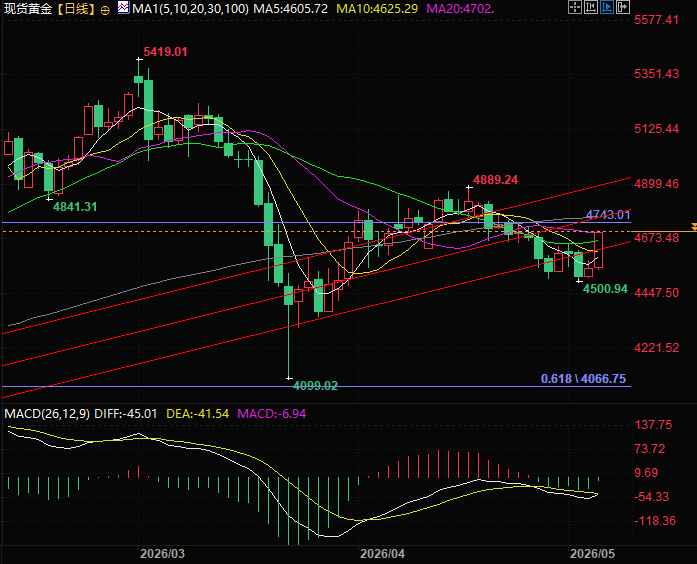
(Spot gold daily chart, source: EasyForex subsidiary)
At 18:48 Beijing time, spot gold was trading at $4,713 per ounce.
The news continues the logic of smoother passage through the Strait of Hormuz recently. This article focuses on the performance of the gold market against the backdrop of the US-Israeli airstrikes on Iran, analyzes the different timing characteristics of gold and the US dollar as safe-haven assets, reviews the declining trend of the US dollar's share in global central bank reserves, and briefly explains the analytical framework for gold.
Differences in the timing of safe-haven investments between gold and the US dollar
Gold typically doesn't react explosively to geopolitical events, but rather to the anticipation of them. Institutional capital quietly begins accumulating gold as intelligence signals, diplomatic breakdowns, or troop movements spread through institutional channels, and by the time the conflict becomes confirmed news, most of the positions have already been established.
The US dollar exhibits the opposite timing characteristics. During the speculative phase before the Iranian airstrikes, the currency market was almost stagnant, but the dollar surged after the conflict was confirmed. Gold is an asset accumulated before the conflict, while the dollar is a safe-haven asset activated after the event. The two often move in opposite directions during the same event.
Gold Price Drivers and Constraints
Inflationary expectations lowered the cost of holding gold, and the delayed interest rate cuts reinforced this trend. Meanwhile, the 10-year US Treasury yield exceeded 4%, and the US dollar index once broke through 100, which put significant pressure on gold prices. Instead of a surge, gold prices fell.
Changes in the US Dollar Reserve Status
The US dollar remains the primary safe-haven currency, but its share of reserves has fallen from 78% at the beginning of this century to 50%, and if it falls below the threshold, it may accelerate its decline (similar to the trend of the pound after the Suez crisis).
The resilience of the US dollar as a trading currency is weakening, and a bipolar reserve system may emerge in the future, with gold becoming a hedging tool, a neutral bridging asset, and a reserve anchor.
Central bank gold purchases and potential risks
Global central bank gold reserves are at their highest level this century, with purchases aimed at diversifying dollar risk. As diversification goals become increasingly similar, the momentum for gold purchases will slow.
Gold's high liquidity makes it vulnerable to forced selling during crises. Historically, central banks have sold gold on a large scale. Although current conditions are different, their attitudes are not static.
Gold's extremely high liquidity actually brings a reverse risk: when portfolio managers or sovereign wealth funds face sudden liquidity needs, they will prioritize selling assets with the largest unrealized gains rather than those with poor performance.
Geopolitical similarities and differences between 2026 and 1979
The current environment bears a striking structural resemblance to that of 1979-1980: the Tehran hostage crisis in the late 1970s, the failed military rescue operation, and the Soviet invasion of Afghanistan all combined to create a perception of continued damage to the United States’ reputation, driving capital toward gold and away from dollar-denominated assets.
The core difference lies in the mode of action: the US-Israeli military action against Iran in 2026 did not establish a multilateral alliance like previous major US military actions. Achieving military objectives without the support of allies may partially restore military prestige, but it cannot bring the diplomatic dividend that has historically translated into increased global confidence in dollar-denominated assets.
It remains questionable whether allies who were not consulted or included in the alliance will increase their dollar reserves after a successful military operation, and unilateral military success will not automatically restore the trust and institutional relationships that drive decisions on sovereign reserve allocation.
Differences between the gold and silver markets
The two are not interchangeable: gold has low storage costs, is a central bank reserve asset, has moderate volatility, and has the potential for tokenization;
Silver has industrial attributes and is rarely regarded as a reserve commodity because its unit price is low, its storage space is large, its volatility is higher, and 75%-80% of its supply is a by-product of metal mining, resulting in weak price signals and easily amplified volatility.
Summary and Technical Analysis:
Gold is highly sensitive to interest rates. At present, the weakening of the US dollar's credit and the reduction in global demand for the US dollar as a reserve currency have further boosted the value of gold as a reserve currency. Currently, the decline in oil prices has constrained inflation expectations, causing a sharp drop in US Treasury yields. Lower interest rates are conducive to a rebound in gold prices.
From a technical perspective, the key resistance level for spot gold is at 4744, which is the 0.768 Fibonacci retracement level of the rise from 1614. Support is around 4650.
(Spot gold daily chart, source: EasyForex subsidiary)
At 18:48 Beijing time, spot gold was trading at $4,713 per ounce.
- Risk Warning and Disclaimer
- The market involves risk, and trading may not be suitable for all investors. This article is for reference only and does not constitute personal investment advice, nor does it take into account certain users’ specific investment objectives, financial situation, or other needs. Any investment decisions made based on this information are at your own risk.