Easing inflation concerns are fueling expectations of a Federal Reserve rate cut, and gold is poised to return to bullish territory.
2026-05-07 09:23:18
Spot gold (XAU/USD) continued its upward trend in early Asian trading on Thursday, briefly touching around $4,700, a new high in a week. Improved market risk sentiment and rising expectations of future interest rate cuts by the Federal Reserve were the main drivers of the gold price increase.

The United States and Iran are negotiating a new peace agreement as President Trump seeks a swift end to the current conflict to alleviate the pressure of rising energy prices on the economy and markets. Trump stated that the conflict is "very likely to end," and progress could even be made before his visit to the capital of a major Asian power next week.
As market expectations for a de-escalation of tensions in the Middle East strengthen, investor concerns about global energy supply disruptions and persistently rising inflation have significantly decreased. Previously, tensions in the Middle East had driven international oil prices up rapidly and exacerbated market anxieties about a resurgence of global inflation.
The market generally believes that if energy price pressures ease, the Federal Reserve's need to maintain a long-term high-interest-rate policy may diminish. Against this backdrop, the market is increasing its bets on future Fed rate cuts, and lower interest rates typically reduce the opportunity cost of holding gold, thus benefiting gold prices.
As a typical non-interest-bearing asset, gold tends to attract more funds during periods of declining interest rates. The recent slowdown in the dollar's upward momentum, coupled with a decline in US Treasury yields, has further improved overall sentiment in the gold market.
Peter Grant, Vice President and Senior Precious Metals Strategist at Zener Metals, said: "The market's optimistic expectations for a final agreement between the United States and Iran have at least eased some of the safe-haven sentiment in the gold market in the short term, but news related to the situation in the Middle East could still change the market's direction at any time."
Despite short-term support for gold prices from expectations of interest rate cuts, the market remains cautious. Investors are currently awaiting Friday's release of US April jobs data, which could directly influence the Federal Reserve's next monetary policy path.
If the US job market continues to be strong, it could reinforce market expectations that the Federal Reserve will postpone interest rate cuts, thereby driving a rebound in the dollar and putting pressure on dollar-denominated gold. Conversely, if the jobs data is weak, it could further strengthen market bets on interest rate cuts, pushing gold prices higher.
From a global market perspective, international demand for safe-haven assets remains high in the near term. Although market risk sentiment has improved somewhat, slowing global economic growth, geopolitical uncertainties, and debt pressures on major economies continue to provide long-term support for gold.
The core logic of the current gold market has gradually shifted from simple safe-haven demand to the interplay between "interest rate cut expectations" and "dollar performance".
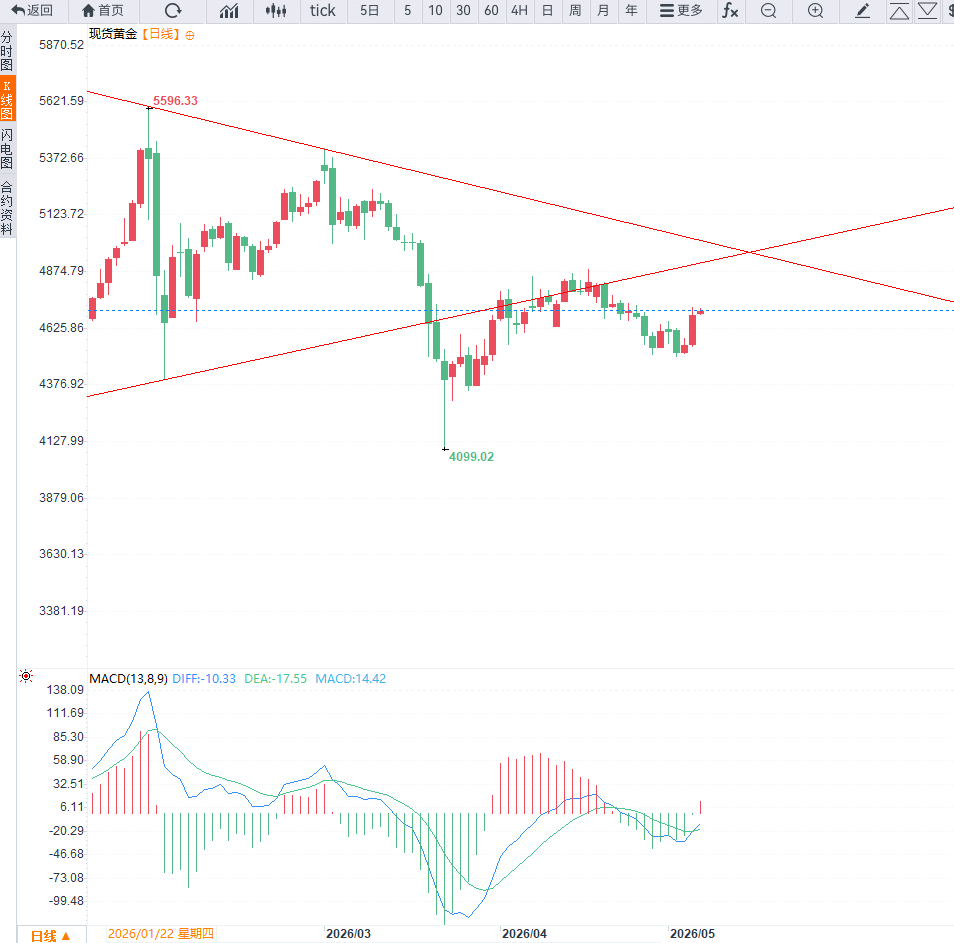
From a technical perspective, gold maintains a strong upward trend on the daily chart. After stabilizing above $4600, bullish momentum has clearly recovered. Currently, the $4750 area is a key short-term resistance zone. A successful break above this level could lead to a further test of the $4800-$4850 range.
On the downside, the $4650 level has formed a significant short-term support. If gold prices pull back but hold this area, the overall upward trend will remain intact. The daily MACD indicator has formed a golden cross again, and the RSI indicator has risen back into the strong zone, indicating that the medium-term bullish trend still dominates.
From a 4-hour chart perspective, gold maintains a slightly bullish trend in the short term, with the moving average system diverging upwards again, indicating that buying power in the market is recovering. However, given the continuous rise in gold prices, the short-term RSI indicator is approaching overbought territory, suggesting that the market may experience some technical consolidation.
If subsequent US employment data is stronger than market expectations, gold may retrace to around $4,660 in the short term; however, if the data is weak and uncertainty arises again in the Middle East, gold may have the opportunity to further challenge the area above $4,750.
Editor's Summary : The current gold market is under the dual influence of "easing tensions in the Middle East" and "rising expectations of a Fed rate cut." Although safe-haven demand has cooled somewhat in the short term, market expectations for a future monetary easing cycle continue to provide strong support for gold. In the medium to long term, the risk of a global economic slowdown, debt pressures, and policy shifts by major central banks may still drive gold to maintain its high levels. However, short-term market volatility may increase significantly, and investors should pay close attention to US employment data, statements from Fed officials, and the latest developments in the Middle East.
The United States and Iran are negotiating a new peace agreement as President Trump seeks a swift end to the current conflict to alleviate the pressure of rising energy prices on the economy and markets. Trump stated that the conflict is "very likely to end," and progress could even be made before his visit to the capital of a major Asian power next week.
As market expectations for a de-escalation of tensions in the Middle East strengthen, investor concerns about global energy supply disruptions and persistently rising inflation have significantly decreased. Previously, tensions in the Middle East had driven international oil prices up rapidly and exacerbated market anxieties about a resurgence of global inflation.
The market generally believes that if energy price pressures ease, the Federal Reserve's need to maintain a long-term high-interest-rate policy may diminish. Against this backdrop, the market is increasing its bets on future Fed rate cuts, and lower interest rates typically reduce the opportunity cost of holding gold, thus benefiting gold prices.
As a typical non-interest-bearing asset, gold tends to attract more funds during periods of declining interest rates. The recent slowdown in the dollar's upward momentum, coupled with a decline in US Treasury yields, has further improved overall sentiment in the gold market.
Peter Grant, Vice President and Senior Precious Metals Strategist at Zener Metals, said: "The market's optimistic expectations for a final agreement between the United States and Iran have at least eased some of the safe-haven sentiment in the gold market in the short term, but news related to the situation in the Middle East could still change the market's direction at any time."
Despite short-term support for gold prices from expectations of interest rate cuts, the market remains cautious. Investors are currently awaiting Friday's release of US April jobs data, which could directly influence the Federal Reserve's next monetary policy path.
If the US job market continues to be strong, it could reinforce market expectations that the Federal Reserve will postpone interest rate cuts, thereby driving a rebound in the dollar and putting pressure on dollar-denominated gold. Conversely, if the jobs data is weak, it could further strengthen market bets on interest rate cuts, pushing gold prices higher.
From a global market perspective, international demand for safe-haven assets remains high in the near term. Although market risk sentiment has improved somewhat, slowing global economic growth, geopolitical uncertainties, and debt pressures on major economies continue to provide long-term support for gold.
The core logic of the current gold market has gradually shifted from simple safe-haven demand to the interplay between "interest rate cut expectations" and "dollar performance".
From a technical perspective, gold maintains a strong upward trend on the daily chart. After stabilizing above $4600, bullish momentum has clearly recovered. Currently, the $4750 area is a key short-term resistance zone. A successful break above this level could lead to a further test of the $4800-$4850 range.
On the downside, the $4650 level has formed a significant short-term support. If gold prices pull back but hold this area, the overall upward trend will remain intact. The daily MACD indicator has formed a golden cross again, and the RSI indicator has risen back into the strong zone, indicating that the medium-term bullish trend still dominates.
From a 4-hour chart perspective, gold maintains a slightly bullish trend in the short term, with the moving average system diverging upwards again, indicating that buying power in the market is recovering. However, given the continuous rise in gold prices, the short-term RSI indicator is approaching overbought territory, suggesting that the market may experience some technical consolidation.
If subsequent US employment data is stronger than market expectations, gold may retrace to around $4,660 in the short term; however, if the data is weak and uncertainty arises again in the Middle East, gold may have the opportunity to further challenge the area above $4,750.
Editor's Summary : The current gold market is under the dual influence of "easing tensions in the Middle East" and "rising expectations of a Fed rate cut." Although safe-haven demand has cooled somewhat in the short term, market expectations for a future monetary easing cycle continue to provide strong support for gold. In the medium to long term, the risk of a global economic slowdown, debt pressures, and policy shifts by major central banks may still drive gold to maintain its high levels. However, short-term market volatility may increase significantly, and investors should pay close attention to US employment data, statements from Fed officials, and the latest developments in the Middle East.
- Risk Warning and Disclaimer
- The market involves risk, and trading may not be suitable for all investors. This article is for reference only and does not constitute personal investment advice, nor does it take into account certain users’ specific investment objectives, financial situation, or other needs. Any investment decisions made based on this information are at your own risk.