Crude oil trading alert: Geopolitical tensions are fluctuating, causing oil prices to adjust; be wary of a downward breakout in the short term.
2026-05-08 09:29:06
International crude oil prices saw a pullback from their highs during Friday's Asian trading session. West Texas Intermediate (WTI) crude oil prices retreated slightly after a period of continuous gains, trading around $95.80 per barrel. Previously, tensions in the Middle East had driven oil prices up rapidly, but as the market received signals of de-escalation from Israel and Iran, some investors began taking profits, putting short-term pressure on prices.

This week, the core focus of the international energy market remains on the escalating geopolitical risks between the United States and Iran. The US military stated that it launched retaliatory military operations against Iran on Thursday, targeting the southern Iranian port city of Bandar Abbas and Qeshm Island near the Strait of Hormuz. The US stated that the operation was primarily a response to previous attacks on US warships and emphasized that it was a "limited military response."
Senior U.S. officials stated that this round of military action does not signify a full-scale resurgence of the conflict, nor does it represent a complete termination of the existing ceasefire agreement. This statement alleviated market concerns about the risk of a full-blown war in the Middle East to some extent, thereby limiting the continued rapid rise in oil prices.
Meanwhile, U.S. Central Command stated that Iran launched missile, drone, and speedboat attacks against three U.S. guided-missile destroyers near the Strait of Hormuz. The U.S. called the actions an "unprovoked provocation" and stated that the U.S. military responded in self-defense. The Iranian military, in turn, accused the U.S. of violating the ceasefire agreement and claimed that U.S. forces attacked ships and civilian areas near the Strait of Hormuz. These statements from both sides further highlight the continued high tension in the region.
The Strait of Hormuz handles approximately 20% of global seaborne crude oil transport and connects several major oil-producing countries in the Persian Gulf, making it one of the world's most critical energy transport routes. The market generally believes that any sustained military conflict or shipping disruptions in the region could severely impact the global crude oil supply chain. Therefore, even with a temporary easing of the current situation, international oil prices have generally remained high.
Furthermore, the Trump administration is currently awaiting a response from Iran regarding its proposal to reopen the Strait of Hormuz. It is understood that Iran may convey its formal position through Pakistan within the next two days. Market analysts believe that if limited diplomatic communication between the two sides resumes, oil prices may see further short-term corrections; however, if negotiations fail or the situation in the Strait deteriorates again, it could reignite risk-taking in the crude oil market.
From a global market perspective, the evolving situation in the Middle East is not only impacting the energy market but is also influencing global inflation expectations, shipping costs, and the prices of safe-haven assets. The US dollar has recently experienced relative volatility, while international bond yields have been affected by inflation concerns stemming from energy price fluctuations. Some investment institutions believe that high oil prices may delay future interest rate cuts by major central banks worldwide, especially given the renewed rise in energy costs, leading to a more cautious outlook on global economic recovery.
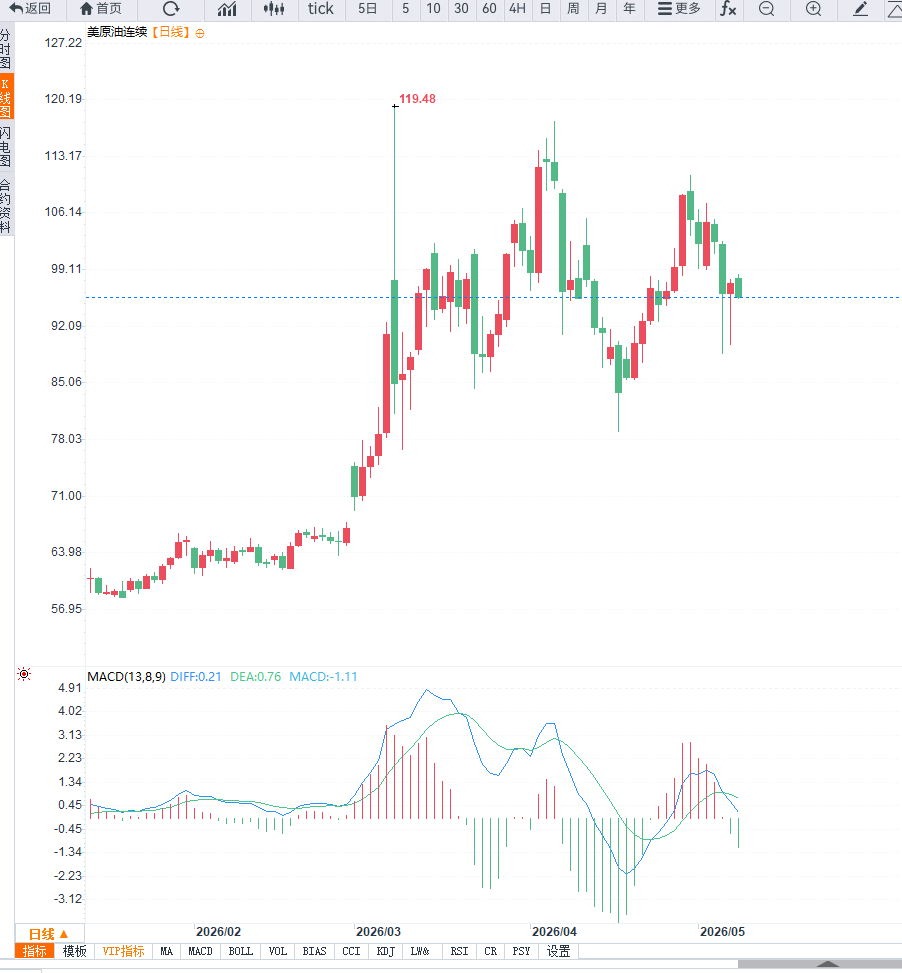
From a technical perspective, WTI crude oil's daily chart structure still maintains a medium- to long-term bullish trend. Oil prices previously broke through the key resistance area of $95 and approached the previous high near $100, indicating that market risk premium is still dominating short-term price movements. Currently, the daily moving average system continues to diverge upwards, and the MACD indicator remains at a high level, suggesting that the medium- to long-term upward trend has not been broken. If oil prices can subsequently hold above $95, they may further test the $97 to $100 area; important support levels are located around $91 and $88.
From a 4-hour chart perspective, WTI crude oil shows signs of a short-term technical correction. The RSI indicator, after entering overbought territory, has retreated, indicating that some short-term bullish funds have begun to exit, leading to high-level fluctuations in oil prices. However, due to the fact that geopolitical risks have not been completely resolved, the bearish force in the market remains relatively limited. If tensions in the Strait of Hormuz escalate again, oil prices may attract safe-haven inflows once more, pushing prices to retest this week's highs.
Current market sentiment is generally cautiously optimistic. On the one hand, investors hope that the situation in the Middle East can be prevented from escalating further; on the other hand, energy supply risks remain a real concern. Given the overall low global crude oil inventories, OPEC+ maintaining production cuts, and rising transportation risks, volatility in the international crude oil market is expected to remain high in the future.
Editor's Summary : The current international crude oil market remains highly driven by geopolitical factors. Although the conciliatory signals from Israel and Iran have temporarily eased market risk aversion, the military friction between the US and Iran near the Strait of Hormuz means that supply risks have not truly been eliminated. For the global energy market, the importance of the Strait of Hormuz means that any changes in the situation could quickly amplify oil price volatility. In the medium to long term, if the situation in the Middle East gradually stabilizes, WTI crude oil may experience a phased correction; however, given the low global inventory, increased transportation risks, and persistent energy security concerns, international oil prices generally still have strong support. The market will need to focus on the progress of negotiations between the US and Iran, the navigation situation in the Strait of Hormuz, and the policy responses of major global economies to high energy prices.
This week, the core focus of the international energy market remains on the escalating geopolitical risks between the United States and Iran. The US military stated that it launched retaliatory military operations against Iran on Thursday, targeting the southern Iranian port city of Bandar Abbas and Qeshm Island near the Strait of Hormuz. The US stated that the operation was primarily a response to previous attacks on US warships and emphasized that it was a "limited military response."
Senior U.S. officials stated that this round of military action does not signify a full-scale resurgence of the conflict, nor does it represent a complete termination of the existing ceasefire agreement. This statement alleviated market concerns about the risk of a full-blown war in the Middle East to some extent, thereby limiting the continued rapid rise in oil prices.
Meanwhile, U.S. Central Command stated that Iran launched missile, drone, and speedboat attacks against three U.S. guided-missile destroyers near the Strait of Hormuz. The U.S. called the actions an "unprovoked provocation" and stated that the U.S. military responded in self-defense. The Iranian military, in turn, accused the U.S. of violating the ceasefire agreement and claimed that U.S. forces attacked ships and civilian areas near the Strait of Hormuz. These statements from both sides further highlight the continued high tension in the region.
The Strait of Hormuz handles approximately 20% of global seaborne crude oil transport and connects several major oil-producing countries in the Persian Gulf, making it one of the world's most critical energy transport routes. The market generally believes that any sustained military conflict or shipping disruptions in the region could severely impact the global crude oil supply chain. Therefore, even with a temporary easing of the current situation, international oil prices have generally remained high.
Furthermore, the Trump administration is currently awaiting a response from Iran regarding its proposal to reopen the Strait of Hormuz. It is understood that Iran may convey its formal position through Pakistan within the next two days. Market analysts believe that if limited diplomatic communication between the two sides resumes, oil prices may see further short-term corrections; however, if negotiations fail or the situation in the Strait deteriorates again, it could reignite risk-taking in the crude oil market.
From a global market perspective, the evolving situation in the Middle East is not only impacting the energy market but is also influencing global inflation expectations, shipping costs, and the prices of safe-haven assets. The US dollar has recently experienced relative volatility, while international bond yields have been affected by inflation concerns stemming from energy price fluctuations. Some investment institutions believe that high oil prices may delay future interest rate cuts by major central banks worldwide, especially given the renewed rise in energy costs, leading to a more cautious outlook on global economic recovery.
From a technical perspective, WTI crude oil's daily chart structure still maintains a medium- to long-term bullish trend. Oil prices previously broke through the key resistance area of $95 and approached the previous high near $100, indicating that market risk premium is still dominating short-term price movements. Currently, the daily moving average system continues to diverge upwards, and the MACD indicator remains at a high level, suggesting that the medium- to long-term upward trend has not been broken. If oil prices can subsequently hold above $95, they may further test the $97 to $100 area; important support levels are located around $91 and $88.
From a 4-hour chart perspective, WTI crude oil shows signs of a short-term technical correction. The RSI indicator, after entering overbought territory, has retreated, indicating that some short-term bullish funds have begun to exit, leading to high-level fluctuations in oil prices. However, due to the fact that geopolitical risks have not been completely resolved, the bearish force in the market remains relatively limited. If tensions in the Strait of Hormuz escalate again, oil prices may attract safe-haven inflows once more, pushing prices to retest this week's highs.
Current market sentiment is generally cautiously optimistic. On the one hand, investors hope that the situation in the Middle East can be prevented from escalating further; on the other hand, energy supply risks remain a real concern. Given the overall low global crude oil inventories, OPEC+ maintaining production cuts, and rising transportation risks, volatility in the international crude oil market is expected to remain high in the future.
Editor's Summary : The current international crude oil market remains highly driven by geopolitical factors. Although the conciliatory signals from Israel and Iran have temporarily eased market risk aversion, the military friction between the US and Iran near the Strait of Hormuz means that supply risks have not truly been eliminated. For the global energy market, the importance of the Strait of Hormuz means that any changes in the situation could quickly amplify oil price volatility. In the medium to long term, if the situation in the Middle East gradually stabilizes, WTI crude oil may experience a phased correction; however, given the low global inventory, increased transportation risks, and persistent energy security concerns, international oil prices generally still have strong support. The market will need to focus on the progress of negotiations between the US and Iran, the navigation situation in the Strait of Hormuz, and the policy responses of major global economies to high energy prices.
- Risk Warning and Disclaimer
- The market involves risk, and trading may not be suitable for all investors. This article is for reference only and does not constitute personal investment advice, nor does it take into account certain users’ specific investment objectives, financial situation, or other needs. Any investment decisions made based on this information are at your own risk.