Easing tensions in the Middle East dampened safe-haven buying, causing the dollar index to decline slightly as it awaits guidance from non-farm payroll data.
2026-05-08 10:33:15
The dollar index (DXY), which measures the dollar's performance against six major currencies, weakened slightly during Friday's Asian trading session, trading around 98.20. This followed a period of pullback after a sustained rebound, primarily driven by easing tensions in the Middle East and improved market risk sentiment.
The core focus of global financial markets recently remains on developments in the Middle East and US economic data. Previously, military tensions between the US and Iran fueled a rapid rise in market risk aversion, supporting the US dollar with capital inflows. However, as the market received signals of de-escalation from both Israel and Iran, investor risk appetite recovered, and demand for the US dollar as a safe haven decreased.
US President Trump stated that the ceasefire agreement between the US and Iran remains in effect, further easing market concerns about a full-blown escalation of conflict in the Middle East. Meanwhile, market research indicates that the US is still awaiting a formal response from Iran regarding proposals to reopen the Strait of Hormuz and end the conflict.
Previously, the U.S. military had launched military strikes against the Iranian port of Bandar Abbas and targets near the Strait of Hormuz in response to Iranian attacks on U.S. warships. U.S. Central Command stated that Iran had launched missile, drone, and speedboat attacks against U.S. guided-missile destroyers transiting the Strait of Hormuz, and the U.S. military subsequently responded in self-defense.
Although market concerns about escalation have eased somewhat, overall tensions in the Persian Gulf and Lebanon remain high. Analysts believe that as long as the potential supply risks in the Strait of Hormuz are not completely eliminated, global market risk aversion will be difficult to completely subside. The temporary de-escalation of the Middle East situation is one of the important reasons for the current short-term decline in the US dollar index. When global market risk appetite improves, funds typically flow from safe-haven assets such as the US dollar to risk assets, thereby weakening the dollar's performance.
However, the overall decline in the US dollar is currently relatively limited, as the market is still awaiting the release of the US April non-farm payroll data tonight. The market expects approximately 62,000 new non-farm jobs in April, significantly lower than the 178,000 added in March, while the unemployment rate is expected to remain around 4.3%. If the US employment data is stronger than expected, it means the US labor market remains resilient, and the Federal Reserve may continue its high-interest-rate policy for a longer period. This would push US Treasury yields higher again, providing support for the dollar. Conversely, if the employment data is significantly weak, it could strengthen market expectations for future Fed rate cuts, further weakening the dollar index.
There is still significant disagreement in the market regarding the future policy path of the Federal Reserve. Some institutions believe that US economic growth is gradually slowing, and the high-interest-rate environment has begun to put pressure on consumption and business investment, thus leaving room for the Fed to cut interest rates in the future. However, others believe that the US job market remains resilient, inflationary pressures have not completely subsided, and the Fed may continue to maintain a cautious stance in the short term. The current trend of the US dollar index has gradually shifted from being driven solely by safe-haven demand to being dominated by "economic data and interest rate expectations." Especially with the market paying close attention to non-farm payroll data, the short-term volatility of the US dollar is expected to increase significantly.
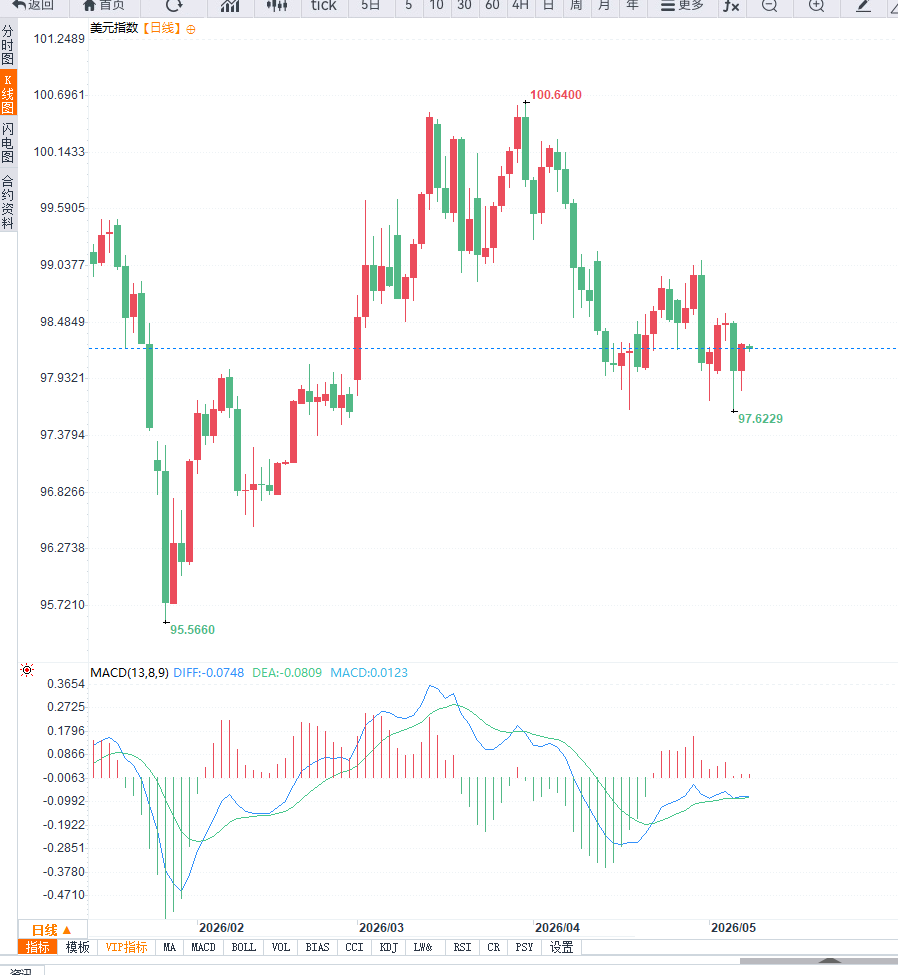
From a daily chart perspective, the US dollar index has recently maintained a low-level consolidation structure. The DXY previously found significant support around 97.20 and subsequently rebounded technically, but strong resistance remains in the 98.80-99.20 area. Technically, the daily MACD has formed a golden cross at a low level and continues to rise, but the red bars are gradually shortening, indicating a weakening of short-term rebound momentum. Meanwhile, the RSI has risen to around 50, suggesting that market sentiment is gradually shifting from weak to neutral. Looking at the moving average system, the 5-day and 10-day moving averages are gradually flattening, while the 20-day moving average is around 98.60, forming a key short-term resistance area. If the US dollar index can subsequently regain a foothold above 98.80, it may further test the 99.50 area; however, if the non-farm payroll data is weak, the DXY may fall back to around 97.50 or even 97.20.
Editor's Summary : The US dollar index is currently in a phase of "high-level consolidation and data-driven price action." While the easing of tensions in the Middle East has reduced some of the safe-haven demand for the dollar, expectations for the US economy and interest rates continue to support it. From a technical perspective, the dollar index maintains a low-level recovery pattern on the daily chart, but the 4-hour chart shows signs of slowing short-term momentum. If US employment data continues to be strong, expectations of higher interest rates from the Federal Reserve may drive the dollar higher again; however, if US economic data continues to cool, the dollar index may re-enter a correction phase.
The core focus of global financial markets recently remains on developments in the Middle East and US economic data. Previously, military tensions between the US and Iran fueled a rapid rise in market risk aversion, supporting the US dollar with capital inflows. However, as the market received signals of de-escalation from both Israel and Iran, investor risk appetite recovered, and demand for the US dollar as a safe haven decreased.
US President Trump stated that the ceasefire agreement between the US and Iran remains in effect, further easing market concerns about a full-blown escalation of conflict in the Middle East. Meanwhile, market research indicates that the US is still awaiting a formal response from Iran regarding proposals to reopen the Strait of Hormuz and end the conflict.
Previously, the U.S. military had launched military strikes against the Iranian port of Bandar Abbas and targets near the Strait of Hormuz in response to Iranian attacks on U.S. warships. U.S. Central Command stated that Iran had launched missile, drone, and speedboat attacks against U.S. guided-missile destroyers transiting the Strait of Hormuz, and the U.S. military subsequently responded in self-defense.
Although market concerns about escalation have eased somewhat, overall tensions in the Persian Gulf and Lebanon remain high. Analysts believe that as long as the potential supply risks in the Strait of Hormuz are not completely eliminated, global market risk aversion will be difficult to completely subside. The temporary de-escalation of the Middle East situation is one of the important reasons for the current short-term decline in the US dollar index. When global market risk appetite improves, funds typically flow from safe-haven assets such as the US dollar to risk assets, thereby weakening the dollar's performance.
However, the overall decline in the US dollar is currently relatively limited, as the market is still awaiting the release of the US April non-farm payroll data tonight. The market expects approximately 62,000 new non-farm jobs in April, significantly lower than the 178,000 added in March, while the unemployment rate is expected to remain around 4.3%. If the US employment data is stronger than expected, it means the US labor market remains resilient, and the Federal Reserve may continue its high-interest-rate policy for a longer period. This would push US Treasury yields higher again, providing support for the dollar. Conversely, if the employment data is significantly weak, it could strengthen market expectations for future Fed rate cuts, further weakening the dollar index.
There is still significant disagreement in the market regarding the future policy path of the Federal Reserve. Some institutions believe that US economic growth is gradually slowing, and the high-interest-rate environment has begun to put pressure on consumption and business investment, thus leaving room for the Fed to cut interest rates in the future. However, others believe that the US job market remains resilient, inflationary pressures have not completely subsided, and the Fed may continue to maintain a cautious stance in the short term. The current trend of the US dollar index has gradually shifted from being driven solely by safe-haven demand to being dominated by "economic data and interest rate expectations." Especially with the market paying close attention to non-farm payroll data, the short-term volatility of the US dollar is expected to increase significantly.
From a daily chart perspective, the US dollar index has recently maintained a low-level consolidation structure. The DXY previously found significant support around 97.20 and subsequently rebounded technically, but strong resistance remains in the 98.80-99.20 area. Technically, the daily MACD has formed a golden cross at a low level and continues to rise, but the red bars are gradually shortening, indicating a weakening of short-term rebound momentum. Meanwhile, the RSI has risen to around 50, suggesting that market sentiment is gradually shifting from weak to neutral. Looking at the moving average system, the 5-day and 10-day moving averages are gradually flattening, while the 20-day moving average is around 98.60, forming a key short-term resistance area. If the US dollar index can subsequently regain a foothold above 98.80, it may further test the 99.50 area; however, if the non-farm payroll data is weak, the DXY may fall back to around 97.50 or even 97.20.
Editor's Summary : The US dollar index is currently in a phase of "high-level consolidation and data-driven price action." While the easing of tensions in the Middle East has reduced some of the safe-haven demand for the dollar, expectations for the US economy and interest rates continue to support it. From a technical perspective, the dollar index maintains a low-level recovery pattern on the daily chart, but the 4-hour chart shows signs of slowing short-term momentum. If US employment data continues to be strong, expectations of higher interest rates from the Federal Reserve may drive the dollar higher again; however, if US economic data continues to cool, the dollar index may re-enter a correction phase.
- Risk Warning and Disclaimer
- The market involves risk, and trading may not be suitable for all investors. This article is for reference only and does not constitute personal investment advice, nor does it take into account certain users’ specific investment objectives, financial situation, or other needs. Any investment decisions made based on this information are at your own risk.