Japan's containment of yen short sellers: Central Bank hawks, Ministry of Finance intervention, and awaiting Bessant's response.
2026-05-08 18:16:42
Japan is attempting to reverse the yen's decline using two key tools: a hawkish stance from the Bank of Japan and the endorsement of US Treasury Secretary Bessenter's policies. These two measures together bolster its intervention to buy yen. The core objective of this strategy is not to dramatically reverse the trend, but rather to substantially increase the cost of shorting the yen.
I. The Bank of Japan and the Ministry of Finance unusually "align"
Last month, Bank of Japan Governor Kazuo Ueda's hawkish shift marked a turning point, bringing the central bank and the Ministry of Finance into rare agreement. Two days after Ueda's speech on April 28, the Ministry of Finance intervened by buying yen for the first time in nearly two years, followed by multiple rounds of operations in May. Sources say this round of intervention has cost nearly 10 trillion yen (approximately US$63.7 billion). Several sources within the Ministry of Finance stated that Ueda's communication was "exceptionally effective" in guiding market expectations.
II. Gaining US endorsement: Bessant's visit to Japan becomes key
Analysts believe Japan may be hoping that Bessant's visit next week—whether through explicit support or carefully worded rhetoric—will signal that the US tolerates Japanese intervention. Bessant previously supported the yen in January by urging the Bank of Japan to accelerate interest rate hikes and leading a US "interest rate review," a move widely seen as a prelude to potential coordinated intervention.
A former Bank of Japan official said, "Nobody wants to go against the United States. I believe Japanese policymakers are communicating with Washington on multiple fronts because the effect would be very different if Bessant openly supported Tokyo's intervention."
III. Bank of Japan's Subsequent Actions: Expectations for a June Rate Hike Rise
Without coordinated intervention, the burden of supporting the yen will fall back on the Bank of Japan. Markets are closely watching a series of speeches by officials ahead of the June policy meeting for clues as to whether last month's hawkish shift is becoming a policy reality.
Unlike previous dovish comments by Ueda that gave traders an excuse to sell the yen, this time he focused on the inflation risks posed by the weak yen, effectively keeping a June rate hike on the agenda. The Bank of Japan has announced that Ueda will travel to Switzerland from May 10-13 to attend a meeting of the Bank for International Settlements, meaning he will miss his meeting with Bessent in Tokyo.
On June 3, Ueda will deliver a highly anticipated speech, and ahead of the June 15-16 meeting, the market is buzzing with speculation about whether policymakers will raise interest rates from 0.75% to 1.0%. The deputy governor and two council members will also speak later this month, and any hints of support for a rate hike could embolden yen bulls.
IV. Political and Structural Headwinds
Prime Minister Sanae Takaichi is a long-time supporter of loose monetary policy and has previously opposed the central bank's tightening measures. A government source stated, "The Prime Minister doesn't want the central bank to raise interest rates, but she also wants to take measures to address rising living costs"—meaning that intervention by buying yen is the only viable option.
Structural forces are also tightening. Japan is heavily reliant on energy imports, and the impact of oil price fluctuations triggered by the Iran war is widening its trade deficit. Regardless of changes in domestic policy, this will strengthen the downward pressure on the yen.
JPMorgan Chase, BNP Paribas, and other institutions believe that the three core issues of the unresolved US-Japan interest rate differential, negative real interest rates in Japan, and continued capital outflows will likely lead to a continuation of the yen's depreciation trend. JPMorgan Chase has given a year-end forecast of 164. Goldman Sachs believes that although Japan theoretically possesses the "firepower" to intervene about 30 times, the authorities prefer to be cautious and only intervene during the "most effective time" when market volatility is high. Mitsubishi UFJ Morgan Stanley Securities stated that the market has regarded the 157 yen range as the authorities' "outer defense line," but the ultimate defense line remains at the 160 level.
An Eastspring Investments portfolio manager points out that critics often argue that intervention serves no purpose other than delaying market trends. However, even if intervention fails to fundamentally reverse the market's directional bias, it at least breaks the momentum of a one-sided decline. Allowing the yen to continue being sold off could lead to a more disorderly depreciation, making the situation even more difficult for the authorities to control.
Japan's core strategy is not to reverse the trend, but to raise the cost of shorting the yen through a triple combination of "central bank hawkish stance + US backing + market intervention," buying time until the global environment is no longer so unfavorable to the yen. Bessant's statement next week and whether the Bank of Japan actually raises interest rates in June will be key to testing the success or failure of this strategy.
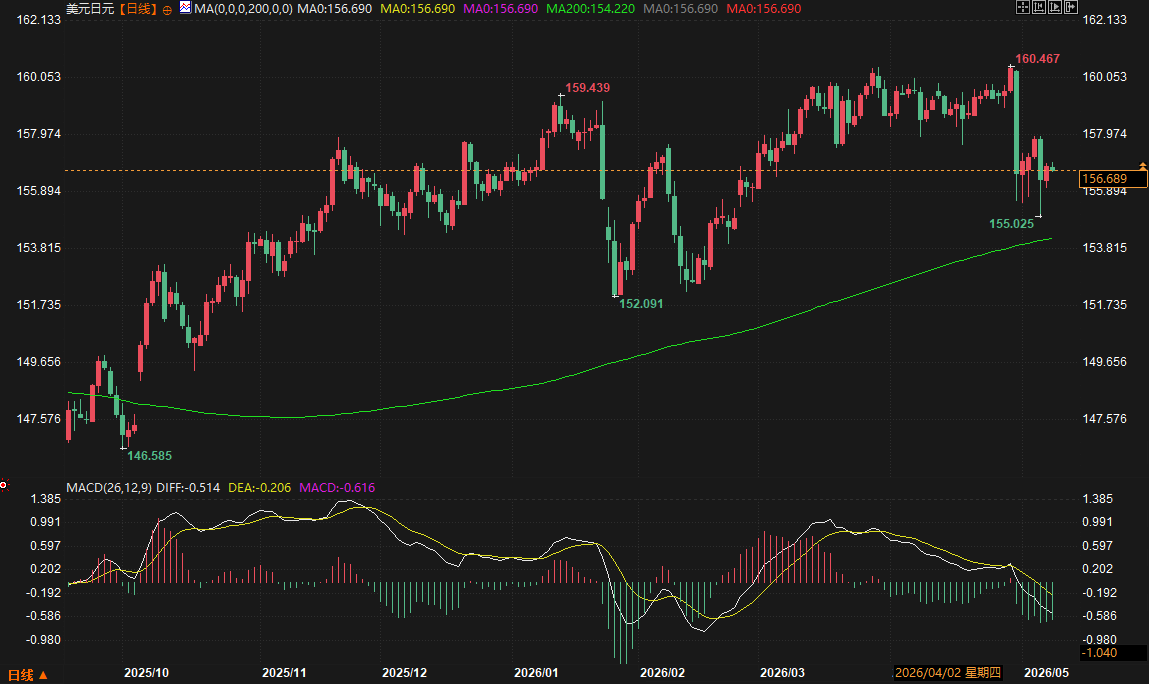
From a technical chart perspective, the USD/JPY pair experienced a sharp sell-off after breaking through the psychological level of 160.00 at the end of April. A suspected intervention by the Japanese Ministry of Finance, costing over $30 billion, propelled the exchange rate down to the 155.50 area. Currently, resistance lies in the 157.89-158.00 range; a break above this level could lead to a test of 159.00. Short-term support is at 156.20-156.27; a breach of this level could see a further decline to the 155.00 mark. Further down, the 200-day moving average is located around 154.00, considered a crucial support level for the long-term trend.
How can the three pillars work together to exert their strength?
I. The Bank of Japan and the Ministry of Finance unusually "align"
Last month, Bank of Japan Governor Kazuo Ueda's hawkish shift marked a turning point, bringing the central bank and the Ministry of Finance into rare agreement. Two days after Ueda's speech on April 28, the Ministry of Finance intervened by buying yen for the first time in nearly two years, followed by multiple rounds of operations in May. Sources say this round of intervention has cost nearly 10 trillion yen (approximately US$63.7 billion). Several sources within the Ministry of Finance stated that Ueda's communication was "exceptionally effective" in guiding market expectations.
II. Gaining US endorsement: Bessant's visit to Japan becomes key
Analysts believe Japan may be hoping that Bessant's visit next week—whether through explicit support or carefully worded rhetoric—will signal that the US tolerates Japanese intervention. Bessant previously supported the yen in January by urging the Bank of Japan to accelerate interest rate hikes and leading a US "interest rate review," a move widely seen as a prelude to potential coordinated intervention.
A former Bank of Japan official said, "Nobody wants to go against the United States. I believe Japanese policymakers are communicating with Washington on multiple fronts because the effect would be very different if Bessant openly supported Tokyo's intervention."
III. Bank of Japan's Subsequent Actions: Expectations for a June Rate Hike Rise
Without coordinated intervention, the burden of supporting the yen will fall back on the Bank of Japan. Markets are closely watching a series of speeches by officials ahead of the June policy meeting for clues as to whether last month's hawkish shift is becoming a policy reality.
Unlike previous dovish comments by Ueda that gave traders an excuse to sell the yen, this time he focused on the inflation risks posed by the weak yen, effectively keeping a June rate hike on the agenda. The Bank of Japan has announced that Ueda will travel to Switzerland from May 10-13 to attend a meeting of the Bank for International Settlements, meaning he will miss his meeting with Bessent in Tokyo.
On June 3, Ueda will deliver a highly anticipated speech, and ahead of the June 15-16 meeting, the market is buzzing with speculation about whether policymakers will raise interest rates from 0.75% to 1.0%. The deputy governor and two council members will also speak later this month, and any hints of support for a rate hike could embolden yen bulls.
IV. Political and Structural Headwinds
Prime Minister Sanae Takaichi is a long-time supporter of loose monetary policy and has previously opposed the central bank's tightening measures. A government source stated, "The Prime Minister doesn't want the central bank to raise interest rates, but she also wants to take measures to address rising living costs"—meaning that intervention by buying yen is the only viable option.
Structural forces are also tightening. Japan is heavily reliant on energy imports, and the impact of oil price fluctuations triggered by the Iran war is widening its trade deficit. Regardless of changes in domestic policy, this will strengthen the downward pressure on the yen.
Intervention is unlikely to change the overall trend, but it can break the momentum of a one-sided decline.
JPMorgan Chase, BNP Paribas, and other institutions believe that the three core issues of the unresolved US-Japan interest rate differential, negative real interest rates in Japan, and continued capital outflows will likely lead to a continuation of the yen's depreciation trend. JPMorgan Chase has given a year-end forecast of 164. Goldman Sachs believes that although Japan theoretically possesses the "firepower" to intervene about 30 times, the authorities prefer to be cautious and only intervene during the "most effective time" when market volatility is high. Mitsubishi UFJ Morgan Stanley Securities stated that the market has regarded the 157 yen range as the authorities' "outer defense line," but the ultimate defense line remains at the 160 level.
An Eastspring Investments portfolio manager points out that critics often argue that intervention serves no purpose other than delaying market trends. However, even if intervention fails to fundamentally reverse the market's directional bias, it at least breaks the momentum of a one-sided decline. Allowing the yen to continue being sold off could lead to a more disorderly depreciation, making the situation even more difficult for the authorities to control.
Japan's core strategy is not to reverse the trend, but to raise the cost of shorting the yen through a triple combination of "central bank hawkish stance + US backing + market intervention," buying time until the global environment is no longer so unfavorable to the yen. Bessant's statement next week and whether the Bank of Japan actually raises interest rates in June will be key to testing the success or failure of this strategy.
Technical Analysis vs. Intervention Risks: USD/JPY Seeks Direction Around 157
From a technical chart perspective, the USD/JPY pair experienced a sharp sell-off after breaking through the psychological level of 160.00 at the end of April. A suspected intervention by the Japanese Ministry of Finance, costing over $30 billion, propelled the exchange rate down to the 155.50 area. Currently, resistance lies in the 157.89-158.00 range; a break above this level could lead to a test of 159.00. Short-term support is at 156.20-156.27; a breach of this level could see a further decline to the 155.00 mark. Further down, the 200-day moving average is located around 154.00, considered a crucial support level for the long-term trend.
- Risk Warning and Disclaimer
- The market involves risk, and trading may not be suitable for all investors. This article is for reference only and does not constitute personal investment advice, nor does it take into account certain users’ specific investment objectives, financial situation, or other needs. Any investment decisions made based on this information are at your own risk.