Cross-Strait "accidental clash": Why did oil prices fall instead of rise?
2026-05-08 18:00:48
On Friday (May 8), international oil prices fell sharply by more than 3% during the Asian and European sessions. Although the US and Iran resumed military conflict last night, global risk appetite was not significantly affected.
On May 7, the tranquility of the Strait of Hormuz was shattered. A U.S. guided-missile destroyer, en route, was attacked by a combined air and sea strike from Iran: multiple missiles, swarms of drones, and agile speedboats attacked in unison.
The U.S. Central Command quickly activated its defensive mode, successfully intercepted all threats, and then carried out a targeted elimination of the Iranian launch site in "self-defense."
Despite the flames, neither side reported significant damage to facilities or casualties.

Despite the volatile atmosphere, the US characterization of the conflict was quite significant. The US military described it as a routine maintenance of "freedom of navigation," rather than the outbreak of war.
Trump's "contradictory rhetoric": In his response, Trump displayed extremely high political skill. On the one hand, he praised the military for "devastating Iran," while on the other hand, he offered a "love tap"-like understatement, defining it as a "little trick" played by Iran out of anxiety.
The bottom line logic: Trump insists that the previous ceasefire agreement is still valid. This "downplaying the issue" approach reflects that the United States does not want to be dragged into a full-scale war, but is trying to keep the conflict within the scope of "accidental clashes" in order to preserve the fruits of the negotiations.
Pakistan's efforts: As the "chief mediator," Pakistan's Foreign Minister and Prime Minister worked around the clock, tirelessly trying to appease both sides. Pakistan even requested that the US military suspend some operations in exchange for a cleaner negotiating environment.
A complex web of events: Meanwhile, the drone attack on the UAE highlighted the fragility of the situation; and the upcoming resumption of the Israel-Lebanon talks on May 14th has turned Middle East geopolitics into a complex game involving multiple parties.
The essence of this round of conflict is for both sides to continue increasing their bargaining chips, and the United States has shown a strong desire to talk. As has been repeatedly pointed out in previous articles, peace talks are in the most fundamental interests of both sides.
Iran established a "management authority" in an attempt to "strangle" Iran by legitimizing its levies, while the United States demonstrated its military red lines through "precision counterattacks."
The US downplaying the definition of conflict is both giving Iran a way out and providing a lifeline for high global oil prices.
As long as both sides agree that "not going to war in full force" is the greatest common denominator, this peculiar pattern of "getting a vote for every punch" will continue.
International oil prices will find support in this cycle of "conflict and renegotiation".
In the short term, as long as both sides can still sit at the negotiating table set up by Pakistan, even if there are occasional sparks in the Strait, the situation will remain on the positive side.
From a technical perspective, the Brent crude oil July contract continues to hold its recent upward channel, with resistance at 103.2. It has tested the upward channel twice, as well as the 20-day and 30-day moving averages, and is currently below the psychological level of 100 yuan. The negotiations that the US is pushing hard are acting like a spring, and oil prices may fall back to around 94 to find support. However, the greater concern is the rapid rebound in oil prices after the positive news is priced in. If oil prices do not rebound significantly, then the upward trend may transition to range-bound trading .
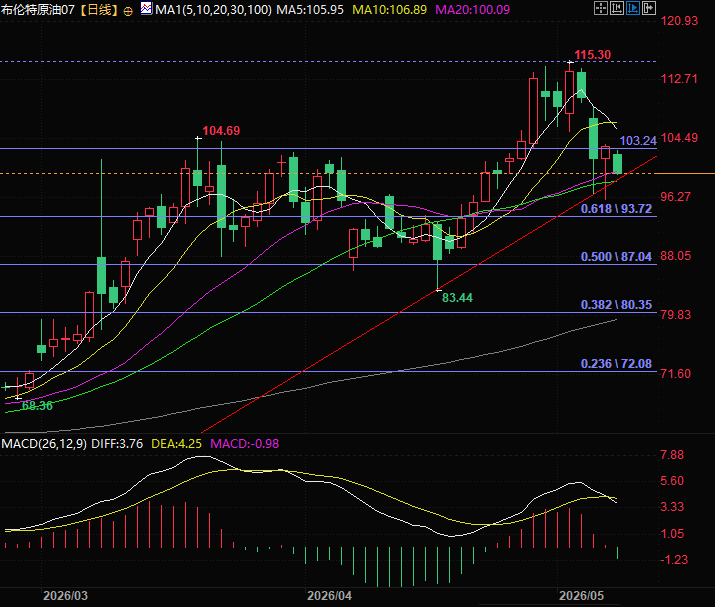
(Brent crude oil July contract daily chart, source: EasyForex)
At 17:54 Beijing time, the Brent crude oil July contract was trading at $99.90 per barrel.
On May 7, the tranquility of the Strait of Hormuz was shattered. A U.S. guided-missile destroyer, en route, was attacked by a combined air and sea strike from Iran: multiple missiles, swarms of drones, and agile speedboats attacked in unison.
The U.S. Central Command quickly activated its defensive mode, successfully intercepted all threats, and then carried out a targeted elimination of the Iranian launch site in "self-defense."
Despite the flames, neither side reported significant damage to facilities or casualties.
Subtle Reactions: The US's "Cooling Down" Approach and Tough Stance
Despite the volatile atmosphere, the US characterization of the conflict was quite significant. The US military described it as a routine maintenance of "freedom of navigation," rather than the outbreak of war.
Trump's "contradictory rhetoric": In his response, Trump displayed extremely high political skill. On the one hand, he praised the military for "devastating Iran," while on the other hand, he offered a "love tap"-like understatement, defining it as a "little trick" played by Iran out of anxiety.
The bottom line logic: Trump insists that the previous ceasefire agreement is still valid. This "downplaying the issue" approach reflects that the United States does not want to be dragged into a full-scale war, but is trying to keep the conflict within the scope of "accidental clashes" in order to preserve the fruits of the negotiations.
Regional Collaboration: Risk Spillover Affects Surrounding Areas
Pakistan's efforts: As the "chief mediator," Pakistan's Foreign Minister and Prime Minister worked around the clock, tirelessly trying to appease both sides. Pakistan even requested that the US military suspend some operations in exchange for a cleaner negotiating environment.
A complex web of events: Meanwhile, the drone attack on the UAE highlighted the fragility of the situation; and the upcoming resumption of the Israel-Lebanon talks on May 14th has turned Middle East geopolitics into a complex game involving multiple parties.
Summary and Technical Analysis:
The essence of this round of conflict is for both sides to continue increasing their bargaining chips, and the United States has shown a strong desire to talk. As has been repeatedly pointed out in previous articles, peace talks are in the most fundamental interests of both sides.
Iran established a "management authority" in an attempt to "strangle" Iran by legitimizing its levies, while the United States demonstrated its military red lines through "precision counterattacks."
The US downplaying the definition of conflict is both giving Iran a way out and providing a lifeline for high global oil prices.
As long as both sides agree that "not going to war in full force" is the greatest common denominator, this peculiar pattern of "getting a vote for every punch" will continue.
International oil prices will find support in this cycle of "conflict and renegotiation".
In the short term, as long as both sides can still sit at the negotiating table set up by Pakistan, even if there are occasional sparks in the Strait, the situation will remain on the positive side.
From a technical perspective, the Brent crude oil July contract continues to hold its recent upward channel, with resistance at 103.2. It has tested the upward channel twice, as well as the 20-day and 30-day moving averages, and is currently below the psychological level of 100 yuan. The negotiations that the US is pushing hard are acting like a spring, and oil prices may fall back to around 94 to find support. However, the greater concern is the rapid rebound in oil prices after the positive news is priced in. If oil prices do not rebound significantly, then the upward trend may transition to range-bound trading .
(Brent crude oil July contract daily chart, source: EasyForex)
At 17:54 Beijing time, the Brent crude oil July contract was trading at $99.90 per barrel.
- Risk Warning and Disclaimer
- The market involves risk, and trading may not be suitable for all investors. This article is for reference only and does not constitute personal investment advice, nor does it take into account certain users’ specific investment objectives, financial situation, or other needs. Any investment decisions made based on this information are at your own risk.