Crude oil trading alert: Recurring geopolitical tensions and supply concerns are supporting oil prices to remain range-bound.
2026-05-11 09:36:58
The situation in the Middle East has once again become the core focus of global financial markets. Following Iran's formal response to the US-proposed ceasefire, market expectations for a de-escalation quickly cooled, replaced by renewed concerns about energy supply security. As a result, international oil prices surged, and the risk premium in the energy market widened significantly.
Iran has submitted a new response proposal to the United States through Pakistani mediation. Iran demands that the U.S. Treasury Department's Office of Foreign Assets Control lift sanctions related to Iranian oil exports within 30 days, and gradually lift restrictions on Iranian ports and ships. Furthermore, Iran proposes a gradual resumption of commercial shipping in the Strait of Hormuz during the ceasefire process. However, the U.S. has reacted extremely strongly. President Trump publicly stated that Iran's conditions are "completely unacceptable" and accused Iran of long-term delays in negotiations.
Market analysts believe that the sudden hardening of the US stance indicates that significant differences remain between the two sides on core issues, particularly regarding the nuclear program, highly enriched uranium stockpiles, and regional security arrangements, making it difficult to reach an agreement in the short term. It is noteworthy that Iran's response did not directly address the key conditions previously set by the US, namely, demanding that Tehran disclose the whereabouts of its highly enriched uranium stockpile and the future plans for its nuclear facilities. The market generally believes that this leaves the ceasefire negotiations without a basis for substantial breakthroughs.
Meanwhile, military signals from Israel further exacerbated market panic. Israeli Prime Minister Netanyahu stated that the military action against Iran was "not over" and emphasized the need to remove Iran's highly enriched uranium and related facilities. Analysts pointed out that Israel's hardline stance means there is still a risk of further escalation in the Middle East, and if military action expands, the global energy transportation system could suffer even greater disruption.
The market's primary focus remains on the Strait of Hormuz. This strait handles approximately 20% of global seaborne crude oil transport and is also a crucial route for global liquefied natural gas (LNG) shipping. Since the escalation of the conflict at the end of February, the strait's transport efficiency has significantly declined, with delays for some oil tankers, a rapid increase in shipping insurance costs, and continued pressure on the global energy supply chain. Although not completely closed, the market generally believes that actual transport capacity has significantly decreased. Some institutions believe the market has already begun pricing in the "risk of long-term supply disruptions." Especially after the US rejected Iran's latest proposal, market optimism regarding the resumption of transport through the Strait of Hormuz has noticeably weakened.
At the same time, global inflationary pressures are once again drawing attention. Every $10 increase in crude oil prices could drive up global transportation, manufacturing, and chemical costs in the short term. For economies heavily reliant on energy imports, the risk of imported inflation could further increase, and some countries may once again face pressure to balance energy prices with economic growth.
From a market sentiment perspective, funds have clearly shifted towards safe-haven trading. Gold, energy stocks, and defensive assets continue to receive buying support, while some overvalued risk assets are showing signs of capital outflow.
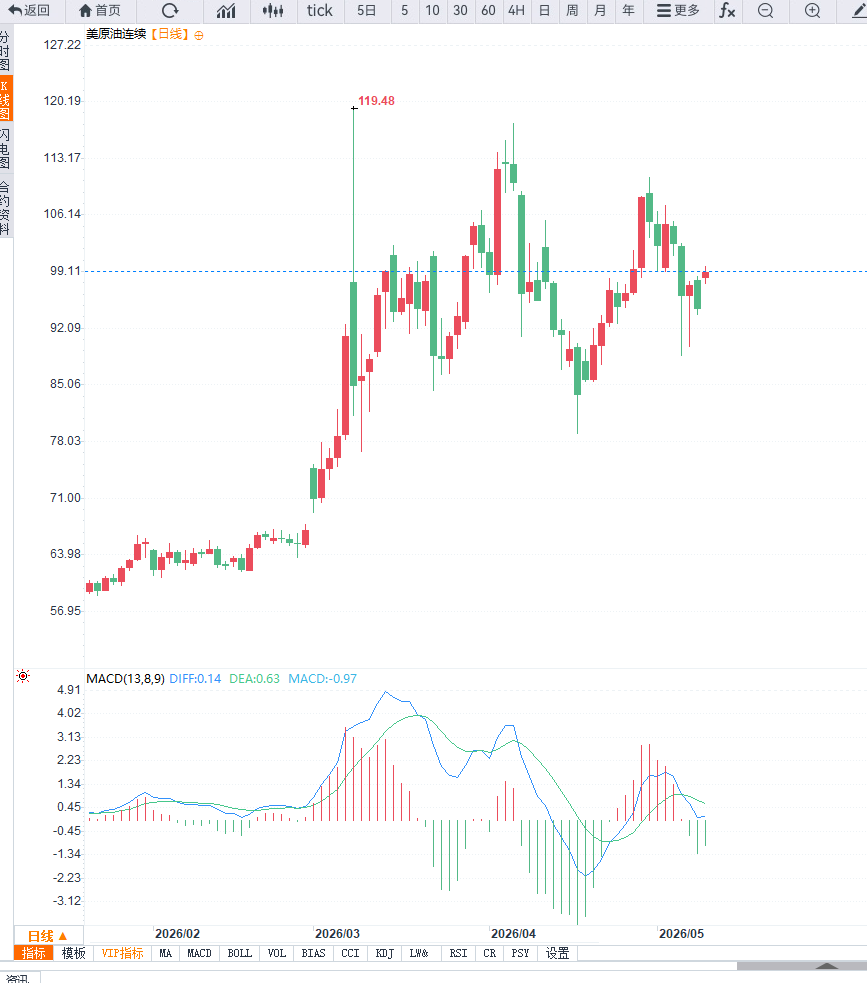
From a technical perspective, international oil prices are currently maintaining a high-level consolidation structure. On the daily chart, Brent crude oil remains within its main upward channel, and the price has not broken below the important support area around $90, indicating a continued bullish trend. Currently, the $105 level presents a temporary technical resistance, and if geopolitical risks escalate further, a test of the $110 area cannot be ruled out. On the 4-hour chart, WTI crude oil's short-term moving averages have re-formed a bullish alignment, and the MACD histogram continues to expand, indicating a slight recovery in short-term market sentiment. The RSI indicator remains relatively high, suggesting that short-term market volatility may increase, but overall bullish momentum has not significantly weakened. If the price stabilizes above the $100 mark, the market may further strengthen its trading logic regarding supply tightness; conversely, if there are signs of easing negotiations, a retest of the $95 support level is possible.
Furthermore, even if the Strait of Hormuz reopens in the future, the recovery of global shipping capacity, inventory, and supply chains will still take time. The real concern in the global energy market is not the short-term ceasefire itself, but rather that the supply recovery cycle may take far longer than market expectations. Some shipping agencies point out that tanker rescheduling, insurance restoration, and inventory replenishment may take weeks or even longer, meaning that international oil prices may remain high in the short term.
Editor's Summary : The current deadlock in US-Iran negotiations suggests that geopolitical risks in the Middle East are unlikely to ease significantly in the short term. The Strait of Hormuz, as one of the world's most important energy transport routes, directly impacts the global crude oil pricing system. While the market still anticipates a breakthrough in diplomatic negotiations, current statements from various parties indicate that supply risk remains the core driver of rising oil prices. The market needs to focus on three key areas going forward: first, whether transport conditions in the Strait of Hormuz will deteriorate further; second, whether the US and Iran will resume substantive negotiations; and third, whether Israel's subsequent military actions will escalate. In the medium to long term, the global energy market may enter a new phase of "high volatility and high risk premiums," and the central level of crude oil prices may continue to rise as a result.
Iran has submitted a new response proposal to the United States through Pakistani mediation. Iran demands that the U.S. Treasury Department's Office of Foreign Assets Control lift sanctions related to Iranian oil exports within 30 days, and gradually lift restrictions on Iranian ports and ships. Furthermore, Iran proposes a gradual resumption of commercial shipping in the Strait of Hormuz during the ceasefire process. However, the U.S. has reacted extremely strongly. President Trump publicly stated that Iran's conditions are "completely unacceptable" and accused Iran of long-term delays in negotiations.
Market analysts believe that the sudden hardening of the US stance indicates that significant differences remain between the two sides on core issues, particularly regarding the nuclear program, highly enriched uranium stockpiles, and regional security arrangements, making it difficult to reach an agreement in the short term. It is noteworthy that Iran's response did not directly address the key conditions previously set by the US, namely, demanding that Tehran disclose the whereabouts of its highly enriched uranium stockpile and the future plans for its nuclear facilities. The market generally believes that this leaves the ceasefire negotiations without a basis for substantial breakthroughs.
Meanwhile, military signals from Israel further exacerbated market panic. Israeli Prime Minister Netanyahu stated that the military action against Iran was "not over" and emphasized the need to remove Iran's highly enriched uranium and related facilities. Analysts pointed out that Israel's hardline stance means there is still a risk of further escalation in the Middle East, and if military action expands, the global energy transportation system could suffer even greater disruption.
The market's primary focus remains on the Strait of Hormuz. This strait handles approximately 20% of global seaborne crude oil transport and is also a crucial route for global liquefied natural gas (LNG) shipping. Since the escalation of the conflict at the end of February, the strait's transport efficiency has significantly declined, with delays for some oil tankers, a rapid increase in shipping insurance costs, and continued pressure on the global energy supply chain. Although not completely closed, the market generally believes that actual transport capacity has significantly decreased. Some institutions believe the market has already begun pricing in the "risk of long-term supply disruptions." Especially after the US rejected Iran's latest proposal, market optimism regarding the resumption of transport through the Strait of Hormuz has noticeably weakened.
At the same time, global inflationary pressures are once again drawing attention. Every $10 increase in crude oil prices could drive up global transportation, manufacturing, and chemical costs in the short term. For economies heavily reliant on energy imports, the risk of imported inflation could further increase, and some countries may once again face pressure to balance energy prices with economic growth.
From a market sentiment perspective, funds have clearly shifted towards safe-haven trading. Gold, energy stocks, and defensive assets continue to receive buying support, while some overvalued risk assets are showing signs of capital outflow.
From a technical perspective, international oil prices are currently maintaining a high-level consolidation structure. On the daily chart, Brent crude oil remains within its main upward channel, and the price has not broken below the important support area around $90, indicating a continued bullish trend. Currently, the $105 level presents a temporary technical resistance, and if geopolitical risks escalate further, a test of the $110 area cannot be ruled out. On the 4-hour chart, WTI crude oil's short-term moving averages have re-formed a bullish alignment, and the MACD histogram continues to expand, indicating a slight recovery in short-term market sentiment. The RSI indicator remains relatively high, suggesting that short-term market volatility may increase, but overall bullish momentum has not significantly weakened. If the price stabilizes above the $100 mark, the market may further strengthen its trading logic regarding supply tightness; conversely, if there are signs of easing negotiations, a retest of the $95 support level is possible.
Furthermore, even if the Strait of Hormuz reopens in the future, the recovery of global shipping capacity, inventory, and supply chains will still take time. The real concern in the global energy market is not the short-term ceasefire itself, but rather that the supply recovery cycle may take far longer than market expectations. Some shipping agencies point out that tanker rescheduling, insurance restoration, and inventory replenishment may take weeks or even longer, meaning that international oil prices may remain high in the short term.
Editor's Summary : The current deadlock in US-Iran negotiations suggests that geopolitical risks in the Middle East are unlikely to ease significantly in the short term. The Strait of Hormuz, as one of the world's most important energy transport routes, directly impacts the global crude oil pricing system. While the market still anticipates a breakthrough in diplomatic negotiations, current statements from various parties indicate that supply risk remains the core driver of rising oil prices. The market needs to focus on three key areas going forward: first, whether transport conditions in the Strait of Hormuz will deteriorate further; second, whether the US and Iran will resume substantive negotiations; and third, whether Israel's subsequent military actions will escalate. In the medium to long term, the global energy market may enter a new phase of "high volatility and high risk premiums," and the central level of crude oil prices may continue to rise as a result.
- Risk Warning and Disclaimer
- The market involves risk, and trading may not be suitable for all investors. This article is for reference only and does not constitute personal investment advice, nor does it take into account certain users’ specific investment objectives, financial situation, or other needs. Any investment decisions made based on this information are at your own risk.