The Australian dollar benefited from the Reserve Bank of Australia's hawkish stance, helping it maintain a high level against the US dollar.
2026-05-11 16:58:03
In the recent foreign exchange market, the Australian dollar (AUD) has continued its strong performance, becoming one of the better-performing risk currencies among the G10 currencies. As market expectations for easing tensions in the Middle East rise, global risk appetite improves, driving funds back towards high-yield and commodity-related currencies. So far this quarter, "risk-averse" currencies, including the Australian dollar, Norwegian krone, and New Zealand dollar, have generally outperformed the US dollar.

Some market institutions point out that improved global risk sentiment and persistently high commodity prices are key drivers behind the Australian dollar's strength. Previously, the market was concerned that the situation in the Middle East could further disrupt global energy supplies, but as some market participants anticipated a possible easing of regional conflicts, risk sentiment improved in stages. Against this backdrop, currencies like the Australian dollar, which are highly correlated with the global economic cycle, have seen inflows of funds.
However, the core factors driving the Australian dollar's rise are not limited to changes in risk sentiment. The Reserve Bank of Australia's (RBA) continued hawkish stance, becoming a key support for the Australian dollar. On May 5th, the RBA announced another 25 basis point rate hike, raising the benchmark interest rate to 4.35% , in line with market expectations. This marks the RBA's third consecutive rate hike. The RBA remains one of the few major G10 central banks maintaining a sustained tightening stance.
In contrast, some major central banks have begun signaling a policy shift or a pause in interest rate hikes, while the Reserve Bank of Australia (RBA) continues to emphasize that inflation risks remain high. Market analysts believe that the RBA's maintenance of high interest rates will help further enhance the attractiveness of Australian dollar assets. As the interest rate differential between Australia and other major economies widens, some international funds are flowing back into the Australian dollar asset market. Meanwhile, Australia's domestic fiscal policy is also a key focus for the market. Some institutions believe that if the Australian government continues to introduce fiscal stimulus policies in the future, it may further push up inflationary pressures, thereby forcing the RBA to maintain a hawkish stance, and even raising interest rates further cannot be ruled out.
However, most economists still expect the Reserve Bank of Australia (RBA) to enter a "wait-and-see" mode in the short term. The market generally anticipates that the RBA will keep interest rates unchanged for the next few months to observe the actual impact of previous rate hikes on the economy and inflation. Furthermore, international commodity price trends also significantly influence the Australian dollar. As a typical commodity currency, the Australian dollar is typically highly correlated with iron ore, energy, and global risk sentiment. Recent high international energy prices, coupled with improved expectations for global industrial demand, have further strengthened market optimism regarding Australia's export prospects.
However, market risks remain. With renewed tensions between the US and Iran, global risk aversion has risen again, and the US dollar has regained some safe-haven support. Some institutions believe that if the situation in the Middle East deteriorates significantly again, risk currencies such as the Australian dollar may face renewed pressure.
From a technical perspective, the AUD/USD daily chart shows that the exchange rate is currently maintaining a generally bullish structure. After stabilizing around 0.6520 , bullish momentum has gradually strengthened. On the daily chart, the exchange rate has regained its position above the 20-day moving average, and the MACD indicator's bullish crossover at a low level indicates a continued expansion of the red bars, suggesting a recovery in medium-term upward momentum. The RSI indicator has risen to around 60, indicating that market sentiment is gradually shifting towards a bullish bias, but has not yet entered extreme overbought territory. The 0.6580 area currently constitutes the first key support level on the daily chart; a break below this level could lead to a retest of the 0.6520 area. On the upside, the 0.6680-0.6720 area has formed a significant resistance zone. If risk appetite continues to improve, the AUD/USD pair still has the potential to test higher levels.
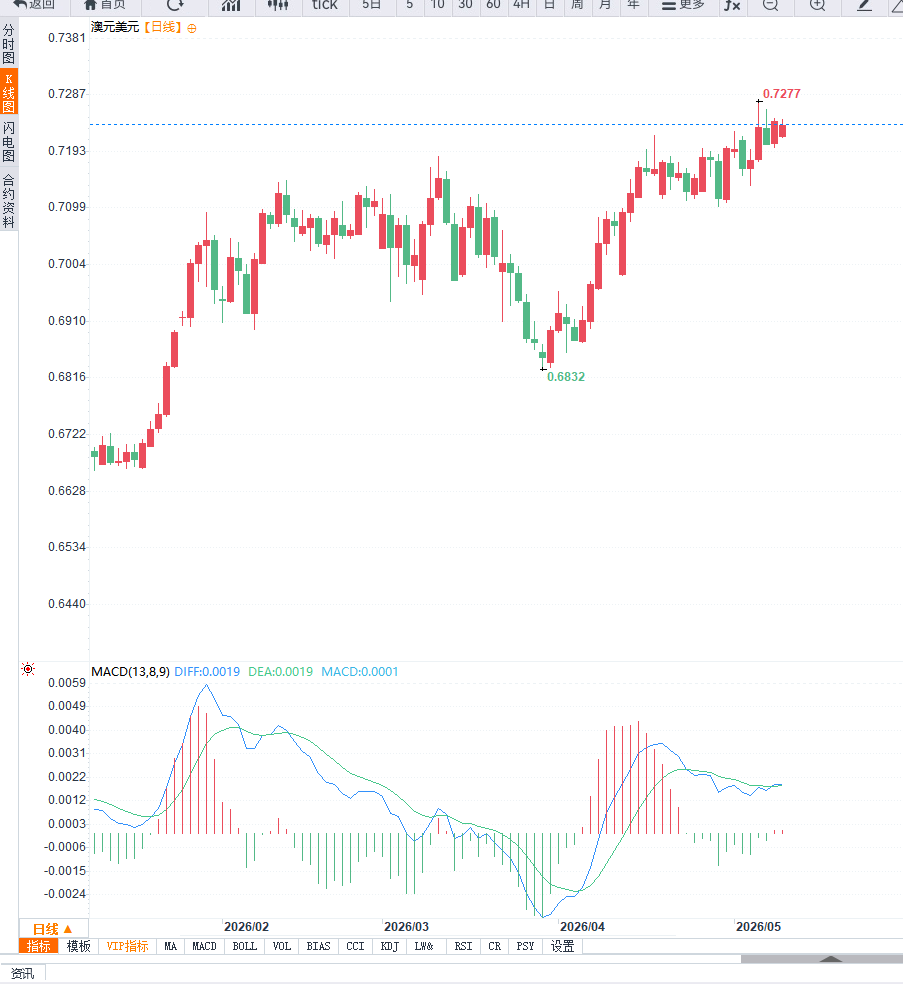
Editor's Summary : The Australian dollar market is currently driven by both improved risk appetite and the Reserve Bank of Australia's (RBA) hawkish policy. Easing tensions in the Middle East initially boosted global risk assets, while the RBA's consecutive interest rate hikes further enhanced the attractiveness of Australian dollar assets. However, significant uncertainty remains regarding global geopolitical risks, and demand for the US dollar as a safe haven could resurface at any time. From a technical perspective, the Australian dollar against the US dollar is maintaining a medium-term recovery trend, but key resistance levels have not yet been fully broken. The market needs to focus on three key areas going forward: first, changes in the Middle East situation; second, subsequent policy signals from the RBA; and third, the trends of global commodity prices and the US dollar index. Overall, the Australian dollar may maintain a slightly bullish trend in the short term, but market volatility may continue to increase.
Some market institutions point out that improved global risk sentiment and persistently high commodity prices are key drivers behind the Australian dollar's strength. Previously, the market was concerned that the situation in the Middle East could further disrupt global energy supplies, but as some market participants anticipated a possible easing of regional conflicts, risk sentiment improved in stages. Against this backdrop, currencies like the Australian dollar, which are highly correlated with the global economic cycle, have seen inflows of funds.
However, the core factors driving the Australian dollar's rise are not limited to changes in risk sentiment. The Reserve Bank of Australia's (RBA) continued hawkish stance, becoming a key support for the Australian dollar. On May 5th, the RBA announced another 25 basis point rate hike, raising the benchmark interest rate to 4.35% , in line with market expectations. This marks the RBA's third consecutive rate hike. The RBA remains one of the few major G10 central banks maintaining a sustained tightening stance.
In contrast, some major central banks have begun signaling a policy shift or a pause in interest rate hikes, while the Reserve Bank of Australia (RBA) continues to emphasize that inflation risks remain high. Market analysts believe that the RBA's maintenance of high interest rates will help further enhance the attractiveness of Australian dollar assets. As the interest rate differential between Australia and other major economies widens, some international funds are flowing back into the Australian dollar asset market. Meanwhile, Australia's domestic fiscal policy is also a key focus for the market. Some institutions believe that if the Australian government continues to introduce fiscal stimulus policies in the future, it may further push up inflationary pressures, thereby forcing the RBA to maintain a hawkish stance, and even raising interest rates further cannot be ruled out.
However, most economists still expect the Reserve Bank of Australia (RBA) to enter a "wait-and-see" mode in the short term. The market generally anticipates that the RBA will keep interest rates unchanged for the next few months to observe the actual impact of previous rate hikes on the economy and inflation. Furthermore, international commodity price trends also significantly influence the Australian dollar. As a typical commodity currency, the Australian dollar is typically highly correlated with iron ore, energy, and global risk sentiment. Recent high international energy prices, coupled with improved expectations for global industrial demand, have further strengthened market optimism regarding Australia's export prospects.
However, market risks remain. With renewed tensions between the US and Iran, global risk aversion has risen again, and the US dollar has regained some safe-haven support. Some institutions believe that if the situation in the Middle East deteriorates significantly again, risk currencies such as the Australian dollar may face renewed pressure.
From a technical perspective, the AUD/USD daily chart shows that the exchange rate is currently maintaining a generally bullish structure. After stabilizing around 0.6520 , bullish momentum has gradually strengthened. On the daily chart, the exchange rate has regained its position above the 20-day moving average, and the MACD indicator's bullish crossover at a low level indicates a continued expansion of the red bars, suggesting a recovery in medium-term upward momentum. The RSI indicator has risen to around 60, indicating that market sentiment is gradually shifting towards a bullish bias, but has not yet entered extreme overbought territory. The 0.6580 area currently constitutes the first key support level on the daily chart; a break below this level could lead to a retest of the 0.6520 area. On the upside, the 0.6680-0.6720 area has formed a significant resistance zone. If risk appetite continues to improve, the AUD/USD pair still has the potential to test higher levels.
Editor's Summary : The Australian dollar market is currently driven by both improved risk appetite and the Reserve Bank of Australia's (RBA) hawkish policy. Easing tensions in the Middle East initially boosted global risk assets, while the RBA's consecutive interest rate hikes further enhanced the attractiveness of Australian dollar assets. However, significant uncertainty remains regarding global geopolitical risks, and demand for the US dollar as a safe haven could resurface at any time. From a technical perspective, the Australian dollar against the US dollar is maintaining a medium-term recovery trend, but key resistance levels have not yet been fully broken. The market needs to focus on three key areas going forward: first, changes in the Middle East situation; second, subsequent policy signals from the RBA; and third, the trends of global commodity prices and the US dollar index. Overall, the Australian dollar may maintain a slightly bullish trend in the short term, but market volatility may continue to increase.
- Risk Warning and Disclaimer
- The market involves risk, and trading may not be suitable for all investors. This article is for reference only and does not constitute personal investment advice, nor does it take into account certain users’ specific investment objectives, financial situation, or other needs. Any investment decisions made based on this information are at your own risk.