A chart shows that the Baltic Dry Index rose slightly, with freight rates increasing across all vessel types.
2026-05-11 22:34:34
As global dry bulk shipping demand continues to recover, freight rates for all types of vessels are rising in tandem. Driven by this, the Baltic Dry Index (BDI) rose slightly on Monday, continuing its recent upward trend.
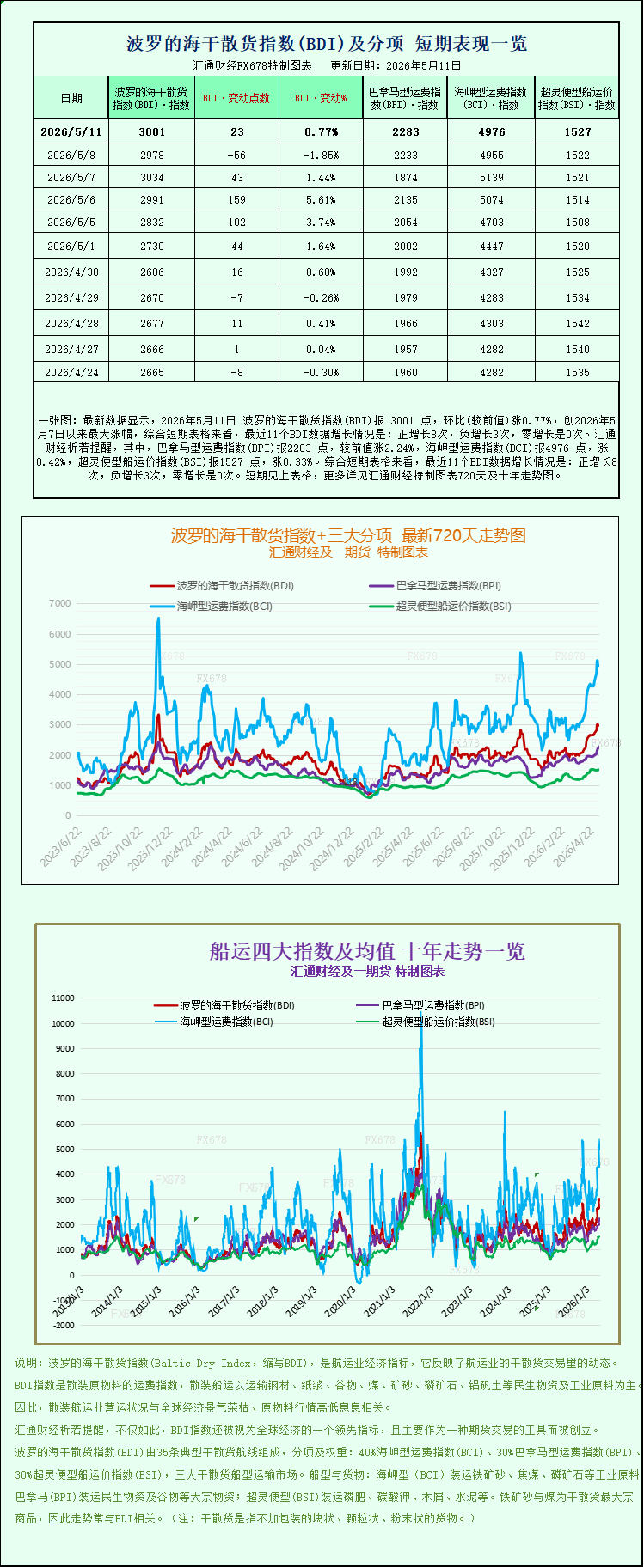
Latest data shows that the Baltic Dry Index (BDI) stood at 3001 points on May 11, 2026, a 0.77% increase compared to the previous week, marking the largest increase since May 7, 2026. Looking at the short-term charts, the BDI has seen positive growth 8 times, negative growth 3 times, and zero growth 0 times in the last 11 BDI data points. Specifically, the Panamax Freight Index (BPI) stood at 2283 points, up 2.24% from the previous week; the Capesize Freight Index (BCI) stood at 4976 points, up 0.42%; and the Supramax Freight Index (BSI) stood at 1527 points, up 0.33%. For detailed 720-day and 10-year trend charts of the Baltic Dry Index and its three main sub-indices, please refer to the specially designed charts.
The Baltic Dry Index (BDI), which tracks global dry bulk shipping freight rates, saw a slight increase on Monday. The main driver was a rebound in freight rates for all major dry bulk vessel types worldwide, with increased market activity and a generally stable and positive trend in the shipping market. As an authoritative index measuring international dry bulk shipping prices, the BDI directly reflects the freight rates for transporting essential goods such as grain, coal, and ore, as well as industrial raw materials. It is highly correlated with global economic conditions and raw material prices, and its fluctuations serve as an important reference signal for global trade trends.
Among them, the Baltic Dry Index, which tracks freight rates for the three core vessel types—Capesize, Panamax, and Supramax—performed strongly, rising slightly by 23 points, or 1.8%, to close at 3001 points. Notably, the index reached its highest level since March 2024 on May 7th. Compared to the average level of 1823.71 points in March 2024, the current index has significantly improved, highlighting the continued recovery of the dry bulk shipping market over the past two years.
Specifically, looking at the performance of different ship types, the Capesize index rose across the board, increasing by 21 points, or 0.4%, to close at 4976 points. Capesize vessels, as one of the mainstays of the dry bulk shipping market, are primarily used to transport bulk industrial raw materials exceeding 80,000 tons, with a typical deadweight tonnage of 150,000 tons. Their core cargoes include iron ore and coal, making them a crucial guarantee for the stable operation of the global industrial supply chain. Correspondingly, the average daily revenue of Capesize vessels carrying 150,000 tons of cargo (including iron ore and coal) also increased, rising by $192 per day to reach $41,630, further improving the profitability of shipping companies.
The rise in Capesize freight rates and revenues is closely related to the continued positive performance of the iron ore market. Boosted by favorable data from China, the world's largest iron ore consumer, iron ore futures prices have risen for the sixth consecutive trading day, with market demand remaining strong. Industry analysts believe that the expected decline in steel exports will help rebalance domestic steel prices and steel mill profit margins, alleviating the industry's supply-demand imbalance. Simultaneously, the year-on-year decrease in iron ore shipments and port inventories has further supported the rise in iron ore prices, thereby increasing demand for iron ore transportation and indirectly driving up Capesize freight rates. According to relevant data, in the first week of May 2026, global iron ore exports totaled 29.3 million tons, a significant increase of 16.1% compared to the previous week. The recovery of shipments from Australian and Brazilian mines has further increased the transportation demand for Capesize vessels.
Besides Capesize vessels, the Panamax market also performed strongly. The Panamax index rose sharply by 50 points, or 2.2%, to close at 2283 points, marking its highest level since March 2024. This represents a significant increase compared to the index's closing level of 1879 points in March 2024. Panamax vessels are the largest bulk carriers that can pass through the Panama Canal when fully loaded, typically with a deadweight tonnage between 60,000 and 70,000 tons. They are mainly used to transport essential goods such as coal and grain, as well as other bulk commodities. Their freight rates are closely linked to global food trade and energy transportation demand.
Benefiting from rising freight rates, the average daily revenue of Panamax vessels also saw steady growth, increasing by $449 per day to reach $20,548, further highlighting the activity in the Panamax vessel market. Recently, stable global food trade demand and a rebound in coal transportation demand, coupled with stable navigation conditions in the Panama Canal, have led to a continued release of market demand for Panamax vessels, driving a simultaneous increase in both freight rates and daily revenue.
Among smaller vessels, the Very Large Vessel (VLS) index also saw a slight increase, rising 5 points, or 0.3%, to close at 1527. As a supplementary force in the dry bulk shipping market, VLS, although smaller than Capesize and Panamax vessels, play a vital role in regional dry bulk shipping due to their flexible navigation advantages. The slight increase in freight rates further confirms the overall recovery of the global dry bulk shipping market, with all vessel sub-types experiencing varying degrees of recovery.
Overall, the slight increase in the Baltic Dry Index reflects a comprehensive rise in freight rates across all vessel types, indicating a continued recovery in global dry bulk shipping demand and active trade in bulk commodities such as iron ore, coal, and grains. Industry insiders predict that, supported by global demand for bulk commodities, the dry bulk shipping market will remain stable in the short term, with freight rates for all vessel types expected to remain at current levels. The Baltic Dry Index is likely to continue its upward trend with fluctuations.
Latest data shows that the Baltic Dry Index (BDI) stood at 3001 points on May 11, 2026, a 0.77% increase compared to the previous week, marking the largest increase since May 7, 2026. Looking at the short-term charts, the BDI has seen positive growth 8 times, negative growth 3 times, and zero growth 0 times in the last 11 BDI data points. Specifically, the Panamax Freight Index (BPI) stood at 2283 points, up 2.24% from the previous week; the Capesize Freight Index (BCI) stood at 4976 points, up 0.42%; and the Supramax Freight Index (BSI) stood at 1527 points, up 0.33%. For detailed 720-day and 10-year trend charts of the Baltic Dry Index and its three main sub-indices, please refer to the specially designed charts.
The Baltic Dry Index (BDI), which tracks global dry bulk shipping freight rates, saw a slight increase on Monday. The main driver was a rebound in freight rates for all major dry bulk vessel types worldwide, with increased market activity and a generally stable and positive trend in the shipping market. As an authoritative index measuring international dry bulk shipping prices, the BDI directly reflects the freight rates for transporting essential goods such as grain, coal, and ore, as well as industrial raw materials. It is highly correlated with global economic conditions and raw material prices, and its fluctuations serve as an important reference signal for global trade trends.
Among them, the Baltic Dry Index, which tracks freight rates for the three core vessel types—Capesize, Panamax, and Supramax—performed strongly, rising slightly by 23 points, or 1.8%, to close at 3001 points. Notably, the index reached its highest level since March 2024 on May 7th. Compared to the average level of 1823.71 points in March 2024, the current index has significantly improved, highlighting the continued recovery of the dry bulk shipping market over the past two years.
Specifically, looking at the performance of different ship types, the Capesize index rose across the board, increasing by 21 points, or 0.4%, to close at 4976 points. Capesize vessels, as one of the mainstays of the dry bulk shipping market, are primarily used to transport bulk industrial raw materials exceeding 80,000 tons, with a typical deadweight tonnage of 150,000 tons. Their core cargoes include iron ore and coal, making them a crucial guarantee for the stable operation of the global industrial supply chain. Correspondingly, the average daily revenue of Capesize vessels carrying 150,000 tons of cargo (including iron ore and coal) also increased, rising by $192 per day to reach $41,630, further improving the profitability of shipping companies.
The rise in Capesize freight rates and revenues is closely related to the continued positive performance of the iron ore market. Boosted by favorable data from China, the world's largest iron ore consumer, iron ore futures prices have risen for the sixth consecutive trading day, with market demand remaining strong. Industry analysts believe that the expected decline in steel exports will help rebalance domestic steel prices and steel mill profit margins, alleviating the industry's supply-demand imbalance. Simultaneously, the year-on-year decrease in iron ore shipments and port inventories has further supported the rise in iron ore prices, thereby increasing demand for iron ore transportation and indirectly driving up Capesize freight rates. According to relevant data, in the first week of May 2026, global iron ore exports totaled 29.3 million tons, a significant increase of 16.1% compared to the previous week. The recovery of shipments from Australian and Brazilian mines has further increased the transportation demand for Capesize vessels.
Besides Capesize vessels, the Panamax market also performed strongly. The Panamax index rose sharply by 50 points, or 2.2%, to close at 2283 points, marking its highest level since March 2024. This represents a significant increase compared to the index's closing level of 1879 points in March 2024. Panamax vessels are the largest bulk carriers that can pass through the Panama Canal when fully loaded, typically with a deadweight tonnage between 60,000 and 70,000 tons. They are mainly used to transport essential goods such as coal and grain, as well as other bulk commodities. Their freight rates are closely linked to global food trade and energy transportation demand.
Benefiting from rising freight rates, the average daily revenue of Panamax vessels also saw steady growth, increasing by $449 per day to reach $20,548, further highlighting the activity in the Panamax vessel market. Recently, stable global food trade demand and a rebound in coal transportation demand, coupled with stable navigation conditions in the Panama Canal, have led to a continued release of market demand for Panamax vessels, driving a simultaneous increase in both freight rates and daily revenue.
Among smaller vessels, the Very Large Vessel (VLS) index also saw a slight increase, rising 5 points, or 0.3%, to close at 1527. As a supplementary force in the dry bulk shipping market, VLS, although smaller than Capesize and Panamax vessels, play a vital role in regional dry bulk shipping due to their flexible navigation advantages. The slight increase in freight rates further confirms the overall recovery of the global dry bulk shipping market, with all vessel sub-types experiencing varying degrees of recovery.
Overall, the slight increase in the Baltic Dry Index reflects a comprehensive rise in freight rates across all vessel types, indicating a continued recovery in global dry bulk shipping demand and active trade in bulk commodities such as iron ore, coal, and grains. Industry insiders predict that, supported by global demand for bulk commodities, the dry bulk shipping market will remain stable in the short term, with freight rates for all vessel types expected to remain at current levels. The Baltic Dry Index is likely to continue its upward trend with fluctuations.
- Risk Warning and Disclaimer
- The market involves risk, and trading may not be suitable for all investors. This article is for reference only and does not constitute personal investment advice, nor does it take into account certain users’ specific investment objectives, financial situation, or other needs. Any investment decisions made based on this information are at your own risk.