The bullish trend for the Australian dollar against the US dollar remains unchanged; a breakout is just a matter of time.
2026-05-12 10:17:11
The Australian dollar may be on the verge of an upward breakout against the US dollar, as the dollar loses one of the key pillars that have supported its strength during the geopolitical tensions of the past few months.

Even with renewed escalation of tensions in the Middle East and continued surge in oil prices, the US dollar has struggled to gain substantial upward momentum, instead falling back to levels that threaten a new round of bearish breakouts for the dollar index.
For the Australian dollar against the US dollar, the timing of this institutional shift is crucial. The Australian dollar is no longer a carry trader, but has evolved into a leveraged expression of risk appetite and the direction of the US dollar.
This relationship has become exceptionally strong over the past month and has further intensified in the past week. Correlation matrices show that the negative correlation between the Australian dollar and the US dollar index has reached extremely high levels across multiple timeframes, confirming that the overall direction of the US dollar is now the dominant force driving the currency pair. Meanwhile, the Australian dollar's strongest positive correlation is increasingly linked to broad risk appetite – its recent correlation with US and global stock markets has surged to 0.96, and it also maintains a close link with implied government bond market volatility.
As long as technology stocks (a key driver of the stock market rally) do not collapse, the Australian dollar will likely remain supported against the US dollar.
This shift in logic suggests that today's federal budget may be more of a "material" for headline writers than a genuine market-moving event. The Australian budget rarely has a lasting impact on the market; and the lack of correlation between the Australian dollar and interest rate differentials also casts doubt on the budget's influence on exchange rates. The same logic largely applies to tonight's US April CPI data. Stable labor market conditions and slow wage growth allow the Federal Reserve to ignore any short-term energy-driven inflationary pulses—as these reflect cost-push rather than demand-pull forces—leaving the market questioning whether this report will significantly alter the US interest rate outlook and thus affect the dollar's trajectory.
Market attention may be more focused on other factors influencing risk sentiment, the most important of which is Trump's visit to China. This meeting could help support risk appetite at a time when risk sentiment appears to be the dominant driver of the Australian dollar against the US dollar. Although the relationship between the US and China is not as close as it used to be, any improvement in sentiment surrounding US-China relations should theoretically be beneficial to the Australian dollar.
On Tuesday (May 12) during the Asian session, the Australian dollar weakened slightly against the US dollar, currently trading around 0.7231, down about 0.24% on the day. It opened at 0.7248, reaching a high of 0.7251 and a low of 0.7221. After hitting a near four-year closing high on Monday, the exchange rate is currently consolidating in a narrow range at high levels, with a fluctuation of only 0.40%, indicating that the market has entered a consolidation phase after continuous gains, with both bulls and bears awaiting a new catalyst.
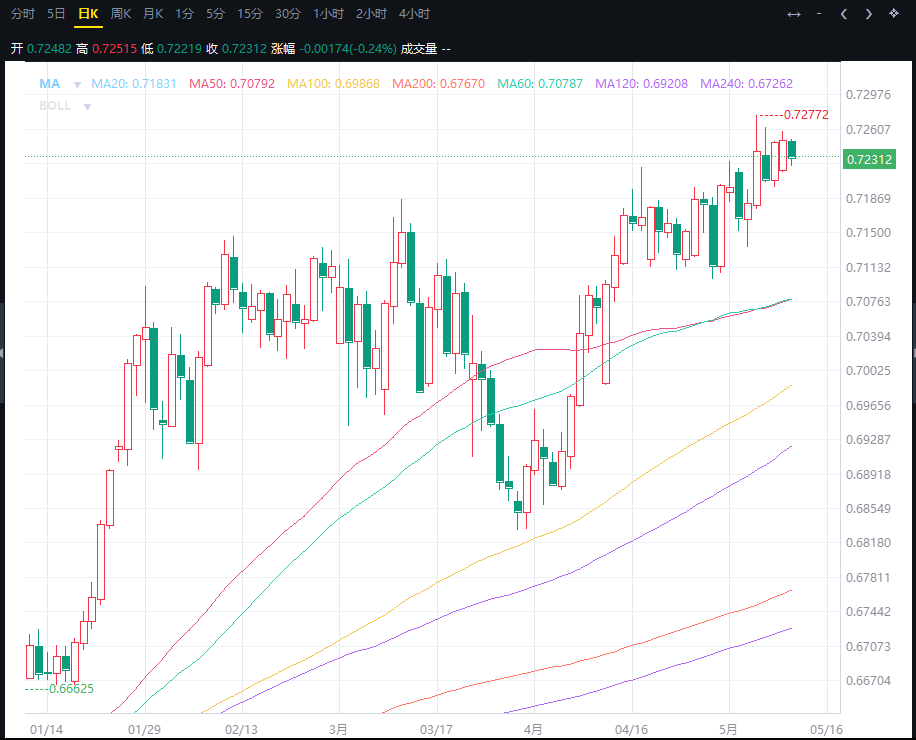
(AUD/USD daily chart, source: FX678)
At 10:16 Beijing time on May 12, the Australian dollar was trading at 0.7231/32 against the US dollar.
Even with renewed escalation of tensions in the Middle East and continued surge in oil prices, the US dollar has struggled to gain substantial upward momentum, instead falling back to levels that threaten a new round of bearish breakouts for the dollar index.
The driving logic for the Australian dollar has shifted: risk sentiment has replaced interest rate differentials as the dominant factor.
For the Australian dollar against the US dollar, the timing of this institutional shift is crucial. The Australian dollar is no longer a carry trader, but has evolved into a leveraged expression of risk appetite and the direction of the US dollar.
This relationship has become exceptionally strong over the past month and has further intensified in the past week. Correlation matrices show that the negative correlation between the Australian dollar and the US dollar index has reached extremely high levels across multiple timeframes, confirming that the overall direction of the US dollar is now the dominant force driving the currency pair. Meanwhile, the Australian dollar's strongest positive correlation is increasingly linked to broad risk appetite – its recent correlation with US and global stock markets has surged to 0.96, and it also maintains a close link with implied government bond market volatility.
As long as technology stocks (a key driver of the stock market rally) do not collapse, the Australian dollar will likely remain supported against the US dollar.
Traditional macroeconomic events may have limited impact: the Australian budget and US CPI are likely to have little effect.
This shift in logic suggests that today's federal budget may be more of a "material" for headline writers than a genuine market-moving event. The Australian budget rarely has a lasting impact on the market; and the lack of correlation between the Australian dollar and interest rate differentials also casts doubt on the budget's influence on exchange rates. The same logic largely applies to tonight's US April CPI data. Stable labor market conditions and slow wage growth allow the Federal Reserve to ignore any short-term energy-driven inflationary pulses—as these reflect cost-push rather than demand-pull forces—leaving the market questioning whether this report will significantly alter the US interest rate outlook and thus affect the dollar's trajectory.
The meeting between Chinese and American leaders: a potential key variable in sentiment.
Market attention may be more focused on other factors influencing risk sentiment, the most important of which is Trump's visit to China. This meeting could help support risk appetite at a time when risk sentiment appears to be the dominant driver of the Australian dollar against the US dollar. Although the relationship between the US and China is not as close as it used to be, any improvement in sentiment surrounding US-China relations should theoretically be beneficial to the Australian dollar.
Consolidation at high levels, poised for a breakout.
On Tuesday (May 12) during the Asian session, the Australian dollar weakened slightly against the US dollar, currently trading around 0.7231, down about 0.24% on the day. It opened at 0.7248, reaching a high of 0.7251 and a low of 0.7221. After hitting a near four-year closing high on Monday, the exchange rate is currently consolidating in a narrow range at high levels, with a fluctuation of only 0.40%, indicating that the market has entered a consolidation phase after continuous gains, with both bulls and bears awaiting a new catalyst.
(AUD/USD daily chart, source: FX678)
At 10:16 Beijing time on May 12, the Australian dollar was trading at 0.7231/32 against the US dollar.
- Risk Warning and Disclaimer
- The market involves risk, and trading may not be suitable for all investors. This article is for reference only and does not constitute personal investment advice, nor does it take into account certain users’ specific investment objectives, financial situation, or other needs. Any investment decisions made based on this information are at your own risk.