The secrets of non-farm payrolls, the drivers of oil prices, the suspense surrounding CPI: The Euro stands at a crossroads.
2026-05-12 11:03:39
On Friday (May 8), the US dollar weakened against major currencies, despite the US jobs report showing that non-farm payrolls increased far more than expected. Investors remained concerned about whether the labor market could fully recover from its difficulties.
While the non-farm payroll report appeared strong, it concealed underlying concerns: part-time employment surged to a 14-month high, household employment declined for the fourth consecutive month, and the unemployment rate remaining stable at 4.3% was merely a "false alarm" of a shrinking labor force. Average hourly wage growth fell short of expectations, indicating that while the economic situation does not support interest rate cuts, there is also no immediate need for rate hikes. Following the report's release, the market's probability of a 25 basis point rate hike before April next year decreased, dragging down US Treasury yields and the dollar.

Despite this, the dollar still gapped up earlier in the week after US President Trump said Iran's response to US peace proposals was "completely unacceptable." Iran has demanded the lifting of sanctions, the right to limited nuclear activities, and the withdrawal of US naval forces around the Strait of Hormuz.
However, the dollar quickly gave back the gains from the gap opening. Meanwhile, oil prices rose due to market concerns that the Strait of Hormuz might not reopen, reigniting fears that inflation might be more persistent than expected and pushing the probability of a Federal Reserve rate hike before April 2027 to 45%.
Against this backdrop, dollar traders will be paying close attention to the US April CPI data due on Tuesday. Market expectations for the April CPI are: headline inflation rising 3.7% year-on-year from 3.3%; core inflation rising slightly to 2.7% year-on-year from 2.6%. The continued rise in the year-on-year change rate of oil prices in April supports the view that headline inflation may be accelerating faster than core price pressures. If the inflation rate approaches twice the Fed's 2% target, it could further boost market expectations for an interest rate hike sometime next year, thus providing more support for the dollar—especially if the US and Iran continue to struggle to reach a solid, lasting peace agreement to end the war.
The current dollar's trajectory is caught in a tug-of-war among multiple factors. The seemingly strong non-farm payroll report masks structural concerns in the labor market, while geopolitical risks continue to support inflation and interest rate hike expectations. Tuesday's April CPI data will be a key variable: if inflation exceeds expectations, it could strengthen market bets on a Fed rate hike in 2027, providing upward momentum for the dollar; if inflation is moderate, it could put downward pressure on the dollar.
From a technical perspective, the euro/dollar pair is consolidating neutrally within the 1.1740-1.1830 range, awaiting inflation data to provide direction. Investors also need to closely monitor developments in the US-Iran situation, as any diplomatic breakthrough or military escalation could have a significant impact on the exchange rate.
The euro is currently trading around 1.1760 against the dollar, down slightly by 0.20% on the day with a range of only 0.25%. After rising, the market has entered a narrow consolidation phase, awaiting the direction of tonight's US CPI data.
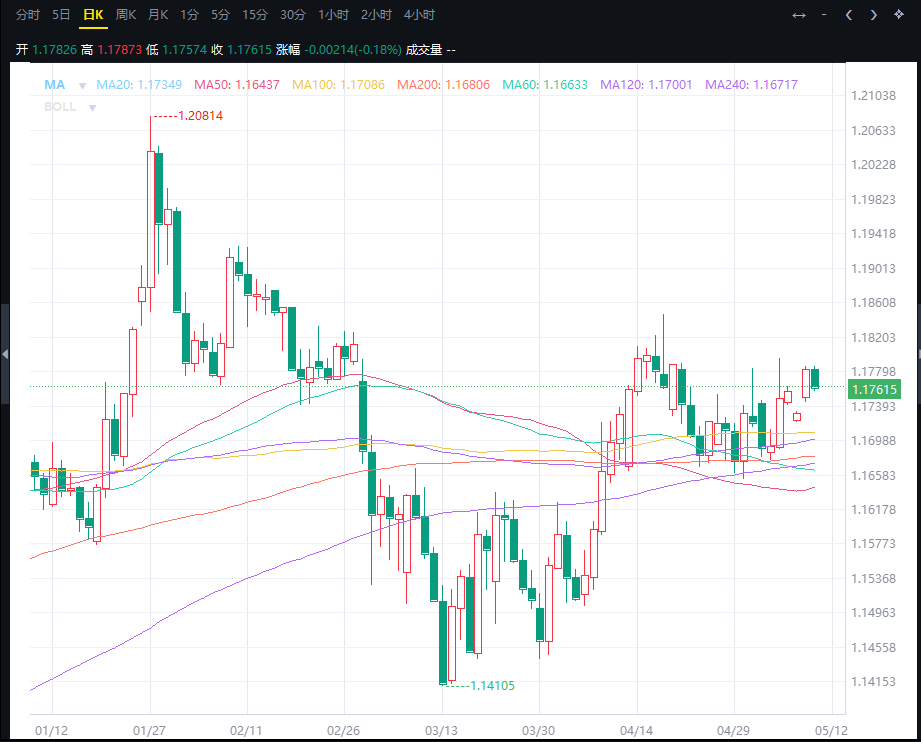
The moving average system shows a clear bullish alignment, with the current price firmly above all major moving averages, including the 20-day moving average (1.1735), the 50-day moving average (1.1644), and the 200-day moving average (1.1681), indicating that the medium-term bullish trend remains unchanged.
If tonight's US CPI data is strong and causes the exchange rate to fall below 1.1670, the current bullish structure will be disrupted; conversely, if inflation is moderate, the euro is expected to test the 1.1830 resistance level.
At 11:02 Beijing time on May 12, the euro was trading at 1.1760/61 against the US dollar.
While the non-farm payroll report appeared strong, it concealed underlying concerns: part-time employment surged to a 14-month high, household employment declined for the fourth consecutive month, and the unemployment rate remaining stable at 4.3% was merely a "false alarm" of a shrinking labor force. Average hourly wage growth fell short of expectations, indicating that while the economic situation does not support interest rate cuts, there is also no immediate need for rate hikes. Following the report's release, the market's probability of a 25 basis point rate hike before April next year decreased, dragging down US Treasury yields and the dollar.
Geopolitics: Continues to support expectations of interest rate hikes
Despite this, the dollar still gapped up earlier in the week after US President Trump said Iran's response to US peace proposals was "completely unacceptable." Iran has demanded the lifting of sanctions, the right to limited nuclear activities, and the withdrawal of US naval forces around the Strait of Hormuz.
However, the dollar quickly gave back the gains from the gap opening. Meanwhile, oil prices rose due to market concerns that the Strait of Hormuz might not reopen, reigniting fears that inflation might be more persistent than expected and pushing the probability of a Federal Reserve rate hike before April 2027 to 45%.
This week's focus: US April CPI data
Against this backdrop, dollar traders will be paying close attention to the US April CPI data due on Tuesday. Market expectations for the April CPI are: headline inflation rising 3.7% year-on-year from 3.3%; core inflation rising slightly to 2.7% year-on-year from 2.6%. The continued rise in the year-on-year change rate of oil prices in April supports the view that headline inflation may be accelerating faster than core price pressures. If the inflation rate approaches twice the Fed's 2% target, it could further boost market expectations for an interest rate hike sometime next year, thus providing more support for the dollar—especially if the US and Iran continue to struggle to reach a solid, lasting peace agreement to end the war.
The current dollar's trajectory is caught in a tug-of-war among multiple factors. The seemingly strong non-farm payroll report masks structural concerns in the labor market, while geopolitical risks continue to support inflation and interest rate hike expectations. Tuesday's April CPI data will be a key variable: if inflation exceeds expectations, it could strengthen market bets on a Fed rate hike in 2027, providing upward momentum for the dollar; if inflation is moderate, it could put downward pressure on the dollar.
The euro is consolidating; will it break out or pull back?
From a technical perspective, the euro/dollar pair is consolidating neutrally within the 1.1740-1.1830 range, awaiting inflation data to provide direction. Investors also need to closely monitor developments in the US-Iran situation, as any diplomatic breakthrough or military escalation could have a significant impact on the exchange rate.
The euro is currently trading around 1.1760 against the dollar, down slightly by 0.20% on the day with a range of only 0.25%. After rising, the market has entered a narrow consolidation phase, awaiting the direction of tonight's US CPI data.
The moving average system shows a clear bullish alignment, with the current price firmly above all major moving averages, including the 20-day moving average (1.1735), the 50-day moving average (1.1644), and the 200-day moving average (1.1681), indicating that the medium-term bullish trend remains unchanged.
If tonight's US CPI data is strong and causes the exchange rate to fall below 1.1670, the current bullish structure will be disrupted; conversely, if inflation is moderate, the euro is expected to test the 1.1830 resistance level.
At 11:02 Beijing time on May 12, the euro was trading at 1.1760/61 against the US dollar.
- Risk Warning and Disclaimer
- The market involves risk, and trading may not be suitable for all investors. This article is for reference only and does not constitute personal investment advice, nor does it take into account certain users’ specific investment objectives, financial situation, or other needs. Any investment decisions made based on this information are at your own risk.