Weak Japanese consumer data coupled with heightened risk aversion in the Middle East sent the dollar/yen pair on a continued rebound.
2026-05-12 10:39:38
The US dollar/Japanese yen pair extended its rebound in Asian trading on Tuesday, rising for the second consecutive session and reaching its highest level in nearly four trading days. While digesting weak Japanese consumer data, the market also continued to focus on the impact of US inflation data and developments in the Middle East on the global foreign exchange market.

The latest data released by Japan's Ministry of Internal Affairs and Communications shows that Japanese household spending fell 2.9% year-on-year in March, significantly weaker than market expectations and a further widening of the decline from the previous month's 1.8%. This marks the fourth consecutive month of decline in Japanese household consumption, reflecting continued pressure on Japanese residents' purchasing power amid high inflation.
Data shows that rising costs of food, energy, and living expenses in Japan are significantly eroding residents' real income. Weak consumption has become one of the main pressures facing Japan's economic recovery. Markets are concerned that if consumption remains sluggish, Japan's economic growth momentum may slow further.
The yen weakened across Asian markets due to data releases, with the USD/JPY pair rising to around 157.50 at one point. Meanwhile, continued tensions in the Middle East further diminished the yen's safe-haven appeal. Previously, the market had hoped for a potential peace agreement between the US and Iran, but recent disagreements over their nuclear programs and the ongoing stalemate in the Strait of Hormuz have reignited risk aversion in the market.
US President Trump recently stated that the current ceasefire between the US and Iran is "extremely fragile." The market believes this means that geopolitical risks in the Middle East are unlikely to ease significantly in the short term. Against this backdrop, the US dollar, as the global reserve currency, has once again attracted some safe-haven inflows. Rising geopolitical risks typically favor a strong dollar, while the Japanese yen is more influenced by domestic Japanese economic data.
However, while the USD/JPY pair has risen in the short term, its overall upward momentum remains relatively limited. This is because market expectations regarding the future path of the Federal Reserve's monetary policy are changing. Currently, the market generally expects the likelihood of further rate hikes by the Fed this year to have significantly decreased. With signs of slowing US economic growth, some institutions are beginning to bet that the Fed may re-enter an easing cycle. This limits the medium- to long-term upward momentum of the dollar.
Meanwhile, the Bank of Japan continued to send hawkish signals. The summary of the Bank of Japan's April meeting indicated that policymakers still leave room for further interest rate hikes. The market believes that if Japanese inflation remains high, the Bank of Japan may continue to normalize its monetary policy. This means the monetary policy divergence between the US and Japan may gradually narrow, thus limiting further significant appreciation of the US dollar against the yen. The market is currently reassessing the impact of future changes in the US-Japan interest rate differential on the exchange rate market.
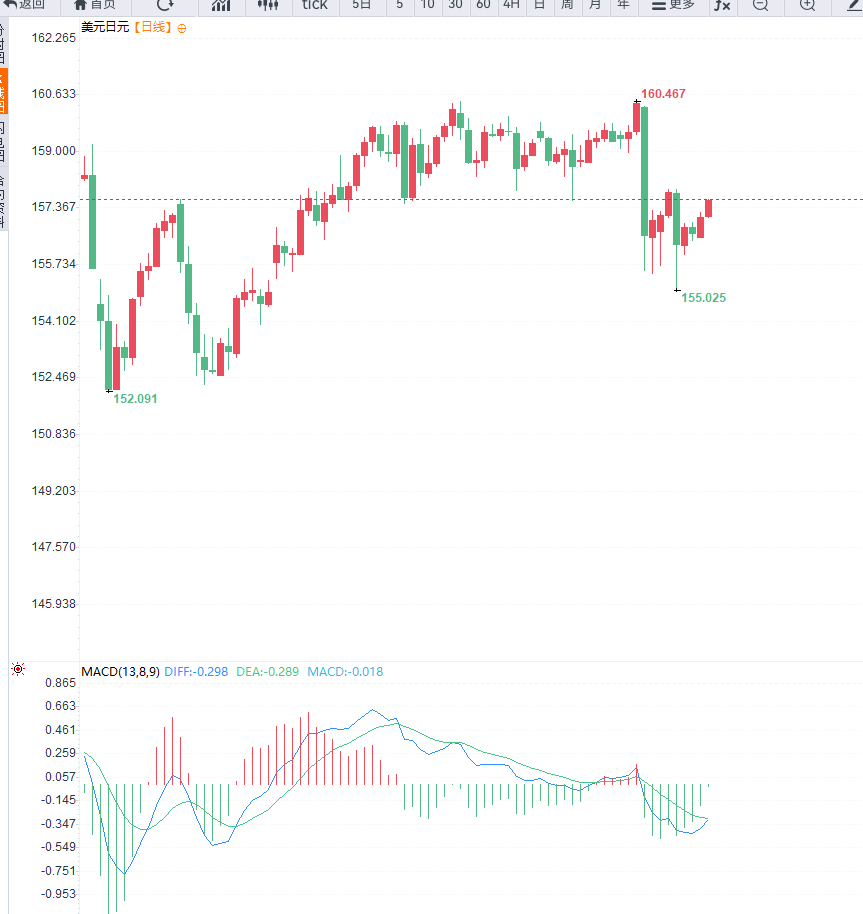
From a technical perspective, the USD/JPY pair remains in a high-level consolidation pattern on the daily chart, trading generally above the medium-term moving average, although short-term bullish momentum has slowed. The MACD indicator is still above the zero line, indicating that the overall trend has not yet turned bearish. However, on the 4-hour chart, the pair has encountered some technical resistance around 157.80, with the RSI indicator approaching high levels, suggesting a need for short-term consolidation. If USD/JPY breaks through the 158 level, it may further test the 159 area; however, if it breaks below the 156.80 support, it may fall back to the 155 area. The market focus has now shifted to the upcoming US Consumer Price Index (CPI) data tonight. If US inflation data continues to exceed expectations, the US dollar index may strengthen further, thus pushing USD/JPY higher; conversely, if inflation slows, it may strengthen market expectations for a Fed rate cut, thereby limiting the dollar's gains.
Overall, the USD/JPY market is currently trading on both the "weak Japanese economy logic" and the "Federal Reserve policy shift logic." Going forward, the situation in the Middle East, US inflation data, and expectations regarding the Bank of Japan's policy will continue to dominate the direction of exchange rate market fluctuations.
Editor's Summary : The current USD/JPY exchange rate exhibits a typical "high-level consolidation" pattern. On one hand, persistently weak Japanese consumer data is putting downward pressure on the yen; on the other hand, cooling expectations for a Fed rate hike and the Bank of Japan's potential rate hike stance are limiting further significant dollar appreciation. Meanwhile, escalating tensions in the Middle East have reaffirmed the dollar's safe-haven appeal, leading to a significant rebound in market risk sentiment. The most crucial variables for the market going forward will remain US inflation data, the Fed's policy path, and whether the Bank of Japan continues its monetary policy normalization efforts. Overall, the USD/JPY exchange rate is likely to maintain high-level consolidation in the short term, but as global monetary policy divergences gradually narrow, exchange rate volatility may increase further.
The latest data released by Japan's Ministry of Internal Affairs and Communications shows that Japanese household spending fell 2.9% year-on-year in March, significantly weaker than market expectations and a further widening of the decline from the previous month's 1.8%. This marks the fourth consecutive month of decline in Japanese household consumption, reflecting continued pressure on Japanese residents' purchasing power amid high inflation.
Data shows that rising costs of food, energy, and living expenses in Japan are significantly eroding residents' real income. Weak consumption has become one of the main pressures facing Japan's economic recovery. Markets are concerned that if consumption remains sluggish, Japan's economic growth momentum may slow further.
The yen weakened across Asian markets due to data releases, with the USD/JPY pair rising to around 157.50 at one point. Meanwhile, continued tensions in the Middle East further diminished the yen's safe-haven appeal. Previously, the market had hoped for a potential peace agreement between the US and Iran, but recent disagreements over their nuclear programs and the ongoing stalemate in the Strait of Hormuz have reignited risk aversion in the market.
US President Trump recently stated that the current ceasefire between the US and Iran is "extremely fragile." The market believes this means that geopolitical risks in the Middle East are unlikely to ease significantly in the short term. Against this backdrop, the US dollar, as the global reserve currency, has once again attracted some safe-haven inflows. Rising geopolitical risks typically favor a strong dollar, while the Japanese yen is more influenced by domestic Japanese economic data.
However, while the USD/JPY pair has risen in the short term, its overall upward momentum remains relatively limited. This is because market expectations regarding the future path of the Federal Reserve's monetary policy are changing. Currently, the market generally expects the likelihood of further rate hikes by the Fed this year to have significantly decreased. With signs of slowing US economic growth, some institutions are beginning to bet that the Fed may re-enter an easing cycle. This limits the medium- to long-term upward momentum of the dollar.
Meanwhile, the Bank of Japan continued to send hawkish signals. The summary of the Bank of Japan's April meeting indicated that policymakers still leave room for further interest rate hikes. The market believes that if Japanese inflation remains high, the Bank of Japan may continue to normalize its monetary policy. This means the monetary policy divergence between the US and Japan may gradually narrow, thus limiting further significant appreciation of the US dollar against the yen. The market is currently reassessing the impact of future changes in the US-Japan interest rate differential on the exchange rate market.
From a technical perspective, the USD/JPY pair remains in a high-level consolidation pattern on the daily chart, trading generally above the medium-term moving average, although short-term bullish momentum has slowed. The MACD indicator is still above the zero line, indicating that the overall trend has not yet turned bearish. However, on the 4-hour chart, the pair has encountered some technical resistance around 157.80, with the RSI indicator approaching high levels, suggesting a need for short-term consolidation. If USD/JPY breaks through the 158 level, it may further test the 159 area; however, if it breaks below the 156.80 support, it may fall back to the 155 area. The market focus has now shifted to the upcoming US Consumer Price Index (CPI) data tonight. If US inflation data continues to exceed expectations, the US dollar index may strengthen further, thus pushing USD/JPY higher; conversely, if inflation slows, it may strengthen market expectations for a Fed rate cut, thereby limiting the dollar's gains.
Overall, the USD/JPY market is currently trading on both the "weak Japanese economy logic" and the "Federal Reserve policy shift logic." Going forward, the situation in the Middle East, US inflation data, and expectations regarding the Bank of Japan's policy will continue to dominate the direction of exchange rate market fluctuations.
Editor's Summary : The current USD/JPY exchange rate exhibits a typical "high-level consolidation" pattern. On one hand, persistently weak Japanese consumer data is putting downward pressure on the yen; on the other hand, cooling expectations for a Fed rate hike and the Bank of Japan's potential rate hike stance are limiting further significant dollar appreciation. Meanwhile, escalating tensions in the Middle East have reaffirmed the dollar's safe-haven appeal, leading to a significant rebound in market risk sentiment. The most crucial variables for the market going forward will remain US inflation data, the Fed's policy path, and whether the Bank of Japan continues its monetary policy normalization efforts. Overall, the USD/JPY exchange rate is likely to maintain high-level consolidation in the short term, but as global monetary policy divergences gradually narrow, exchange rate volatility may increase further.
- Risk Warning and Disclaimer
- The market involves risk, and trading may not be suitable for all investors. This article is for reference only and does not constitute personal investment advice, nor does it take into account certain users’ specific investment objectives, financial situation, or other needs. Any investment decisions made based on this information are at your own risk.