The situation in the Middle East and the risk of economic slowdown are suppressing expectations of interest rate hikes, with the market anticipating that the European Central Bank may keep interest rates unchanged in June.
2026-05-12 17:07:37
As the situation in the Middle East continues to escalate and international energy prices remain high, discussions about the future monetary policy path of the European Central Bank (ECB) are clearly heating up. However, TD Securities' latest assessment indicates a significantly cautious stance on the ECB's policy outlook for June. Contrary to some market expectations, TD Securities believes the ECB is more likely to maintain interest rates at its June meeting rather than raise them further.

The report points out that the European economy still faces pressure from slowing growth, and market concerns about the "secondary transmission effect" of inflation have not yet fully materialized. The "secondary transmission effect" mainly refers to the phenomenon where rising energy prices further drive up wages, services, and core consumer prices, thus creating long-term inflationary pressure. TD Securities believes that there are currently no sufficiently obvious signs of runaway wages and core inflation in Europe, therefore the European Central Bank lacks the need for an immediate interest rate hike in the short term.
The biggest variable in the market remains the situation in the Middle East. With the ceasefire between the US and Iran still fragile, the market is concerned that the risks to shipping through the Strait of Hormuz may escalate further. The Strait of Hormuz handles approximately 20% of global seaborne crude oil transport, making energy supply risks a significant factor driving up international oil prices. Brent crude oil prices have recently remained around $104, and high energy prices are again pushing up global inflation expectations. However, TD Securities believes that while rising energy prices will increase inflationary pressures in Europe, the momentum of European economic growth itself has clearly weakened. In particular, manufacturing activity, consumer confidence, and business investment intentions have all slowed to varying degrees recently.
Against the backdrop of weak economic growth, the European Central Bank needs to find a balance between "controlling inflation" and "avoiding further economic slowdown".
Analysts suggest three different scenarios ahead of the European Central Bank's (ECB) June meeting in the coming weeks. The first scenario involves a gradual easing of tensions in the Middle East and a decline in energy prices, potentially easing inflationary pressures in Europe temporarily. The second scenario involves a continued stalemate, with oil prices remaining high, but domestic demand in Europe remaining weak. The third scenario involves a renewed escalation of tensions in the Middle East, coupled with a significant secondary transmission of inflation in Europe, leading to continued rapid increases in wages and service prices. TD Securities points out that only the third scenario is likely to truly prompt the ECB to reconsider raising interest rates. Currently, the combined probability of the first two scenarios remains above 50%.
Therefore, the institution believes that the European Central Bank is more likely to keep interest rates unchanged in June and continue to monitor subsequent data changes, while allowing the current tight financial environment to continue to play a role in curbing inflation. In fact, financial conditions in Europe have already tightened significantly. Eurozone financing costs remain high, corporate loan demand continues to decline, and the real estate market is also suppressed by high interest rates. At the same time, some European countries still face significant fiscal pressure, and the high-interest-rate environment is gradually affecting the cost of government debt financing.
From a market performance perspective, the euro has maintained a high-level consolidation pattern recently. Although the US dollar index has rebounded recently due to safe-haven demand and high US inflation expectations, the euro has not shown a significant downward trend. The market believes that if the European Central Bank continues to maintain a cautious stance and the Federal Reserve also maintains high interest rates, the interest rate differential between the US and Europe may change relatively limitedly. From a technical perspective, the euro/dollar exchange rate is still trading within an upward channel, but the short-term upward momentum has slowed. The daily chart shows that the exchange rate continues to be above major moving averages, and the medium- to long-term bullish structure has not been broken. However, the 4-hour chart shows that the short-term market has entered a consolidation phase. With the release of US CPI and subsequent European inflation data, exchange rate volatility may further increase.
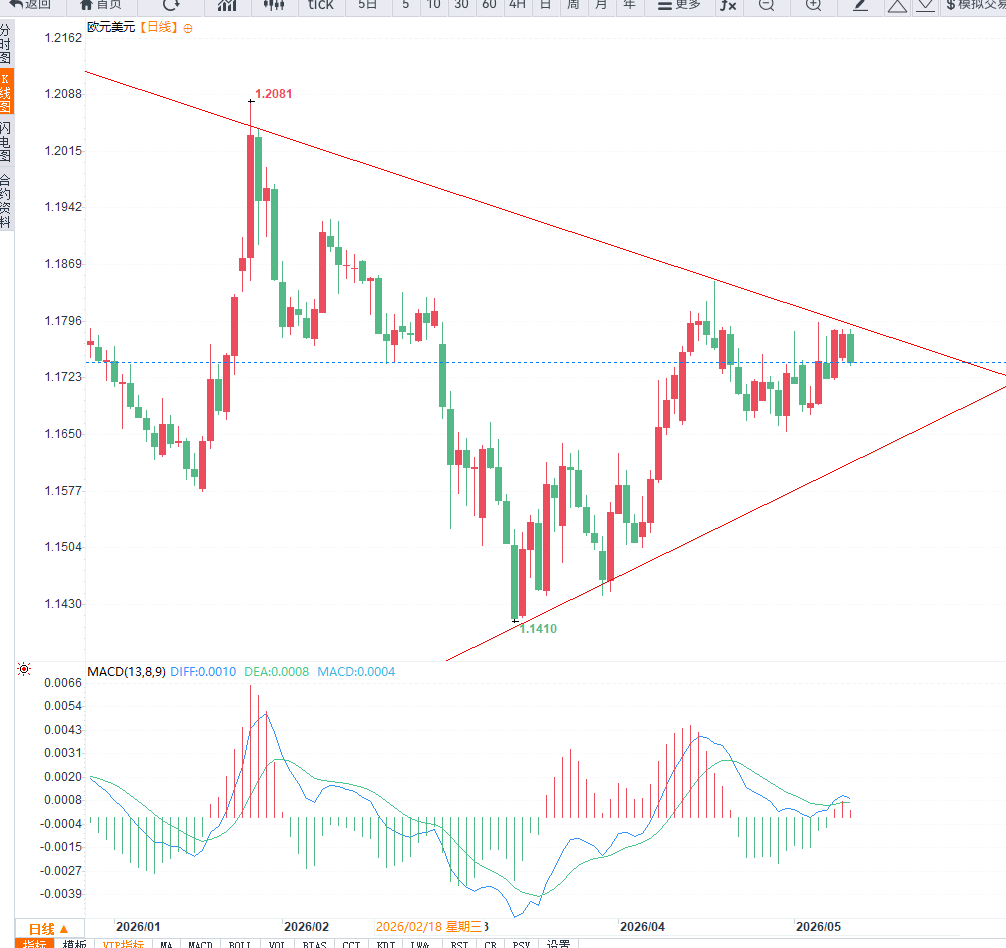
If European economic data continues to weaken, the euro may face some downward pressure; however, if the situation in the Middle East leads to a renewed acceleration of inflation in Europe, market expectations for an ECB interest rate hike may rise again. Overall, the ECB's policy outlook remains highly dependent on changes in energy prices, the situation in the Middle East, and the performance of domestic European economic data.
Editor's Summary : The European Central Bank (ECB) is currently facing a complex policy environment. On the one hand, the situation in the Middle East is pushing up international oil prices and increasing inflationary pressures in Europe; on the other hand, the continued slowdown in European economic growth and market confidence is limiting the scope for further interest rate hikes. TD Securities believes that unless a significant "double-dip inflation effect" occurs in Europe, the ECB is more likely to keep interest rates unchanged in June. Going forward, the market should focus on European inflation data, wage growth, and developments in the Middle East, as these factors will continue to determine the ECB's future policy path and the euro's trajectory.
The report points out that the European economy still faces pressure from slowing growth, and market concerns about the "secondary transmission effect" of inflation have not yet fully materialized. The "secondary transmission effect" mainly refers to the phenomenon where rising energy prices further drive up wages, services, and core consumer prices, thus creating long-term inflationary pressure. TD Securities believes that there are currently no sufficiently obvious signs of runaway wages and core inflation in Europe, therefore the European Central Bank lacks the need for an immediate interest rate hike in the short term.
The biggest variable in the market remains the situation in the Middle East. With the ceasefire between the US and Iran still fragile, the market is concerned that the risks to shipping through the Strait of Hormuz may escalate further. The Strait of Hormuz handles approximately 20% of global seaborne crude oil transport, making energy supply risks a significant factor driving up international oil prices. Brent crude oil prices have recently remained around $104, and high energy prices are again pushing up global inflation expectations. However, TD Securities believes that while rising energy prices will increase inflationary pressures in Europe, the momentum of European economic growth itself has clearly weakened. In particular, manufacturing activity, consumer confidence, and business investment intentions have all slowed to varying degrees recently.
Against the backdrop of weak economic growth, the European Central Bank needs to find a balance between "controlling inflation" and "avoiding further economic slowdown".
Analysts suggest three different scenarios ahead of the European Central Bank's (ECB) June meeting in the coming weeks. The first scenario involves a gradual easing of tensions in the Middle East and a decline in energy prices, potentially easing inflationary pressures in Europe temporarily. The second scenario involves a continued stalemate, with oil prices remaining high, but domestic demand in Europe remaining weak. The third scenario involves a renewed escalation of tensions in the Middle East, coupled with a significant secondary transmission of inflation in Europe, leading to continued rapid increases in wages and service prices. TD Securities points out that only the third scenario is likely to truly prompt the ECB to reconsider raising interest rates. Currently, the combined probability of the first two scenarios remains above 50%.
Therefore, the institution believes that the European Central Bank is more likely to keep interest rates unchanged in June and continue to monitor subsequent data changes, while allowing the current tight financial environment to continue to play a role in curbing inflation. In fact, financial conditions in Europe have already tightened significantly. Eurozone financing costs remain high, corporate loan demand continues to decline, and the real estate market is also suppressed by high interest rates. At the same time, some European countries still face significant fiscal pressure, and the high-interest-rate environment is gradually affecting the cost of government debt financing.
From a market performance perspective, the euro has maintained a high-level consolidation pattern recently. Although the US dollar index has rebounded recently due to safe-haven demand and high US inflation expectations, the euro has not shown a significant downward trend. The market believes that if the European Central Bank continues to maintain a cautious stance and the Federal Reserve also maintains high interest rates, the interest rate differential between the US and Europe may change relatively limitedly. From a technical perspective, the euro/dollar exchange rate is still trading within an upward channel, but the short-term upward momentum has slowed. The daily chart shows that the exchange rate continues to be above major moving averages, and the medium- to long-term bullish structure has not been broken. However, the 4-hour chart shows that the short-term market has entered a consolidation phase. With the release of US CPI and subsequent European inflation data, exchange rate volatility may further increase.
If European economic data continues to weaken, the euro may face some downward pressure; however, if the situation in the Middle East leads to a renewed acceleration of inflation in Europe, market expectations for an ECB interest rate hike may rise again. Overall, the ECB's policy outlook remains highly dependent on changes in energy prices, the situation in the Middle East, and the performance of domestic European economic data.
Editor's Summary : The European Central Bank (ECB) is currently facing a complex policy environment. On the one hand, the situation in the Middle East is pushing up international oil prices and increasing inflationary pressures in Europe; on the other hand, the continued slowdown in European economic growth and market confidence is limiting the scope for further interest rate hikes. TD Securities believes that unless a significant "double-dip inflation effect" occurs in Europe, the ECB is more likely to keep interest rates unchanged in June. Going forward, the market should focus on European inflation data, wage growth, and developments in the Middle East, as these factors will continue to determine the ECB's future policy path and the euro's trajectory.
- Risk Warning and Disclaimer
- The market involves risk, and trading may not be suitable for all investors. This article is for reference only and does not constitute personal investment advice, nor does it take into account certain users’ specific investment objectives, financial situation, or other needs. Any investment decisions made based on this information are at your own risk.