Gold Trading Alert: Hopes for peace with Iran dashed + US inflation skyrockets, gold prices surge and then retreat. Is there still a chance for bulls?
2026-05-13 07:33:33
The gold market experienced significant volatility on Tuesday (May 12). Spot gold initially surged to a three-week high of $4773.37 per ounce in early trading, before weakening and hitting a low of around $4638.40 after the release of strong US CPI data. It ultimately closed at $4715.07, down approximately 0.4%. US gold futures fell 0.9% to $4686.70. While this appears to be a short-term correction, it actually reflects the combined pressures of soaring oil prices, persistent inflation, and interest rate expectations, which are reshaping the investment logic for gold.
On Wednesday (May 13) in early Asian trading, spot gold traded in a narrow range, currently around $4,720 per ounce.
Oil prices rose for the third consecutive day on Tuesday, with U.S. crude futures surging over 4% to above $102 and Brent crude holding steady above $107. The reason lies in the situation in the Middle East: U.S. President Trump publicly stated that the ceasefire agreement with Iran was "precarious," and Tehran rejected the U.S. proposal, insisting on a list of demands that Trump called "a pile of junk." Iran's assertion of sovereignty over the Strait of Hormuz further amplifies the risk of global oil supply disruptions.
The latest forecast from the U.S. Energy Information Administration (EIA) indicates that the closure of the Strait of Hormuz may be extended to late May, meaning that the loss of Middle Eastern oil and gas supplies will be far greater than previously expected. Even if navigation resumes in the future, the global oil trade pattern will not return to normal until the end of 2026 or the beginning of 2027. Global oil inventories are being depleted at an unprecedented rate, and are expected to decrease by approximately 2.6 million barrels per day this year, far exceeding the earlier forecast of 300,000 barrels per day.
Bart Melek, Global Head of Commodity Strategy at TD Securities, points out that rising oil prices have significantly increased the risk of the Federal Reserve and other central banks being forced to raise interest rates to combat stagflation, and gold is paying the price. High oil prices not only directly push up inflation but also weaken gold's appeal as a traditional safe-haven asset—because in a stagflationary environment, the market prefers to hold strong currencies such as the US dollar.
The U.S. Department of Labor released its April CPI data, showing that the Consumer Price Index rose 0.6% month-over-month and expanded its year-over-year increase to 3.8%, the highest level since May 2023, exceeding market expectations. Energy prices contributed more than 40% of the increase, with gasoline prices rising 5.4% and other motor vehicle fuels surging 17%. Food prices also rebounded significantly, with grocery store inflation rising to a near four-year high, and prices for beef, coffee, fruits and vegetables, and dairy products generally increasing.
Core CPI rose 0.4% month-on-month and 2.8% year-on-year, partly due to one-off rent adjustments, but the transmission effects of service sector prices (rents, airfares) and tariffs continued to manifest. Strong employment data further solidified the Federal Reserve's "hold steady" stance. The market widely expects the Fed to maintain interest rates in the current range of 3.50%-3.75% until 2027.
According to the CME FedWatch tool, the probability of an interest rate cut this year has essentially dropped to zero, while the probability of a 25 basis point rate hike in December has risen to 36%.
Although gold has traditionally been regarded as an inflation hedge, its holding costs have risen significantly in a high-interest-rate environment, and its non-interest-bearing properties have become a significant drag.
Wall Street stocks came under pressure as a result, and the dollar index rose 0.4% to 98.29, its biggest one-day gain since early April. U.S. Treasury yields also rose in tandem, with the two-year yield reaching a near six-week high. The simultaneous rise in the dollar and Treasury yields exerted double pressure on gold, which is priced in dollars and does not generate interest.
Investors have turned their attention to Wednesday's release of the US Producer Price Index (PPI), which is expected to further confirm whether inflationary pressures are spreading from upstream to downstream industries. The meeting between Trump and Chinese President Xi Jinping on Thursday and Friday is also attracting significant attention. Previously, the US imposed sanctions on relevant Chinese entities over Iranian oil shipments, and the potential escalation of US-China trade frictions could continue to support the dollar and oil prices.
It's worth noting that Indian banks resumed gold imports after a month-long suspension. This move by a traditional gold-consuming nation may provide some support for the market in the future. However, given the current macroeconomic environment, its influence is unlikely to reverse the overall trend in the short term.
In summary, this round of gold price correction is the result of a confluence of negative factors: Middle East geopolitical risks have pushed up energy prices, US inflation data has reinforced expectations of high interest rates, and both the US dollar and US Treasury yields have strengthened, collectively compressing the space for gold's survival. Domestic political pressure on the Trump administration—voters blaming its economic policies for high oil prices and high inflation—has also further increased policy uncertainty.
The future direction of gold prices will depend on the final outcome of this stagflation game. If high inflation persists but economic growth slows significantly, forcing central banks to grapple with the dilemma of controlling inflation and avoiding recession, gold's safe-haven appeal will ultimately prevail. Conversely, if central banks do continue to raise interest rates under inflationary pressure, gold will face further downward pressure in the short term.
However, gold has not completely lost its appeal. As long as the conflict in the Middle East does not substantially ease, the risk of global supply chain disruptions will persist; and as long as inflation cannot quickly fall back to the Federal Reserve's 2% target range, safe-haven demand will still have a foothold. The current sharp fluctuations in gold prices between $4,600 and $4,800 are providing a potential entry window for medium- to long-term investors.
For ordinary investors, it is necessary to closely monitor oil price trends, statements from Federal Reserve officials, and the outcomes of high-level meetings between China and the United States. In 2026, with the coexistence of stagflation risks and geopolitical uncertainties, gold remains an important asset for risk diversification, but caution is still needed in the short term, awaiting clearer macroeconomic signals.
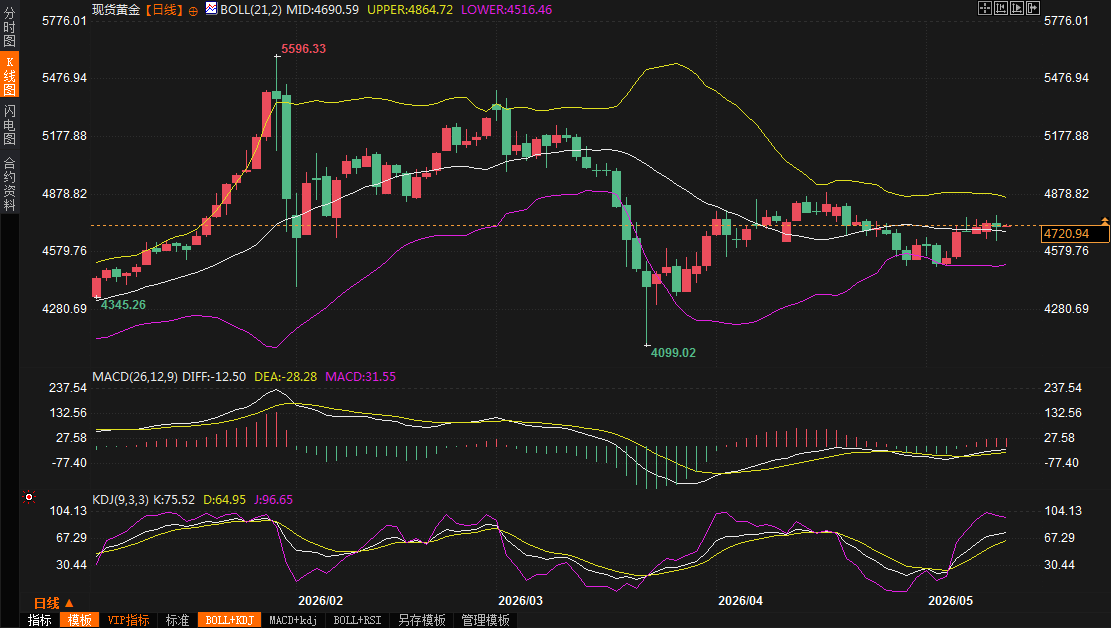
(Spot gold daily chart, source: FX678)
At 07:32 Beijing time, spot gold was trading at $4,721.25 per ounce.
On Wednesday (May 13) in early Asian trading, spot gold traded in a narrow range, currently around $4,720 per ounce.
Escalating geopolitical conflicts: Oil prices become the biggest "killer" of gold.
Oil prices rose for the third consecutive day on Tuesday, with U.S. crude futures surging over 4% to above $102 and Brent crude holding steady above $107. The reason lies in the situation in the Middle East: U.S. President Trump publicly stated that the ceasefire agreement with Iran was "precarious," and Tehran rejected the U.S. proposal, insisting on a list of demands that Trump called "a pile of junk." Iran's assertion of sovereignty over the Strait of Hormuz further amplifies the risk of global oil supply disruptions.
The latest forecast from the U.S. Energy Information Administration (EIA) indicates that the closure of the Strait of Hormuz may be extended to late May, meaning that the loss of Middle Eastern oil and gas supplies will be far greater than previously expected. Even if navigation resumes in the future, the global oil trade pattern will not return to normal until the end of 2026 or the beginning of 2027. Global oil inventories are being depleted at an unprecedented rate, and are expected to decrease by approximately 2.6 million barrels per day this year, far exceeding the earlier forecast of 300,000 barrels per day.
Bart Melek, Global Head of Commodity Strategy at TD Securities, points out that rising oil prices have significantly increased the risk of the Federal Reserve and other central banks being forced to raise interest rates to combat stagflation, and gold is paying the price. High oil prices not only directly push up inflation but also weaken gold's appeal as a traditional safe-haven asset—because in a stagflationary environment, the market prefers to hold strong currencies such as the US dollar.
US inflation data pours cold water on the Fed's rate cut path seems far off.
The U.S. Department of Labor released its April CPI data, showing that the Consumer Price Index rose 0.6% month-over-month and expanded its year-over-year increase to 3.8%, the highest level since May 2023, exceeding market expectations. Energy prices contributed more than 40% of the increase, with gasoline prices rising 5.4% and other motor vehicle fuels surging 17%. Food prices also rebounded significantly, with grocery store inflation rising to a near four-year high, and prices for beef, coffee, fruits and vegetables, and dairy products generally increasing.
Core CPI rose 0.4% month-on-month and 2.8% year-on-year, partly due to one-off rent adjustments, but the transmission effects of service sector prices (rents, airfares) and tariffs continued to manifest. Strong employment data further solidified the Federal Reserve's "hold steady" stance. The market widely expects the Fed to maintain interest rates in the current range of 3.50%-3.75% until 2027.
According to the CME FedWatch tool, the probability of an interest rate cut this year has essentially dropped to zero, while the probability of a 25 basis point rate hike in December has risen to 36%.
Although gold has traditionally been regarded as an inflation hedge, its holding costs have risen significantly in a high-interest-rate environment, and its non-interest-bearing properties have become a significant drag.
Wall Street stocks came under pressure as a result, and the dollar index rose 0.4% to 98.29, its biggest one-day gain since early April. U.S. Treasury yields also rose in tandem, with the two-year yield reaching a near six-week high. The simultaneous rise in the dollar and Treasury yields exerted double pressure on gold, which is priced in dollars and does not generate interest.
Market Focus Preview: PPI Data, US-China Meeting, and Indian Gold Demand
Investors have turned their attention to Wednesday's release of the US Producer Price Index (PPI), which is expected to further confirm whether inflationary pressures are spreading from upstream to downstream industries. The meeting between Trump and Chinese President Xi Jinping on Thursday and Friday is also attracting significant attention. Previously, the US imposed sanctions on relevant Chinese entities over Iranian oil shipments, and the potential escalation of US-China trade frictions could continue to support the dollar and oil prices.
It's worth noting that Indian banks resumed gold imports after a month-long suspension. This move by a traditional gold-consuming nation may provide some support for the market in the future. However, given the current macroeconomic environment, its influence is unlikely to reverse the overall trend in the short term.
Gold Market Outlook: Short-term pressure, but still holds investment value in the medium to long term.
In summary, this round of gold price correction is the result of a confluence of negative factors: Middle East geopolitical risks have pushed up energy prices, US inflation data has reinforced expectations of high interest rates, and both the US dollar and US Treasury yields have strengthened, collectively compressing the space for gold's survival. Domestic political pressure on the Trump administration—voters blaming its economic policies for high oil prices and high inflation—has also further increased policy uncertainty.
The future direction of gold prices will depend on the final outcome of this stagflation game. If high inflation persists but economic growth slows significantly, forcing central banks to grapple with the dilemma of controlling inflation and avoiding recession, gold's safe-haven appeal will ultimately prevail. Conversely, if central banks do continue to raise interest rates under inflationary pressure, gold will face further downward pressure in the short term.
However, gold has not completely lost its appeal. As long as the conflict in the Middle East does not substantially ease, the risk of global supply chain disruptions will persist; and as long as inflation cannot quickly fall back to the Federal Reserve's 2% target range, safe-haven demand will still have a foothold. The current sharp fluctuations in gold prices between $4,600 and $4,800 are providing a potential entry window for medium- to long-term investors.
For ordinary investors, it is necessary to closely monitor oil price trends, statements from Federal Reserve officials, and the outcomes of high-level meetings between China and the United States. In 2026, with the coexistence of stagflation risks and geopolitical uncertainties, gold remains an important asset for risk diversification, but caution is still needed in the short term, awaiting clearer macroeconomic signals.
(Spot gold daily chart, source: FX678)
At 07:32 Beijing time, spot gold was trading at $4,721.25 per ounce.
- Risk Warning and Disclaimer
- The market involves risk, and trading may not be suitable for all investors. This article is for reference only and does not constitute personal investment advice, nor does it take into account certain users’ specific investment objectives, financial situation, or other needs. Any investment decisions made based on this information are at your own risk.