Crude Oil Trading Alert: The closure of the Strait of Hormuz exacerbates global supply concerns, causing WTI crude oil to rebound to the $100 mark and reach a new high for the period.
2026-05-13 09:35:46
The international crude oil market continued its strong upward trend this week, with WTI crude oil rising for several consecutive trading days. On Tuesday, it reached a high of around $102.50, before slightly retreating during Wednesday's Asian session, trading around $101.37. Continued concerns about disruptions to global energy supplies pushed oil prices back above the $100 mark , reaching a significant high in recent times.

The core driver of this price surge remains the impact of the prolonged closure of the Strait of Hormuz on global energy transportation. As one of the world's most important oil shipping routes, the Strait of Hormuz handles approximately 20% of global seaborne crude oil transport . Its continued obstruction signifies a significant decline in the efficiency of international crude oil circulation, forcing refiners and energy-importing countries to reassess supply security risks. This week, US President Trump publicly rejected Tehran's latest peace proposal, stating that the current ceasefire is "close to failure." The US government is assessing new military action options and discussing whether to expand escort operations for commercial vessels in the Strait of Hormuz. This means that the likelihood of normal shipping activity in the strait returning in the short term has further decreased, and market risk aversion has clearly intensified.
Saudi Aramco CEO Amin Nasser said, "The global market is currently losing about 100 million barrels of crude oil supply per week, and if the current situation continues, the return of the energy market to normal may even be delayed until 2027."
These remarks further amplified market concerns about a global supply crisis. Energy traders have begun to reassess the supply and demand balance for the coming quarters, with some institutions even predicting that international oil prices may re-enter a period of high volatility if the Strait of Hormuz remains closed for an extended period.
Meanwhile, the market is awaiting today's U.S. Energy Information Administration (EIA) crude oil inventory report to determine whether domestic crude oil supply in the U.S. has tightened further. Last week, U.S. crude oil inventories fell by approximately 2.3 million barrels, less than the market's expected decrease of 3.3 million barrels. Although inventories are still on a downward trend, the actual decline was less than expected, indicating that the tightness in U.S. crude oil supply has not yet completely spiraled out of control. However, due to the continued extension of the Strait of Hormuz closure, the market generally expects U.S. crude oil inventories to continue to decline in the coming weeks. If this week's EIA data shows a further widening of the inventory decline, WTI crude oil may officially break through the $100 mark and further test higher levels.
In addition to inventory data, the market is also focused on the progress of a new round of communication between the US and Asian countries. Investors hope that Asian countries can promote de-escalation, thereby reducing the risk of global energy supply disruptions. Furthermore, the upcoming US PPI (Producer Price Index) data is also receiving close attention, as rising energy prices continue to be transmitted to the inflationary level.
From a market sentiment perspective, funds are clearly continuing to flow into the energy sector. As geopolitical risks have not yet eased, some institutional investors are increasing their allocation to crude oil and related energy assets to hedge against potential inflation risks.
From a technical perspective, WTI crude oil's daily chart still maintains a clear bullish trend. Currently, the price is trading above $100 and has not broken below the medium-term moving average support, indicating that the medium-to-long-term upward structure remains intact. Although oil prices previously experienced a slight pullback from the $105 area, the overall trend remains strong. However, the Stochastic Relative Strength Index (Stochastic RSI) has fallen back to around 40, indicating that short-term upward momentum is beginning to slow. This means that while oil prices remain in a strong range, further upward movement may face periods of consolidation and profit-taking pressure.
From a 4-hour chart perspective, WTI crude oil is still maintaining a high-level consolidation structure in the short term. The stochastic RSI indicator is around 42, indicating that market momentum is in a neutral to slightly bullish zone, and the short-term trend is more inclined towards consolidation at high levels than a trend reversal. The first short-term support is at the psychological support level of $100 ; a break below this level could lead to a further test of the $95.00 support area. On the upside, given the lack of significant technical resistance, the $105 level will become the most important battleground between bulls and bears in the next phase. A successful break above this level could open up new upside potential.
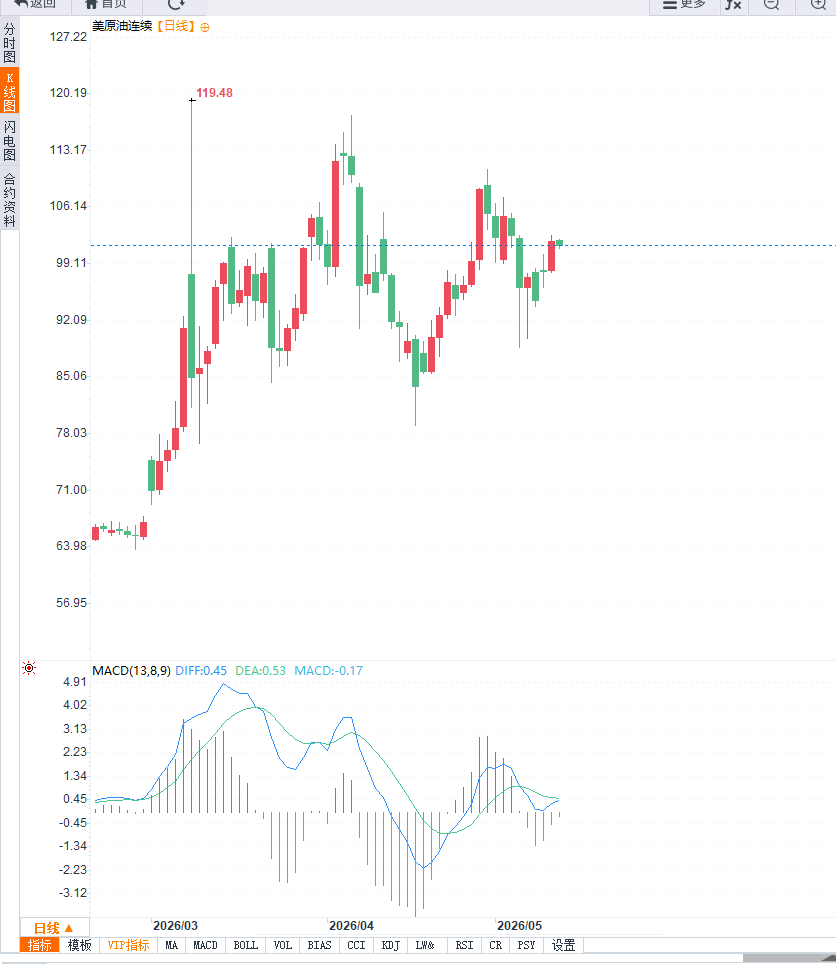
Overall, the international crude oil market has gradually shifted from a traditional supply and demand logic to a geopolitical risk-driven model. Developments in the Strait of Hormuz, changes in US inventories, and policy moves by major global economies will determine whether oil prices will enter a new upward cycle.
Editor's Summary : The biggest risk in the current crude oil market is no longer slowing demand, but rather the continued expansion of supply-side uncertainty. The prolonged closure of the Strait of Hormuz is continuously impacting global energy transportation efficiency, and the market's lack of clear expectations regarding the future recovery timeline is driving funds to flow into the energy market as a safe haven. WTI crude oil's return to $100 is not only a technical breakthrough but also signifies a revaluation of global energy security risks by the market. However, with the rapid rise in oil prices, signs of slowing momentum have begun to emerge in the short term. If subsequent EIA inventory data falls short of expectations, or if there are signs of easing tensions in the Middle East, oil prices may experience a temporary pullback from their highs. But in the medium to long term, as long as global supply risks are not significantly resolved, international oil prices will generally remain high.
The core driver of this price surge remains the impact of the prolonged closure of the Strait of Hormuz on global energy transportation. As one of the world's most important oil shipping routes, the Strait of Hormuz handles approximately 20% of global seaborne crude oil transport . Its continued obstruction signifies a significant decline in the efficiency of international crude oil circulation, forcing refiners and energy-importing countries to reassess supply security risks. This week, US President Trump publicly rejected Tehran's latest peace proposal, stating that the current ceasefire is "close to failure." The US government is assessing new military action options and discussing whether to expand escort operations for commercial vessels in the Strait of Hormuz. This means that the likelihood of normal shipping activity in the strait returning in the short term has further decreased, and market risk aversion has clearly intensified.
Saudi Aramco CEO Amin Nasser said, "The global market is currently losing about 100 million barrels of crude oil supply per week, and if the current situation continues, the return of the energy market to normal may even be delayed until 2027."
These remarks further amplified market concerns about a global supply crisis. Energy traders have begun to reassess the supply and demand balance for the coming quarters, with some institutions even predicting that international oil prices may re-enter a period of high volatility if the Strait of Hormuz remains closed for an extended period.
Meanwhile, the market is awaiting today's U.S. Energy Information Administration (EIA) crude oil inventory report to determine whether domestic crude oil supply in the U.S. has tightened further. Last week, U.S. crude oil inventories fell by approximately 2.3 million barrels, less than the market's expected decrease of 3.3 million barrels. Although inventories are still on a downward trend, the actual decline was less than expected, indicating that the tightness in U.S. crude oil supply has not yet completely spiraled out of control. However, due to the continued extension of the Strait of Hormuz closure, the market generally expects U.S. crude oil inventories to continue to decline in the coming weeks. If this week's EIA data shows a further widening of the inventory decline, WTI crude oil may officially break through the $100 mark and further test higher levels.
In addition to inventory data, the market is also focused on the progress of a new round of communication between the US and Asian countries. Investors hope that Asian countries can promote de-escalation, thereby reducing the risk of global energy supply disruptions. Furthermore, the upcoming US PPI (Producer Price Index) data is also receiving close attention, as rising energy prices continue to be transmitted to the inflationary level.
From a market sentiment perspective, funds are clearly continuing to flow into the energy sector. As geopolitical risks have not yet eased, some institutional investors are increasing their allocation to crude oil and related energy assets to hedge against potential inflation risks.
From a technical perspective, WTI crude oil's daily chart still maintains a clear bullish trend. Currently, the price is trading above $100 and has not broken below the medium-term moving average support, indicating that the medium-to-long-term upward structure remains intact. Although oil prices previously experienced a slight pullback from the $105 area, the overall trend remains strong. However, the Stochastic Relative Strength Index (Stochastic RSI) has fallen back to around 40, indicating that short-term upward momentum is beginning to slow. This means that while oil prices remain in a strong range, further upward movement may face periods of consolidation and profit-taking pressure.
From a 4-hour chart perspective, WTI crude oil is still maintaining a high-level consolidation structure in the short term. The stochastic RSI indicator is around 42, indicating that market momentum is in a neutral to slightly bullish zone, and the short-term trend is more inclined towards consolidation at high levels than a trend reversal. The first short-term support is at the psychological support level of $100 ; a break below this level could lead to a further test of the $95.00 support area. On the upside, given the lack of significant technical resistance, the $105 level will become the most important battleground between bulls and bears in the next phase. A successful break above this level could open up new upside potential.
Overall, the international crude oil market has gradually shifted from a traditional supply and demand logic to a geopolitical risk-driven model. Developments in the Strait of Hormuz, changes in US inventories, and policy moves by major global economies will determine whether oil prices will enter a new upward cycle.
Editor's Summary : The biggest risk in the current crude oil market is no longer slowing demand, but rather the continued expansion of supply-side uncertainty. The prolonged closure of the Strait of Hormuz is continuously impacting global energy transportation efficiency, and the market's lack of clear expectations regarding the future recovery timeline is driving funds to flow into the energy market as a safe haven. WTI crude oil's return to $100 is not only a technical breakthrough but also signifies a revaluation of global energy security risks by the market. However, with the rapid rise in oil prices, signs of slowing momentum have begun to emerge in the short term. If subsequent EIA inventory data falls short of expectations, or if there are signs of easing tensions in the Middle East, oil prices may experience a temporary pullback from their highs. But in the medium to long term, as long as global supply risks are not significantly resolved, international oil prices will generally remain high.
- Risk Warning and Disclaimer
- The market involves risk, and trading may not be suitable for all investors. This article is for reference only and does not constitute personal investment advice, nor does it take into account certain users’ specific investment objectives, financial situation, or other needs. Any investment decisions made based on this information are at your own risk.