The Reserve Bank of Australia's hawkish stance supported the Australian dollar, which remained high against the US dollar.
2026-05-13 15:13:18
The Australian dollar (AUD/USD) maintained its rebound during Wednesday's Asian trading session, trading around 0.7240. The Reserve Bank of Australia (RBA) continued its hawkish stance, providing support for the Australian dollar, but the overall strength of the US dollar limited the upside potential. The RBA announced on May 5th that it would raise its benchmark interest rate to 4.35% , marking the third consecutive rate hike this year, in line with market expectations. As the RBA continues to curb inflation through tightening policies, market expectations for yields on Australian dollar assets have improved.

Currently, Australia still faces high service sector price pressures and a tight labor market, so the market generally believes that the Reserve Bank of Australia is unlikely to quickly shift to an easing policy in the short term.
Some international institutions have indicated that the Reserve Bank of Australia is currently more inclined to maintain a "wait-and-see" approach, but if domestic fiscal stimulus in Australia expands further, the possibility of further interest rate hikes cannot be ruled out.
The Australian dollar has remained relatively stable recently, given the Reserve Bank of Australia's continued hawkish stance. Meanwhile, high global commodity prices have also provided some support for the Australian dollar. However, the strength of the US dollar continues to put pressure on the AUD/USD exchange rate.
Data released by the U.S. Bureau of Labor Statistics showed that the U.S. Consumer Price Index (CPI) rose to 3.8% year-on-year in April, higher than the previous month's 3.3% and exceeding market expectations of 3.7%, reaching its highest level since May 2023. On a monthly basis, the U.S. CPI rose 0.6% in April, indicating that inflationary pressures in the U.S. remain stubborn. Meanwhile, core inflation also remained high, suggesting that cost pressures in the U.S. service sector and housing have not yet eased significantly.
Influenced by the data, the market has renewed its expectations that the Federal Reserve will maintain high interest rates or even raise them further. According to the CME Group rate watch tool, the market now expects the probability of the Fed raising rates by another 25 basis points before the end of the year to have risen to about 30% .
US Treasury yields remained high, providing overall support for the US dollar index. This means that although the Reserve Bank of Australia also maintained a hawkish stance, the US dollar's interest rate advantage still limited further upside potential for AUD/USD.
The market is currently focused on the US April Producer Price Index (PPI) data to be released Wednesday evening, hoping to further assess future US inflation trends through changes in producer prices. The market expects the US April PPI annual rate to rise to 4.9% from the previous 4.0%, while the core PPI is expected to rise to 4.3% . If the data continues to exceed expectations, the market may further strengthen its expectations of high interest rates from the Federal Reserve, thereby driving the US dollar higher.
From a daily chart perspective, AUD/USD maintains its overall medium-term upward trend with a slight bias. The exchange rate has been consistently trading above the 50-day EMA and well above the 200-day EMA, indicating that the medium-to-long-term uptrend remains intact. Technically, the daily MACD remains above the zero line, but the bullish momentum is narrowing, suggesting a slowdown in the Australian dollar's upward momentum. The Stochastic Relative Strength Index (SRSI) is hovering around 50, indicating a short-term consolidation phase. The first key resistance level on the daily chart is around 0.7280 ; a break above this level could lead to a test of the 0.7350 area. Further key medium-term resistance lies at the psychological level of 0.7400. On the downside, the 0.7200 area provides initial support, followed by the 0.7160 area near the 50-day EMA. If the US dollar continues to strengthen, AUD/USD may retest these support levels.
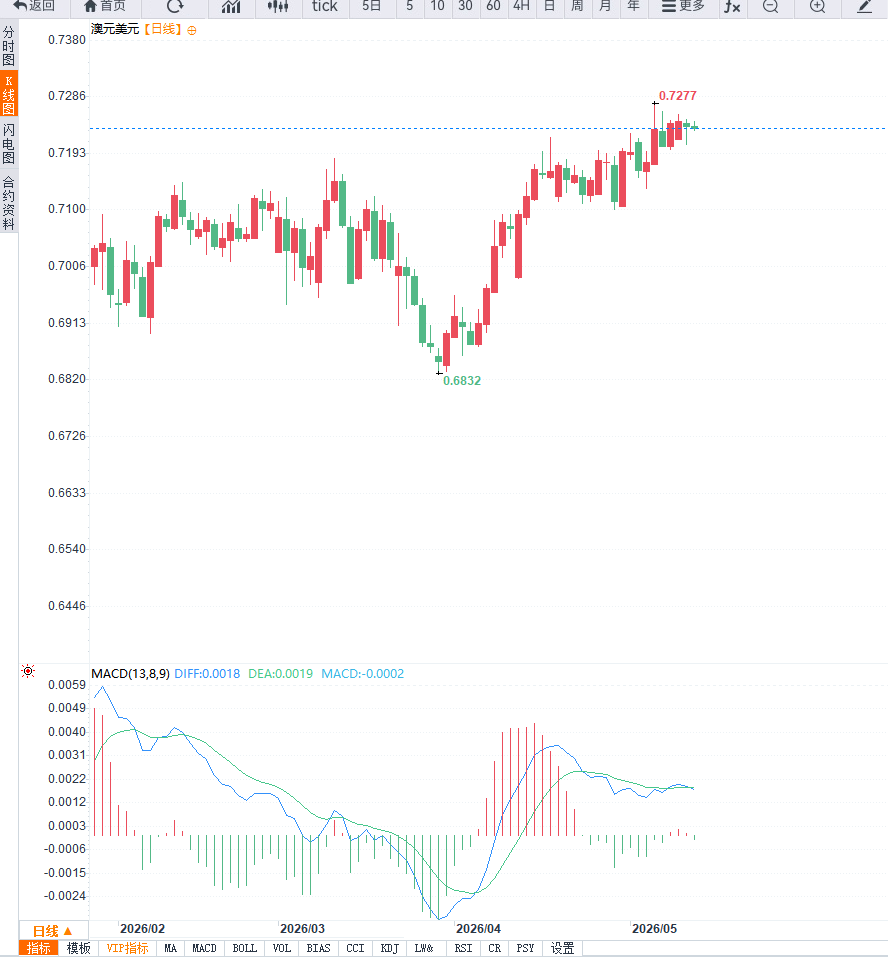
Overall, the current AUD/USD exchange rate movement is primarily driven by the policy interplay between the Reserve Bank of Australia's (RBA) hawkish stance and the Federal Reserve's (Federal Reserve) high interest rate expectations. As long as the RBA maintains its hawkish policy and global commodity prices remain high, the Australian dollar will likely find some support. However, a strong US dollar environment may limit its upside potential.
Editor's Summary : The current AUD/USD exchange rate is being influenced by both the Reserve Bank of Australia's (RBA) hawkish policy and expectations of high US interest rates. The RBA's consecutive rate hikes have strengthened market expectations that Australian interest rates will remain high, providing support for the Australian dollar. However, renewed US inflation data has increased market expectations that the Federal Reserve will maintain high interest rates or even raise them further, thus pushing the US dollar strong. From a technical perspective, AUD/USD maintains a generally bullish medium-term trend, but has entered a consolidation phase at higher levels in the short term. The future market direction will mainly depend on US PPI data, Federal Reserve policy expectations, and changes in global commodity market trends.
Currently, Australia still faces high service sector price pressures and a tight labor market, so the market generally believes that the Reserve Bank of Australia is unlikely to quickly shift to an easing policy in the short term.
Some international institutions have indicated that the Reserve Bank of Australia is currently more inclined to maintain a "wait-and-see" approach, but if domestic fiscal stimulus in Australia expands further, the possibility of further interest rate hikes cannot be ruled out.
The Australian dollar has remained relatively stable recently, given the Reserve Bank of Australia's continued hawkish stance. Meanwhile, high global commodity prices have also provided some support for the Australian dollar. However, the strength of the US dollar continues to put pressure on the AUD/USD exchange rate.
Data released by the U.S. Bureau of Labor Statistics showed that the U.S. Consumer Price Index (CPI) rose to 3.8% year-on-year in April, higher than the previous month's 3.3% and exceeding market expectations of 3.7%, reaching its highest level since May 2023. On a monthly basis, the U.S. CPI rose 0.6% in April, indicating that inflationary pressures in the U.S. remain stubborn. Meanwhile, core inflation also remained high, suggesting that cost pressures in the U.S. service sector and housing have not yet eased significantly.
Influenced by the data, the market has renewed its expectations that the Federal Reserve will maintain high interest rates or even raise them further. According to the CME Group rate watch tool, the market now expects the probability of the Fed raising rates by another 25 basis points before the end of the year to have risen to about 30% .
US Treasury yields remained high, providing overall support for the US dollar index. This means that although the Reserve Bank of Australia also maintained a hawkish stance, the US dollar's interest rate advantage still limited further upside potential for AUD/USD.
The market is currently focused on the US April Producer Price Index (PPI) data to be released Wednesday evening, hoping to further assess future US inflation trends through changes in producer prices. The market expects the US April PPI annual rate to rise to 4.9% from the previous 4.0%, while the core PPI is expected to rise to 4.3% . If the data continues to exceed expectations, the market may further strengthen its expectations of high interest rates from the Federal Reserve, thereby driving the US dollar higher.
From a daily chart perspective, AUD/USD maintains its overall medium-term upward trend with a slight bias. The exchange rate has been consistently trading above the 50-day EMA and well above the 200-day EMA, indicating that the medium-to-long-term uptrend remains intact. Technically, the daily MACD remains above the zero line, but the bullish momentum is narrowing, suggesting a slowdown in the Australian dollar's upward momentum. The Stochastic Relative Strength Index (SRSI) is hovering around 50, indicating a short-term consolidation phase. The first key resistance level on the daily chart is around 0.7280 ; a break above this level could lead to a test of the 0.7350 area. Further key medium-term resistance lies at the psychological level of 0.7400. On the downside, the 0.7200 area provides initial support, followed by the 0.7160 area near the 50-day EMA. If the US dollar continues to strengthen, AUD/USD may retest these support levels.
Overall, the current AUD/USD exchange rate movement is primarily driven by the policy interplay between the Reserve Bank of Australia's (RBA) hawkish stance and the Federal Reserve's (Federal Reserve) high interest rate expectations. As long as the RBA maintains its hawkish policy and global commodity prices remain high, the Australian dollar will likely find some support. However, a strong US dollar environment may limit its upside potential.
Editor's Summary : The current AUD/USD exchange rate is being influenced by both the Reserve Bank of Australia's (RBA) hawkish policy and expectations of high US interest rates. The RBA's consecutive rate hikes have strengthened market expectations that Australian interest rates will remain high, providing support for the Australian dollar. However, renewed US inflation data has increased market expectations that the Federal Reserve will maintain high interest rates or even raise them further, thus pushing the US dollar strong. From a technical perspective, AUD/USD maintains a generally bullish medium-term trend, but has entered a consolidation phase at higher levels in the short term. The future market direction will mainly depend on US PPI data, Federal Reserve policy expectations, and changes in global commodity market trends.
- Risk Warning and Disclaimer
- The market involves risk, and trading may not be suitable for all investors. This article is for reference only and does not constitute personal investment advice, nor does it take into account certain users’ specific investment objectives, financial situation, or other needs. Any investment decisions made based on this information are at your own risk.