With the blockade line breached and discussions about a windfall profits tax underway, will oil prices return to $115 or fall back to $96?
2026-05-13 15:15:53
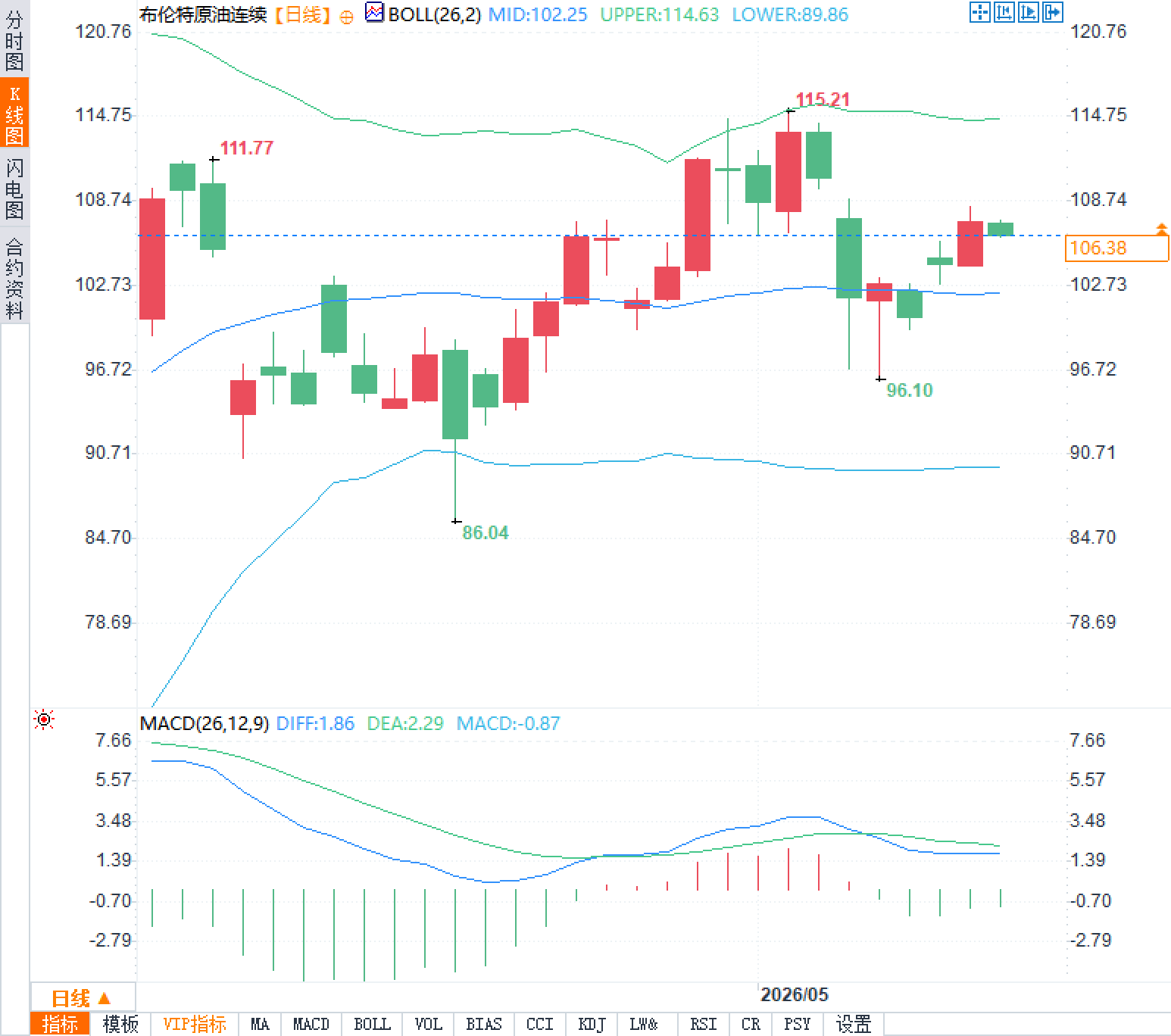
On Wednesday, May 13th, the Brent crude oil futures contract was trading at $106.38 per barrel, having recently touched above $108 before retreating. The Bollinger Bands have a middle band at $102.25 per barrel, an upper band at $114.63 per barrel, and a lower band at $89.86 per barrel; the price is currently trading above the middle band. The MACD indicator shows a DIFF of 1.86, a DEA of 2.29, and a MACD histogram of -0.87, indicating a weak bearish crossover. The recent trading range of $115.21 per barrel to $96.10 per barrel, coupled with the latest developments in the Middle East geopolitical situation, is pushing the crude oil market into a new phase of risk premium reassessment.
A liquefied petroleum gas (LPG) carrier, Tara Gas, which has transported cargo to Iran on numerous occasions, has crossed the blockade line announced by the US Navy last month (extending from Rashad in Oman to the Iran-Pakistan border) and is currently sailing southeast. This event has directly disrupted market expectations regarding the effectiveness of the blockade. Meanwhile, the upcoming meeting of EU energy ministers to discuss imposing a windfall profits tax on energy companies further amplifies the transmission effect of supply-side uncertainty on prices.

The core of the Tara Gas incident lies in the fact that its predecessor, Gas Global, has been repeatedly named by US senators and related organizations as having ties to Iran. This voyage had already loaded Iranian liquefied petroleum gas in early May. Ship tracking platform data shows that the vessel continued its voyage after crossing the officially designated blockade line by the US military. The US Central Command had previously stated publicly that it had redirected 65 commercial vessels and disabled 4 since the blockade began. Although some tankers had previously successfully slipped through the blockade, Tara Gas's public crossing signifies a reassessment of the actual effectiveness of the blockade by shipping companies. Currently, Brent crude oil has risen by more than 15% since the outbreak of the Iranian conflict at the end of February, and the risk premium has fully priced in geopolitical factors. However, the actual duration of the shipping disruption will remain a key variable determining the price center in the next stage.
From a daily chart perspective, Brent crude oil prices are currently above the middle Bollinger Band, with approximately $8 of room remaining before the upper band, while the lower band provides strong support. The recent high of $115.21/barrel forms a significant resistance level, while the low of $96.10/barrel corresponds to the previous selling bottom. Although the MACD indicator is in weak territory, the narrowing of the histogram suggests a weakening of bearish momentum. Fundamentally, the continued US naval presence and the power struggle over Iran's control of the Strait of Hormuz will lead to increased shipping costs and capacity constraints, thereby pushing up crude oil transportation premiums. The EU's five member states have explicitly supported imposing a windfall profits tax on energy companies' profits generated by rising oil prices. If this policy is finalized after Thursday's meeting, it will directly impact the hedging behavior of energy giants in crude oil futures, further exacerbating financial volatility.
Greek Energy Minister Nikos Taragas and Spanish Energy Minister Sara Aagesen have both publicly stated their support for imposing a special tax on the extra profits energy companies gain from rising oil prices. A meeting of EU energy ministers will be held this Thursday, and the five countries have reached a preliminary consensus. This policy aims to mitigate the impact of abnormal energy price fluctuations caused by geopolitical conflicts on end consumers, but for upstream producers and traders, it means a direct compression of cash flow and return on investment. Historically, similar windfall profits taxes have led some energy companies to reduce capital expenditures and postpone new project commissioning, potentially further tightening the elasticity of global crude oil supply in the long term. In the current environment, refinery crack spreads are already at high levels; if the windfall profits tax is implemented, some European refineries may choose to reduce processing volumes.
A liquefied petroleum gas (LPG) carrier, Tara Gas, which has transported cargo to Iran on numerous occasions, has crossed the blockade line announced by the US Navy last month (extending from Rashad in Oman to the Iran-Pakistan border) and is currently sailing southeast. This event has directly disrupted market expectations regarding the effectiveness of the blockade. Meanwhile, the upcoming meeting of EU energy ministers to discuss imposing a windfall profits tax on energy companies further amplifies the transmission effect of supply-side uncertainty on prices.
Shipping in the Strait of Hormuz
The core of the Tara Gas incident lies in the fact that its predecessor, Gas Global, has been repeatedly named by US senators and related organizations as having ties to Iran. This voyage had already loaded Iranian liquefied petroleum gas in early May. Ship tracking platform data shows that the vessel continued its voyage after crossing the officially designated blockade line by the US military. The US Central Command had previously stated publicly that it had redirected 65 commercial vessels and disabled 4 since the blockade began. Although some tankers had previously successfully slipped through the blockade, Tara Gas's public crossing signifies a reassessment of the actual effectiveness of the blockade by shipping companies. Currently, Brent crude oil has risen by more than 15% since the outbreak of the Iranian conflict at the end of February, and the risk premium has fully priced in geopolitical factors. However, the actual duration of the shipping disruption will remain a key variable determining the price center in the next stage.
Price range judgment based on the convergence of technical and fundamental factors
From a daily chart perspective, Brent crude oil prices are currently above the middle Bollinger Band, with approximately $8 of room remaining before the upper band, while the lower band provides strong support. The recent high of $115.21/barrel forms a significant resistance level, while the low of $96.10/barrel corresponds to the previous selling bottom. Although the MACD indicator is in weak territory, the narrowing of the histogram suggests a weakening of bearish momentum. Fundamentally, the continued US naval presence and the power struggle over Iran's control of the Strait of Hormuz will lead to increased shipping costs and capacity constraints, thereby pushing up crude oil transportation premiums. The EU's five member states have explicitly supported imposing a windfall profits tax on energy companies' profits generated by rising oil prices. If this policy is finalized after Thursday's meeting, it will directly impact the hedging behavior of energy giants in crude oil futures, further exacerbating financial volatility.
The potential impact of EU windfall profits tax discussions on the energy supply chain
Greek Energy Minister Nikos Taragas and Spanish Energy Minister Sara Aagesen have both publicly stated their support for imposing a special tax on the extra profits energy companies gain from rising oil prices. A meeting of EU energy ministers will be held this Thursday, and the five countries have reached a preliminary consensus. This policy aims to mitigate the impact of abnormal energy price fluctuations caused by geopolitical conflicts on end consumers, but for upstream producers and traders, it means a direct compression of cash flow and return on investment. Historically, similar windfall profits taxes have led some energy companies to reduce capital expenditures and postpone new project commissioning, potentially further tightening the elasticity of global crude oil supply in the long term. In the current environment, refinery crack spreads are already at high levels; if the windfall profits tax is implemented, some European refineries may choose to reduce processing volumes.
Frequently Asked Questions
Question 1: What does Tara Gas's crossing of the US blockade mean for Brent crude oil supply?
A: This incident directly challenges the actual deterrent power of the blockade line. Although the U.S. Central Command has intercepted multiple vessels, Tara Gas's successful passage indicates that some shipping companies are testing the boundary through ship registration changes or detour strategies. The market has already priced in some of the shipping risk, but the actual scale of disruption in the strait still depends on the intensity of subsequent naval interceptions.
Question 2: How long might the tensions in the Strait of Hormuz last, and what is the outlook for crude oil prices?
A: The current conflict has lasted for nearly three months since it broke out at the end of February, and the blockade line remains an important reference point for shipping companies. The Tara Gas incident revealed loopholes in the blockade's implementation, but the US military presence still constitutes a substantial deterrent. Some traders expect the tensions to remain high in the short term, and oil prices will likely maintain a wide trading range of $100-$115 per barrel. If the conflict escalates further, the upside potential for prices will open up further; conversely, if diplomatic efforts make progress, the risk premium may fall rapidly. Technically, the Bollinger Band middle line at $102.25 per barrel provides important support, but geopolitical variables remain the decisive factor.
- Risk Warning and Disclaimer
- The market involves risk, and trading may not be suitable for all investors. This article is for reference only and does not constitute personal investment advice, nor does it take into account certain users’ specific investment objectives, financial situation, or other needs. Any investment decisions made based on this information are at your own risk.