The US-Iran rivalry may conceal a "debt settlement strategy": Oil prices may rise in tandem with gold prices, contrary to expectations.
2026-05-13 16:17:00
On Wednesday (May 13), during the Asian and European sessions, international oil prices fell slightly, but global risk appetite remained optimistic. Currently, there is even a phenomenon where oil prices and equity assets are rising together. At the same time, there is still a situation where negative news for precious metals presents a buying opportunity.
The US-Iran ceasefire agreement remains fragile on paper, but in reality, neither side wants to break it.
What's the story behind the US's unjust encirclement and maintenance of a tight balance?
Currently, the strategy of the United States and its allies remains to maintain "maximum pressure" in order to force Iran to compromise.
With the UK officially announcing the deployment of drones, fighter jets, and warships to participate in the multinational escort mission in the Strait of Hormuz, the US is no longer satisfied with financial sanctions, but has completed a physical encirclement of Iran's energy choke point militarily.
President Trump has made frequent statements recently, not only claiming that the current blockade "has achieved the desired effect," but also issuing a stronger statement: "If Iran does not make the right choice, we will completely resolve this matter."
This "using force to promote talks" stance reflects the aggressive mentality of the US after gaining the upper hand, with the "stick" in negotiations now far outweighing the "carrot."
Despite Pakistan's mediation, structural contradictions in the negotiations remain significant.
Iran's insistence on U.S. compensation for war losses caused by years of sanctions is seen by Washington as a "political provocation."
For Trump, any form of "official reparations" is tantamount to admitting policy failure, which is an absolute political taboo within the Republican Party.
Republican heavyweight Lindsey Graham publicly questioned Pakistan's neutrality. This noise from domestic hawks not only hampered Trump's diplomatic maneuvering but also greatly fueled Iran's doubts about the U.S.'s sincerity in negotiations, preventing the two sides from returning to the negotiating table for a long time.
However, before his visit to China, Trump reiterated his support for Pakistan as a mediator between Iran and the United States, praising Pakistani Prime Minister Sheikh Sharif and Army Chief of Staff Asim Munir for their help in facilitating the fragile ceasefire agreement with Iran that officially came into effect last month.
One of the core reasons Trump is so confident this time is his claim to energy autonomy. On the 12th, Trump reiterated that inflation is "temporary".
He reiterated that U.S. oil production is about to experience an "explosive growth," which is not only to stabilize domestic oil prices but also a strategic deterrent against Iran.
At the same time, there was a coordinated policy toward Russia. Notably, Trump hinted at a possible easing of the Russian oil exemption policy when mentioning it. Through flexible handling of Russian oil export controls, the global oil supply is expected to increase significantly.
Once global oil prices fall due to increased supply from the US and Russia, Iran's path to earning foreign exchange through black market oil exports at a premium will be cut off. Trump is attempting to devalue Iran's oil holdings by "flooding the market."
Despite the significant pressure inflation has placed on the global economy, countries like the United States are tacitly observing the situation. It's worth noting that major powers like the US and Japan currently have very high levels of national debt, and the annual interest rate growth rate cannot keep up with the GDP growth rate. If the situation deteriorates to the point that the credit of their currencies is affected, leading to capital outflows, that would be far more serious than rising inflation.
Therefore, one of the most effective ways to resolve government debt is to accept the devaluation of purchasing power and the rise in prices. This is equivalent to indirectly reducing the government debt pressure. Since the debt stock is rigid, but nominal GDP can be achieved through price increases, the debt-to-GDP ratio will eventually decrease. At the same time, because the US dollar is linked to oil, the issuance of US bonds to expand credit during periods of rising inflation will not even lead to the devaluation of the local currency. In this way, the US replaces the previously valuable US dollars with the worthless US dollars.
Regarding Iran's five pre-emptive demands, especially the most controversial "war damages reparations," future developments may seek a soft landing through a "transfer of interests."
To allow both sides a way out, the US and Iran may reach a hidden "compensation package" under Pakistan's mediation:
Phased release of restricted funds: The United States may allow the phased release of hundreds of billions of dollars in Iranian assets frozen overseas under the guise of a "humanitarian fund".
This was nominally a "return of property" rather than "official compensation," which saved face for the United States and alleviated Iran's cash flow crisis.
A tacit agreement to open up oil exports: The two sides may reach an agreement to grant certain countries more exemptions from oil imports without lifting all sanctions.
This disguised liberalization of oil exports will become a de facto "economic dividend" for Iran.
This behavior translates the compensation into technical access for the repair of Iranian energy facilities and the improvement of civil aviation safety, ultimately achieving the effect of using economic cooperation to mask political concessions.
The current US-Iran rivalry is at a stage where there is pressure on paper, but opportunities in trade.
The US tries to make Iran uncomfortable in order to gain benefits at the negotiating table, while turning a blind eye to inflation and transferring US debt to the world to share the burden. In the process of diluting debt, corporate revenue increases, which leads to a continuous rise in global equity assets under high interest rates, subsidizing the interests of shareholders with the interests of creditors.
Following this logic, rising oil prices are due to two factors: the closure of the Strait of Hormuz and the US debt crisis. Meanwhile, as the market becomes accustomed to high oil prices and high inflation, the arrival of a window for corporate price increases has led to an asset feast for the wealthy. In the midterm elections, politicians can largely offset the negative impact of inflation on their election prospects by providing good welfare to the people and stirring up emotions.
From a technical perspective, Brent crude oil broke through the key Fibonacci retracement level of 106.43 and is currently retracing. As repeatedly mentioned in previous articles, rising oil prices are in the interest of all parties, and oil prices are likely to continue to raise the valuation center. Furthermore, with improved risk appetite, there may even be a phenomenon where oil prices rise together with interest rate-sensitive commodities such as gold.
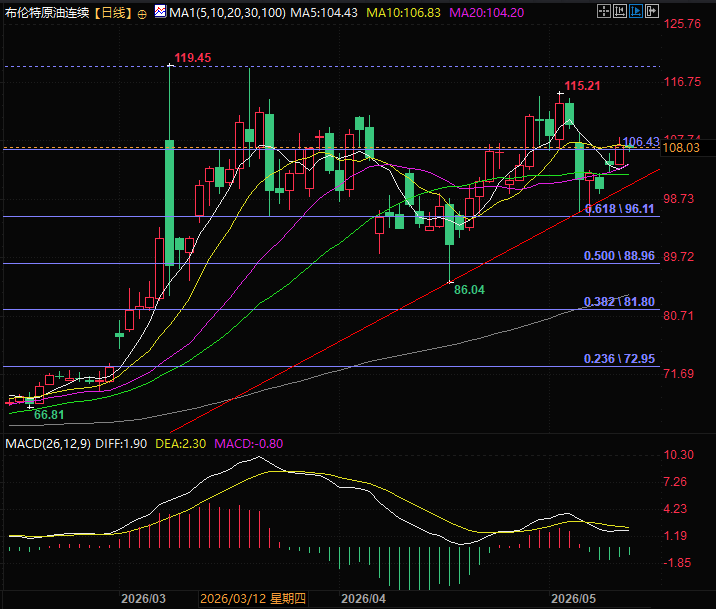
(Brent crude oil futures daily chart, source: EasyForex)
At 16:12 Beijing time, Brent crude oil futures contracts were trading at $106.92 per barrel.
The US-Iran ceasefire agreement remains fragile on paper, but in reality, neither side wants to break it.
What's the story behind the US's unjust encirclement and maintenance of a tight balance?
Encirclement and Pressure: From Economic Blockade to Physical Blockade
Currently, the strategy of the United States and its allies remains to maintain "maximum pressure" in order to force Iran to compromise.
With the UK officially announcing the deployment of drones, fighter jets, and warships to participate in the multinational escort mission in the Strait of Hormuz, the US is no longer satisfied with financial sanctions, but has completed a physical encirclement of Iran's energy choke point militarily.
President Trump has made frequent statements recently, not only claiming that the current blockade "has achieved the desired effect," but also issuing a stronger statement: "If Iran does not make the right choice, we will completely resolve this matter."
This "using force to promote talks" stance reflects the aggressive mentality of the US after gaining the upper hand, with the "stick" in negotiations now far outweighing the "carrot."
Public opinion coordination, non-physical pressure
Despite Pakistan's mediation, structural contradictions in the negotiations remain significant.
Iran's insistence on U.S. compensation for war losses caused by years of sanctions is seen by Washington as a "political provocation."
For Trump, any form of "official reparations" is tantamount to admitting policy failure, which is an absolute political taboo within the Republican Party.
Republican heavyweight Lindsey Graham publicly questioned Pakistan's neutrality. This noise from domestic hawks not only hampered Trump's diplomatic maneuvering but also greatly fueled Iran's doubts about the U.S.'s sincerity in negotiations, preventing the two sides from returning to the negotiating table for a long time.
However, before his visit to China, Trump reiterated his support for Pakistan as a mediator between Iran and the United States, praising Pakistani Prime Minister Sheikh Sharif and Army Chief of Staff Asim Munir for their help in facilitating the fragile ceasefire agreement with Iran that officially came into effect last month.
Reconstructing the Energy Game: The Explosive Rebound of the US Oil Market
One of the core reasons Trump is so confident this time is his claim to energy autonomy. On the 12th, Trump reiterated that inflation is "temporary".
He reiterated that U.S. oil production is about to experience an "explosive growth," which is not only to stabilize domestic oil prices but also a strategic deterrent against Iran.
At the same time, there was a coordinated policy toward Russia. Notably, Trump hinted at a possible easing of the Russian oil exemption policy when mentioning it. Through flexible handling of Russian oil export controls, the global oil supply is expected to increase significantly.
Once global oil prices fall due to increased supply from the US and Russia, Iran's path to earning foreign exchange through black market oil exports at a premium will be cut off. Trump is attempting to devalue Iran's oil holdings by "flooding the market."
Considerations for inflation and clever ways to maintain the status quo
Despite the significant pressure inflation has placed on the global economy, countries like the United States are tacitly observing the situation. It's worth noting that major powers like the US and Japan currently have very high levels of national debt, and the annual interest rate growth rate cannot keep up with the GDP growth rate. If the situation deteriorates to the point that the credit of their currencies is affected, leading to capital outflows, that would be far more serious than rising inflation.
Therefore, one of the most effective ways to resolve government debt is to accept the devaluation of purchasing power and the rise in prices. This is equivalent to indirectly reducing the government debt pressure. Since the debt stock is rigid, but nominal GDP can be achieved through price increases, the debt-to-GDP ratio will eventually decrease. At the same time, because the US dollar is linked to oil, the issuance of US bonds to expand credit during periods of rising inflation will not even lead to the devaluation of the local currency. In this way, the US replaces the previously valuable US dollars with the worthless US dollars.
Future Evolution: How to Change the Name of "Compensation"?
Regarding Iran's five pre-emptive demands, especially the most controversial "war damages reparations," future developments may seek a soft landing through a "transfer of interests."
To allow both sides a way out, the US and Iran may reach a hidden "compensation package" under Pakistan's mediation:
Phased release of restricted funds: The United States may allow the phased release of hundreds of billions of dollars in Iranian assets frozen overseas under the guise of a "humanitarian fund".
This was nominally a "return of property" rather than "official compensation," which saved face for the United States and alleviated Iran's cash flow crisis.
A tacit agreement to open up oil exports: The two sides may reach an agreement to grant certain countries more exemptions from oil imports without lifting all sanctions.
This disguised liberalization of oil exports will become a de facto "economic dividend" for Iran.
This behavior translates the compensation into technical access for the repair of Iranian energy facilities and the improvement of civil aviation safety, ultimately achieving the effect of using economic cooperation to mask political concessions.
Summary and Technical Analysis:
The current US-Iran rivalry is at a stage where there is pressure on paper, but opportunities in trade.
The US tries to make Iran uncomfortable in order to gain benefits at the negotiating table, while turning a blind eye to inflation and transferring US debt to the world to share the burden. In the process of diluting debt, corporate revenue increases, which leads to a continuous rise in global equity assets under high interest rates, subsidizing the interests of shareholders with the interests of creditors.
Following this logic, rising oil prices are due to two factors: the closure of the Strait of Hormuz and the US debt crisis. Meanwhile, as the market becomes accustomed to high oil prices and high inflation, the arrival of a window for corporate price increases has led to an asset feast for the wealthy. In the midterm elections, politicians can largely offset the negative impact of inflation on their election prospects by providing good welfare to the people and stirring up emotions.
From a technical perspective, Brent crude oil broke through the key Fibonacci retracement level of 106.43 and is currently retracing. As repeatedly mentioned in previous articles, rising oil prices are in the interest of all parties, and oil prices are likely to continue to raise the valuation center. Furthermore, with improved risk appetite, there may even be a phenomenon where oil prices rise together with interest rate-sensitive commodities such as gold.
(Brent crude oil futures daily chart, source: EasyForex)
At 16:12 Beijing time, Brent crude oil futures contracts were trading at $106.92 per barrel.
- Risk Warning and Disclaimer
- The market involves risk, and trading may not be suitable for all investors. This article is for reference only and does not constitute personal investment advice, nor does it take into account certain users’ specific investment objectives, financial situation, or other needs. Any investment decisions made based on this information are at your own risk.