The International Energy Agency lowered its global crude oil supply forecast, and oil prices remained above $100.
2026-05-13 16:49:58
International crude oil markets continued their high-level fluctuations on Wednesday. Although WTI crude oil prices briefly fell to around $101.50 during the European session, overall market sentiment remained supported by escalating tensions in the Middle East and expectations of tight global supply. The International Energy Agency's latest monthly report shows that global crude oil supply risks are rapidly increasing due to disruptions in shipping through the Strait of Hormuz and the continued deterioration of the Middle East situation. The agency predicts that global crude oil supply may decrease by 3.9 million barrels per day in 2026, far exceeding its previous forecast of a 1.5 million barrel per day decline.
Meanwhile, the International Energy Agency (IEA) projects that global crude oil supply will be 1.78 million barrels per day (bpd) below demand in 2026, compared to a previous forecast of approximately 410,000 bpd oversupply. This indicates that the global energy market balance is rapidly shifting towards a supply shortage. The report points out that the Middle East conflict has already had a significant impact on global energy transportation. The Strait of Hormuz handles approximately 20% of global maritime energy transport. Due to the continued rise in transportation security risks in the region, the Strait of Hormuz has resulted in a cumulative loss of 12.8 million bpd in global crude oil supply since February of this year.
The International Energy Agency (IEA) also lowered its global oil demand forecast. The agency predicts that global oil demand will decrease by approximately 420,000 barrels per day (bpd ) in 2026, significantly higher than the previously projected decline of 80,000 bpd, due to the situation in the Middle East and global economic uncertainty. However, even with the downward revision in demand forecasts, the supply-side shock remains more severe. Global refinery utilization rates are expected to decline by approximately 1.6 million bpd in 2026 due to restrictions on oil exports, attacks on refining facilities, and export restrictions imposed by some countries.
Regarding inventories, the International Energy Agency (IEA) stated that the Middle East conflict is depleting global crude oil inventories at an unprecedented rate. Global commercial crude oil inventories fell by approximately 246 million barrels in March and April alone, marking one of the fastest declines in recent years. Despite the IEA's significantly bullish supply risk forecast, the market's short-term reaction was relatively limited. WTI crude oil prices did not rise rapidly after the data release, but instead maintained a slight downward trend.
Analysts believe the market has already priced in some of the Middle East risk premium, while investors are also focused on the potential impact of a global economic slowdown on energy demand. Furthermore, the recent strength of the US dollar has also limited further upside potential for oil prices. However, from an overall market structure perspective, the tight supply situation in the crude oil market remains unresolved. Some institutions believe that if shipping through the Strait of Hormuz deteriorates further, international oil prices may retest $100 or even higher.
From a technical perspective, WTI crude oil's daily chart still maintains a clear bullish trend. Oil prices are currently trading above both the 20-day and 100-day moving averages, indicating that medium- to long-term buying power remains dominant. The key support level for WTI crude oil is currently around $96, with stronger support around $93. The RSI indicator remains above 60, suggesting that bullish momentum has not completely dissipated, but it is approaching higher levels in the short term, implying that oil prices may enter a period of consolidation.
From a 4-hour chart perspective, WTI crude oil has encountered resistance multiple times in the $102-$105 range recently, indicating significant profit-taking pressure above. The MACD indicator's momentum is starting to narrow, and short-term market sentiment is gradually becoming more cautious. However, as long as oil prices remain above $96, the overall upward trend remains intact. If the situation in the Middle East escalates further, WTI crude oil still has a chance to retest the $105 level.
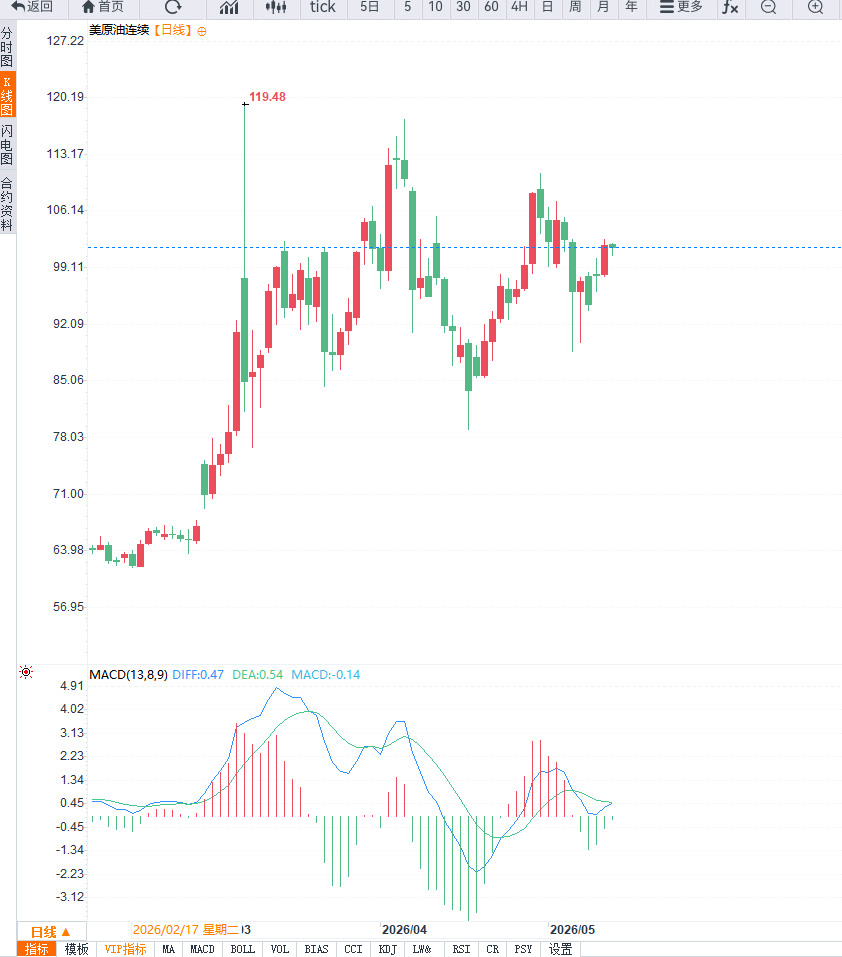
Overall, the crude oil market is currently affected by both "supply contraction" and "demand concerns," but due to the more prominent supply risks, international oil prices are generally maintaining a strong trend.
Editor's Summary : The International Energy Agency's significant downward revision of its global crude oil supply forecast reflects the profound impact of the current situation in the Middle East on the global energy market. Shipping risks in the Strait of Hormuz, rapidly declining global inventories, and shrinking refining capacity are all reinforcing market concerns about a widening supply gap in the future. While a global economic slowdown may dampen some crude oil demand, current supply-side uncertainties are clearly more dominant. Especially given the continued decline in global inventories, international oil prices are likely to remain high in the short term. The market focus will now be on developments in the Strait of Hormuz, progress in US-Iran relations, and the subsequent production policies of major oil-producing countries. If the situation in the Middle East deteriorates further, the international crude oil market may re-enter a phase of high volatility and high risk.
Meanwhile, the International Energy Agency (IEA) projects that global crude oil supply will be 1.78 million barrels per day (bpd) below demand in 2026, compared to a previous forecast of approximately 410,000 bpd oversupply. This indicates that the global energy market balance is rapidly shifting towards a supply shortage. The report points out that the Middle East conflict has already had a significant impact on global energy transportation. The Strait of Hormuz handles approximately 20% of global maritime energy transport. Due to the continued rise in transportation security risks in the region, the Strait of Hormuz has resulted in a cumulative loss of 12.8 million bpd in global crude oil supply since February of this year.
The International Energy Agency (IEA) also lowered its global oil demand forecast. The agency predicts that global oil demand will decrease by approximately 420,000 barrels per day (bpd ) in 2026, significantly higher than the previously projected decline of 80,000 bpd, due to the situation in the Middle East and global economic uncertainty. However, even with the downward revision in demand forecasts, the supply-side shock remains more severe. Global refinery utilization rates are expected to decline by approximately 1.6 million bpd in 2026 due to restrictions on oil exports, attacks on refining facilities, and export restrictions imposed by some countries.
Regarding inventories, the International Energy Agency (IEA) stated that the Middle East conflict is depleting global crude oil inventories at an unprecedented rate. Global commercial crude oil inventories fell by approximately 246 million barrels in March and April alone, marking one of the fastest declines in recent years. Despite the IEA's significantly bullish supply risk forecast, the market's short-term reaction was relatively limited. WTI crude oil prices did not rise rapidly after the data release, but instead maintained a slight downward trend.
Analysts believe the market has already priced in some of the Middle East risk premium, while investors are also focused on the potential impact of a global economic slowdown on energy demand. Furthermore, the recent strength of the US dollar has also limited further upside potential for oil prices. However, from an overall market structure perspective, the tight supply situation in the crude oil market remains unresolved. Some institutions believe that if shipping through the Strait of Hormuz deteriorates further, international oil prices may retest $100 or even higher.
From a technical perspective, WTI crude oil's daily chart still maintains a clear bullish trend. Oil prices are currently trading above both the 20-day and 100-day moving averages, indicating that medium- to long-term buying power remains dominant. The key support level for WTI crude oil is currently around $96, with stronger support around $93. The RSI indicator remains above 60, suggesting that bullish momentum has not completely dissipated, but it is approaching higher levels in the short term, implying that oil prices may enter a period of consolidation.
From a 4-hour chart perspective, WTI crude oil has encountered resistance multiple times in the $102-$105 range recently, indicating significant profit-taking pressure above. The MACD indicator's momentum is starting to narrow, and short-term market sentiment is gradually becoming more cautious. However, as long as oil prices remain above $96, the overall upward trend remains intact. If the situation in the Middle East escalates further, WTI crude oil still has a chance to retest the $105 level.
Overall, the crude oil market is currently affected by both "supply contraction" and "demand concerns," but due to the more prominent supply risks, international oil prices are generally maintaining a strong trend.
Editor's Summary : The International Energy Agency's significant downward revision of its global crude oil supply forecast reflects the profound impact of the current situation in the Middle East on the global energy market. Shipping risks in the Strait of Hormuz, rapidly declining global inventories, and shrinking refining capacity are all reinforcing market concerns about a widening supply gap in the future. While a global economic slowdown may dampen some crude oil demand, current supply-side uncertainties are clearly more dominant. Especially given the continued decline in global inventories, international oil prices are likely to remain high in the short term. The market focus will now be on developments in the Strait of Hormuz, progress in US-Iran relations, and the subsequent production policies of major oil-producing countries. If the situation in the Middle East deteriorates further, the international crude oil market may re-enter a phase of high volatility and high risk.
- Risk Warning and Disclaimer
- The market involves risk, and trading may not be suitable for all investors. This article is for reference only and does not constitute personal investment advice, nor does it take into account certain users’ specific investment objectives, financial situation, or other needs. Any investment decisions made based on this information are at your own risk.