PPI exceeded expectations across the board, dashing hopes for a US interest rate cut.
2026-05-13 21:03:08
In her latest quarterly article, Atlanta Federal Reserve Bank interim president Cheryl Weinabul pointed out that the Middle East conflict has become the latest variable impacting the U.S. economy in recent years.
Since the outbreak of the global pandemic, the US economy has faced multiple challenges, including soaring inflation, the Russia-Ukraine conflict, tariff adjustments, and government shutdowns. Now, the escalating situation in the Middle East has further restricted the supply of oil and key global commodities, adding uncertainty to an already complex economic environment.
Meanwhile, combined with the recently released US PPI data, the PPI growth rate was 6% and the core PPI growth rate was 5.2%, both significantly exceeding the expected 4.9% and 4.3% respectively. As a leading indicator of CPI for 3-6 months, this suggests that the US inflation level may rise further, making the prospect of interest rate cuts even more remote.

From the current economic fundamentals, the US economy has shown a certain degree of resilience. Preliminary data from the US Bureau of Economic Analysis (BEA) shows that real GDP grew by 2% in the first quarter of 2026, which is basically in line with the long-term trend growth rate of the economy, indicating that the macroeconomy is still operating smoothly under multiple pressures.
As a core driver of two-thirds of U.S. economic activity, consumer spending, while volatile, remained generally robust: real consumer spending growth, adjusted for inflation, slowed slightly in the first three months, mainly due to rising gasoline prices – consumer spending on gasoline and other energy products surged by $81 billion in March (annualized, excluding utilities), a stark contrast to the $6.7 billion increase in February, forcing consumers to cut back on spending in other areas.
However, feedback from businesses indicates that demand for products and services remains stable, and the disruptions caused by the Middle East conflict have not yet led to a significant increase in costs.
With inflation exceeding 2% for over five years and core indicators remaining high, price stability is one of the core objectives of the Federal Reserve's dual mandate, but the current inflation situation in the United States is still far from optimistic.
As of March 2026, the inflation rate has exceeded the Federal Reserve's 2% policy target for 61 consecutive months. The year-on-year increase in the Consumer Price Index (CPI) further rose to 3.8% in April. Although the Federal Reserve's preferred Personal Consumption Expenditures (PCE) price index has not yet been released (it is expected to be released at the end of May), it will almost certainly continue to be above the target level.
Meanwhile, PPI continued to push up inflation expectations, and gold prices had already begun to fall before the data was released, while the US dollar began to rise.
The energy market volatility triggered by the Middle East conflict has exacerbated inflation concerns, and the sharp rise in oil prices and global shipping costs has put significant cost pressure on energy-dependent businesses such as manufacturers and freight companies.
Energy industry insiders revealed that even if the conflict subsides as soon as possible, oil prices will be difficult to fall back to pre-conflict levels quickly. Coupled with the time lag in the resumption of shipping in the Strait of Hormuz, high energy prices may continue until the second half of 2026 or even the beginning of next year.
If this trend continues, it will be transmitted through the industrial chain to overall prices, further eroding consumer purchasing power. After experiencing inflation and tariff-related price increases following the pandemic, American consumers' ability to bear prices is nearing a critical point. Continued price increases may trigger a contraction in consumption, thereby inhibiting economic activity.
Although surface data shows a recovery in employment growth and a low unemployment rate, the overall employment structure has undergone significant changes.
Data shows that an average of 76,000 new jobs were created each month in the first four months of this year, a significant rebound from the slight increase of 10,000 per month in 2025. The unemployment rate in April remained stable at 4.3%, only 0.1 percentage points higher than the same period last year and lower than the average level since the beginning of the 21st century.
Federal Reserve Chairman Jerome Powell described the situation as a "disturbing" balance—with labor force growth stalled due to reduced immigration, the current rate of unemployment can be kept stable by adding about 30,000 jobs per month, without the high growth rates of the past.
However, beneath the seemingly robust labor market lies a structural divergence. On the one hand, employment growth exhibits a K-shaped pattern, with the healthcare industry becoming the sole core pillar. In the past year, this sector contributed 146% of the total job growth, implying that other industries are actually facing job losses.
On the other hand, wage growth is significantly unbalanced, with high-income groups seeing a 6% increase in after-tax wages, while the lower-income groups only saw a 1.5% increase, which is lower than the inflation rate during the same period, resulting in a reduction in the actual purchasing power of low-income groups.
This structural polarization not only exacerbates economic inequality but also presents additional challenges to the Federal Reserve's policy-making.
Faced with the complex interplay of economic growth, inflationary pressures, and the labor market, the Federal Reserve chose to maintain the federal funds rate range at 3.5%-3.75% at its April Federal Open Market Committee (FOMC) meeting, a decision supported by Atlanta Fed interim president Wena Bull.
She believes that the current monetary policy is in a moderately restrictive to neutral range, which avoids the inflation risk that easing policies may exacerbate, and also prevents strong tightening from disrupting the balance of the labor market, leaving room for policy adjustments after the macroeconomic situation becomes clearer.
The market generally expects the Federal Reserve to maintain the current interest rate level throughout the year. The CME FedWatch Tool shows that there is about a 70% probability that interest rates will remain in the 3.5%-3.75% range before the end of the year.
However, uncertainties remain: if the Middle East conflict continues to drive up energy prices and inflationary pressures increase further, the Federal Reserve may face the difficult decision of restarting interest rate hikes.
Conversely, if a contraction in consumption leads to downward pressure on the economy and a rise in the unemployment rate, expectations for interest rate cuts may be reignited.
Overall, since 2026, the US economy has shown strong resilience despite multiple disturbances, with GDP growth in line with long-term trends, a stable labor market, and no significant decline in consumer demand.
However, the energy supply shocks caused by the Middle East conflict, persistently high inflationary pressures, structural divergence in the labor market, and potential risks to the global supply chain continue to cast a shadow over the economic outlook.
As Werner stated, it is currently impossible to predict the exact path of the geopolitical conflict and its economic impact, but if the turmoil continues for several months, it could create dual pressures on price stability and economic growth.
For the Federal Reserve, finding a balance between the two risks of its dual mandate will be a key challenge for some time to come.
The future trajectory of the US economy depends not only on the evolution of the geopolitical situation, but also on the precise adjustment of monetary policy and the continued release of the economy's own resilience.
The US dollar index continued to rise, influenced by recent inflation data such as CPI and PPI.
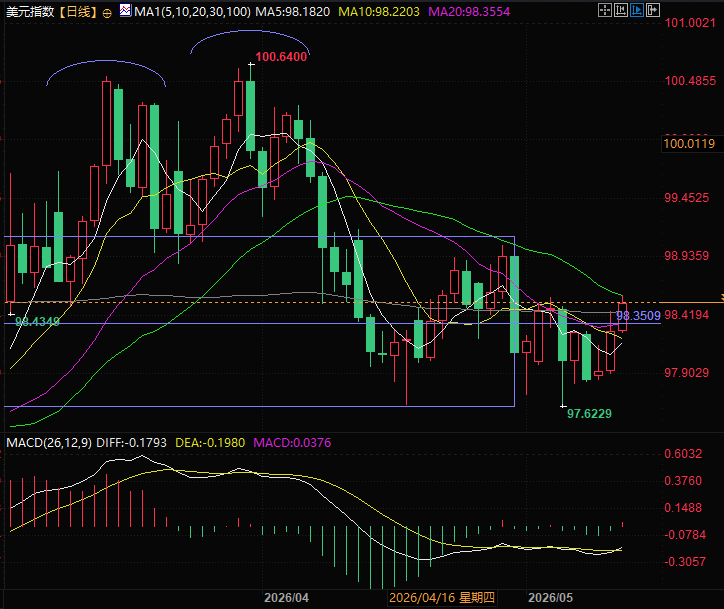
(US Dollar Index Daily Chart, Source: EasyForex)
At 21:02 Beijing time, the US dollar index is currently at 98.55.
Since the outbreak of the global pandemic, the US economy has faced multiple challenges, including soaring inflation, the Russia-Ukraine conflict, tariff adjustments, and government shutdowns. Now, the escalating situation in the Middle East has further restricted the supply of oil and key global commodities, adding uncertainty to an already complex economic environment.
Meanwhile, combined with the recently released US PPI data, the PPI growth rate was 6% and the core PPI growth rate was 5.2%, both significantly exceeding the expected 4.9% and 4.3% respectively. As a leading indicator of CPI for 3-6 months, this suggests that the US inflation level may rise further, making the prospect of interest rate cuts even more remote.
The economic fundamentals are sound, but consumer spending exhibits structural fluctuations.
From the current economic fundamentals, the US economy has shown a certain degree of resilience. Preliminary data from the US Bureau of Economic Analysis (BEA) shows that real GDP grew by 2% in the first quarter of 2026, which is basically in line with the long-term trend growth rate of the economy, indicating that the macroeconomy is still operating smoothly under multiple pressures.
As a core driver of two-thirds of U.S. economic activity, consumer spending, while volatile, remained generally robust: real consumer spending growth, adjusted for inflation, slowed slightly in the first three months, mainly due to rising gasoline prices – consumer spending on gasoline and other energy products surged by $81 billion in March (annualized, excluding utilities), a stark contrast to the $6.7 billion increase in February, forcing consumers to cut back on spending in other areas.
However, feedback from businesses indicates that demand for products and services remains stable, and the disruptions caused by the Middle East conflict have not yet led to a significant increase in costs.
Inflationary pressures remain high, posing a challenge to price stability.
With inflation exceeding 2% for over five years and core indicators remaining high, price stability is one of the core objectives of the Federal Reserve's dual mandate, but the current inflation situation in the United States is still far from optimistic.
As of March 2026, the inflation rate has exceeded the Federal Reserve's 2% policy target for 61 consecutive months. The year-on-year increase in the Consumer Price Index (CPI) further rose to 3.8% in April. Although the Federal Reserve's preferred Personal Consumption Expenditures (PCE) price index has not yet been released (it is expected to be released at the end of May), it will almost certainly continue to be above the target level.
Meanwhile, PPI continued to push up inflation expectations, and gold prices had already begun to fall before the data was released, while the US dollar began to rise.
Increased volatility in energy markets raises the risk of inflation transmission.
The energy market volatility triggered by the Middle East conflict has exacerbated inflation concerns, and the sharp rise in oil prices and global shipping costs has put significant cost pressure on energy-dependent businesses such as manufacturers and freight companies.
Energy industry insiders revealed that even if the conflict subsides as soon as possible, oil prices will be difficult to fall back to pre-conflict levels quickly. Coupled with the time lag in the resumption of shipping in the Strait of Hormuz, high energy prices may continue until the second half of 2026 or even the beginning of next year.
If this trend continues, it will be transmitted through the industrial chain to overall prices, further eroding consumer purchasing power. After experiencing inflation and tariff-related price increases following the pandemic, American consumers' ability to bear prices is nearing a critical point. Continued price increases may trigger a contraction in consumption, thereby inhibiting economic activity.
The labor market has shown resilience in stabilizing, but structural divergence harbors hidden concerns.
Although surface data shows a recovery in employment growth and a low unemployment rate, the overall employment structure has undergone significant changes.
Data shows that an average of 76,000 new jobs were created each month in the first four months of this year, a significant rebound from the slight increase of 10,000 per month in 2025. The unemployment rate in April remained stable at 4.3%, only 0.1 percentage points higher than the same period last year and lower than the average level since the beginning of the 21st century.
Federal Reserve Chairman Jerome Powell described the situation as a "disturbing" balance—with labor force growth stalled due to reduced immigration, the current rate of unemployment can be kept stable by adding about 30,000 jobs per month, without the high growth rates of the past.
However, beneath the seemingly robust labor market lies a structural divergence. On the one hand, employment growth exhibits a K-shaped pattern, with the healthcare industry becoming the sole core pillar. In the past year, this sector contributed 146% of the total job growth, implying that other industries are actually facing job losses.
On the other hand, wage growth is significantly unbalanced, with high-income groups seeing a 6% increase in after-tax wages, while the lower-income groups only saw a 1.5% increase, which is lower than the inflation rate during the same period, resulting in a reduction in the actual purchasing power of low-income groups.
This structural polarization not only exacerbates economic inequality but also presents additional challenges to the Federal Reserve's policy-making.
Monetary policy remains on hold; finding a balance will test policy wisdom.
Faced with the complex interplay of economic growth, inflationary pressures, and the labor market, the Federal Reserve chose to maintain the federal funds rate range at 3.5%-3.75% at its April Federal Open Market Committee (FOMC) meeting, a decision supported by Atlanta Fed interim president Wena Bull.
She believes that the current monetary policy is in a moderately restrictive to neutral range, which avoids the inflation risk that easing policies may exacerbate, and also prevents strong tightening from disrupting the balance of the labor market, leaving room for policy adjustments after the macroeconomic situation becomes clearer.
The policy path for the whole year remains uncertain, and two-way risks need to be observed.
The market generally expects the Federal Reserve to maintain the current interest rate level throughout the year. The CME FedWatch Tool shows that there is about a 70% probability that interest rates will remain in the 3.5%-3.75% range before the end of the year.
However, uncertainties remain: if the Middle East conflict continues to drive up energy prices and inflationary pressures increase further, the Federal Reserve may face the difficult decision of restarting interest rate hikes.
Conversely, if a contraction in consumption leads to downward pressure on the economy and a rise in the unemployment rate, expectations for interest rate cuts may be reignited.
Conclusion: Resilience is essential, but vigilance against risks is necessary; the road ahead remains uncertain.
Overall, since 2026, the US economy has shown strong resilience despite multiple disturbances, with GDP growth in line with long-term trends, a stable labor market, and no significant decline in consumer demand.
However, the energy supply shocks caused by the Middle East conflict, persistently high inflationary pressures, structural divergence in the labor market, and potential risks to the global supply chain continue to cast a shadow over the economic outlook.
As Werner stated, it is currently impossible to predict the exact path of the geopolitical conflict and its economic impact, but if the turmoil continues for several months, it could create dual pressures on price stability and economic growth.
For the Federal Reserve, finding a balance between the two risks of its dual mandate will be a key challenge for some time to come.
The future trajectory of the US economy depends not only on the evolution of the geopolitical situation, but also on the precise adjustment of monetary policy and the continued release of the economy's own resilience.
The US dollar index continued to rise, influenced by recent inflation data such as CPI and PPI.
(US Dollar Index Daily Chart, Source: EasyForex)
At 21:02 Beijing time, the US dollar index is currently at 98.55.
- Risk Warning and Disclaimer
- The market involves risk, and trading may not be suitable for all investors. This article is for reference only and does not constitute personal investment advice, nor does it take into account certain users’ specific investment objectives, financial situation, or other needs. Any investment decisions made based on this information are at your own risk.