With political infighting escalating in the UK and the bond market tightening, what will become of the pound?
2026-05-13 21:52:51
The constitutional ceremonies in the United Kingdom are rooted in history, with the opening ceremony of Parliament as the core. Through solemn traditional procedures, they symbolize the monarch's "reigning but not ruling," confirm the actual power of Parliament and the Cabinet, and serve as a vehicle for the legitimacy of the constitutional monarchy, while also having a function of institutional stability and being subject to current controversies.
On Wednesday, the opening ceremony of the British Parliament was held as scheduled. King Charles III, dressed in traditional court attire, delivered his annual speech in the House of Lords, officially unveiling the policy blueprint of the current Labour government.
This ceremony, which carries constitutional significance, is overshadowed by a deep political crisis—Last week's crushing defeat of the Labour Party in the local elections has put Prime Minister Keir Starmer's ruling position in jeopardy, and the escalating unrest has been dominating media headlines for a long time.
Starmer's leadership crisis has been brewing for some time. Following the local election defeat, more than 80 Labour MPs publicly called for the Prime Minister's resignation, and his key rival within the party, Health Secretary Wes Streitting, repeatedly sought to meet with Starmer. Although his private request on Tuesday was rejected, the two still had a brief 17-minute meeting before Wednesday's speech.
Although Starmer has temporarily withstood the pressure to resign and barely managed to defuse the immediate challenge, the Labor union has made it clear that it opposes him leading the party in the next general election. The power struggle within the party has not ended, and this hasty meeting is more like a temporary compromise for the balance of power.
For Starmer, the King's Speech and its accompanying policy agenda became a crucial opportunity to divert public and market attention and gain breathing room.
As the "spokesperson" for government policy, Charles III unveiled an "ambitious policy plan" in his speech, encompassing 35 bills and drafts. The plan focuses on strengthening public services, reforming the governance system, and reversing the economic recession, while also addressing key areas such as economic security, energy security, national security, and UK-EU relations.
This speech, drafted by the government, attempts to address voters' dissatisfaction with slow change and weak improvement in people's livelihoods, and to reshape the political narrative. However, from the outside perspective, there are still huge doubts about whether it can be implemented.
Markets reacted extremely quickly to political turmoil. With four prime ministers in the past four years, the lack of policy continuity has investors on edge – on Tuesday, concerns that leadership changes could loosen the fiscal discipline enforced by Chancellor Rachel Reeves sent UK government bond yields surging by double digits.
On Wednesday, as the Stammers position appeared to stabilize, Treasury yields fell by 2 to 6 basis points, with the 10-year benchmark rate fluctuating around 5.067%.
However, the market's brief respite has not dispelled deep-seated anxieties. Saxo Bank's UK investment strategist, Neil Wilson, bluntly stated that the King's speech could only temporarily quell the party's internal plot, and the bond market remains highly tense. It would not be surprising if a wave of cabinet resignations were to follow.
Former Chancellor of the Exchequer Jim O'Neill, in an interview with CNBC, went even further, stating that "voters are treating leadership elections like a game, ignoring the risks of economic stagnation and financial instability." He warned that the constitutional vulnerability of a change in prime minister is putting Britain in a dangerous position.
This political turmoil, intertwined with market volatility, ultimately spilled over into the currency market, making the pound's trajectory highly unpredictable.
Historical data shows that political turmoil in the UK often triggers sharp fluctuations in the pound sterling. In the previous crisis triggered by the Truss government's "mini-budget," the pound sterling was close to parity with the dollar, while it would rebound in stages when the political situation eased.
Currently, although Starmer has temporarily stabilized the situation and sentiment in the Treasury market has calmed down somewhat, multiple risks remain, including unresolved power struggles within the party, doubts about the implementation of the policy blueprint, and pressure on economic growth. These uncertainties continue to suppress the pound's performance.
From the perspective of market expectations, the divergence in the timing of the Bank of England's interest rate cut has further exacerbated the volatility of the pound.
High core inflation and high inflation in the services sector, coupled with strong wage growth, have put the Bank of England in a dilemma regarding its interest rate cuts, while market bets on a rate cut in 2025 have risen significantly.
Under the multiple pressures of unresolved political turmoil, weak economic fundamentals, and an unclear monetary policy path, the pound is unlikely to receive sustained support in the short term. Its trend will continue to be closely watched in relation to the evolution of the UK political situation, the stability of fiscal policy, and the central bank's interest rate decisions. Any new power shifts or policy changes could trigger a new round of volatility in the exchange rate market.
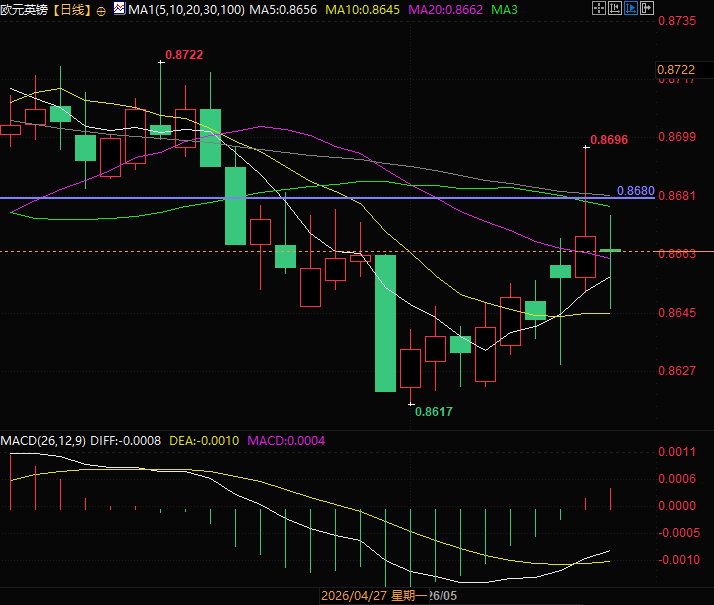
(Euro/Pound Sterling daily chart, source: FX678)
At 21:50 Beijing time, the euro was trading at 0.8666/67 against the pound.
On Wednesday, the opening ceremony of the British Parliament was held as scheduled. King Charles III, dressed in traditional court attire, delivered his annual speech in the House of Lords, officially unveiling the policy blueprint of the current Labour government.
This ceremony, which carries constitutional significance, is overshadowed by a deep political crisis—Last week's crushing defeat of the Labour Party in the local elections has put Prime Minister Keir Starmer's ruling position in jeopardy, and the escalating unrest has been dominating media headlines for a long time.
Starmer's leadership crisis has been brewing for some time. Following the local election defeat, more than 80 Labour MPs publicly called for the Prime Minister's resignation, and his key rival within the party, Health Secretary Wes Streitting, repeatedly sought to meet with Starmer. Although his private request on Tuesday was rejected, the two still had a brief 17-minute meeting before Wednesday's speech.
Although Starmer has temporarily withstood the pressure to resign and barely managed to defuse the immediate challenge, the Labor union has made it clear that it opposes him leading the party in the next general election. The power struggle within the party has not ended, and this hasty meeting is more like a temporary compromise for the balance of power.
For Starmer, the King's Speech and its accompanying policy agenda became a crucial opportunity to divert public and market attention and gain breathing room.
Policy blueprints and the sensitive interplay of the market
As the "spokesperson" for government policy, Charles III unveiled an "ambitious policy plan" in his speech, encompassing 35 bills and drafts. The plan focuses on strengthening public services, reforming the governance system, and reversing the economic recession, while also addressing key areas such as economic security, energy security, national security, and UK-EU relations.
This speech, drafted by the government, attempts to address voters' dissatisfaction with slow change and weak improvement in people's livelihoods, and to reshape the political narrative. However, from the outside perspective, there are still huge doubts about whether it can be implemented.
Markets reacted extremely quickly to political turmoil. With four prime ministers in the past four years, the lack of policy continuity has investors on edge – on Tuesday, concerns that leadership changes could loosen the fiscal discipline enforced by Chancellor Rachel Reeves sent UK government bond yields surging by double digits.
On Wednesday, as the Stammers position appeared to stabilize, Treasury yields fell by 2 to 6 basis points, with the 10-year benchmark rate fluctuating around 5.067%.
However, the market's brief respite has not dispelled deep-seated anxieties. Saxo Bank's UK investment strategist, Neil Wilson, bluntly stated that the King's speech could only temporarily quell the party's internal plot, and the bond market remains highly tense. It would not be surprising if a wave of cabinet resignations were to follow.
Former Chancellor of the Exchequer Jim O'Neill, in an interview with CNBC, went even further, stating that "voters are treating leadership elections like a game, ignoring the risks of economic stagnation and financial instability." He warned that the constitutional vulnerability of a change in prime minister is putting Britain in a dangerous position.
The outlook for the pound under political uncertainty
This political turmoil, intertwined with market volatility, ultimately spilled over into the currency market, making the pound's trajectory highly unpredictable.
Historical data shows that political turmoil in the UK often triggers sharp fluctuations in the pound sterling. In the previous crisis triggered by the Truss government's "mini-budget," the pound sterling was close to parity with the dollar, while it would rebound in stages when the political situation eased.
Currently, although Starmer has temporarily stabilized the situation and sentiment in the Treasury market has calmed down somewhat, multiple risks remain, including unresolved power struggles within the party, doubts about the implementation of the policy blueprint, and pressure on economic growth. These uncertainties continue to suppress the pound's performance.
From the perspective of market expectations, the divergence in the timing of the Bank of England's interest rate cut has further exacerbated the volatility of the pound.
High core inflation and high inflation in the services sector, coupled with strong wage growth, have put the Bank of England in a dilemma regarding its interest rate cuts, while market bets on a rate cut in 2025 have risen significantly.
Under the multiple pressures of unresolved political turmoil, weak economic fundamentals, and an unclear monetary policy path, the pound is unlikely to receive sustained support in the short term. Its trend will continue to be closely watched in relation to the evolution of the UK political situation, the stability of fiscal policy, and the central bank's interest rate decisions. Any new power shifts or policy changes could trigger a new round of volatility in the exchange rate market.
(Euro/Pound Sterling daily chart, source: FX678)
At 21:50 Beijing time, the euro was trading at 0.8666/67 against the pound.
- Risk Warning and Disclaimer
- The market involves risk, and trading may not be suitable for all investors. This article is for reference only and does not constitute personal investment advice, nor does it take into account certain users’ specific investment objectives, financial situation, or other needs. Any investment decisions made based on this information are at your own risk.