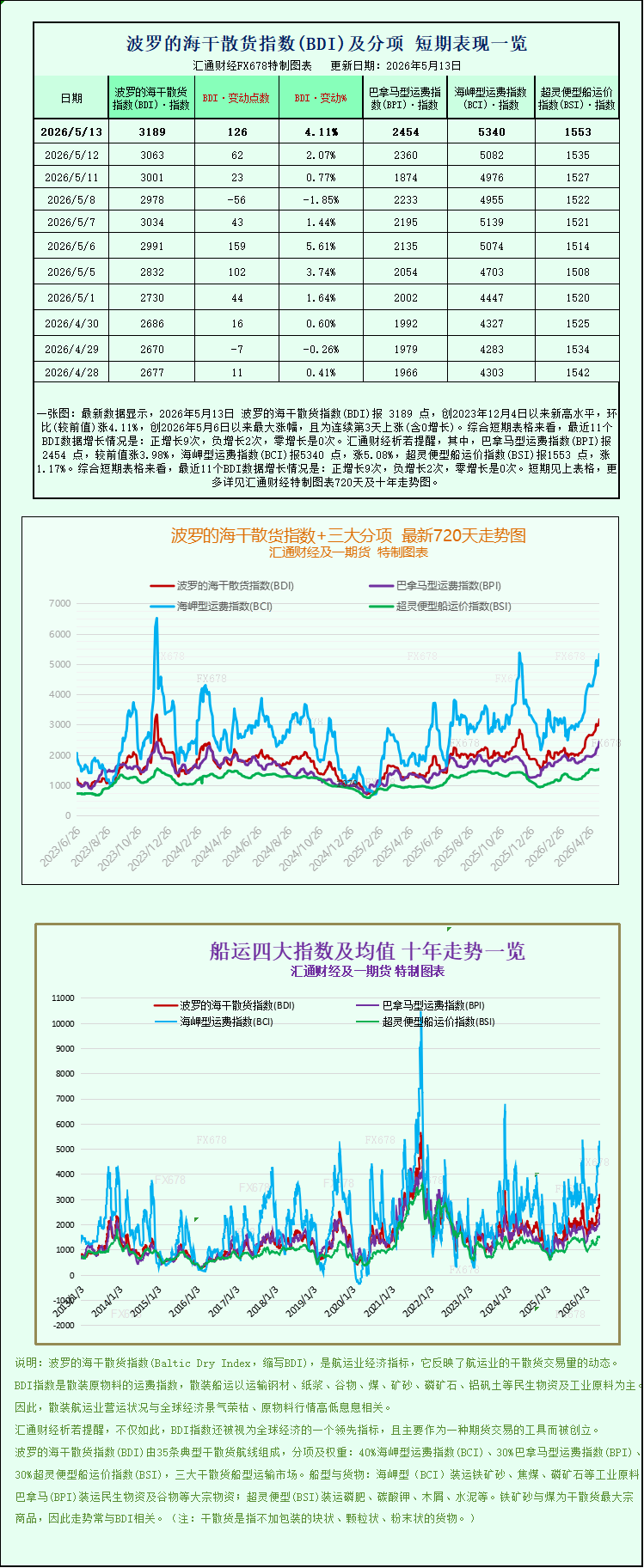
One chart: The Baltic Dry Index rose, with all shipping sectors achieving growth.
2026-05-13 23:03:39
Latest data shows that the Baltic Dry Index (BDI) reached 3189 points on May 13, 2026, a new high since December 4, 2023, up 4.11% month-on-month, the largest increase since May 6, 2026, and marking the third consecutive day of increase (including zero growth). Looking at the short-term charts, the recent 11 BDI data points show: 9 positive increases, 2 negative increases, and 0 zero increases. Specifically, the Panamax Freight Index (BPI) reached 2454 points, up 3.98% from the previous value; the Capesize Freight Index (BCI) reached 5340 points, up 5.08%; and the Supramax Freight Index (BSI) reached 1553 points, up 1.17%. For detailed 720-day and 10-year trend charts of the Baltic Dry Index and its three main sub-indices, please refer to the specially designed charts.
The Baltic Dry Index (BDI), which tracks global dry bulk shipping freight rates, saw a significant increase on Wednesday. This growth was mainly driven by a synchronized rise in freight rates across all major vessel types globally. The entire shipping sector, covering all areas of dry bulk transportation, experienced varying degrees of growth, reflecting signs of recovery in the current international dry bulk shipping market. As an authoritative index for measuring international dry bulk shipping prices, the Baltic Dry Index directly reflects the freight rates for bulk carriers transporting consumer goods such as grain, coal, and ore, as well as industrial raw materials. Its fluctuations are closely related to global trade activity.
Among them, the Baltic Dry Index, which tracks freight rates for the three major dry bulk carriers—Capesize, Panamax, and Supramax—performed strongly, rising 126 points, or 4.1%, to close at 3189 points, a recent high. This rise indicates a recovery in overall demand in the global dry bulk shipping market, with effective release of capacity demand for the three core vessel types, driving a steady increase in overall freight rates.
Specifically, the Capesize (also known as Good Hope size) index performed the strongest. The Capesize index surged 258 points, or 5.1%, to close at 5340 points, becoming the core driver of the overall index increase. Capesize vessels, as large ships in dry bulk shipping, are mainly used to transport bulk industrial raw materials of 150,000 tons or more, primarily iron ore and coal. Due to their large tonnage, these ships cannot pass through the Suez Canal and usually need to detour around the Cape of Good Hope or Cape Horn, requiring high standards for port depth and infrastructure. Correspondingly, the average daily revenue of Capesize vessels carrying 150,000 tons of cargo (including iron ore and coal) also increased, rising by $2,342 per day to reach $44,930, significantly improving the profit margins of shipping companies.
It is worth noting that iron ore futures prices, a major cargo transported by Capesize vessels, showed an unclear trend on Wednesday. Traders are closely weighing the impact of two key factors: on the one hand, declining shipments from Australia and Brazil, the two major iron ore exporting countries, have led to a tightening of global iron ore supply; on the other hand, weak demand from China's domestic steel industry has slowed its iron ore procurement. These two factors intertwine, causing volatile iron ore futures prices and influencing long-term transport demand expectations for Capesize vessels to some extent. According to relevant futures data, the closing price of iron ore futures contracts on May 13 was 838.5 yuan/ton, with relatively mild fluctuations and no clear trend.
Besides Capesize vessels, the Panamax sector also saw significant growth. The Panamax index rose 94 points, or 4%, to close at 2454, continuing its recent upward trend. Panamax vessels are the largest type of ships that meet the navigability requirements of the Panama Canal. They are mainly used to transport bulk cargo of 60,000 to 70,000 tons, primarily coal and grain. They offer high navigational flexibility and can connect the Pacific and Atlantic shipping routes via the Panama Canal, making them a mainstay of global dry bulk shipping. Correspondingly, the average daily revenue of Panamax vessels also increased, rising by $842 to $22,083, directly reflecting the continued recovery in global demand for transporting essential goods and bulk commodities such as coal and grain.
In the smaller tonnage vessel sector, Supramax vessels performed steadily, becoming an important supplement to the dry bulk shipping market. The Supramax vessel index rose 18 points, or 1.2%, to close at 1553 points. These vessels have shallow drafts, strong port adaptability, and wide navigation coverage, mainly transporting goods such as phosphate fertilizer, potassium carbonate, and sawdust. The steady increase in their freight rates indicates that the small and medium tonnage dry bulk shipping market is also recovering in tandem, further confirming the overall recovery trend of the global dry bulk shipping market and reflecting the coordinated growth pattern of different tonnage vessel sectors.
Overall, the comprehensive rise in the Baltic Dry Index and the synchronized growth across all vessel sectors directly reflect the recovery in demand in the global dry bulk shipping market. With the steady increase in freight rates and daily revenue for all vessel types, the operating conditions of shipping companies will further improve. Meanwhile, market dynamics for core transported commodities such as iron ore will continue to influence the future trend of the dry bulk shipping market.
The Baltic Dry Index (BDI), which tracks global dry bulk shipping freight rates, saw a significant increase on Wednesday. This growth was mainly driven by a synchronized rise in freight rates across all major vessel types globally. The entire shipping sector, covering all areas of dry bulk transportation, experienced varying degrees of growth, reflecting signs of recovery in the current international dry bulk shipping market. As an authoritative index for measuring international dry bulk shipping prices, the Baltic Dry Index directly reflects the freight rates for bulk carriers transporting consumer goods such as grain, coal, and ore, as well as industrial raw materials. Its fluctuations are closely related to global trade activity.
Among them, the Baltic Dry Index, which tracks freight rates for the three major dry bulk carriers—Capesize, Panamax, and Supramax—performed strongly, rising 126 points, or 4.1%, to close at 3189 points, a recent high. This rise indicates a recovery in overall demand in the global dry bulk shipping market, with effective release of capacity demand for the three core vessel types, driving a steady increase in overall freight rates.
Specifically, the Capesize (also known as Good Hope size) index performed the strongest. The Capesize index surged 258 points, or 5.1%, to close at 5340 points, becoming the core driver of the overall index increase. Capesize vessels, as large ships in dry bulk shipping, are mainly used to transport bulk industrial raw materials of 150,000 tons or more, primarily iron ore and coal. Due to their large tonnage, these ships cannot pass through the Suez Canal and usually need to detour around the Cape of Good Hope or Cape Horn, requiring high standards for port depth and infrastructure. Correspondingly, the average daily revenue of Capesize vessels carrying 150,000 tons of cargo (including iron ore and coal) also increased, rising by $2,342 per day to reach $44,930, significantly improving the profit margins of shipping companies.
It is worth noting that iron ore futures prices, a major cargo transported by Capesize vessels, showed an unclear trend on Wednesday. Traders are closely weighing the impact of two key factors: on the one hand, declining shipments from Australia and Brazil, the two major iron ore exporting countries, have led to a tightening of global iron ore supply; on the other hand, weak demand from China's domestic steel industry has slowed its iron ore procurement. These two factors intertwine, causing volatile iron ore futures prices and influencing long-term transport demand expectations for Capesize vessels to some extent. According to relevant futures data, the closing price of iron ore futures contracts on May 13 was 838.5 yuan/ton, with relatively mild fluctuations and no clear trend.
Besides Capesize vessels, the Panamax sector also saw significant growth. The Panamax index rose 94 points, or 4%, to close at 2454, continuing its recent upward trend. Panamax vessels are the largest type of ships that meet the navigability requirements of the Panama Canal. They are mainly used to transport bulk cargo of 60,000 to 70,000 tons, primarily coal and grain. They offer high navigational flexibility and can connect the Pacific and Atlantic shipping routes via the Panama Canal, making them a mainstay of global dry bulk shipping. Correspondingly, the average daily revenue of Panamax vessels also increased, rising by $842 to $22,083, directly reflecting the continued recovery in global demand for transporting essential goods and bulk commodities such as coal and grain.
In the smaller tonnage vessel sector, Supramax vessels performed steadily, becoming an important supplement to the dry bulk shipping market. The Supramax vessel index rose 18 points, or 1.2%, to close at 1553 points. These vessels have shallow drafts, strong port adaptability, and wide navigation coverage, mainly transporting goods such as phosphate fertilizer, potassium carbonate, and sawdust. The steady increase in their freight rates indicates that the small and medium tonnage dry bulk shipping market is also recovering in tandem, further confirming the overall recovery trend of the global dry bulk shipping market and reflecting the coordinated growth pattern of different tonnage vessel sectors.
Overall, the comprehensive rise in the Baltic Dry Index and the synchronized growth across all vessel sectors directly reflect the recovery in demand in the global dry bulk shipping market. With the steady increase in freight rates and daily revenue for all vessel types, the operating conditions of shipping companies will further improve. Meanwhile, market dynamics for core transported commodities such as iron ore will continue to influence the future trend of the dry bulk shipping market.
- Risk Warning and Disclaimer
- The market involves risk, and trading may not be suitable for all investors. This article is for reference only and does not constitute personal investment advice, nor does it take into account certain users’ specific investment objectives, financial situation, or other needs. Any investment decisions made based on this information are at your own risk.