













Silver prices bucked the trend and rose, with the Chinese market being the key driver of silver market movements.
2026-05-14 00:23:48
Silver prices saw a significant rise during the US trading session on Wednesday (May 13). This surge was primarily driven by strong physical demand from China and continued buying momentum across major Asian markets. China's silver imports have reached a record high, fueled by both enthusiastic participation from domestic retail investors and a substantial increase in industrial demand for silver from the photovoltaic solar energy industry. These two factors have jointly supported the market. The Shanghai silver market has maintained a high premium for an extended period, offering a clear price advantage and further attracting continuous inflows of international arbitrage funds into the domestic silver market.
TD Securities analysis points out that rising silver premiums and continued increases in imports in the Chinese market are jointly contributing to the upward trend in silver prices. The analysts emphasize that the continued active buying by funds on the Shanghai Futures Exchange and the continued openness of import arbitrage windows fully demonstrate the robust fundamentals of Asian real demand, which can completely offset the wait-and-see and cautious sentiment in Western markets.
Silver prices rose steadily on Wednesday, reaching approximately $89.047 during the session, a daily increase of 2.93%. Typically, a stronger dollar coupled with rising US Treasury yields weakens the investment appeal of non-interest-bearing assets like silver. However, in this round of price increases, strong physical buying in Asia provided robust support, offsetting the negative pressure from macroeconomic factors. Latest market data shows that silver prices were particularly resilient during Asian trading hours, with Shanghai spot silver showing a significant premium over the London benchmark price, clearly highlighting the current imbalance in the global silver supply and demand structure.
Strong demand for silver is not limited to the Chinese market; major Asian silver-consuming countries such as India have also contributed considerable purchasing power, collectively strengthening the bottom support of the global silver market. Robust physical buying in Asia has effectively offset the downward pressure from a stronger dollar, while also alleviating market pessimism regarding the Federal Reserve's prolonged maintenance of high interest rates.
Geopolitics fuels safe-haven buying demand
Tensions in the Middle East, coupled with various market expectations regarding the Federal Reserve's future monetary policy, continue to boost market interest in precious metals. The deadlock in negotiations between the US and Iran, raising the risk of energy supply disruptions, has directly fueled global inflation expectations, prompting many investors to include silver in their safe-haven asset allocation portfolios.
The US-Iran negotiations have stalled, and geopolitical tensions in the Middle East remain high. Against this backdrop, silver's safe-haven appeal has been consistently activated, leading to a steady upward price trend. Growing concerns about disruptions to the energy supply chain are further exacerbating global inflationary pressures, driving increased investor interest in precious metals. In addition, long-term structural demand for silver from solar photovoltaic, new energy vehicles, and high-end electronics industries continues to solidify silver's long-term investment value as an industrial metal, unaffected by excessive short-term market speculation.
US Inflation and the Impact of Federal Reserve Policy
The latest US inflation data has reinforced market expectations that the Federal Reserve will maintain a tight monetary policy for an extended period. The US Consumer Price Index (CPI) rose 3.8% year-on-year in April, the highest level since May 2023; the Producer Price Index (PPI) climbed even higher, reaching 6% year-on-year. High inflation has pushed up US Treasury yields, thus supporting the strength of the US dollar.
Despite facing multiple negative macroeconomic headwinds such as a stronger dollar and expectations of high interest rates, silver has demonstrated remarkable price resilience, fully reflecting the buffering effect of substantial physical demand on negative financial factors. Against the backdrop of a generally bearish macroeconomic environment for precious metals, silver's counter-trend resistance is particularly prominent, exhibiting independent price action.
TD Securities analysts stated bluntly that current demand in the Chinese market is the core factor driving the silver market's price movement. In recent weeks, professional institutions and experienced traders at the Shanghai Futures Exchange have consistently bought silver on dips, keeping the domestic silver premium consistently high. Meanwhile, import arbitrage opportunities persist, indicating that the upward driving force of Asian physical demand on silver prices has surpassed the volatility impact of conventional commodity trading systems.
Key price levels and technical trends for bulls and bears
Analysts generally agree that as long as physical buying in Asia remains active, the downside potential for silver prices will be significantly limited.
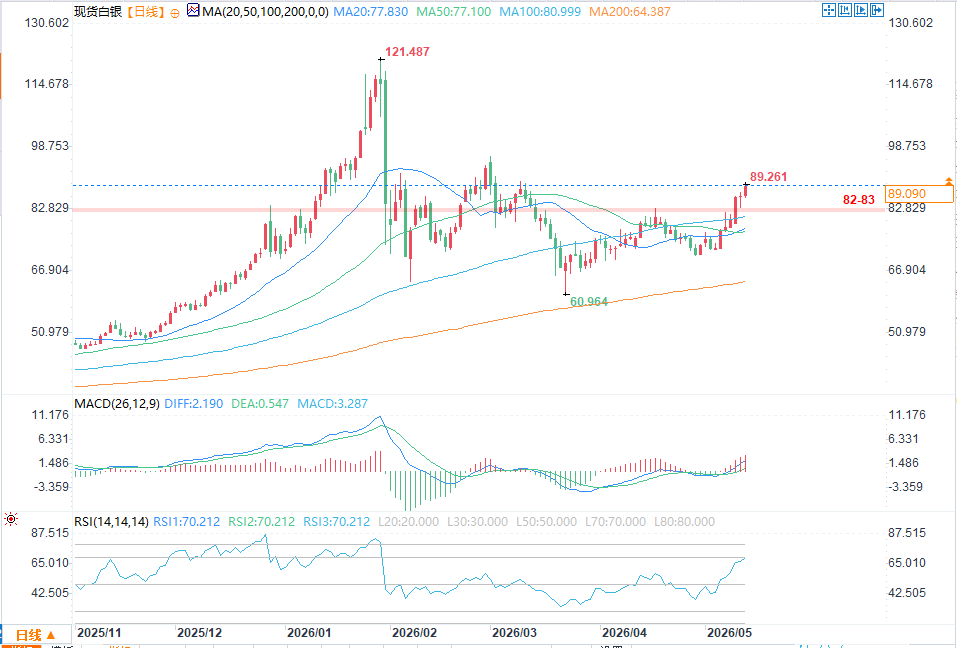
(Spot silver daily chart source: EasyTrade)
From a bullish perspective, the primary target for silver's rebound is to return to the $87.26-$89.73 range; once this range is successfully broken, the next target is $90.02, followed by the $91.34-$98.49 pullback and correction range.
Short sellers are watching for a break below the key support level of $84.90. If the price breaks down, the next downside targets are $84.00 and $82.12.
Key technical resistance levels: First resistance is the $87.26-$89.73 range, second resistance is $90.02; key support levels are $84.90 and $84.00.
From a technical perspective, if silver prices can firmly hold above the $90 mark, it will open up a new round of upward potential, and market funds will gradually turn their attention to the important psychological level of $100.
Summarize
Overall, the current silver market is in a deep interplay between supply and demand fundamentals and negative macroeconomic and financial factors. Strong physical demand in Asia, especially China, has become the most stable and reliable core driver supporting the silver price's resilience and upward trend.
TD Securities analysis points out that rising silver premiums and continued increases in imports in the Chinese market are jointly contributing to the upward trend in silver prices. The analysts emphasize that the continued active buying by funds on the Shanghai Futures Exchange and the continued openness of import arbitrage windows fully demonstrate the robust fundamentals of Asian real demand, which can completely offset the wait-and-see and cautious sentiment in Western markets.
Silver prices rose steadily on Wednesday, reaching approximately $89.047 during the session, a daily increase of 2.93%. Typically, a stronger dollar coupled with rising US Treasury yields weakens the investment appeal of non-interest-bearing assets like silver. However, in this round of price increases, strong physical buying in Asia provided robust support, offsetting the negative pressure from macroeconomic factors. Latest market data shows that silver prices were particularly resilient during Asian trading hours, with Shanghai spot silver showing a significant premium over the London benchmark price, clearly highlighting the current imbalance in the global silver supply and demand structure.
Strong demand for silver is not limited to the Chinese market; major Asian silver-consuming countries such as India have also contributed considerable purchasing power, collectively strengthening the bottom support of the global silver market. Robust physical buying in Asia has effectively offset the downward pressure from a stronger dollar, while also alleviating market pessimism regarding the Federal Reserve's prolonged maintenance of high interest rates.
Geopolitics fuels safe-haven buying demand
Tensions in the Middle East, coupled with various market expectations regarding the Federal Reserve's future monetary policy, continue to boost market interest in precious metals. The deadlock in negotiations between the US and Iran, raising the risk of energy supply disruptions, has directly fueled global inflation expectations, prompting many investors to include silver in their safe-haven asset allocation portfolios.
The US-Iran negotiations have stalled, and geopolitical tensions in the Middle East remain high. Against this backdrop, silver's safe-haven appeal has been consistently activated, leading to a steady upward price trend. Growing concerns about disruptions to the energy supply chain are further exacerbating global inflationary pressures, driving increased investor interest in precious metals. In addition, long-term structural demand for silver from solar photovoltaic, new energy vehicles, and high-end electronics industries continues to solidify silver's long-term investment value as an industrial metal, unaffected by excessive short-term market speculation.
US Inflation and the Impact of Federal Reserve Policy
The latest US inflation data has reinforced market expectations that the Federal Reserve will maintain a tight monetary policy for an extended period. The US Consumer Price Index (CPI) rose 3.8% year-on-year in April, the highest level since May 2023; the Producer Price Index (PPI) climbed even higher, reaching 6% year-on-year. High inflation has pushed up US Treasury yields, thus supporting the strength of the US dollar.
Despite facing multiple negative macroeconomic headwinds such as a stronger dollar and expectations of high interest rates, silver has demonstrated remarkable price resilience, fully reflecting the buffering effect of substantial physical demand on negative financial factors. Against the backdrop of a generally bearish macroeconomic environment for precious metals, silver's counter-trend resistance is particularly prominent, exhibiting independent price action.
TD Securities analysts stated bluntly that current demand in the Chinese market is the core factor driving the silver market's price movement. In recent weeks, professional institutions and experienced traders at the Shanghai Futures Exchange have consistently bought silver on dips, keeping the domestic silver premium consistently high. Meanwhile, import arbitrage opportunities persist, indicating that the upward driving force of Asian physical demand on silver prices has surpassed the volatility impact of conventional commodity trading systems.
Key price levels and technical trends for bulls and bears
Analysts generally agree that as long as physical buying in Asia remains active, the downside potential for silver prices will be significantly limited.
(Spot silver daily chart source: EasyTrade)
From a bullish perspective, the primary target for silver's rebound is to return to the $87.26-$89.73 range; once this range is successfully broken, the next target is $90.02, followed by the $91.34-$98.49 pullback and correction range.
Short sellers are watching for a break below the key support level of $84.90. If the price breaks down, the next downside targets are $84.00 and $82.12.
Key technical resistance levels: First resistance is the $87.26-$89.73 range, second resistance is $90.02; key support levels are $84.90 and $84.00.
From a technical perspective, if silver prices can firmly hold above the $90 mark, it will open up a new round of upward potential, and market funds will gradually turn their attention to the important psychological level of $100.
Summarize
Overall, the current silver market is in a deep interplay between supply and demand fundamentals and negative macroeconomic and financial factors. Strong physical demand in Asia, especially China, has become the most stable and reliable core driver supporting the silver price's resilience and upward trend.
- Risk Warning and Disclaimer
- The market involves risk, and trading may not be suitable for all investors. This article is for reference only and does not constitute personal investment advice, nor does it take into account certain users’ specific investment objectives, financial situation, or other needs. Any investment decisions made based on this information are at your own risk.

