Crude Oil Trading Alert: Rising Middle East supply risks and expectations of Saudi production cuts keep US crude oil prices consolidating.
2026-05-14 09:20:13
WTI crude oil prices continued their downward trend during Thursday's Asian trading session, trading around $101.26 per barrel. This marks the second consecutive day of declines in oil prices, primarily due to market caution ahead of US President Trump's talks with major Asian countries. Investors are generally concerned about the global economic growth outlook and future demand changes, leading some long positions to temporarily exit the market and observe.

However, compared to concerns about the demand side, the market is currently more focused on global crude oil supply risks. The United States has recently intensified restrictions on Iranian crude oil exports and issued warnings to financial institutions assisting in these transactions. This has reignited market concerns about the stability of energy supplies in the Middle East.
Meanwhile, data released by the U.S. Energy Information Administration (EIA) shows that since the escalation of the Middle East conflict at the end of February this year, crude oil and fuel shipments through the Strait of Hormuz decreased by nearly 6 million barrels per day in the first quarter. The Strait of Hormuz handles approximately 20% of global seaborne crude oil shipments and is one of the world's most important energy transport routes. If shipping in this region remains restricted, the global crude oil supply chain will face even greater pressure.
The International Energy Agency (IEA) further warned that even if the situation in the Middle East eases as early as next month, the global crude oil market may still remain significantly undersupplied until October. The market expects global commercial crude oil inventories to continue declining in the coming months, thus supporting high international oil prices.
Furthermore, Saudi Arabia revealed to OPEC that its crude oil production has fallen to its lowest level since 1990. As a core global oil producer, Saudi Arabia's production changes have a significant impact on international oil prices. Currently, Saudi production cuts, coupled with Middle East geopolitical risks, have further strengthened market expectations of future supply shortages.
From a market perspective, although WTI crude oil has experienced a short-term correction, its overall price remains near its recent highs. Funding data indicates that some institutional investors are reassessing the future size of the crude oil supply gap, while safe-haven funds continue to flow into the energy sector.
From a daily chart perspective, WTI crude oil maintains its medium- to long-term upward trend. The price is currently trading above major moving averages, indicating that the bullish structure remains intact. If it can regain a foothold above $102, the market may retest the $105 level. Key support levels to watch are $95 and $92; a break below these levels could trigger further profit-taking. Technically, the RSI has retreated somewhat but remains near its strong zone, suggesting that while bullish momentum has weakened, a trend reversal to bearish has not yet materialized.
The 4-hour chart shows that WTI crude oil has recently entered a high-level consolidation phase, with short-term moving averages beginning to flatten, indicating increased divergence between bulls and bears. The MACD indicator shows signs of a bearish crossover at a high level, suggesting a possible further short-term pullback. However, if the situation in the Middle East continues to deteriorate, oil prices may quickly regain buying support. Overall, the core driving factor in the current market remains from the supply side, rather than the demand side.
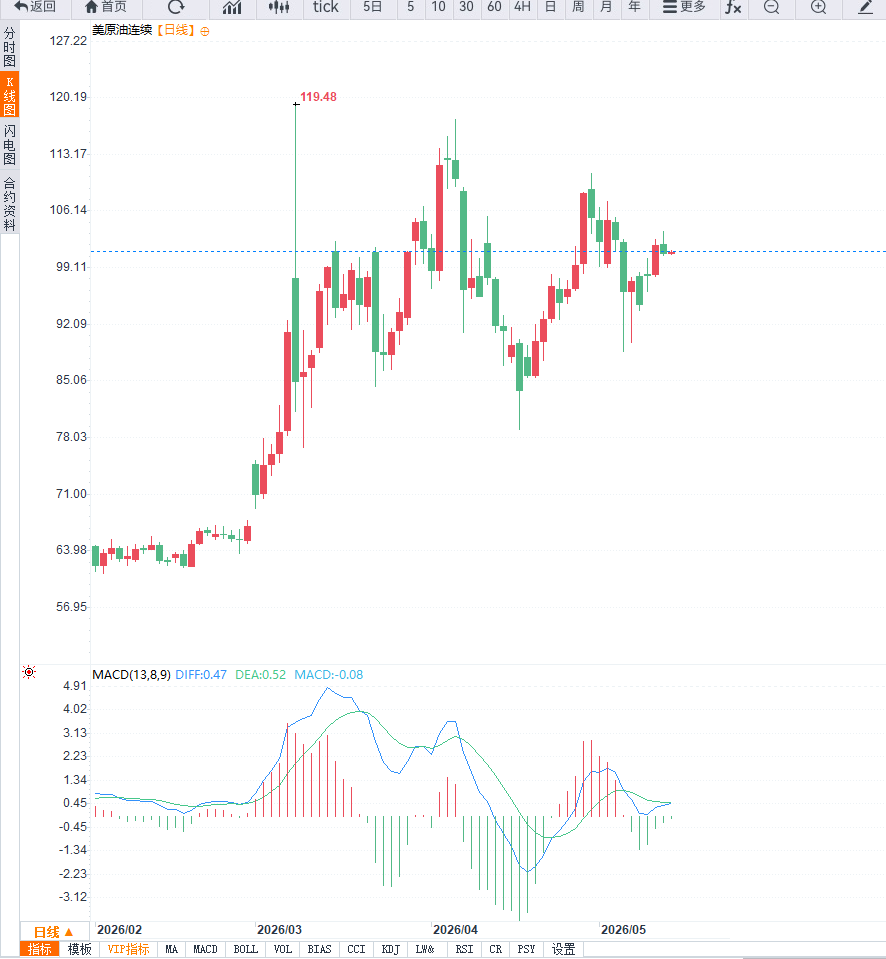
Editor's Summary : The international crude oil market is currently seeking a new balance between demand concerns and supply risks. While talks between the US and Asian countries have raised expectations for future economic and trade developments, the situation in the Middle East, reduced shipping in the Strait of Hormuz, and Saudi production cuts remain the main sources of risk for the global energy market. In the medium to long term, as long as the recovery rate of global crude oil supply lags behind the growth rate of market demand, international oil prices still have a basis for maintaining high levels. The market will need to focus on changes in the Middle East situation, OPEC production policies, and changes in global inventory data. If supply risks escalate further, WTI crude oil may retest the $100 level.
However, compared to concerns about the demand side, the market is currently more focused on global crude oil supply risks. The United States has recently intensified restrictions on Iranian crude oil exports and issued warnings to financial institutions assisting in these transactions. This has reignited market concerns about the stability of energy supplies in the Middle East.
Meanwhile, data released by the U.S. Energy Information Administration (EIA) shows that since the escalation of the Middle East conflict at the end of February this year, crude oil and fuel shipments through the Strait of Hormuz decreased by nearly 6 million barrels per day in the first quarter. The Strait of Hormuz handles approximately 20% of global seaborne crude oil shipments and is one of the world's most important energy transport routes. If shipping in this region remains restricted, the global crude oil supply chain will face even greater pressure.
The International Energy Agency (IEA) further warned that even if the situation in the Middle East eases as early as next month, the global crude oil market may still remain significantly undersupplied until October. The market expects global commercial crude oil inventories to continue declining in the coming months, thus supporting high international oil prices.
Furthermore, Saudi Arabia revealed to OPEC that its crude oil production has fallen to its lowest level since 1990. As a core global oil producer, Saudi Arabia's production changes have a significant impact on international oil prices. Currently, Saudi production cuts, coupled with Middle East geopolitical risks, have further strengthened market expectations of future supply shortages.
From a market perspective, although WTI crude oil has experienced a short-term correction, its overall price remains near its recent highs. Funding data indicates that some institutional investors are reassessing the future size of the crude oil supply gap, while safe-haven funds continue to flow into the energy sector.
From a daily chart perspective, WTI crude oil maintains its medium- to long-term upward trend. The price is currently trading above major moving averages, indicating that the bullish structure remains intact. If it can regain a foothold above $102, the market may retest the $105 level. Key support levels to watch are $95 and $92; a break below these levels could trigger further profit-taking. Technically, the RSI has retreated somewhat but remains near its strong zone, suggesting that while bullish momentum has weakened, a trend reversal to bearish has not yet materialized.
The 4-hour chart shows that WTI crude oil has recently entered a high-level consolidation phase, with short-term moving averages beginning to flatten, indicating increased divergence between bulls and bears. The MACD indicator shows signs of a bearish crossover at a high level, suggesting a possible further short-term pullback. However, if the situation in the Middle East continues to deteriorate, oil prices may quickly regain buying support. Overall, the core driving factor in the current market remains from the supply side, rather than the demand side.
Editor's Summary : The international crude oil market is currently seeking a new balance between demand concerns and supply risks. While talks between the US and Asian countries have raised expectations for future economic and trade developments, the situation in the Middle East, reduced shipping in the Strait of Hormuz, and Saudi production cuts remain the main sources of risk for the global energy market. In the medium to long term, as long as the recovery rate of global crude oil supply lags behind the growth rate of market demand, international oil prices still have a basis for maintaining high levels. The market will need to focus on changes in the Middle East situation, OPEC production policies, and changes in global inventory data. If supply risks escalate further, WTI crude oil may retest the $100 level.
- Risk Warning and Disclaimer
- The market involves risk, and trading may not be suitable for all investors. This article is for reference only and does not constitute personal investment advice, nor does it take into account certain users’ specific investment objectives, financial situation, or other needs. Any investment decisions made based on this information are at your own risk.