US inflation data hit record highs, raising concerns about stagflation; gold faces short-term pressure but demonstrates strong medium- to long-term resilience.
2026-05-14 10:27:22
Global inflation concerns have continued to escalate over the past two months, and the market has gradually digested the reality that the Federal Reserve's rate cut expectations have not materialized, putting downward pressure on gold prices.
From Tuesday to Wednesday, the US released two major inflation data points, CPI and PPI, both significantly exceeding expectations. Inflation stickiness has further strengthened, and the market's probability of an interest rate hike before the end of the year has risen to over 30%. Gold prices are currently weak due to short-term pressure from interest rate hike expectations. However, industry analysts believe that high inflation may drag the economy towards stagflation, highlighting gold's value as a hedge against inflation and economic downturn. The medium- to long-term bullish logic remains intact.
On Tuesday, the U.S. Bureau of Labor Statistics released Consumer Price Index (CPI) data, showing that the overall U.S. CPI rose 3.8% year-on-year, while core inflation, excluding food and energy, rose 2.8% year-on-year. The overall performance exceeded market expectations, and the inflation level moved further away from the Federal Reserve's 2% inflation target.
Following closely behind, the Producer Price Index (PPI) released on Wednesday once again ignited the market. U.S. wholesale prices surged 6.0% year-on-year in April, marking the largest annual increase since December 2022; core PPI rose 4.4% year-on-year, also reaching a new high since February 2023.
Two consecutive inflation reports exceeding expectations have completely reversed market policy expectations. Current financial market pricing indicates that the probability of the Federal Reserve raising interest rates before the end of this year has exceeded 30%.
Rising expectations of interest rate hikes will increase the opportunity cost of holding gold, a non-interest-bearing asset, directly putting downward pressure on gold prices. However, against the backdrop of widespread inflation, gold has not experienced a significant collapse, with prices consistently consolidating in a narrow range below $4,700 per ounce. This level has become a crucial short-term technical watershed, indicating an overall weak but limited downside potential.
Global currency market analyst Fawad Razaqzada believes that persistently high inflation is eroding economic growth momentum, a concern that provides implicit support for gold. He stated that high inflation coupled with rising US Treasury yields is detrimental to the performance of risk assets. In recent years, gold has been highly correlated with US stocks, making it susceptible to short-term sentiment-driven fluctuations. However, the increased demand for safe-haven assets in a high-inflation environment determines a short-term downward pressure on gold, but a positive medium- to long-term outlook.
In a research report on Wednesday, Lazardda analyzed that inflationary pressures have begun to drag down economic activity, and the United States is gradually moving towards a stagflation pattern of low growth and high inflation. Just one day after the CPI data exceeded expectations, the PPI also saw a significant drop, with wholesale inflation surging in April, exacerbating market concerns about a potential stagflation in the US economy.
The US-Iran tensions pushing up energy prices is just the beginning; the price increase effect is no longer limited to crude oil. Rising upstream costs are gradually being transmitted throughout the entire industry chain, with inflation in the service sector accelerating simultaneously. This top-down price transmission effect is precisely the situation the market was most worried about, and it also means that US inflation is highly sticky and unlikely to fall quickly.
Industry analysts generally believe that once stagflation is established, it will be a long-term positive for gold. Economic slowdown coupled with high inflation makes it difficult for the Federal Reserve to continue tightening monetary policy, making it easier for real yields to fall than rise, significantly reducing the cost of holding gold and laying a solid foundation for a medium- to long-term upward trend in gold prices.
The market's attention is now focused on the US retail sales data to be released on Thursday. Under the dual pressure of high oil prices and entrenched inflation, the strength of consumer spending will be a key indicator of economic resilience and will further influence the Fed's policy stance and the subsequent trend of gold prices.
Overall, the unexpected surge in both US CPI and PPI, coupled with persistently high inflation stickiness, has increased expectations of a Fed rate hike, putting downward pressure on gold prices in the short term. However, the transmission of inflation across all industries and the rising risk of stagflation provide gold with both safe-haven and inflation-hedging support, demonstrating its resilience. While short-term gold prices remain constrained by policy expectations, the medium- to long-term stagflation logic continues to unfold, and the overall bullish trend for gold remains unchanged. Future price movements will heavily depend on retail sales data and the Fed's policy statements.
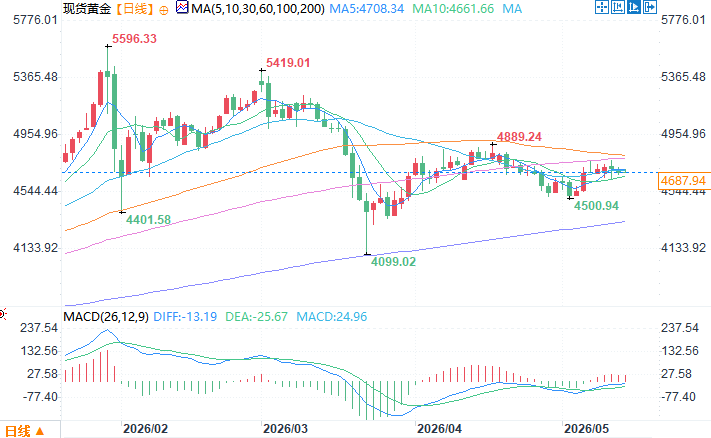
Spot gold daily chart source: EasyForex
At 10:27 AM Beijing time on May 14, spot gold was trading at $4692.94 per ounce.
From Tuesday to Wednesday, the US released two major inflation data points, CPI and PPI, both significantly exceeding expectations. Inflation stickiness has further strengthened, and the market's probability of an interest rate hike before the end of the year has risen to over 30%. Gold prices are currently weak due to short-term pressure from interest rate hike expectations. However, industry analysts believe that high inflation may drag the economy towards stagflation, highlighting gold's value as a hedge against inflation and economic downturn. The medium- to long-term bullish logic remains intact.
Both inflation data have exceeded the target and deviated from the Federal Reserve's policy objective.
On Tuesday, the U.S. Bureau of Labor Statistics released Consumer Price Index (CPI) data, showing that the overall U.S. CPI rose 3.8% year-on-year, while core inflation, excluding food and energy, rose 2.8% year-on-year. The overall performance exceeded market expectations, and the inflation level moved further away from the Federal Reserve's 2% inflation target.
Following closely behind, the Producer Price Index (PPI) released on Wednesday once again ignited the market. U.S. wholesale prices surged 6.0% year-on-year in April, marking the largest annual increase since December 2022; core PPI rose 4.4% year-on-year, also reaching a new high since February 2023.
Two consecutive inflation reports exceeding expectations have completely reversed market policy expectations. Current financial market pricing indicates that the probability of the Federal Reserve raising interest rates before the end of this year has exceeded 30%.
Rising interest rate hike expectations put pressure on gold prices, but gold prices showed resilience during the trading session.
Rising expectations of interest rate hikes will increase the opportunity cost of holding gold, a non-interest-bearing asset, directly putting downward pressure on gold prices. However, against the backdrop of widespread inflation, gold has not experienced a significant collapse, with prices consistently consolidating in a narrow range below $4,700 per ounce. This level has become a crucial short-term technical watershed, indicating an overall weak but limited downside potential.
Global currency market analyst Fawad Razaqzada believes that persistently high inflation is eroding economic growth momentum, a concern that provides implicit support for gold. He stated that high inflation coupled with rising US Treasury yields is detrimental to the performance of risk assets. In recent years, gold has been highly correlated with US stocks, making it susceptible to short-term sentiment-driven fluctuations. However, the increased demand for safe-haven assets in a high-inflation environment determines a short-term downward pressure on gold, but a positive medium- to long-term outlook.
Inflation transmission is spreading across the board, raising the risk of stagflation in the US economy.
In a research report on Wednesday, Lazardda analyzed that inflationary pressures have begun to drag down economic activity, and the United States is gradually moving towards a stagflation pattern of low growth and high inflation. Just one day after the CPI data exceeded expectations, the PPI also saw a significant drop, with wholesale inflation surging in April, exacerbating market concerns about a potential stagflation in the US economy.
The US-Iran tensions pushing up energy prices is just the beginning; the price increase effect is no longer limited to crude oil. Rising upstream costs are gradually being transmitted throughout the entire industry chain, with inflation in the service sector accelerating simultaneously. This top-down price transmission effect is precisely the situation the market was most worried about, and it also means that US inflation is highly sticky and unlikely to fall quickly.
Stagflation is favorable for gold; the market awaits guidance from retail data.
Industry analysts generally believe that once stagflation is established, it will be a long-term positive for gold. Economic slowdown coupled with high inflation makes it difficult for the Federal Reserve to continue tightening monetary policy, making it easier for real yields to fall than rise, significantly reducing the cost of holding gold and laying a solid foundation for a medium- to long-term upward trend in gold prices.
The market's attention is now focused on the US retail sales data to be released on Thursday. Under the dual pressure of high oil prices and entrenched inflation, the strength of consumer spending will be a key indicator of economic resilience and will further influence the Fed's policy stance and the subsequent trend of gold prices.
Summarize
Overall, the unexpected surge in both US CPI and PPI, coupled with persistently high inflation stickiness, has increased expectations of a Fed rate hike, putting downward pressure on gold prices in the short term. However, the transmission of inflation across all industries and the rising risk of stagflation provide gold with both safe-haven and inflation-hedging support, demonstrating its resilience. While short-term gold prices remain constrained by policy expectations, the medium- to long-term stagflation logic continues to unfold, and the overall bullish trend for gold remains unchanged. Future price movements will heavily depend on retail sales data and the Fed's policy statements.
Spot gold daily chart source: EasyForex
At 10:27 AM Beijing time on May 14, spot gold was trading at $4692.94 per ounce.
- Risk Warning and Disclaimer
- The market involves risk, and trading may not be suitable for all investors. This article is for reference only and does not constitute personal investment advice, nor does it take into account certain users’ specific investment objectives, financial situation, or other needs. Any investment decisions made based on this information are at your own risk.