Better-than-expected US inflation data and escalating tensions in the Middle East fueled safe-haven demand, keeping gold prices range-bound at high levels.
2026-05-14 10:07:52
Gold prices (XAU/USD) maintained their upward trend during Thursday's Asian trading session, trading around $4,700 per ounce. Rising risk aversion in the market is one of the main reasons driving the continued rise in gold prices. Investors are currently closely watching important talks between the US and major Asian powers, while the escalating situation in the Middle East is further enhancing gold's appeal as a safe-haven asset.

Despite some market expectations for a de-escalation of tensions between the two sides, the escalating situation in Iran has fueled significant global demand for safe-haven assets. Gold, as a traditional safe-haven asset, typically attracts investment during periods of heightened geopolitical risk. The current escalating energy supply risks in the Middle East are also driving up global inflation expectations, further exacerbating market concerns about economic uncertainty.
Meanwhile, the latest U.S. inflation data further amplified market volatility. Data released Wednesday by the U.S. Bureau of Labor Statistics showed that the U.S. Producer Price Index (PPI) rose 6.0% year-on-year in April, higher than the previous level of 4.3% and significantly higher than the market expectation of 4.9%. On a monthly basis, the U.S. PPI rose 1.4% in April, far exceeding the previous value of 0.7% and the market expectation of 0.5%.
This marks the first time since December 2022 that US wholesale inflation has reached such a high level. The market believes that rising oil prices and increased energy costs due to the situation in the Middle East are among the key factors driving this round of inflationary rebound.
Higher-than-expected inflation data quickly altered market perceptions of the Federal Reserve's policy path. Investors began to believe that the Fed might need to maintain high interest rates for an extended period to curb persistent inflationary pressures. Typically, a high-interest-rate environment diminishes the appeal of gold, as gold itself does not generate interest income, while dollar-denominated assets offer higher returns.
However, the gold market is currently exhibiting a typical "dual-driven" characteristic. On the one hand, the Federal Reserve's maintenance of high interest rates will limit the upside potential for gold; on the other hand, the escalating situation in the Middle East and global economic uncertainty continue to drive safe-haven buying. The interplay of these two forces is keeping gold prices in a high-level consolidation pattern.
From a fund flow perspective, some global institutional investors have recently continued to increase their gold allocations. Market concerns about a potential further deterioration in the global financial environment have led to a renewed rise in gold's importance as a long-term safe-haven asset.
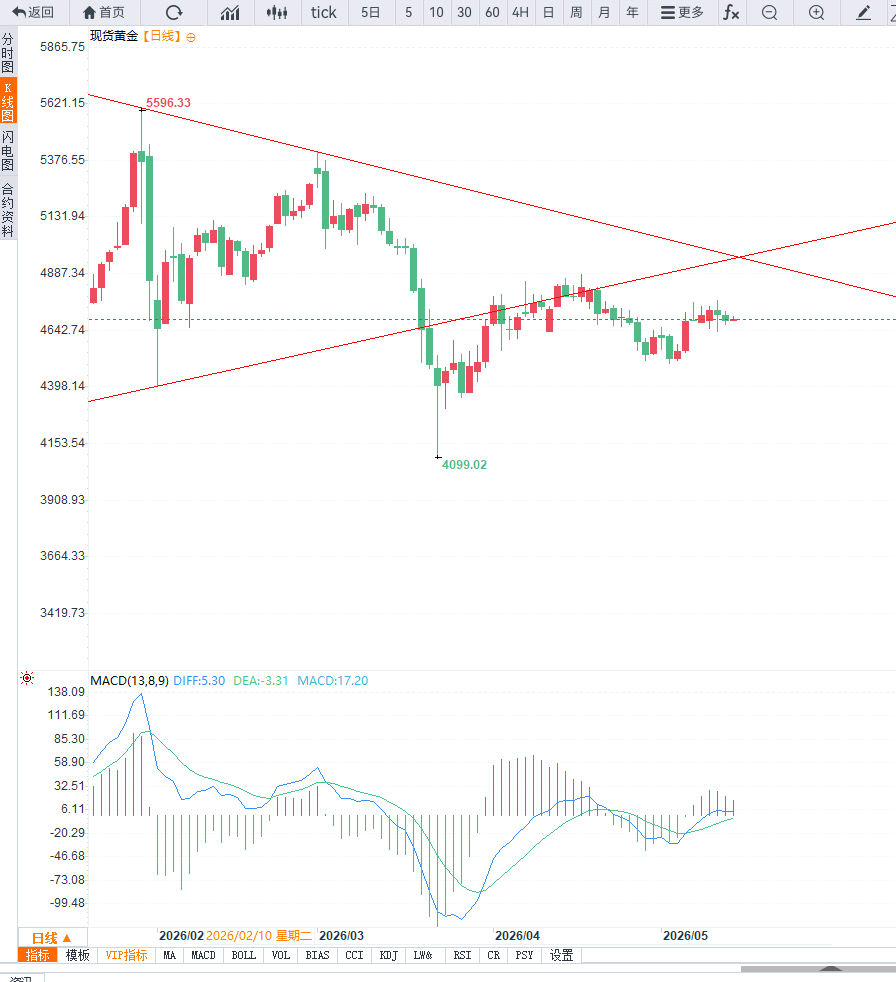
From a daily chart perspective, gold maintains its overall strong bullish trend. The price is trading above the major moving average system, indicating that the medium-to-long-term upward structure remains unchanged. The area around $4700 has become a key short-term resistance zone; a break above this level could lead to further testing of $4750 and even $4800. Key support levels to watch are $4650 and the psychological level of $4600.
The 4-hour chart shows that gold's short-term upward momentum has slowed, but it still maintains a high-level consolidation structure overall. While the MACD indicator shows signs of top divergence, it has not yet formed a clear bearish signal. The RSI indicator remains near the strong zone, indicating that buying pressure still dominates the market. If subsequent US economic data continues to be strong, gold may face some technical correction pressure; however, if Middle East risks continue to escalate, safe-haven flows may push gold prices further upward.
Editor's Summary : The current gold market is driven by both high inflation and high safe-haven demand. Better-than-expected US PPI data has significantly increased market expectations that the Federal Reserve will maintain high interest rates for an extended period. However, at the same time, escalating tensions in the Middle East and global economic uncertainty continue to enhance gold's safe-haven appeal. From an overall perspective, as long as global geopolitical risks remain unresolved, gold prices will continue to have strong support in the medium to long term. Future market focus will be on US retail sales data, Federal Reserve policy statements, and developments in the Middle East. If inflation remains high and safe-haven demand further intensifies, gold prices are expected to remain high and may even reach new highs.
Despite some market expectations for a de-escalation of tensions between the two sides, the escalating situation in Iran has fueled significant global demand for safe-haven assets. Gold, as a traditional safe-haven asset, typically attracts investment during periods of heightened geopolitical risk. The current escalating energy supply risks in the Middle East are also driving up global inflation expectations, further exacerbating market concerns about economic uncertainty.
Meanwhile, the latest U.S. inflation data further amplified market volatility. Data released Wednesday by the U.S. Bureau of Labor Statistics showed that the U.S. Producer Price Index (PPI) rose 6.0% year-on-year in April, higher than the previous level of 4.3% and significantly higher than the market expectation of 4.9%. On a monthly basis, the U.S. PPI rose 1.4% in April, far exceeding the previous value of 0.7% and the market expectation of 0.5%.
This marks the first time since December 2022 that US wholesale inflation has reached such a high level. The market believes that rising oil prices and increased energy costs due to the situation in the Middle East are among the key factors driving this round of inflationary rebound.
Higher-than-expected inflation data quickly altered market perceptions of the Federal Reserve's policy path. Investors began to believe that the Fed might need to maintain high interest rates for an extended period to curb persistent inflationary pressures. Typically, a high-interest-rate environment diminishes the appeal of gold, as gold itself does not generate interest income, while dollar-denominated assets offer higher returns.
However, the gold market is currently exhibiting a typical "dual-driven" characteristic. On the one hand, the Federal Reserve's maintenance of high interest rates will limit the upside potential for gold; on the other hand, the escalating situation in the Middle East and global economic uncertainty continue to drive safe-haven buying. The interplay of these two forces is keeping gold prices in a high-level consolidation pattern.
From a fund flow perspective, some global institutional investors have recently continued to increase their gold allocations. Market concerns about a potential further deterioration in the global financial environment have led to a renewed rise in gold's importance as a long-term safe-haven asset.
From a daily chart perspective, gold maintains its overall strong bullish trend. The price is trading above the major moving average system, indicating that the medium-to-long-term upward structure remains unchanged. The area around $4700 has become a key short-term resistance zone; a break above this level could lead to further testing of $4750 and even $4800. Key support levels to watch are $4650 and the psychological level of $4600.
The 4-hour chart shows that gold's short-term upward momentum has slowed, but it still maintains a high-level consolidation structure overall. While the MACD indicator shows signs of top divergence, it has not yet formed a clear bearish signal. The RSI indicator remains near the strong zone, indicating that buying pressure still dominates the market. If subsequent US economic data continues to be strong, gold may face some technical correction pressure; however, if Middle East risks continue to escalate, safe-haven flows may push gold prices further upward.
Editor's Summary : The current gold market is driven by both high inflation and high safe-haven demand. Better-than-expected US PPI data has significantly increased market expectations that the Federal Reserve will maintain high interest rates for an extended period. However, at the same time, escalating tensions in the Middle East and global economic uncertainty continue to enhance gold's safe-haven appeal. From an overall perspective, as long as global geopolitical risks remain unresolved, gold prices will continue to have strong support in the medium to long term. Future market focus will be on US retail sales data, Federal Reserve policy statements, and developments in the Middle East. If inflation remains high and safe-haven demand further intensifies, gold prices are expected to remain high and may even reach new highs.
- Risk Warning and Disclaimer
- The market involves risk, and trading may not be suitable for all investors. This article is for reference only and does not constitute personal investment advice, nor does it take into account certain users’ specific investment objectives, financial situation, or other needs. Any investment decisions made based on this information are at your own risk.