Warsh officially confirmed as Federal Reserve Chairman! Can he get Trump to cut interest rates as he wants? The market says the probability is only 1%.
2026-05-14 10:59:48
Kevin Warsh was officially confirmed as Federal Reserve Chairman on Wednesday (May 13) with a narrow margin of 54 votes (the lowest vote share in history). After eight and a half years, Trump has finally reversed one of the few presidential mistakes he has admitted to—choosing Powell over Warsh in 2017. However, the market is now worried: Will Trump regret this decision again? Can Warsh successfully lead the Fed in a dangerous political environment while maintaining its independence?
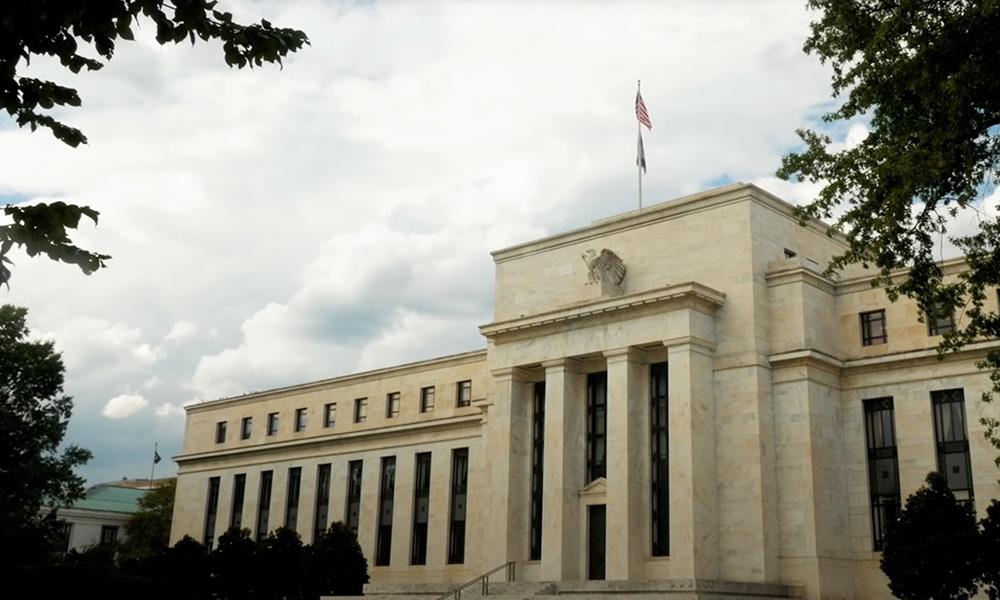
Warsh received 54 votes to confirm his candidacy, the lowest number of votes since the Senate began requiring confirmation of a Federal Reserve chair in 1977. The previous record holder was Yellen (56 votes in 2014). The only Democrat to vote in favor was Pennsylvania Senator Fetman, while Minority Leader Schumer voted against – a stark contrast to Schumer's unanimous support for Warsh's appointment as a Federal Reserve governor in 2006. Back then, Schumer stated that Warsh "clearly understands that the Federal Reserve must be independent, non-ideological, and non-partisan."
Powell found a key ally in the Senate when facing attacks from Trump. Warsh, on the other hand, faced threats from Republican Senator Tillis—who had demanded the Justice Department drop its criminal investigation into the Federal Reserve before proceeding with the confirmation process. Washington, D.C. U.S. Attorney Piro dropped the charges in April, clearing the way for Warsh.
Many longtime observers of the Federal Reserve have deemed Warsh "hopeless," believing he either fantasizes about shaking the Fed's entrenched bureaucracy or, as Massachusetts Senator Warren put it, is merely a "puppet" of Trump. However, Warsh didn't get to this point by luck—he was considered by Trump before the 2024 election and even advised Trump against firing Powell (a suggestion that was personally detrimental to him).
Stanford economist Kogan (Wash's undergraduate professor and now a friend) said that Walsh's ability lay not only in his ideology (he once served as a research assistant for conservative economist Friedman), but also in his ability to connect his own beliefs with the ideas and aspirations of others and find common ground.
Upon taking office, Warsh will need to immediately demonstrate his political acumen both inside and outside the Federal Reserve. With the April CPI jumping to 3.8% and core inflation rising for the third consecutive month, some Fed members are concerned that interest rates are not set high enough to curb inflation.
Trump's expectation of rapid interest rate cuts lacks support within the Federal Reserve. Warsh stated explicitly at his confirmation hearing that he never promised Trump that he could do so. He believes the Fed has historically been overly obsessed with the minutiae of short-term economic data, sacrificing market credibility—evidence of which is that both market participants and consumers expect inflation to remain below the 2% target within five years.
Warsh's reform plan includes: abandoning forward guidance on interest rate paths, unifying the agency's messaging, updating data sources, and renegotiating the division of economic management responsibilities with the Treasury Department.
According to CME FedWatch, the market believes there is only a 1% chance of Warsh cutting interest rates this year. If Trump doesn't see a rate cut by June, there is indeed a possibility of discontent erupting. But Warsh isn't passively waiting—he has spent nearly a decade preparing for this moment and might be able to convince Trump that he can deliver the economic "golden age" the president so desperately wants. This isn't the first time Trump has abruptly changed course when someone he trusts offers a convenient idea.
Most institutions believe the window for interest rate cuts is closing, while a few institutions still insist on a rate cut within the year, forming a clear contrast between a "hawkish consensus" and a "dovish lone courage."
Goldman Sachs has postponed its expectation for the first rate cut from September 2026 to December 2026, and anticipates another rate cut in March 2027, delaying each cut by one quarter. Goldman Sachs analysts point out that if the labor market does not weaken sufficiently this year, the final two rate cuts may not be completed until 2027.
Bank of America's stance is more hawkish. Bank of America Global Research expects the Federal Reserve to keep interest rates unchanged for the remainder of 2026, with the first rate cut postponed until July 2027. Bank of America economists stated explicitly: "The data simply does not support a rate cut this year. Core inflation is too high and is still rising. The April jobs report was the final straw."
Matt Hornbach, global head of macro strategy at Morgan Stanley, said the April inflation report "will certainly be a bit trickier," and that sharp fluctuations in oil prices will have a significant impact on inflation trends before the end of the year.
Warsh's polarized vote reflects more of a shift in American politics than of his personal political stance. His core argument is that, despite the deteriorating political environment, he understands better than anyone how to ensure the Federal Reserve's enduring influence as a stabilizing force. Now, he has the opportunity to prove himself. If he fails, a crucial bulwark of American economic strength will crumble along with him.
The postponement of interest rate cuts signifies a further cooling of market expectations for easing policies from the Federal Reserve. The US dollar index has rebounded from its late April low of 97.63 to around 98.50.
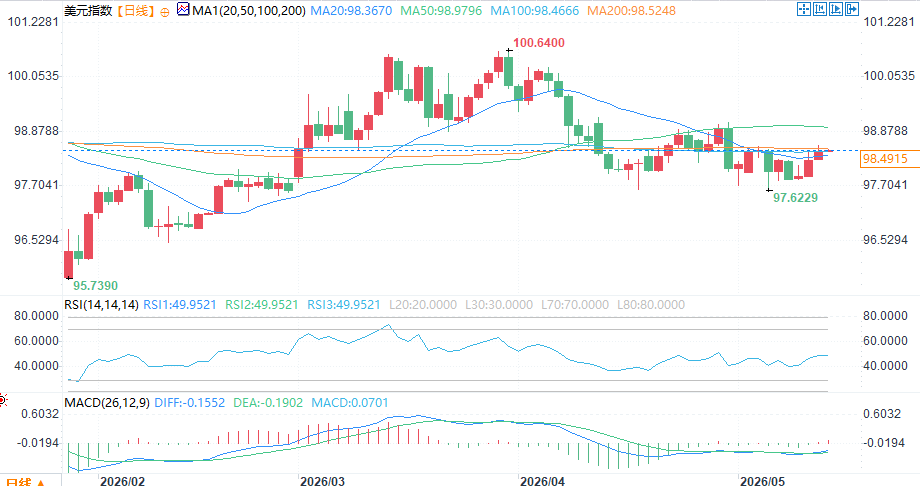
(US Dollar Index Daily Chart, Source: FX678)
Looking at the daily moving averages for the US Dollar Index, the 20-day moving average (MA20) (98.37), 100-day moving average (MA100) (98.47), and 200-day moving average (MA200) (98.52) are closely clustered within a narrow range of 98.37-98.52, while the 50-day moving average (MA50) (98.98) is positioned higher. The current price is around 98.50, having broken above the MA20 (98.37) and MA100 (98.47), but still slightly below the MA200 (98.52), presenting a delicate pattern of "breaking through short-term moving averages and challenging long-term moving averages." This is a positive signal—the price has broken above the moving averages, indicating improved short-term momentum. However, the MA200 (98.52) is just a short distance away, forming immediate technical resistance.
At 10:59 AM Beijing time on May 14, the US dollar index was at 98.49.
The weakest support in history, a perilous political environment
Warsh received 54 votes to confirm his candidacy, the lowest number of votes since the Senate began requiring confirmation of a Federal Reserve chair in 1977. The previous record holder was Yellen (56 votes in 2014). The only Democrat to vote in favor was Pennsylvania Senator Fetman, while Minority Leader Schumer voted against – a stark contrast to Schumer's unanimous support for Warsh's appointment as a Federal Reserve governor in 2006. Back then, Schumer stated that Warsh "clearly understands that the Federal Reserve must be independent, non-ideological, and non-partisan."
Powell found a key ally in the Senate when facing attacks from Trump. Warsh, on the other hand, faced threats from Republican Senator Tillis—who had demanded the Justice Department drop its criminal investigation into the Federal Reserve before proceeding with the confirmation process. Washington, D.C. U.S. Attorney Piro dropped the charges in April, clearing the way for Warsh.
Walsh's independence: Critics underestimated him
Many longtime observers of the Federal Reserve have deemed Warsh "hopeless," believing he either fantasizes about shaking the Fed's entrenched bureaucracy or, as Massachusetts Senator Warren put it, is merely a "puppet" of Trump. However, Warsh didn't get to this point by luck—he was considered by Trump before the 2024 election and even advised Trump against firing Powell (a suggestion that was personally detrimental to him).
Stanford economist Kogan (Wash's undergraduate professor and now a friend) said that Walsh's ability lay not only in his ideology (he once served as a research assistant for conservative economist Friedman), but also in his ability to connect his own beliefs with the ideas and aspirations of others and find common ground.
Internal challenges for the Federal Reserve: persistent inflation makes interest rate cuts no easy task.
Upon taking office, Warsh will need to immediately demonstrate his political acumen both inside and outside the Federal Reserve. With the April CPI jumping to 3.8% and core inflation rising for the third consecutive month, some Fed members are concerned that interest rates are not set high enough to curb inflation.
Trump's expectation of rapid interest rate cuts lacks support within the Federal Reserve. Warsh stated explicitly at his confirmation hearing that he never promised Trump that he could do so. He believes the Fed has historically been overly obsessed with the minutiae of short-term economic data, sacrificing market credibility—evidence of which is that both market participants and consumers expect inflation to remain below the 2% target within five years.
Warsh's reform plan includes: abandoning forward guidance on interest rate paths, unifying the agency's messaging, updating data sources, and renegotiating the division of economic management responsibilities with the Treasury Department.
Market and Outlook: Only 1% chance of an interest rate cut; Trump's patience is limited.
According to CME FedWatch, the market believes there is only a 1% chance of Warsh cutting interest rates this year. If Trump doesn't see a rate cut by June, there is indeed a possibility of discontent erupting. But Warsh isn't passively waiting—he has spent nearly a decade preparing for this moment and might be able to convince Trump that he can deliver the economic "golden age" the president so desperately wants. This isn't the first time Trump has abruptly changed course when someone he trusts offers a convenient idea.
Most institutions believe the window for interest rate cuts is closing, while a few institutions still insist on a rate cut within the year, forming a clear contrast between a "hawkish consensus" and a "dovish lone courage."
Goldman Sachs has postponed its expectation for the first rate cut from September 2026 to December 2026, and anticipates another rate cut in March 2027, delaying each cut by one quarter. Goldman Sachs analysts point out that if the labor market does not weaken sufficiently this year, the final two rate cuts may not be completed until 2027.
Bank of America's stance is more hawkish. Bank of America Global Research expects the Federal Reserve to keep interest rates unchanged for the remainder of 2026, with the first rate cut postponed until July 2027. Bank of America economists stated explicitly: "The data simply does not support a rate cut this year. Core inflation is too high and is still rising. The April jobs report was the final straw."
Matt Hornbach, global head of macro strategy at Morgan Stanley, said the April inflation report "will certainly be a bit trickier," and that sharp fluctuations in oil prices will have a significant impact on inflation trends before the end of the year.
Walsh's Opportunities and Risks
Warsh's polarized vote reflects more of a shift in American politics than of his personal political stance. His core argument is that, despite the deteriorating political environment, he understands better than anyone how to ensure the Federal Reserve's enduring influence as a stabilizing force. Now, he has the opportunity to prove himself. If he fails, a crucial bulwark of American economic strength will crumble along with him.
The dollar strengthened.
The postponement of interest rate cuts signifies a further cooling of market expectations for easing policies from the Federal Reserve. The US dollar index has rebounded from its late April low of 97.63 to around 98.50.
(US Dollar Index Daily Chart, Source: FX678)
Looking at the daily moving averages for the US Dollar Index, the 20-day moving average (MA20) (98.37), 100-day moving average (MA100) (98.47), and 200-day moving average (MA200) (98.52) are closely clustered within a narrow range of 98.37-98.52, while the 50-day moving average (MA50) (98.98) is positioned higher. The current price is around 98.50, having broken above the MA20 (98.37) and MA100 (98.47), but still slightly below the MA200 (98.52), presenting a delicate pattern of "breaking through short-term moving averages and challenging long-term moving averages." This is a positive signal—the price has broken above the moving averages, indicating improved short-term momentum. However, the MA200 (98.52) is just a short distance away, forming immediate technical resistance.
At 10:59 AM Beijing time on May 14, the US dollar index was at 98.49.
- Risk Warning and Disclaimer
- The market involves risk, and trading may not be suitable for all investors. This article is for reference only and does not constitute personal investment advice, nor does it take into account certain users’ specific investment objectives, financial situation, or other needs. Any investment decisions made based on this information are at your own risk.