The dollar index remained range-bound as expectations of higher interest rates from the Federal Reserve strengthened and risk aversion intensified.
2026-05-14 13:13:38
The US dollar index (DXY) maintained its strength during Thursday's Asian trading session, trading around 98.50. Recent US inflation data has consistently exceeded expectations, significantly increasing market expectations that the Federal Reserve will maintain its high interest rate policy, thus driving the dollar index higher.

Looking at the performance of major currencies this week, the US dollar remained strong overall, especially against the Japanese yen. Market data shows that the USD/JPY exchange rate rose by nearly 0.85% this week, while the Australian dollar was one of the few currencies that maintained relative strength against the US dollar.
Market sentiment regarding the Federal Reserve's policy path has shifted significantly. According to the CME FedWatch tool, the market now expects approximately a 66.8% probability that the Fed will maintain current interest rates this year, with a 32.2% probability that the Fed may raise rates again. The market has largely abandoned its previous expectation of rapid rate cuts by the Fed.
The core reason for the shift in market expectations stems from the continued rise in US inflation data. Data from the US Bureau of Labor Statistics shows that the US Consumer Price Index (CPI) rose 3.8% year-on-year in April, higher than March's 3.3%. At the same time, the US Producer Price Index (PPI) rose 6.0% year-on-year in April, far exceeding market expectations of 4.9% and significantly higher than the previous value of 4.3%.
On a monthly basis, the US Producer Price Index (PPI) rose 1.4% in April, far exceeding market expectations of 0.5%. This is the strongest wholesale inflation data in the US since the end of 2022. The market believes that the escalating tensions in the Middle East, driving up energy prices, is one of the key reasons for the resurgence of inflation in the US. With international oil prices remaining high, US companies' production costs continue to rise, further increasing market concerns about future inflationary pressures.
Typically, persistently high inflation means the Federal Reserve needs to maintain higher interest rates to curb rising demand and prices. A higher interest rate environment pushes up US Treasury yields and enhances the attractiveness of dollar assets, thus leading to a continued flow of international funds into the dollar market.
Investors are currently focused on US economic data and the Federal Reserve's policy path. The upcoming US retail sales data for April will be a key driver of the dollar index's next move. The market expects US retail sales to grow by 0.5% month-on-month in April, lower than the previous 1.7%. If the data remains strong, it could further reinforce market confidence in the resilience of the US economy, thus pushing the dollar index higher.
From the daily chart of the US Dollar Index (DXY), the overall structure has returned to a medium-term uptrend. The price continues to trade above the 20-day and 50-day moving averages, indicating that the bullish trend remains dominant. The area around 98.50 has become a key short-term support zone, while the 99.00-99.30 area represents a significant resistance zone. The daily MACD indicator has rebounded upwards, suggesting that the medium-term upward momentum of the US dollar is recovering. The RSI indicator remains above 60, indicating an overall bullish market, but it has not yet entered an extremely overbought state.
From the 4-hour chart, the US dollar index has recently entered a consolidation phase at high levels. Short-term moving averages remain in a bullish alignment, indicating a continued strong short-term trend. While the MACD indicator has shown some overbought conditions, a clear death cross signal has not yet appeared. The RSI indicator remains around the 55-60 range, suggesting that buying pressure still dominates the market. If the US dollar index effectively breaks through 99.00, it may further test the 99.50 area; if it falls below 98.20, a short-term pullback to around 97.80 is possible.
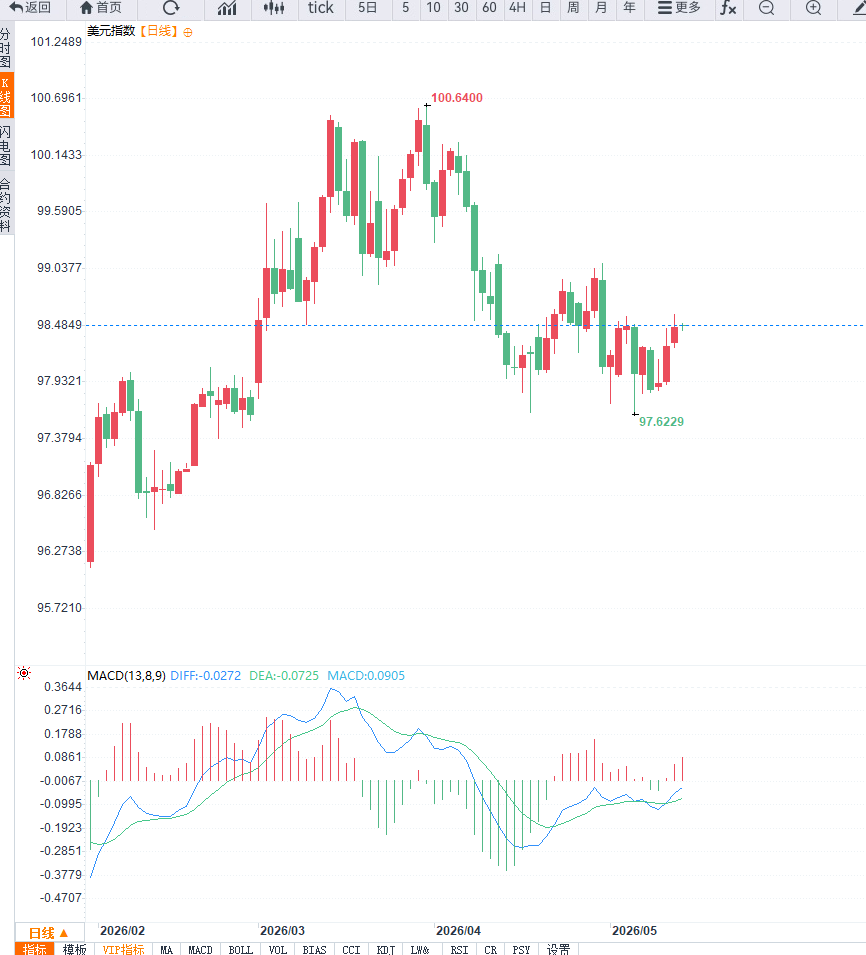
Overall, the US dollar index is currently supported by expectations of high inflation and high interest rates in the United States, while US retail sales data and changes in global risk sentiment will determine the direction of the dollar's next phase.
Editor's Summary : The core drivers of the current US dollar index remain the renewed rise in US inflation and market expectations that the Federal Reserve will maintain high interest rates for an extended period. With CPI and PPI data consistently exceeding expectations, the market has significantly reduced its bets on interest rate cuts this year and has even begun discussing the possibility of another rate hike. From a technical perspective, the US dollar index maintains an overall strong trend, but it is approaching a key resistance level in the short term. Going forward, market focus will be on US retail sales data, changes in US Treasury yields, and the outcome of talks between the US and major Asian countries. If the US economy continues to show resilience, the US dollar index still has room for further upward movement.
Looking at the performance of major currencies this week, the US dollar remained strong overall, especially against the Japanese yen. Market data shows that the USD/JPY exchange rate rose by nearly 0.85% this week, while the Australian dollar was one of the few currencies that maintained relative strength against the US dollar.
Market sentiment regarding the Federal Reserve's policy path has shifted significantly. According to the CME FedWatch tool, the market now expects approximately a 66.8% probability that the Fed will maintain current interest rates this year, with a 32.2% probability that the Fed may raise rates again. The market has largely abandoned its previous expectation of rapid rate cuts by the Fed.
The core reason for the shift in market expectations stems from the continued rise in US inflation data. Data from the US Bureau of Labor Statistics shows that the US Consumer Price Index (CPI) rose 3.8% year-on-year in April, higher than March's 3.3%. At the same time, the US Producer Price Index (PPI) rose 6.0% year-on-year in April, far exceeding market expectations of 4.9% and significantly higher than the previous value of 4.3%.
On a monthly basis, the US Producer Price Index (PPI) rose 1.4% in April, far exceeding market expectations of 0.5%. This is the strongest wholesale inflation data in the US since the end of 2022. The market believes that the escalating tensions in the Middle East, driving up energy prices, is one of the key reasons for the resurgence of inflation in the US. With international oil prices remaining high, US companies' production costs continue to rise, further increasing market concerns about future inflationary pressures.
Typically, persistently high inflation means the Federal Reserve needs to maintain higher interest rates to curb rising demand and prices. A higher interest rate environment pushes up US Treasury yields and enhances the attractiveness of dollar assets, thus leading to a continued flow of international funds into the dollar market.
Investors are currently focused on US economic data and the Federal Reserve's policy path. The upcoming US retail sales data for April will be a key driver of the dollar index's next move. The market expects US retail sales to grow by 0.5% month-on-month in April, lower than the previous 1.7%. If the data remains strong, it could further reinforce market confidence in the resilience of the US economy, thus pushing the dollar index higher.
From the daily chart of the US Dollar Index (DXY), the overall structure has returned to a medium-term uptrend. The price continues to trade above the 20-day and 50-day moving averages, indicating that the bullish trend remains dominant. The area around 98.50 has become a key short-term support zone, while the 99.00-99.30 area represents a significant resistance zone. The daily MACD indicator has rebounded upwards, suggesting that the medium-term upward momentum of the US dollar is recovering. The RSI indicator remains above 60, indicating an overall bullish market, but it has not yet entered an extremely overbought state.
From the 4-hour chart, the US dollar index has recently entered a consolidation phase at high levels. Short-term moving averages remain in a bullish alignment, indicating a continued strong short-term trend. While the MACD indicator has shown some overbought conditions, a clear death cross signal has not yet appeared. The RSI indicator remains around the 55-60 range, suggesting that buying pressure still dominates the market. If the US dollar index effectively breaks through 99.00, it may further test the 99.50 area; if it falls below 98.20, a short-term pullback to around 97.80 is possible.
Overall, the US dollar index is currently supported by expectations of high inflation and high interest rates in the United States, while US retail sales data and changes in global risk sentiment will determine the direction of the dollar's next phase.
Editor's Summary : The core drivers of the current US dollar index remain the renewed rise in US inflation and market expectations that the Federal Reserve will maintain high interest rates for an extended period. With CPI and PPI data consistently exceeding expectations, the market has significantly reduced its bets on interest rate cuts this year and has even begun discussing the possibility of another rate hike. From a technical perspective, the US dollar index maintains an overall strong trend, but it is approaching a key resistance level in the short term. Going forward, market focus will be on US retail sales data, changes in US Treasury yields, and the outcome of talks between the US and major Asian countries. If the US economy continues to show resilience, the US dollar index still has room for further upward movement.
- Risk Warning and Disclaimer
- The market involves risk, and trading may not be suitable for all investors. This article is for reference only and does not constitute personal investment advice, nor does it take into account certain users’ specific investment objectives, financial situation, or other needs. Any investment decisions made based on this information are at your own risk.