Gold Trading Alert: Middle East Situation + Fed Rate Hike Expectations – Will Gold Price Reach $4600 Next?
2026-05-15 07:53:21
Spot gold weakened slightly on Thursday (May 14), falling nearly 1% to around $4,655 per ounce, marking its third consecutive day of decline. US gold futures for June delivery also fell 0.4% to $4,686.20 per ounce. This movement was mainly pressured by a stronger US dollar index and a rebound in US Treasury yields. Investor sentiment became cautious, closely awaiting the latest developments in the Middle East and the potential catalyst from the meeting between US President Trump and Chinese President Xi Jinping. In early Asian trading on Friday (May 15), spot gold traded in a narrow range near its recent lows, currently hovering around $4,652 per ounce.
The current gold market lacks clear directional guidance, with price movements exhibiting a distinctly weak and volatile pattern. The US dollar index rose 0.3% on Thursday, hitting a two-week high, directly increasing the holding cost of dollar-denominated gold and significantly suppressing non-US dollar investors. Meanwhile, US Treasury yields, after a previous surge, have retreated slightly but remain at relatively high levels overall, especially the 10-year Treasury yield, which touched near an 11-month high. These factors combined have created a significant bearish outlook for gold, a non-yielding asset.
A significant shift in expectations regarding the Federal Reserve's monetary policy has further exacerbated downward pressure on gold prices. Driven by the Middle East conflict and soaring energy prices, both the US Producer Price Index (PPI) and Consumer Price Index (CPI) rose sharply in April, largely extinguishing market expectations for a Fed rate cut. The CME FedWatch tool shows a 53.5% probability of interest rates remaining unchanged by December, only a 1.7% probability of a cumulative 25 basis point rate cut, while the probability of at least a 25 basis point rate hike has risen to 44.7%. Although gold is traditionally considered an inflation hedge, rising interest rates often diminish its appeal as the opportunity cost of holding gold increases significantly.
New York Fed President Williams' remarks on Thursday further reinforced market expectations that the Fed will maintain a cautious stance. He stated that current monetary policy is in a "good" position, and there is absolutely no reason to immediately raise or lower interest rates; continued observation of developments is necessary. Regarding inflation, Williams believes that rising short-term inflation expectations are not unexpected, but long-term expectations remain stable, and the job market has not shown a significant second-round effect. Supply chain pressures and uncertainty surrounding the energy price outlook are the main variables at present, and these factors combined make it difficult for gold to escape its current consolidation pattern in the short term.
Geopolitical uncertainty remains the core supporting force in the current gold market, while also posing a potential downside risk. Continued tensions in the Middle East, with the Strait of Hormuz essentially blocked, have kept oil prices high. US crude oil rose to $102.35 per barrel at one point, while Brent crude closed at $105.55 per barrel. Although Iranian state media reported that approximately 30 ships transited the strait, and some Chinese vessels were allowed passage, rumors of attacks and the overall blockade continue to cast a shadow over the energy supply outlook.
Bart Melek, global head of commodities strategy at TD Securities, pointed out that if the Middle East conflict is not effectively resolved, gold faces the risk of a sharp decline. However, a sharp drop in energy product inventories and supply could push up inflation, indirectly supporting gold. High oil prices have begun to spread to other goods and services, which is a key reason for the recent higher-than-expected US inflation data. Dissent within the Republican Party regarding the war with Iran is also increasing. Although Congress has repeatedly rejected resolutions to withdraw troops, the number of Republican lawmakers supporting withdrawal has increased, indicating rising discontent within the party. This further increases the uncertainty of the situation.
Against this backdrop, the meeting between Trump and the Chinese leader has become the focus of market attention. Chinese President Xi Jinping stated at the summit's opening ceremony that trade negotiations are making progress, and the meeting will cover a wide range of topics, including key issues such as trade and the reopening of the Strait of Hormuz. If the meeting brings substantial signs of easing tensions, gold's safe-haven premium may quickly decline; conversely, continued geopolitical tensions will continue to support gold. Tradu senior market analyst Nikos Zabras believes that gold is currently weighing geopolitical uncertainty, the economic impact of the Middle East conflict, and expectations for a potential solution from the Xi-Trump meeting.
Despite rising inflationary pressures, US economic data showed resilience, which to some extent supported the performance of the dollar and risk assets. US retail sales rose 0.5% in April, in line with expectations, with consumers maintaining their spending levels despite rising gasoline prices, indicating that the "internal substitution effect" was not significant. Initial jobless claims rose slightly to 211,000 last week, with the overall job market remaining stable. These data boosted market optimism regarding the US economic outlook.
In the stock market, technology stocks were the main driving force, with the S&P 500 and Nasdaq indices hitting new closing highs, and the Dow Jones Industrial Average nearing its all-time high. Shares of companies whose executives accompanied Trump on his trip, such as Tesla and Nvidia, performed strongly, especially after the approval of Nvidia's chip sales to China, which boosted related stocks. The bond market saw a rebound, with a brief pullback in oil prices providing support for US Treasuries. The 10-year Treasury yield retreated from its highs, and key technical levels attracted buying interest.
Kansas City Fed President Schmid and other officials have identified inflation as the biggest risk to the U.S. economy, but have also emphasized the economy's "remarkable resilience." These statements reflect the Fed's delicate balancing act between high inflation and economic stability.
Overall, the current gold market is in a complex environment with intertwined bullish and bearish factors. A stronger US dollar, rising expectations of a Federal Reserve rate hike, and a recovery in short-term risk appetite are putting downward pressure on gold, while the continued uncertainty of Middle East geopolitical conflicts and the volatility that could result from potential major diplomatic breakthroughs are providing important support for gold.
Investors need to closely monitor the specific outcomes of the meeting between the leaders of China and the United States, as well as the actual navigation situation in the Strait of Hormuz. If tensions in the Middle East ease, gold may face further downside risk; in the short term, pay attention to the support level around 4640. If this level is broken, it may further test the 4600 psychological level. Conversely, if the energy crisis deepens or diplomatic progress falls short of expectations, gold's safe-haven attributes will regain market favor. In the short term, gold prices may continue to fluctuate within the current range, while in the medium to long term, global uncertainties will continue to provide structural opportunities for this traditional safe-haven asset.
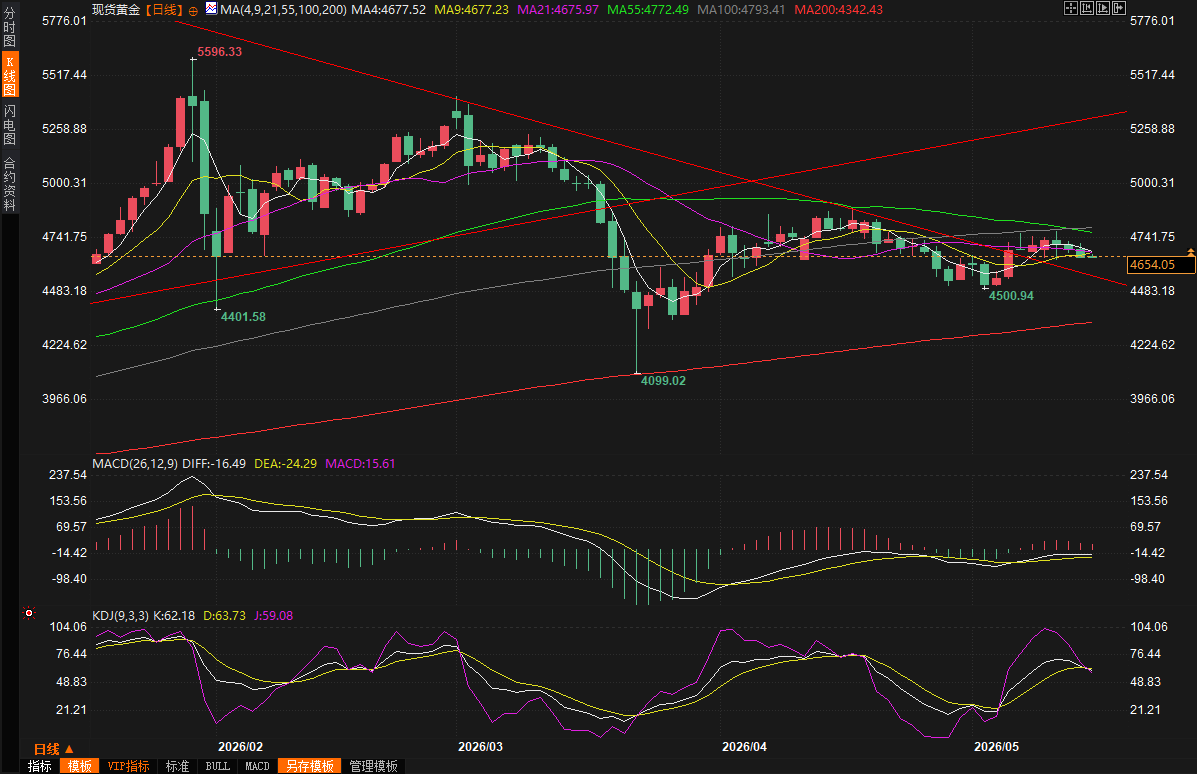
(Spot gold daily chart, source: FX678)
At 07:52 Beijing time, spot gold was trading at $4652.98 per ounce.
Gold Market Under Pressure: Double Whammy from Dollar and Yields
The current gold market lacks clear directional guidance, with price movements exhibiting a distinctly weak and volatile pattern. The US dollar index rose 0.3% on Thursday, hitting a two-week high, directly increasing the holding cost of dollar-denominated gold and significantly suppressing non-US dollar investors. Meanwhile, US Treasury yields, after a previous surge, have retreated slightly but remain at relatively high levels overall, especially the 10-year Treasury yield, which touched near an 11-month high. These factors combined have created a significant bearish outlook for gold, a non-yielding asset.
A significant shift in expectations regarding the Federal Reserve's monetary policy has further exacerbated downward pressure on gold prices. Driven by the Middle East conflict and soaring energy prices, both the US Producer Price Index (PPI) and Consumer Price Index (CPI) rose sharply in April, largely extinguishing market expectations for a Fed rate cut. The CME FedWatch tool shows a 53.5% probability of interest rates remaining unchanged by December, only a 1.7% probability of a cumulative 25 basis point rate cut, while the probability of at least a 25 basis point rate hike has risen to 44.7%. Although gold is traditionally considered an inflation hedge, rising interest rates often diminish its appeal as the opportunity cost of holding gold increases significantly.
New York Fed President Williams' remarks on Thursday further reinforced market expectations that the Fed will maintain a cautious stance. He stated that current monetary policy is in a "good" position, and there is absolutely no reason to immediately raise or lower interest rates; continued observation of developments is necessary. Regarding inflation, Williams believes that rising short-term inflation expectations are not unexpected, but long-term expectations remain stable, and the job market has not shown a significant second-round effect. Supply chain pressures and uncertainty surrounding the energy price outlook are the main variables at present, and these factors combined make it difficult for gold to escape its current consolidation pattern in the short term.
Middle East turmoil and the meeting between Chinese and American leaders: A double-edged sword for gold's safe-haven appeal.
Geopolitical uncertainty remains the core supporting force in the current gold market, while also posing a potential downside risk. Continued tensions in the Middle East, with the Strait of Hormuz essentially blocked, have kept oil prices high. US crude oil rose to $102.35 per barrel at one point, while Brent crude closed at $105.55 per barrel. Although Iranian state media reported that approximately 30 ships transited the strait, and some Chinese vessels were allowed passage, rumors of attacks and the overall blockade continue to cast a shadow over the energy supply outlook.
Bart Melek, global head of commodities strategy at TD Securities, pointed out that if the Middle East conflict is not effectively resolved, gold faces the risk of a sharp decline. However, a sharp drop in energy product inventories and supply could push up inflation, indirectly supporting gold. High oil prices have begun to spread to other goods and services, which is a key reason for the recent higher-than-expected US inflation data. Dissent within the Republican Party regarding the war with Iran is also increasing. Although Congress has repeatedly rejected resolutions to withdraw troops, the number of Republican lawmakers supporting withdrawal has increased, indicating rising discontent within the party. This further increases the uncertainty of the situation.
Against this backdrop, the meeting between Trump and the Chinese leader has become the focus of market attention. Chinese President Xi Jinping stated at the summit's opening ceremony that trade negotiations are making progress, and the meeting will cover a wide range of topics, including key issues such as trade and the reopening of the Strait of Hormuz. If the meeting brings substantial signs of easing tensions, gold's safe-haven premium may quickly decline; conversely, continued geopolitical tensions will continue to support gold. Tradu senior market analyst Nikos Zabras believes that gold is currently weighing geopolitical uncertainty, the economic impact of the Middle East conflict, and expectations for a potential solution from the Xi-Trump meeting.
The resilience of the US economy is evident, with both the stock and bond markets showing strong performance.
Despite rising inflationary pressures, US economic data showed resilience, which to some extent supported the performance of the dollar and risk assets. US retail sales rose 0.5% in April, in line with expectations, with consumers maintaining their spending levels despite rising gasoline prices, indicating that the "internal substitution effect" was not significant. Initial jobless claims rose slightly to 211,000 last week, with the overall job market remaining stable. These data boosted market optimism regarding the US economic outlook.
In the stock market, technology stocks were the main driving force, with the S&P 500 and Nasdaq indices hitting new closing highs, and the Dow Jones Industrial Average nearing its all-time high. Shares of companies whose executives accompanied Trump on his trip, such as Tesla and Nvidia, performed strongly, especially after the approval of Nvidia's chip sales to China, which boosted related stocks. The bond market saw a rebound, with a brief pullback in oil prices providing support for US Treasuries. The 10-year Treasury yield retreated from its highs, and key technical levels attracted buying interest.
Kansas City Fed President Schmid and other officials have identified inflation as the biggest risk to the U.S. economy, but have also emphasized the economy's "remarkable resilience." These statements reflect the Fed's delicate balancing act between high inflation and economic stability.
Outlook: Gold is under pressure in the short term, but long-term support remains.
Overall, the current gold market is in a complex environment with intertwined bullish and bearish factors. A stronger US dollar, rising expectations of a Federal Reserve rate hike, and a recovery in short-term risk appetite are putting downward pressure on gold, while the continued uncertainty of Middle East geopolitical conflicts and the volatility that could result from potential major diplomatic breakthroughs are providing important support for gold.
Investors need to closely monitor the specific outcomes of the meeting between the leaders of China and the United States, as well as the actual navigation situation in the Strait of Hormuz. If tensions in the Middle East ease, gold may face further downside risk; in the short term, pay attention to the support level around 4640. If this level is broken, it may further test the 4600 psychological level. Conversely, if the energy crisis deepens or diplomatic progress falls short of expectations, gold's safe-haven attributes will regain market favor. In the short term, gold prices may continue to fluctuate within the current range, while in the medium to long term, global uncertainties will continue to provide structural opportunities for this traditional safe-haven asset.
(Spot gold daily chart, source: FX678)
At 07:52 Beijing time, spot gold was trading at $4652.98 per ounce.
- Risk Warning and Disclaimer
- The market involves risk, and trading may not be suitable for all investors. This article is for reference only and does not constitute personal investment advice, nor does it take into account certain users’ specific investment objectives, financial situation, or other needs. Any investment decisions made based on this information are at your own risk.