The weakening gold price hides a deeper story; institutions analyze a major shift in the safe-haven logic of gold.
2026-05-15 11:18:22
Geopolitical tensions in Iran have disrupted the global commodities market, with international oil prices surging while gold prices have fallen in the opposite direction. On Friday (May 15) in Asian trading, spot gold fell nearly 1% to around $4607.30 per ounce.
HSBC's chief precious metals analyst believes that gold's current price movement has not deviated from fundamentals, with physical demand remaining solid, especially supported by strong institutional buying in major Asian countries. Meanwhile, the historical correlation between gold and oil prices has been completely restructured, and gold is exhibiting more risk asset characteristics in 2026. Short-term pressure does not change its medium- to long-term investment value. Supported by geopolitical instability, central bank gold purchases, and the demand for asset diversification, the outlook remains positive.
James Steel, chief precious metals analyst at HSBC, said that despite the downward fluctuations in gold prices due to the situation, actual demand for gold remains strong. The support from major Asian markets is particularly evident, with the premium between domestic and international gold exchanges in those countries remaining around $20 per ounce, reflecting robust domestic buying and a shift in focus from traditional jewelry and small-scale investments to large-scale institutional gold bar purchases.
This change stems from regulatory policy adjustments in major Asian countries and India, which have allowed leading domestic insurance institutions and Indian asset management firms to increase their gold reserves. Meanwhile, the central bank of the major Asian country added 8.1 tons of gold last month, with continued central bank purchases further solidifying market support at the bottom.
Regarding the pullback in gold prices after reaching $5,400 per ounce at the end of January, Steele analyzed that the previous rally was overheated, with a large influx of long-term sidelined funds and even capital that had never been involved in gold entering the market. Combined with data from the U.S. Commodity Futures Trading Commission, the market at that time had excessively concentrated long positions, creating a technical need for a correction.
Some market observers question whether gold prices have fallen despite geopolitical conflicts, suggesting that its safe-haven appeal has failed. Steele disagrees, stating that soaring oil prices have fueled inflation expectations, while US Treasury yields and the dollar have strengthened, putting downward pressure on the stock market. The market urgently needs to withdraw liquidity, and investors selling gold is simply cashing out their hedging policies, not a sign that gold has lost its safe-haven function.
Regarding the evolving relationship between gold and oil prices, Steele stated that in the 1970s and 80s, the two showed a clear positive correlation, with oil price fluctuations driving gold price movements in the same direction. However, since the 1990s, oil's weight in the global economy has declined, and the correlation between gold and oil has gradually weakened. Currently, the correlation coefficient is only 0.15, frequently turning negative, indicating that it is currently in a negative correlation phase, and the traditional logic of simultaneous rises and falls no longer applies.
In terms of asset allocation, he believes that gold is a high-quality alternative hard asset, possessing both scarce physical attributes and high liquidity, and exhibiting extremely low long-term correlation with the assets of tech giants. Compared to physical assets such as farmland, which are difficult to liquidate quickly, gold can be traded flexibly at any time, prompting more and more asset management institutions to include gold in their portfolios for the first time.
On April 2nd, HSBC commodity strategists Willem Sels and Lucia Ku stated that cross-asset correlations have significantly increased, highlighting the diversification value of gold in portfolios. Despite short-term weakness, the institutions maintain their overweight rating for the next six months, upholding a bullish stance in the medium to long term.
Analysts say that inflationary disturbances are exacerbating interest rate volatility, and monetary policy expectations are being continuously repriced. Policymakers will likely maintain stable interest rates for a period before considering further easing. Investment strategies include leveraging high-quality corporate bonds and emerging market local currency bonds for returns, while also allocating gold to hedge portfolio risks. Given the continued geopolitical uncertainty and central bank gold purchases, the short-term pullback in gold prices does not alter the long-term upward trend.
On March 30th, HSBC Asset Management analysts pointed out that gold's performance in 2026 had broken out of the traditional safe-haven framework and was more closely resembling that of risk assets. During periods of geopolitical tension and a strengthening US dollar, gold experienced a sell-off, with a 15% year-to-date decline in March alone. A stronger dollar increased holding costs, and hawkish interest rate expectations suppressed the valuation of non-interest-bearing assets. The portfolio structure was biased towards retail investors and leveraged funds, making them prone to concentrated exits during market volatility.
Overall, the decline in gold prices amid the Iranian conflict is not due to a failure of safe-haven demand, but rather a result of the combined effects of liquidity withdrawal, previous overcrowding of long positions, and a restructuring of the gold-oil correlation. Physical demand from major Asian institutions and central bank gold purchases provide solid support, and as a highly liquid hard asset, gold continues to see increased demand for diversified asset allocation. Although 2026 may exhibit short-term characteristics of a risk asset with increased volatility, the medium- to long-term investment logic for gold remains solid, supported by factors such as de-dollarization, geopolitical hedging, and portfolio diversification. The short-term adjustment is merely a temporary pause.
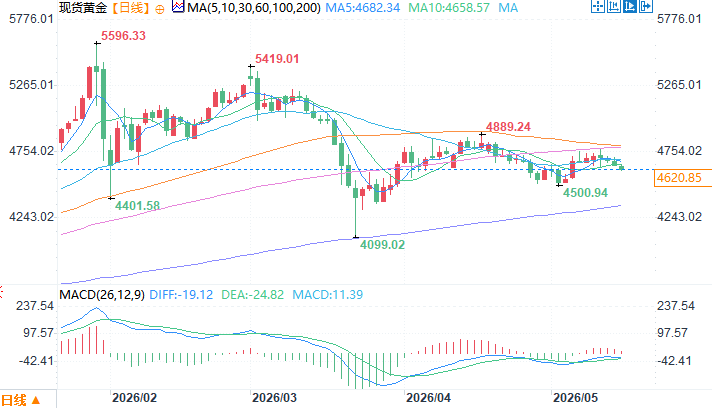
Spot gold daily chart source: EasyForex
At 11:16 AM Beijing time on May 15, spot gold was trading at $4,616.85 per ounce.
HSBC's chief precious metals analyst believes that gold's current price movement has not deviated from fundamentals, with physical demand remaining solid, especially supported by strong institutional buying in major Asian countries. Meanwhile, the historical correlation between gold and oil prices has been completely restructured, and gold is exhibiting more risk asset characteristics in 2026. Short-term pressure does not change its medium- to long-term investment value. Supported by geopolitical instability, central bank gold purchases, and the demand for asset diversification, the outlook remains positive.
Demand from major Asian countries underpins gold allocation; institutional investors become the main force.
James Steel, chief precious metals analyst at HSBC, said that despite the downward fluctuations in gold prices due to the situation, actual demand for gold remains strong. The support from major Asian markets is particularly evident, with the premium between domestic and international gold exchanges in those countries remaining around $20 per ounce, reflecting robust domestic buying and a shift in focus from traditional jewelry and small-scale investments to large-scale institutional gold bar purchases.
This change stems from regulatory policy adjustments in major Asian countries and India, which have allowed leading domestic insurance institutions and Indian asset management firms to increase their gold reserves. Meanwhile, the central bank of the major Asian country added 8.1 tons of gold last month, with continued central bank purchases further solidifying market support at the bottom.
The previous surge in prices overheated the market, leading to overcrowding and a rational correction.
Regarding the pullback in gold prices after reaching $5,400 per ounce at the end of January, Steele analyzed that the previous rally was overheated, with a large influx of long-term sidelined funds and even capital that had never been involved in gold entering the market. Combined with data from the U.S. Commodity Futures Trading Commission, the market at that time had excessively concentrated long positions, creating a technical need for a correction.
Some market observers question whether gold prices have fallen despite geopolitical conflicts, suggesting that its safe-haven appeal has failed. Steele disagrees, stating that soaring oil prices have fueled inflation expectations, while US Treasury yields and the dollar have strengthened, putting downward pressure on the stock market. The market urgently needs to withdraw liquidity, and investors selling gold is simply cashing out their hedging policies, not a sign that gold has lost its safe-haven function.
The correlation between gold and oil has been completely rewritten, and we have now entered an era of negative correlation.
Regarding the evolving relationship between gold and oil prices, Steele stated that in the 1970s and 80s, the two showed a clear positive correlation, with oil price fluctuations driving gold price movements in the same direction. However, since the 1990s, oil's weight in the global economy has declined, and the correlation between gold and oil has gradually weakened. Currently, the correlation coefficient is only 0.15, frequently turning negative, indicating that it is currently in a negative correlation phase, and the traditional logic of simultaneous rises and falls no longer applies.
In terms of asset allocation, he believes that gold is a high-quality alternative hard asset, possessing both scarce physical attributes and high liquidity, and exhibiting extremely low long-term correlation with the assets of tech giants. Compared to physical assets such as farmland, which are difficult to liquidate quickly, gold can be traded flexibly at any time, prompting more and more asset management institutions to include gold in their portfolios for the first time.
HSBC remains bullish in the medium to long term, with short-term headwinds being only temporary.
On April 2nd, HSBC commodity strategists Willem Sels and Lucia Ku stated that cross-asset correlations have significantly increased, highlighting the diversification value of gold in portfolios. Despite short-term weakness, the institutions maintain their overweight rating for the next six months, upholding a bullish stance in the medium to long term.
Analysts say that inflationary disturbances are exacerbating interest rate volatility, and monetary policy expectations are being continuously repriced. Policymakers will likely maintain stable interest rates for a period before considering further easing. Investment strategies include leveraging high-quality corporate bonds and emerging market local currency bonds for returns, while also allocating gold to hedge portfolio risks. Given the continued geopolitical uncertainty and central bank gold purchases, the short-term pullback in gold prices does not alter the long-term upward trend.
On March 30th, HSBC Asset Management analysts pointed out that gold's performance in 2026 had broken out of the traditional safe-haven framework and was more closely resembling that of risk assets. During periods of geopolitical tension and a strengthening US dollar, gold experienced a sell-off, with a 15% year-to-date decline in March alone. A stronger dollar increased holding costs, and hawkish interest rate expectations suppressed the valuation of non-interest-bearing assets. The portfolio structure was biased towards retail investors and leveraged funds, making them prone to concentrated exits during market volatility.
Summarize
Overall, the decline in gold prices amid the Iranian conflict is not due to a failure of safe-haven demand, but rather a result of the combined effects of liquidity withdrawal, previous overcrowding of long positions, and a restructuring of the gold-oil correlation. Physical demand from major Asian institutions and central bank gold purchases provide solid support, and as a highly liquid hard asset, gold continues to see increased demand for diversified asset allocation. Although 2026 may exhibit short-term characteristics of a risk asset with increased volatility, the medium- to long-term investment logic for gold remains solid, supported by factors such as de-dollarization, geopolitical hedging, and portfolio diversification. The short-term adjustment is merely a temporary pause.
Spot gold daily chart source: EasyForex
At 11:16 AM Beijing time on May 15, spot gold was trading at $4,616.85 per ounce.
- Risk Warning and Disclaimer
- The market involves risk, and trading may not be suitable for all investors. This article is for reference only and does not constitute personal investment advice, nor does it take into account certain users’ specific investment objectives, financial situation, or other needs. Any investment decisions made based on this information are at your own risk.