Major shifts in silver supply and demand: UBS significantly lowers its silver price forecast, effectively limiting its upside potential.
2026-05-15 10:40:16
UBS's latest silver market outlook report points out that global silver is facing triple pressures: cooling investment demand, weakening industrial consumption, and a rebound in mine supply. The supply-demand gap will narrow significantly, directly weakening silver's cross-cycle upward momentum. Institutions have simultaneously lowered their silver price targets across multiple future timeframes, relying solely on gold's price action to form a bottom support. The gold-silver ratio is expected to gradually return to a reasonable range. Furthermore, institutions are offering new trading strategies, indicating that a short-term downward trend in silver prices is already evident.
In a research report, UBS strategists Wayne Gordon and Dominic Schnider analyzed that high silver prices in 2026 will significantly suppress silver demand from the photovoltaic industry, while also noticeably dampening consumption in the silverware and jewelry sectors. Overall, their calculations indicate that the photovoltaic and jewelry sectors will combined reduce silver consumption by approximately 50 million ounces, becoming the core factor dragging down physical demand.
On the investment side, there are very obvious signs of funds withdrawing from the silver market.
Globally available silver ETF holdings have decreased by nearly 70 million ounces, with current holdings falling to around 794 million ounces; speculative net long positions in the futures market have also contracted significantly, remaining just above 100 million ounces.
Due to the continued outflow of funds, UBS has lowered its full-year silver investment demand forecast from over 400 million ounces to 300 million ounces. The institution admitted that, given the continued withdrawal of funds throughout the year, the expectation of 300 million ounces is already a rather optimistic judgment.
Based on a reassessment of the supply and demand dynamics, UBS has comprehensively lowered its silver price forecasts. The company has reduced its Q2 2026 end-of-quarter silver price forecast from $100 per ounce to $85, its September target price from $95 to $85, and its year-end target price from $85 to $80. At the same time, it has lowered its March 2027 forward price forecast from $85 to $75.
On the supply and demand side, the silver market supply gap is expected to narrow to 60-70 million ounces in 2026, a sharp decrease from the previous estimate of 300 million ounces. Strategists say that with the supply and demand gap narrowing significantly, the outlook for silver prices across all timeframes has been revised downwards. In the baseline scenario, silver will mainly trade sideways within a range, with little chance of a significant upward trend.
UBS stated that the stable performance of gold prices prevented silver prices from experiencing a deeper correction. Strategists noted that they remain optimistic about a medium- to long-term upward trend in gold prices, which could serve as an important valuation anchor for silver, and the correlation between gold and silver prices has been strengthening recently. They predict that the gold-silver ratio will gradually converge towards a reasonable range of 75 to 80.
Overall supply is improving marginally, with full-year silver mine production expected to rise to 850 million ounces, further easing the market shortage.
In terms of trading strategy, Gordon and Schneider prefer a volatility-selling strategy and do not recommend long-term, one-sided buying. Although implied volatility for silver has declined from its year-to-date high, actual volatility in February approached 150%, and it remains at historically high levels. Analysts believe that selling downside risk and profiting from holding positions over the next three months presents a good investment opportunity.
On Thursday, spot silver prices continued their downward trend, falling 4.53% to close at $83.49 per ounce. As of 10:30 AM Beijing time on Friday, it had briefly hit a four-day low of $80.60, and is currently trading around $81.05 per ounce, further solidifying its weak trend.
Overall, both industrial and investment demand for silver weakened, while mine supply steadily increased, significantly narrowing the supply-demand gap and completely suppressing silver's medium- to long-term upward potential. UBS lowered its silver price targets across the board, with only limited support from gold, suggesting the market is likely to remain range-bound with a slight downward bias. Continued capital outflows coupled with easing fundamentals have put significant pressure on short-term silver prices, shifting the trading logic from one-sided long positions to volatility arbitrage. Going forward, close monitoring of gold price movements and changes in physical demand is crucial.
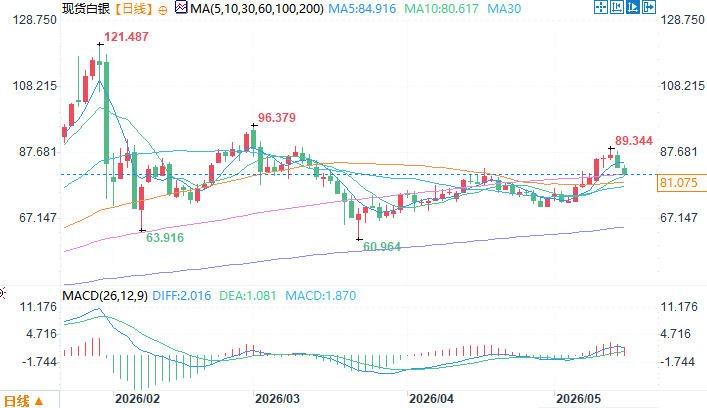
Spot silver daily chart source: EasyForex
At 10:39 AM Beijing time on May 15, spot silver was trading at $81.05 per ounce.
Weak physical demand drags down both photovoltaic and jewelry sales.
In a research report, UBS strategists Wayne Gordon and Dominic Schnider analyzed that high silver prices in 2026 will significantly suppress silver demand from the photovoltaic industry, while also noticeably dampening consumption in the silverware and jewelry sectors. Overall, their calculations indicate that the photovoltaic and jewelry sectors will combined reduce silver consumption by approximately 50 million ounces, becoming the core factor dragging down physical demand.
Investment demand has waned significantly, with ETF and futures positions declining in tandem.
On the investment side, there are very obvious signs of funds withdrawing from the silver market.
Globally available silver ETF holdings have decreased by nearly 70 million ounces, with current holdings falling to around 794 million ounces; speculative net long positions in the futures market have also contracted significantly, remaining just above 100 million ounces.
Due to the continued outflow of funds, UBS has lowered its full-year silver investment demand forecast from over 400 million ounces to 300 million ounces. The institution admitted that, given the continued withdrawal of funds throughout the year, the expectation of 300 million ounces is already a rather optimistic judgment.
Multiple timeframe silver price targets have been collectively lowered as the supply-demand gap has narrowed sharply.
Based on a reassessment of the supply and demand dynamics, UBS has comprehensively lowered its silver price forecasts. The company has reduced its Q2 2026 end-of-quarter silver price forecast from $100 per ounce to $85, its September target price from $95 to $85, and its year-end target price from $85 to $80. At the same time, it has lowered its March 2027 forward price forecast from $85 to $75.
On the supply and demand side, the silver market supply gap is expected to narrow to 60-70 million ounces in 2026, a sharp decrease from the previous estimate of 300 million ounces. Strategists say that with the supply and demand gap narrowing significantly, the outlook for silver prices across all timeframes has been revised downwards. In the baseline scenario, silver will mainly trade sideways within a range, with little chance of a significant upward trend.
Gold becomes the only support as the gold-silver ratio gradually returns to normal.
UBS stated that the stable performance of gold prices prevented silver prices from experiencing a deeper correction. Strategists noted that they remain optimistic about a medium- to long-term upward trend in gold prices, which could serve as an important valuation anchor for silver, and the correlation between gold and silver prices has been strengthening recently. They predict that the gold-silver ratio will gradually converge towards a reasonable range of 75 to 80.
Overall supply is improving marginally, with full-year silver mine production expected to rise to 850 million ounces, further easing the market shortage.
Trading strategy shifts as silver prices continue to weaken in the short term.
In terms of trading strategy, Gordon and Schneider prefer a volatility-selling strategy and do not recommend long-term, one-sided buying. Although implied volatility for silver has declined from its year-to-date high, actual volatility in February approached 150%, and it remains at historically high levels. Analysts believe that selling downside risk and profiting from holding positions over the next three months presents a good investment opportunity.
On Thursday, spot silver prices continued their downward trend, falling 4.53% to close at $83.49 per ounce. As of 10:30 AM Beijing time on Friday, it had briefly hit a four-day low of $80.60, and is currently trading around $81.05 per ounce, further solidifying its weak trend.
Summarize
Overall, both industrial and investment demand for silver weakened, while mine supply steadily increased, significantly narrowing the supply-demand gap and completely suppressing silver's medium- to long-term upward potential. UBS lowered its silver price targets across the board, with only limited support from gold, suggesting the market is likely to remain range-bound with a slight downward bias. Continued capital outflows coupled with easing fundamentals have put significant pressure on short-term silver prices, shifting the trading logic from one-sided long positions to volatility arbitrage. Going forward, close monitoring of gold price movements and changes in physical demand is crucial.
Spot silver daily chart source: EasyForex
At 10:39 AM Beijing time on May 15, spot silver was trading at $81.05 per ounce.
- Risk Warning and Disclaimer
- The market involves risk, and trading may not be suitable for all investors. This article is for reference only and does not constitute personal investment advice, nor does it take into account certain users’ specific investment objectives, financial situation, or other needs. Any investment decisions made based on this information are at your own risk.