Don't just focus on "no rate hike"! Williams' silence on rate cuts is the real hawkish stance, giving dollar bulls a new reason to buy.
2026-05-15 10:45:11
New York Federal Reserve President John Williams said on Thursday (May 14) that given the uncertainty surrounding the Middle East wars, he currently believes the Fed does not need to consider any adjustments to its interest rate policy. The official, speaking in New York, said that current monetary policy is in a "good place," adding, "I see absolutely no reason to raise or lower rates right now."
On May 12, according to data released by the U.S. Bureau of Labor Statistics, the U.S. CPI rose 3.8% year-on-year in April, exceeding the market expectation of 3.7% and reaching a new high since May 2023; the core CPI, excluding food and energy, rose 2.8% year-on-year, exceeding the expectation of 2.7% and reaching a new high since September 2025.
Williams, often referred to in the media as the Federal Reserve's "number three," made the remarks at a business economists' conference, largely reiterating his recent views. He stated that maintaining stable inflation expectations is crucial. While rising short-term inflation expectations are not surprising, the fact that long-term forecasts have remained stable is a positive sign.
Williams believes that most of the impact of tariffs on inflation may have already materialized, but he is still closely monitoring the evolution of price pressures. Given that inflation expectations remain stable and the labor market has not pushed up price pressures, "we are not seeing...an unusual second-round effect or persistent impact. But we still need to continue to observe," the official said.
Williams also stated that the strong performance of the stock market was not surprising given investors' views on the economic outlook. "People are optimistic about future productivity growth, partly due to artificial intelligence and other factors," Williams said. Given this "bullish" outlook on the economy, "it's not surprising that the stock market is at a high level."
Currently, investors expect the target range for the federal funds rate (currently 3.5% to 3.75%) to remain unchanged in the coming months.
The Middle East wars have caused a sharp rise in price pressures, but it is unclear how long these pressures will last as the conflicts remain unresolved.
Overall, Williams' speech conveyed a clear "wait and see" signal. Despite the upside risks to inflation from the Middle East conflict, the Fed believes its current monetary policy stance is appropriate, long-term inflation expectations are stable, and the labor market is not posing additional pressure. Coupled with strong market optimism reflected in the stock market (partly driven by AI-driven productivity expectations), the Fed lacks urgency to adjust interest rates in the short term. The future policy path will depend on the evolution of the Middle East conflict and its impact on the persistence of inflation.
Williams' statement of "neither raising nor lowering interest rates" was not new in itself, but the market interpreted it in two ways: First, the Fed is unlikely to panic-raise rates in the short term due to the Middle East war, which alleviated some extreme concerns; second, and more importantly, Williams made no mention of the possibility of a rate cut, which contrasted with some market expectations of a "rate cut by the end of the year." Against the backdrop of persistently stronger-than-expected inflation data (April CPI hit a new high since May 2023), "no rate cut" itself provides relative support for the dollar—when the market realizes that the Fed will not easily shift to easing, the dollar naturally gains upward momentum.
Fueled by recent strong US employment and inflation data, the US dollar index has risen for four consecutive trading days. On Friday (May 15th) in Asian trading, it briefly touched 99.09, its highest level since April 13th, and is currently trading around 99.04. According to the daily chart of the US dollar index, the technical pattern shows clear signs of stabilizing and continuing the rebound.
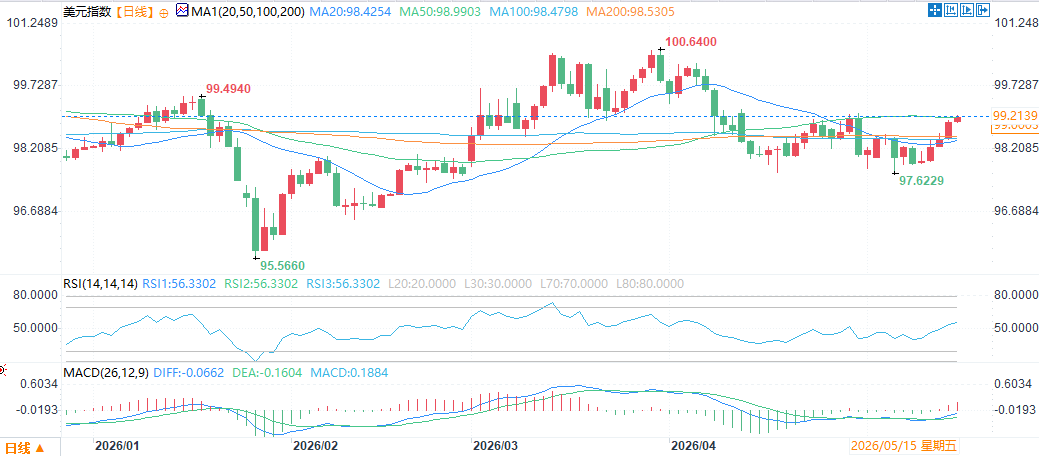
(US Dollar Index Daily Chart, Source: FX678)
Regarding the moving average system, the index has successfully stabilized above all four moving averages. Specifically, the 20-day moving average (MA20) is at 98.43, the 50-day moving average (MA50) is at 98.99, the 100-day moving average (MA100) is at 98.48, and the 200-day moving average (MA200) is at 98.53. Currently, the index is trading around 99, significantly higher than the MA20, MA100, MA200, and MA50, and the four moving averages are gradually converging, showing initial signs of a "convergence followed by upward divergence." This is a typical signal of the end of a downtrend and the formation of a bullish pattern. Resistance is located in the 100.64-101.25 area, while support is concentrated in the 98.50-99.00 range. Given the overall positive turn in technical indicators, a bullish strategy can be maintained, with a stop-loss order placed if the daily closing price falls below 98.40 (MA20), targeting the 100.64-101.25 area.
At 10:45 AM Beijing time on May 15, the US dollar index was at 99.04.
Inflation expectations are stable, and short-term fluctuations are not a concern.
On May 12, according to data released by the U.S. Bureau of Labor Statistics, the U.S. CPI rose 3.8% year-on-year in April, exceeding the market expectation of 3.7% and reaching a new high since May 2023; the core CPI, excluding food and energy, rose 2.8% year-on-year, exceeding the expectation of 2.7% and reaching a new high since September 2025.
Williams, often referred to in the media as the Federal Reserve's "number three," made the remarks at a business economists' conference, largely reiterating his recent views. He stated that maintaining stable inflation expectations is crucial. While rising short-term inflation expectations are not surprising, the fact that long-term forecasts have remained stable is a positive sign.
Williams believes that most of the impact of tariffs on inflation may have already materialized, but he is still closely monitoring the evolution of price pressures. Given that inflation expectations remain stable and the labor market has not pushed up price pressures, "we are not seeing...an unusual second-round effect or persistent impact. But we still need to continue to observe," the official said.
The strong stock market performance was not unexpected; AI is expected to boost productivity.
Williams also stated that the strong performance of the stock market was not surprising given investors' views on the economic outlook. "People are optimistic about future productivity growth, partly due to artificial intelligence and other factors," Williams said. Given this "bullish" outlook on the economy, "it's not surprising that the stock market is at a high level."
Currently, investors expect the target range for the federal funds rate (currently 3.5% to 3.75%) to remain unchanged in the coming months.
The Middle East wars have put pressure on prices, and their sustainability remains to be seen.
The Middle East wars have caused a sharp rise in price pressures, but it is unclear how long these pressures will last as the conflicts remain unresolved.
Overall, Williams' speech conveyed a clear "wait and see" signal. Despite the upside risks to inflation from the Middle East conflict, the Fed believes its current monetary policy stance is appropriate, long-term inflation expectations are stable, and the labor market is not posing additional pressure. Coupled with strong market optimism reflected in the stock market (partly driven by AI-driven productivity expectations), the Fed lacks urgency to adjust interest rates in the short term. The future policy path will depend on the evolution of the Middle East conflict and its impact on the persistence of inflation.
Williams' statement of "neither raising nor lowering interest rates" was not new in itself, but the market interpreted it in two ways: First, the Fed is unlikely to panic-raise rates in the short term due to the Middle East war, which alleviated some extreme concerns; second, and more importantly, Williams made no mention of the possibility of a rate cut, which contrasted with some market expectations of a "rate cut by the end of the year." Against the backdrop of persistently stronger-than-expected inflation data (April CPI hit a new high since May 2023), "no rate cut" itself provides relative support for the dollar—when the market realizes that the Fed will not easily shift to easing, the dollar naturally gains upward momentum.
The US dollar index has risen above 99, and bullish signs are emerging from the moving averages.
Fueled by recent strong US employment and inflation data, the US dollar index has risen for four consecutive trading days. On Friday (May 15th) in Asian trading, it briefly touched 99.09, its highest level since April 13th, and is currently trading around 99.04. According to the daily chart of the US dollar index, the technical pattern shows clear signs of stabilizing and continuing the rebound.
(US Dollar Index Daily Chart, Source: FX678)
Regarding the moving average system, the index has successfully stabilized above all four moving averages. Specifically, the 20-day moving average (MA20) is at 98.43, the 50-day moving average (MA50) is at 98.99, the 100-day moving average (MA100) is at 98.48, and the 200-day moving average (MA200) is at 98.53. Currently, the index is trading around 99, significantly higher than the MA20, MA100, MA200, and MA50, and the four moving averages are gradually converging, showing initial signs of a "convergence followed by upward divergence." This is a typical signal of the end of a downtrend and the formation of a bullish pattern. Resistance is located in the 100.64-101.25 area, while support is concentrated in the 98.50-99.00 range. Given the overall positive turn in technical indicators, a bullish strategy can be maintained, with a stop-loss order placed if the daily closing price falls below 98.40 (MA20), targeting the 100.64-101.25 area.
At 10:45 AM Beijing time on May 15, the US dollar index was at 99.04.
- Risk Warning and Disclaimer
- The market involves risk, and trading may not be suitable for all investors. This article is for reference only and does not constitute personal investment advice, nor does it take into account certain users’ specific investment objectives, financial situation, or other needs. Any investment decisions made based on this information are at your own risk.