Black Friday saw gold prices fall by more than 1% as the positive news was already priced in.
2026-05-15 15:34:16
On Friday (May 15), during the Asian and European sessions, spot gold fell sharply, down 1.85% to trade around 4566, while international oil prices rose slightly, with WTI crude oil up about 2% and Brent crude oil up about 1%.
As the US state visit to China came to a close, global trading saw a wave of profit-taking, with the South Korean stock market even triggering a circuit breaker. The rapid contraction of global risk appetite led to a downward adjustment in precious metals along with global equity markets.
Meanwhile, on a geopolitical level, Iran is currently unable to sell crude oil through the Strait of Hormuz. Although the United States has withdrawn one long-serving aircraft carrier, it still has two aircraft carriers working together with its British and French fleets to blockade Iran's shadow fleet in the long term.
The Fed's interest rate path also indicates that declining expectations of rate cuts are not conducive to the development of precious metals.
In the early stages of the game, Trump took the initiative to play the public opinion card, staging a political public relations show.
In a public interview, he made victory-oriented remarks, deliberately downplaying the strategic threat posed by Iran's highly enriched uranium, stating that Iran's stockpiling of related nuclear materials was more for public relations considerations, and claiming that the US military's 24/7 monitoring had effectively sealed the relevant nuclear materials, which no longer posed a security threat to the United States.
The essence of this rhetoric is to weaken Iran's strategic leverage, appease domestic voters, and attempt to seize the initiative in public opinion.
Latest intelligence indicates that Iran has demonstrated remarkable resilience in the face of war, with its military forces rapidly recovering: 30 of the 33 missile bases along the Strait of Hormuz have been restored to operational capability, and the country still retains 70% of its mobile missile launchers and pre-war missile stockpiles, giving it the ability to blockade the strait and launch a second strike at any time, significantly diminishing the effectiveness of the US's direct military pressure.
Faced with the rapidly resurgent military threat from Iran, coupled with the continuous depletion of its own advanced weaponry, the United States has adjusted its Middle East operational strategy, abandoning a full-scale head-on confrontation.
The withdrawal of the nuclear-powered aircraft carrier USS Ford, which had been deployed in the Middle East for a long time, back to the United States signifies that the US is not willing to get bogged down in a protracted positional war, but instead is adopting a precision strike model of cutting off supplies and strangling Iran, using a maritime blockade to cut off Iran's economic lifeline.
The United States, together with its allies such as Britain and France, launched a routine maritime blockade plan, building an encirclement network in the Strait of Hormuz and the Gulf of Oman, directly cutting off Iran's crude oil export channels by intercepting and seizing "shadow tankers" exported by Iran.
With crude oil unable to be shipped out and domestic storage capacity saturated, Iran was forced to drastically reduce production, even facing a complete shutdown. Its energy export revenue was almost completely cut off, and the huge economic losses directly and severely damaged its national strength, achieving a modern version of the strategic goal of "cutting off the army's food supply".
The substantial disruption to Iranian oil supplies has directly reshaped the global energy landscape, allowing the United States to reap geopolitical benefits.
Leveraging its geopolitical control over the Middle East and its security dependence on energy-importing countries in Europe and Asia, the United States is accelerating the signing of long-term crude oil purchase contracts with multiple countries.
Affected by the turmoil in the Middle East and rising global inflation, the unit price and transaction volume of newly signed crude oil contracts are far higher than pre-war levels. The United States has successfully seized the share of traditional energy exports from the Middle East, realized the high-level cashing out of energy assets, and further consolidated the petrodollar's dominance.
From a trading perspective: As Trump began his state visit to China, the high-level meeting between the two major powers released a signal of easing tensions, and the market began to trade on the logic that the positive news had been fully priced in. After all, during the period of uncertainty in the US-Iran negotiations, global assets experienced a significant surge, which was easily interpreted by the market as a reflection of the positive impact of the state visit. However, now that the positive news has been realized, global capital markets have begun a pricing correction.
The fact that new Federal Reserve Chairman Warsh passed the vote with the largest margin of disagreement in history, coupled with the unusual decision of former Chairman Powell to remain on the Federal Reserve Board of Governors, suggests that the Federal Reserve under Warsh is not a blank slate, and that the process of getting to know each other and implementing interest rate cuts may not be so easy or quick to achieve.
For precious metals, one factor is the contraction of risk appetite, with silver and gold being the first to come under pressure as bargain hunters close their positions after the positive news is realized. At the same time, oil prices continue to rise, pushing up global inflation and further suppressing precious metal prices by raising the central interest rate.
The substantial supply shortage caused by the disruption of Iranian crude oil supplies has effectively capped any downside potential for oil prices.
Even though the overall market's risk aversion has subsided somewhat, oil prices still show a strong pattern of slight increases and high-level fluctuations, with supply-side constraints becoming the core supporting logic.
The Strait of Hormuz is still awaiting substantive negotiation results and navigation status. Currently , navigation through the strait is improving marginally . Meanwhile, Iran's crude oil storage capacity may run out within a month, even with production cuts, leading to a complete shutdown.
Therefore, the overall timetable for peace talks is getting closer and closer. So today's decline in gold prices is mainly due to the realization of positive news leading to a contraction in risk appetite. In the future, the market will continue to focus on marginal geopolitical changes and the adjustment path of the Federal Reserve's monetary and fiscal policies.
Technical Analysis: Spot gold was suppressed by the key price level of 4743 (the 0.768 Fibonacci retracement level of this rise), and then broke down below the upward channel. It is currently finding support near the middle line. Subsequent support levels are at the psychological level of 4500 and near the lower line of the channel, while the resistance level is around 4743.
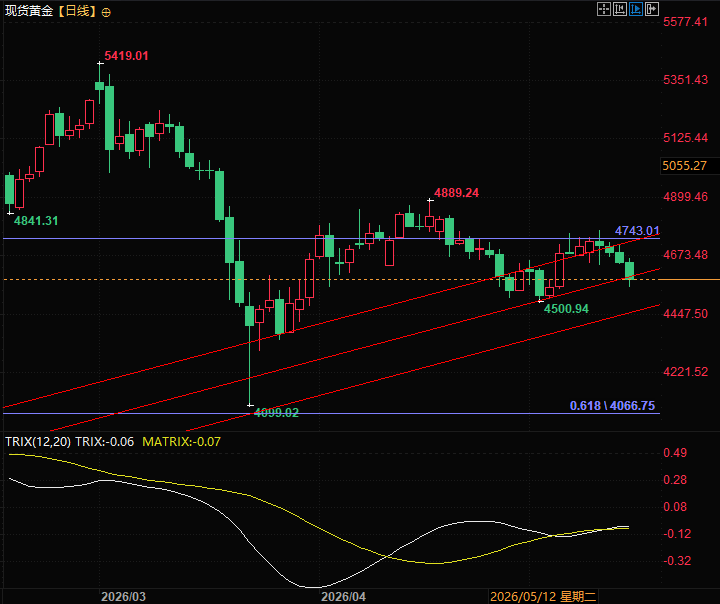
(Spot gold daily chart, source: EasyForex subsidiary)
At 15:28 Beijing time, spot gold was trading at $4,582 per ounce.
As the US state visit to China came to a close, global trading saw a wave of profit-taking, with the South Korean stock market even triggering a circuit breaker. The rapid contraction of global risk appetite led to a downward adjustment in precious metals along with global equity markets.
Meanwhile, on a geopolitical level, Iran is currently unable to sell crude oil through the Strait of Hormuz. Although the United States has withdrawn one long-serving aircraft carrier, it still has two aircraft carriers working together with its British and French fleets to blockade Iran's shadow fleet in the long term.
The Fed's interest rate path also indicates that declining expectations of rate cuts are not conducive to the development of precious metals.
Trump's "PR show" downplays Iran nuclear bargaining chip
In the early stages of the game, Trump took the initiative to play the public opinion card, staging a political public relations show.
In a public interview, he made victory-oriented remarks, deliberately downplaying the strategic threat posed by Iran's highly enriched uranium, stating that Iran's stockpiling of related nuclear materials was more for public relations considerations, and claiming that the US military's 24/7 monitoring had effectively sealed the relevant nuclear materials, which no longer posed a security threat to the United States.
The essence of this rhetoric is to weaken Iran's strategic leverage, appease domestic voters, and attempt to seize the initiative in public opinion.
Iran's military capabilities are rapidly recovering, prompting the US to shift towards a strategy of "cutting off supplies and strangling" it.
Latest intelligence indicates that Iran has demonstrated remarkable resilience in the face of war, with its military forces rapidly recovering: 30 of the 33 missile bases along the Strait of Hormuz have been restored to operational capability, and the country still retains 70% of its mobile missile launchers and pre-war missile stockpiles, giving it the ability to blockade the strait and launch a second strike at any time, significantly diminishing the effectiveness of the US's direct military pressure.
Faced with the rapidly resurgent military threat from Iran, coupled with the continuous depletion of its own advanced weaponry, the United States has adjusted its Middle East operational strategy, abandoning a full-scale head-on confrontation.
The withdrawal of the nuclear-powered aircraft carrier USS Ford, which had been deployed in the Middle East for a long time, back to the United States signifies that the US is not willing to get bogged down in a protracted positional war, but instead is adopting a precision strike model of cutting off supplies and strangling Iran, using a maritime blockade to cut off Iran's economic lifeline.
The United States, together with its allies such as Britain and France, launched a routine maritime blockade plan, building an encirclement network in the Strait of Hormuz and the Gulf of Oman, directly cutting off Iran's crude oil export channels by intercepting and seizing "shadow tankers" exported by Iran.
With crude oil unable to be shipped out and domestic storage capacity saturated, Iran was forced to drastically reduce production, even facing a complete shutdown. Its energy export revenue was almost completely cut off, and the huge economic losses directly and severely damaged its national strength, achieving a modern version of the strategic goal of "cutting off the army's food supply".
Energy Dividend: The US Locks in High-Priced Long-Term Contracts and Reaps Geopolitical Premiums
The substantial disruption to Iranian oil supplies has directly reshaped the global energy landscape, allowing the United States to reap geopolitical benefits.
Leveraging its geopolitical control over the Middle East and its security dependence on energy-importing countries in Europe and Asia, the United States is accelerating the signing of long-term crude oil purchase contracts with multiple countries.
Affected by the turmoil in the Middle East and rising global inflation, the unit price and transaction volume of newly signed crude oil contracts are far higher than pre-war levels. The United States has successfully seized the share of traditional energy exports from the Middle East, realized the high-level cashing out of energy assets, and further consolidated the petrodollar's dominance.
Market divergence: Gold prices retreated under pressure, while crude oil prices remained firm at high levels.
From a trading perspective: As Trump began his state visit to China, the high-level meeting between the two major powers released a signal of easing tensions, and the market began to trade on the logic that the positive news had been fully priced in. After all, during the period of uncertainty in the US-Iran negotiations, global assets experienced a significant surge, which was easily interpreted by the market as a reflection of the positive impact of the state visit. However, now that the positive news has been realized, global capital markets have begun a pricing correction.
The fact that new Federal Reserve Chairman Warsh passed the vote with the largest margin of disagreement in history, coupled with the unusual decision of former Chairman Powell to remain on the Federal Reserve Board of Governors, suggests that the Federal Reserve under Warsh is not a blank slate, and that the process of getting to know each other and implementing interest rate cuts may not be so easy or quick to achieve.
For precious metals, one factor is the contraction of risk appetite, with silver and gold being the first to come under pressure as bargain hunters close their positions after the positive news is realized. At the same time, oil prices continue to rise, pushing up global inflation and further suppressing precious metal prices by raising the central interest rate.
The substantial supply shortage caused by the disruption of Iranian crude oil supplies has effectively capped any downside potential for oil prices.
Even though the overall market's risk aversion has subsided somewhat, oil prices still show a strong pattern of slight increases and high-level fluctuations, with supply-side constraints becoming the core supporting logic.
Summary and Technical Analysis:
The Strait of Hormuz is still awaiting substantive negotiation results and navigation status. Currently , navigation through the strait is improving marginally . Meanwhile, Iran's crude oil storage capacity may run out within a month, even with production cuts, leading to a complete shutdown.
Therefore, the overall timetable for peace talks is getting closer and closer. So today's decline in gold prices is mainly due to the realization of positive news leading to a contraction in risk appetite. In the future, the market will continue to focus on marginal geopolitical changes and the adjustment path of the Federal Reserve's monetary and fiscal policies.
Technical Analysis: Spot gold was suppressed by the key price level of 4743 (the 0.768 Fibonacci retracement level of this rise), and then broke down below the upward channel. It is currently finding support near the middle line. Subsequent support levels are at the psychological level of 4500 and near the lower line of the channel, while the resistance level is around 4743.
(Spot gold daily chart, source: EasyForex subsidiary)
At 15:28 Beijing time, spot gold was trading at $4,582 per ounce.
- Risk Warning and Disclaimer
- The market involves risk, and trading may not be suitable for all investors. This article is for reference only and does not constitute personal investment advice, nor does it take into account certain users’ specific investment objectives, financial situation, or other needs. Any investment decisions made based on this information are at your own risk.