Import prices saw their biggest increase in 26 years, and Dubai crude oil prices doubled: Who will be the first to be affected by this fire in the Middle East?
2026-05-15 16:29:40
Kim Jin-il, the newly appointed policymaker at the Bank of Korea, said on Friday (May 15) that inflation concerns have intensified due to high oil prices triggered by the Middle East conflict. Kim officially began his four-year term on the Bank of Korea's seven-member policy board on Friday, with his first interest rate decision meeting scheduled for May 28.
Jin Chenyi stated that the economic situation is improving, driven by the technology industry, but there is a high degree of uncertainty in global investment, and inequality still exists domestically.
Regarding financial stability, Jin Chenyi pointed out that vigilance against risks to capital flows is rising, while household debt and housing price issues still exist.
However, Kim Jin-il's concerns about inflationary pressures are not unfounded. On a broader level, the Middle East conflict is directly impacting the South Korean economy through energy prices.
South Korea is a major global energy importer, heavily reliant on Middle Eastern oil—approximately 70-72% of its crude oil imports come from Gulf countries, and a significant portion of its liquefied natural gas (LNG) also originates from Qatar and other regions. The Strait of Hormuz, blocked due to conflict, directly chokes South Korea's energy lifeline. Data shows that South Korea's import prices surged 16.1% month-on-month in March, the largest increase since 1998, with Dubai crude oil prices nearly doubling to $128.52 per barrel. During the same period, the South Korean won depreciated by about 2.6% against the US dollar, further amplifying imported inflationary pressures. South Korean President Lee Jae-myung has stated that the economy is in a "wartime-level" crisis and has called on the National Assembly to pass a supplementary budget of 26.2 trillion won.
As a newly appointed policy board member, Kim Jin-il explicitly listed inflation as the most pressing concern. Rising oil prices due to the Middle East conflict are exacerbating imported inflationary pressures in South Korea. His remarks suggest that the Bank of Korea may need to reassess its current policy stance at its first interest rate decision meeting on May 28.
Kim Jin-il's remarks were not an isolated incident. On the same day, the Bank of Japan warned of a summer price surge, and the market priced in a 60% probability of a June rate hike; while the European Central Bank had doubts about a June rate hike due to weak economic conditions, inflationary pressures remained; and the Federal Reserve postponed its rate cut expectations due to better-than-expected data. Global central banks are collectively shifting towards a "higher and longer" interest rate environment, putting pressure on emerging market currencies (including the South Korean won).
Kim Jin-il's remarks revealed growing concerns about inflation within the Bank of Korea's policy committee. Energy prices, driven by the Middle East conflict, are becoming a major source of inflationary pressure in South Korea, while technology-driven economic growth faces challenges such as global investment uncertainty, capital flow risks, and household debt. As a newly appointed member, his inflation concerns could influence the policy stance at the May 28th interest rate meeting. If inflationary pressures continue to rise, the Bank of Korea may face pressure to tighten monetary policy.
The Korean won weakened further against the dollar on Friday, trading around 1330, a new low since mid-April, influenced by both Kim Jin-il's inflation warning and a strong dollar. US April CPI and PPI both exceeded expectations, and the market's pricing in a Federal Reserve rate hike has risen to 36.9%, with the dollar index holding firm above 99. In South Korea, although the central bank may maintain a tight stance due to inflationary pressures, the won is highly sensitive to market sentiment and tends to react sharply when global risk aversion intensifies. Kim Jin-il's points about "high uncertainty in global investment" and "rising capital flow risks" accurately reflect the current situation facing the won.
Faced with the short-term weakness of the Korean won, international investment banks and South Korean domestic institutions have given completely different assessments.
UBS maintains its bullish stance on the Korean won, believing it is undervalued by more than 5%. A strong current account surplus (expected to remain above 10% of GDP) and the inclusion of Korean government bonds in the WGBI will drive capital inflows. UBS expects the USD/KRW exchange rate to fall below 1,400 in the second half of the year.
In contrast, the Korea Institute for International Economic Policy takes a more cautious approach. The institute points out that the Middle East conflict has created a "chain reaction structure"—oil prices, inflation, and interest rates are all under pressure simultaneously, making managing the won's volatility more important than predicting its direction. While strong exports and the inclusion of the Korean Won in the WGBI are stabilizing factors, rising energy prices will increase import settlement demand, and global financial markets will shift towards risk aversion, leading to greater won volatility.
On Friday, the US dollar opened at 1491.96 against the South Korean won, then fell all the way down and broke below the 1500 mark, currently trading at 1500.53.
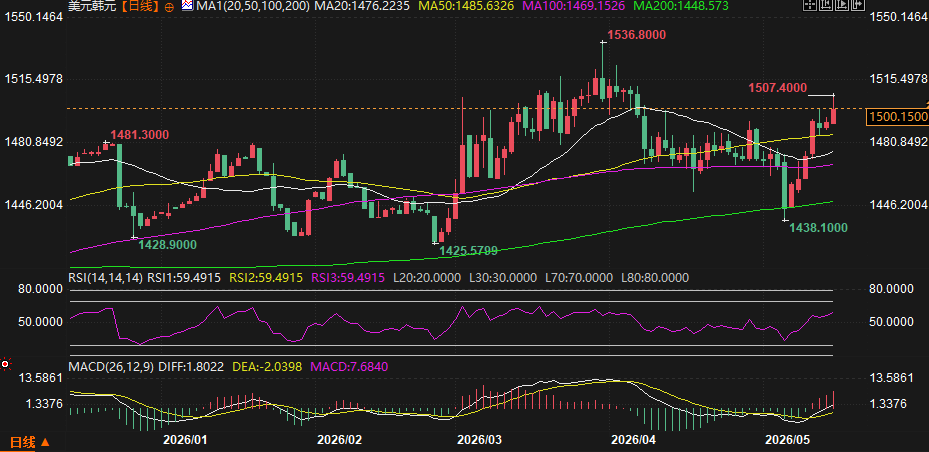
(USD/KRW daily chart, source: FX678)
According to the USD/KRW daily chart, the current technical pattern exhibits extremely strong bullish dominance. The price has effectively broken through and stabilized above all four moving averages, forming a textbook bullish alignment. Specifically, the 20-day moving average (MA20) is at 1476.22, the 50-day moving average (MA50) is at 1485.63, the 100-day moving average (MA100) is at 1469.15, and the 200-day moving average (MA20) is at 1448.57. The current exchange rate is trading in the 1500 area (with an intraday high of 1507.40), significantly higher than all moving averages. Furthermore, the short-term MA20 has crossed above the MA100 and MA200, and the MA50 has also turned upwards, presenting a typical strong bullish pattern of "moving averages converging and then diverging upwards."
At 16:01 Beijing time on May 15, the US dollar was trading at 1498.85 against the South Korean won.
Economic growth and risks coexist
Jin Chenyi stated that the economic situation is improving, driven by the technology industry, but there is a high degree of uncertainty in global investment, and inequality still exists domestically.
Regarding financial stability, Jin Chenyi pointed out that vigilance against risks to capital flows is rising, while household debt and housing price issues still exist.
Lee Jae-myung: "The economy is in a wartime-level crisis."
However, Kim Jin-il's concerns about inflationary pressures are not unfounded. On a broader level, the Middle East conflict is directly impacting the South Korean economy through energy prices.
South Korea is a major global energy importer, heavily reliant on Middle Eastern oil—approximately 70-72% of its crude oil imports come from Gulf countries, and a significant portion of its liquefied natural gas (LNG) also originates from Qatar and other regions. The Strait of Hormuz, blocked due to conflict, directly chokes South Korea's energy lifeline. Data shows that South Korea's import prices surged 16.1% month-on-month in March, the largest increase since 1998, with Dubai crude oil prices nearly doubling to $128.52 per barrel. During the same period, the South Korean won depreciated by about 2.6% against the US dollar, further amplifying imported inflationary pressures. South Korean President Lee Jae-myung has stated that the economy is in a "wartime-level" crisis and has called on the National Assembly to pass a supplementary budget of 26.2 trillion won.
Inflation concerns become a policy focus
As a newly appointed policy board member, Kim Jin-il explicitly listed inflation as the most pressing concern. Rising oil prices due to the Middle East conflict are exacerbating imported inflationary pressures in South Korea. His remarks suggest that the Bank of Korea may need to reassess its current policy stance at its first interest rate decision meeting on May 28.
Kim Jin-il's remarks were not an isolated incident. On the same day, the Bank of Japan warned of a summer price surge, and the market priced in a 60% probability of a June rate hike; while the European Central Bank had doubts about a June rate hike due to weak economic conditions, inflationary pressures remained; and the Federal Reserve postponed its rate cut expectations due to better-than-expected data. Global central banks are collectively shifting towards a "higher and longer" interest rate environment, putting pressure on emerging market currencies (including the South Korean won).
Kim Jin-il's remarks revealed growing concerns about inflation within the Bank of Korea's policy committee. Energy prices, driven by the Middle East conflict, are becoming a major source of inflationary pressure in South Korea, while technology-driven economic growth faces challenges such as global investment uncertainty, capital flow risks, and household debt. As a newly appointed member, his inflation concerns could influence the policy stance at the May 28th interest rate meeting. If inflationary pressures continue to rise, the Bank of Korea may face pressure to tighten monetary policy.
The Korean won weakened further against the dollar on Friday, trading around 1330, a new low since mid-April, influenced by both Kim Jin-il's inflation warning and a strong dollar. US April CPI and PPI both exceeded expectations, and the market's pricing in a Federal Reserve rate hike has risen to 36.9%, with the dollar index holding firm above 99. In South Korea, although the central bank may maintain a tight stance due to inflationary pressures, the won is highly sensitive to market sentiment and tends to react sharply when global risk aversion intensifies. Kim Jin-il's points about "high uncertainty in global investment" and "rising capital flow risks" accurately reflect the current situation facing the won.
Faced with the short-term weakness of the Korean won, international investment banks and South Korean domestic institutions have given completely different assessments.
UBS maintains its bullish stance on the Korean won, believing it is undervalued by more than 5%. A strong current account surplus (expected to remain above 10% of GDP) and the inclusion of Korean government bonds in the WGBI will drive capital inflows. UBS expects the USD/KRW exchange rate to fall below 1,400 in the second half of the year.
In contrast, the Korea Institute for International Economic Policy takes a more cautious approach. The institute points out that the Middle East conflict has created a "chain reaction structure"—oil prices, inflation, and interest rates are all under pressure simultaneously, making managing the won's volatility more important than predicting its direction. While strong exports and the inclusion of the Korean Won in the WGBI are stabilizing factors, rising energy prices will increase import settlement demand, and global financial markets will shift towards risk aversion, leading to greater won volatility.
On Friday, the US dollar opened at 1491.96 against the South Korean won, then fell all the way down and broke below the 1500 mark, currently trading at 1500.53.
(USD/KRW daily chart, source: FX678)
According to the USD/KRW daily chart, the current technical pattern exhibits extremely strong bullish dominance. The price has effectively broken through and stabilized above all four moving averages, forming a textbook bullish alignment. Specifically, the 20-day moving average (MA20) is at 1476.22, the 50-day moving average (MA50) is at 1485.63, the 100-day moving average (MA100) is at 1469.15, and the 200-day moving average (MA20) is at 1448.57. The current exchange rate is trading in the 1500 area (with an intraday high of 1507.40), significantly higher than all moving averages. Furthermore, the short-term MA20 has crossed above the MA100 and MA200, and the MA50 has also turned upwards, presenting a typical strong bullish pattern of "moving averages converging and then diverging upwards."
At 16:01 Beijing time on May 15, the US dollar was trading at 1498.85 against the South Korean won.
- Risk Warning and Disclaimer
- The market involves risk, and trading may not be suitable for all investors. This article is for reference only and does not constitute personal investment advice, nor does it take into account certain users’ specific investment objectives, financial situation, or other needs. Any investment decisions made based on this information are at your own risk.