With the Bank of Japan poised to raise interest rates in June, why are yen bulls still taking a wait-and-see approach?
2026-05-15 17:08:16
A recent survey conducted from May 7 to 14 shows that nearly two-thirds of economists expect the Bank of Japan to raise its key interest rate to 1.0% in June to continue normalizing monetary policy amid escalating inflation concerns stemming from the Iran war. Furthermore, the median forecast in the survey indicates that the Bank of Japan will raise rates to 1.25% in the fourth quarter and further to 1.50% in the third quarter of next year.
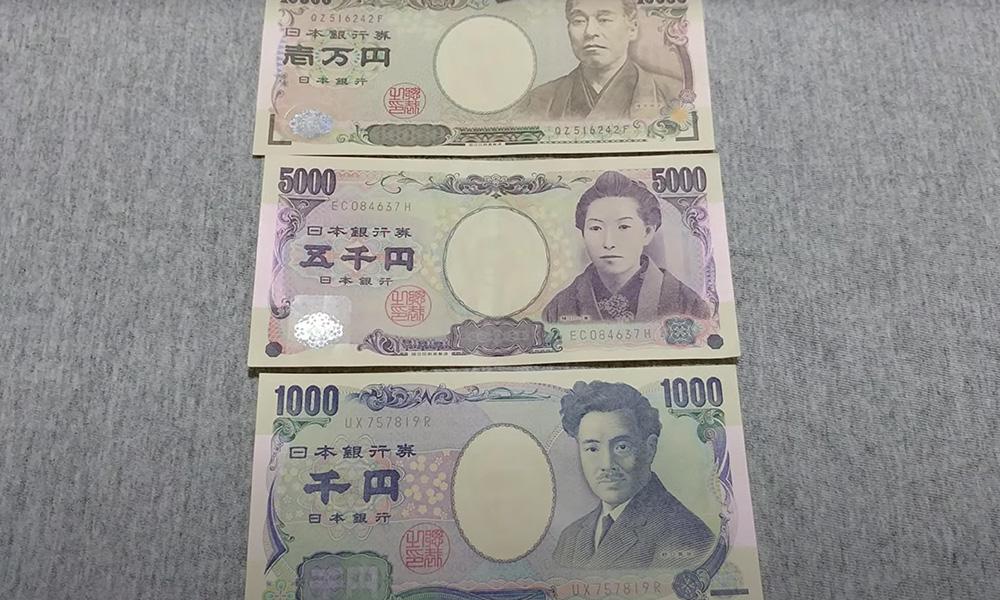
The Bank of Japan kept its policy rate unchanged at 0.75% last month to assess the impact of the conflict. However, three of its nine policy board members dissented, calling for a rate hike to 1.00%, indicating growing concern about inflationary pressures stemming from a war-driven energy shock. Kazunosuke Masu, a board member who voted to keep the rate unchanged in April, said on Thursday that the central bank should raise rates as soon as possible without clear signs of an economic slowdown, suggesting he might join the opposition in supporting a rate hike next month.
A survey shows that nearly two-thirds of economists expect the policy rate to rise to 1.0% by the end of June, similar to the results of last month's survey. With one exception, all respondents expect a rate hike by the end of September. A senior market economist at Mizuho Securities stated, "Given that economic, price, and wage conditions remain intact, we believe the June meeting—about six months from the December 2025 meeting—is the most likely time for a rate hike."
The Bank of Japan also faces pressure: When it kept interest rates unchanged in April, Japanese authorities intervened in the foreign exchange market multiple times to support the yen, which had fallen below the 160 level. Many believe that without tighter monetary policy, the effectiveness of foreign exchange interventions, such as the recent spending of approximately 10 trillion yen to curb the yen's depreciation, will be significantly reduced. Nomura Securities' chief economist stated that the Bank of Japan also leans towards raising interest rates in June to address the upside price risks posed by the yen's depreciation—which is harming the Japanese economy by pushing up import costs.
However, several economists have pointed out that if the uncertainty surrounding the war persists, and Japan faces the risk of production cuts due to weak consumption and supply chain disruptions, the Bank of Japan may prefer to remain on hold. Prime Minister Sanae Takaichi, a long-time advocate of loose monetary policy, has previously opposed the Bank of Japan tightening its policy.
Unlike its US and European counterparts, Japan's policy rate of 0.75% remains below the neutral rate, which neither stimulates nor restricts economic activity. With inflation around 2%, the Bank of Japan risks overheating and further weakening of the yen if it maintains deeply negative real borrowing costs.
A survey revealed that nearly three-quarters of respondents, when answering supplementary questions, indicated that persistent inflation poses a greater threat to the Japanese economy than a slowdown in demand over the next 12 months. The chief strategist at T&D Asset Management stated, "The authorities are attempting to stem the yen's depreciation by hinting at potential intervention, but given negative real interest rates and the risk that high oil prices could worsen the trade balance, the effect is likely to be limited."
Lee Hardman of MUFG Financial Group pointed out that inflation risks stemming from the Middle East conflict, along with hawkish comments from committee members, are strengthening market expectations for a near-term interest rate hike. He specifically mentioned that committee member Kazunosuke Ekizuki hinted that "if there are no clear signs of an economic slowdown, interest rates should be raised as soon as possible," which further solidified expectations of a June rate hike.
Strategists at Daiwa Securities said the Bank of Japan may consider coordinating interest rate hikes with foreign exchange market interventions by the Ministry of Finance, referencing the intervention patterns of 2022 and 2024.
Market consensus is strong that the Bank of Japan will raise interest rates in June, with expectations that rates will rise to 1.0% and further increase to 1.25% by the end of the year. At the April meeting, three members voted in favor of a rate hike, and another member hinted at a possible defection, indicating a growing hawkish faction within the central bank. Imported inflationary pressures from a weak yen and high oil prices are the main drivers of the rate hike; however, weak consumption, supply chain disruption risks, and Prime Minister Sanae Takaichi's dovish stance pose potential obstacles. With the threat of inflation outweighing concerns about slowing demand, the Bank of Japan faces a difficult balance between raising rates to curb yen depreciation and avoiding a hard landing for the economy. The June meeting will be a crucial window to verify this policy shift.
From a technical perspective, although the US dollar index rose above 99 supported by US economic data, the USD/JPY pair encountered significant resistance above 159.00, with the market remaining wary of the "dual threat" of intervention and interest rate hikes by the Bank of Japan.
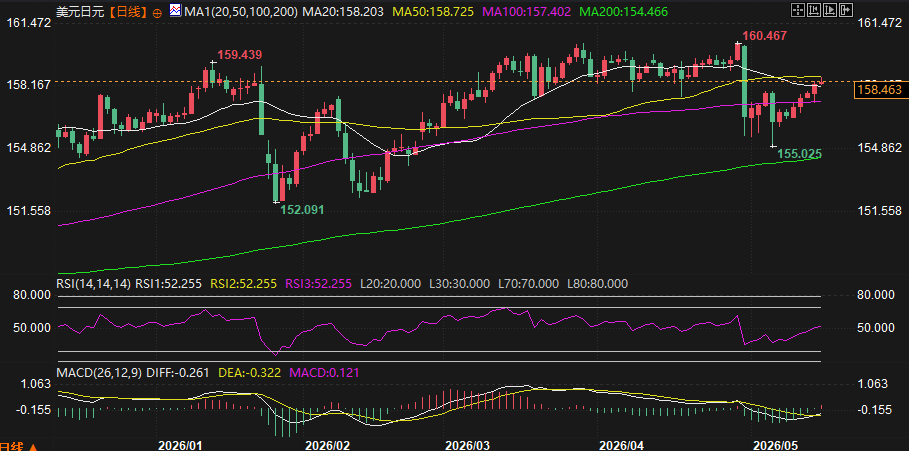
(USD/JPY daily chart, source: FX678)
According to the USD/JPY daily chart, the current technical pattern shows a high-level consolidation with unclear direction, and the price is trading within a range of multiple moving averages. Specifically, the 20-day moving average (MA20) is at 158.20, the 50-day moving average (MA50) is at 158.73, the 100-day moving average (MA100) is at 157.40, and the 200-day moving average (MA200) is at 154.47. The current exchange rate is trading around 158.48, which is exactly within a narrow range above the MA20 and below the MA50. An upward break above 158.73 is needed to challenge the previous highs of 159.44 and even 160.47.
At 17:00 Beijing time on May 15, the USD/JPY exchange rate was 158.56/57.
Divergence was already evident at the April meeting, with hawkish members potentially leaning towards the rate hike camp.
The Bank of Japan kept its policy rate unchanged at 0.75% last month to assess the impact of the conflict. However, three of its nine policy board members dissented, calling for a rate hike to 1.00%, indicating growing concern about inflationary pressures stemming from a war-driven energy shock. Kazunosuke Masu, a board member who voted to keep the rate unchanged in April, said on Thursday that the central bank should raise rates as soon as possible without clear signs of an economic slowdown, suggesting he might join the opposition in supporting a rate hike next month.
Interest rate hike expectations are solid, and the weakness of the yen adds to the urgency.
A survey shows that nearly two-thirds of economists expect the policy rate to rise to 1.0% by the end of June, similar to the results of last month's survey. With one exception, all respondents expect a rate hike by the end of September. A senior market economist at Mizuho Securities stated, "Given that economic, price, and wage conditions remain intact, we believe the June meeting—about six months from the December 2025 meeting—is the most likely time for a rate hike."
The Bank of Japan also faces pressure: When it kept interest rates unchanged in April, Japanese authorities intervened in the foreign exchange market multiple times to support the yen, which had fallen below the 160 level. Many believe that without tighter monetary policy, the effectiveness of foreign exchange interventions, such as the recent spending of approximately 10 trillion yen to curb the yen's depreciation, will be significantly reduced. Nomura Securities' chief economist stated that the Bank of Japan also leans towards raising interest rates in June to address the upside price risks posed by the yen's depreciation—which is harming the Japanese economy by pushing up import costs.
The path to raising interest rates is not without obstacles.
However, several economists have pointed out that if the uncertainty surrounding the war persists, and Japan faces the risk of production cuts due to weak consumption and supply chain disruptions, the Bank of Japan may prefer to remain on hold. Prime Minister Sanae Takaichi, a long-time advocate of loose monetary policy, has previously opposed the Bank of Japan tightening its policy.
Inflation poses a greater threat, and negative real interest rates exacerbate the yen's predicament.
Unlike its US and European counterparts, Japan's policy rate of 0.75% remains below the neutral rate, which neither stimulates nor restricts economic activity. With inflation around 2%, the Bank of Japan risks overheating and further weakening of the yen if it maintains deeply negative real borrowing costs.
A survey revealed that nearly three-quarters of respondents, when answering supplementary questions, indicated that persistent inflation poses a greater threat to the Japanese economy than a slowdown in demand over the next 12 months. The chief strategist at T&D Asset Management stated, "The authorities are attempting to stem the yen's depreciation by hinting at potential intervention, but given negative real interest rates and the risk that high oil prices could worsen the trade balance, the effect is likely to be limited."
Institutional View: June Interest Rate Hike Window Attracts Much Attention
Lee Hardman of MUFG Financial Group pointed out that inflation risks stemming from the Middle East conflict, along with hawkish comments from committee members, are strengthening market expectations for a near-term interest rate hike. He specifically mentioned that committee member Kazunosuke Ekizuki hinted that "if there are no clear signs of an economic slowdown, interest rates should be raised as soon as possible," which further solidified expectations of a June rate hike.
Strategists at Daiwa Securities said the Bank of Japan may consider coordinating interest rate hikes with foreign exchange market interventions by the Ministry of Finance, referencing the intervention patterns of 2022 and 2024.
Market consensus is strong that the Bank of Japan will raise interest rates in June, with expectations that rates will rise to 1.0% and further increase to 1.25% by the end of the year. At the April meeting, three members voted in favor of a rate hike, and another member hinted at a possible defection, indicating a growing hawkish faction within the central bank. Imported inflationary pressures from a weak yen and high oil prices are the main drivers of the rate hike; however, weak consumption, supply chain disruption risks, and Prime Minister Sanae Takaichi's dovish stance pose potential obstacles. With the threat of inflation outweighing concerns about slowing demand, the Bank of Japan faces a difficult balance between raising rates to curb yen depreciation and avoiding a hard landing for the economy. The June meeting will be a crucial window to verify this policy shift.
The tug-of-war between bulls and bears in the moving average sandwich
From a technical perspective, although the US dollar index rose above 99 supported by US economic data, the USD/JPY pair encountered significant resistance above 159.00, with the market remaining wary of the "dual threat" of intervention and interest rate hikes by the Bank of Japan.
(USD/JPY daily chart, source: FX678)
According to the USD/JPY daily chart, the current technical pattern shows a high-level consolidation with unclear direction, and the price is trading within a range of multiple moving averages. Specifically, the 20-day moving average (MA20) is at 158.20, the 50-day moving average (MA50) is at 158.73, the 100-day moving average (MA100) is at 157.40, and the 200-day moving average (MA200) is at 154.47. The current exchange rate is trading around 158.48, which is exactly within a narrow range above the MA20 and below the MA50. An upward break above 158.73 is needed to challenge the previous highs of 159.44 and even 160.47.
At 17:00 Beijing time on May 15, the USD/JPY exchange rate was 158.56/57.
- Risk Warning and Disclaimer
- The market involves risk, and trading may not be suitable for all investors. This article is for reference only and does not constitute personal investment advice, nor does it take into account certain users’ specific investment objectives, financial situation, or other needs. Any investment decisions made based on this information are at your own risk.