Gold Trading Alert: Is the Nearly 4% Weekly Drop in Gold Prices Just the Beginning? The Triple Strain of a Dollar, Yields, and Interest Rate Hike Expectations Is Not Over Yet
2026-05-18 07:48:56
Spot gold suffered a sharp decline on Friday (May 15), falling 2.45% to close at $4,538 per ounce, after hitting a low of $4,511 per ounce during the session, its lowest level since May 4. The weekly decline was even more significant, reaching 3.75%, catching many bullish investors off guard. Meanwhile, US gold futures for June delivery also succumbed to the downturn, falling 2.7% to $4,560 per ounce.
Marex analyst Edward Meir pointed out that "there are two reasons for the sell-off in the (precious metals) market. First, the US dollar is performing quite strongly; second, we are not only seeing rising (US) (bond) yields, but also a global trend of rising yields."
Amid escalating geopolitical risks, gold, a traditional safe-haven asset, is competing with the US dollar and US Treasury bonds for safe-haven funds, with the latter clearly gaining more favor recently. On Monday (May 18) in early Asian trading, spot gold traded in a narrow range at low levels, currently hovering around $4537.09 per ounce.
The stalemate in the US-Iran conflict is far from over; on the contrary, the situation continues to escalate. UAE officials said on Sunday that a nuclear power plant in the country caught fire due to a drone attack; Saudi Arabia reported intercepting three drones that flew from Iraqi airspace. These incidents indicate that although hostilities during the conflict with Iran have significantly decreased since the ceasefire agreement took effect in April, drone launches from Iraq towards Gulf states such as Saudi Arabia and Kuwait continue.
A foreign policy advisor to the UAE president characterized the drone attack as a "terrorist attack," stating it represented a dangerous escalation of the situation. The International Atomic Energy Agency called for maximum military restraint near any nuclear power plant, while confirming that the Barakah nuclear power plant in the UAE was safe and that the attack did not result in any radioactive material leaks.
The diplomatic deadlock is equally worrying. According to Iran's Fars News Agency, the US, in responding to Iran's proposal, listed five key conditions, including Iran transferring 400 kilograms of enriched uranium to the US and allowing Iran to retain only one nuclear facility. The report emphasizes that even if Iran meets these conditions, the threat of an attack on Iran by the US and Israel will remain. Analysts point out that the US proposal is not aimed at resolving the problem, but rather at achieving political and military objectives that it failed to achieve during the war through negotiation.
Trump's tough stance on social media further escalated tensions: "Time is of the essence for Iran. They had better act quickly or they will have nothing. No time to lose!" According to Axios, Trump is expected to meet with his senior national security advisor on Tuesday to discuss military action against Iran. A senior spokesperson for the Iranian armed forces warned that if the United States again threatens or takes military action against Iran, US military assets and forces in the region will face a "new, offensive, unexpected, and storm-like response."
The US dollar index rose for five consecutive trading days, climbing to 99.21, marking its biggest weekly gain in two months. This strong dollar performance is not accidental; it's driven by the continued surge in US Treasury yields. The 10-year US Treasury yield rose to 4.599%, hitting a near one-year high. What does this mean for gold investors? Simply put, the opportunity cost of holding gold is rising sharply. Since gold itself does not generate interest, investors' willingness to hold gold decreases significantly when bond yields climb.
More importantly, this round of yield increases is not unique to the United States; as Meir stated, it is a global trend. This means that US Treasury bonds, once considered "risk-free" assets, are now offering real positive returns, directly competing with gold, which yields zero. In this interest rate environment, capital flowing into dollar assets rather than gold becomes a rational and inevitable choice.
While gold investors were anxious about falling prices, the international oil market presented a completely different picture. Brent crude futures closed at $109.26 per barrel, up 3.35%; U.S. crude futures closed at $105.42 per barrel, a significant increase of 4.2%. Last week, Brent crude rose by a cumulative 7.84%, while U.S. crude surged by 10.48%.
The surge in oil prices stemmed directly from a sharp escalation of geopolitical risks. US President Trump issued a stern warning to Iran, stating that patience with Iran was running out and time was running out. Iranian Foreign Minister Araqchi responded forcefully, stating that Iran had no trust in the US and was prepared to return to the battlefield. This tit-for-tat exchange of words completely shattered market hopes for the restoration of normal traffic flow through the Strait of Hormuz, a vital global energy transport route.
A comment from an analyst at Commerzbank was telling: "The rhetoric between the US and Iran has become noticeably more confrontational again. Although the ceasefire remains in place, hopes for a swift reopening of the Strait of Hormuz have been dashed." Approximately one-fifth of the world's oil and liquefied natural gas are typically transported through the Strait of Hormuz. The continued disruption of this crucial waterway is triggering a chain reaction in global energy markets, with inflation being one of the most worrying byproducts.
The performance of the US bond market further confirms the growing concern about inflation. The yield on the 2-year Treasury note rose to 4.086%, the highest since March 2025; the yield on the 10-year Treasury note rose 14 basis points to 4.599%, the highest since May 2025; and the yield on the 30-year Treasury note even touched 5.131%, also the highest level in a year.
Mike Sanders, head of fixed income at Madison Investments, offered a very insightful analysis: "The bond market is finally realizing that energy prices may not see a quick resolution and decline, and we must factor in long-term inflation expectations into prices." This statement reveals the core shift in current market sentiment—previously, the market generally believed that the energy price increases caused by the Middle East conflict were temporary, but with the ceasefire agreement failing to be implemented and diplomatic efforts stalled, investors have had to reassess this assumption.
John Luke Tyner of Aptus Capital Advisors offered another perspective on the rising yields: the large-scale issuance of bonds by companies to fund AI-related spending, coupled with signs of accelerating US economic growth, has jointly driven up yields. This suggests that the current rise in yields reflects not only inflation expectations but also a recovery in real economic demand.
The continued rise in inflationary pressures is altering market expectations regarding the Federal Reserve's policy path. According to data from the Chicago Mercantile Exchange's FedWatch tool, the market now estimates a 49.5% probability of a rate hike of at least 25 basis points at the Fed's December meeting, compared to just 14.3% a week ago. This dramatic shift in expectations is one of the core drivers behind the strengthening dollar and the downward pressure on gold.
Remarks by New York Fed President Williams indicate that Fed officials are closely monitoring developments. He stated that given the uncertainty surrounding the Middle East war, the Fed currently sees no need to consider adjusting interest rate policy. However, he also acknowledged that monetary policy is already in a good position. Several other Fed officials have sent clearer signals: curbing inflationary pressures is the top priority, and if price pressures continue to intensify, the possibility of raising interest rates cannot be ruled out.
FXStreet senior analyst Joseph Trevisani's comments highlight the transmission mechanism between crude oil prices and inflation expectations: "If U.S. crude oil prices rise from $95 to $105, then many inflation expectations must be readjusted, and in fact, expectations are being readjusted." This readjustment of expectations is the underlying logic behind soaring bond yields, a stronger dollar, and pressure on gold.
Kitco News' weekly gold survey reveals an interesting divergence among market participants. Of the 13 Wall Street analysts surveyed, only 2 expect gold prices to rise in the coming week, a mere 15%; while a whopping 10 analysts predict further declines, a staggering 77%. Wall Street sentiment has deeply succumbed to bearish territory, with professional investors generally pessimistic about gold's short-term prospects.
In stark contrast, Main Street investors remain bullish. In Kitco's online poll, 17 retail traders, or 59%, believe gold prices will rise in the coming week; only 4, or 14%, predict gold will lose ground further. This cognitive gap between professional and retail investors reflects differing understandings of the market's pricing logic for gold. Retail investors still tend to equate geopolitical risks with rising gold prices, while professional investors are more aware that, in the current interest rate and exchange rate environment, gold's safe-haven properties are being overshadowed by the US dollar and US Treasury bonds.
In the coming week, market focus will remain on the developments in the Middle East conflict and its impact on energy prices and bond yields. On the economic data front, the market will see key indicators including April pending home sales, the minutes of the March Federal Reserve monetary policy meeting, weekly jobless claims, the Philadelphia Fed manufacturing survey, April housing starts, and the May S&P Flash Sale Manufacturing and Services PMIs. The University of Michigan's final consumer sentiment index, released on Friday, will provide an important reference for the market's close next week.
However, the core variable dominating the gold market narrative is likely to remain the ongoing conflict in the Middle East and its transmission effects on oil prices and bond yields. As long as energy supplies from the Strait of Hormuz remain largely blocked, inflationary pressures will be difficult to alleviate, the shadow of interest rate hikes will continue to loom over the market, and the US dollar and US Treasury yields will continue to exert downward pressure on gold.
The coming week is crucial for gold investors. If the situation in the Middle East deteriorates further, causing oil prices to continue to surge, market expectations for interest rate hikes will be strengthened, and gold may face greater downward pressure. Conversely, if diplomatic efforts make a breakthrough, the Strait of Hormuz is expected to reopen, inflation expectations will cool, and the shadow of interest rate hikes will dissipate, gold may experience a retaliatory rebound.
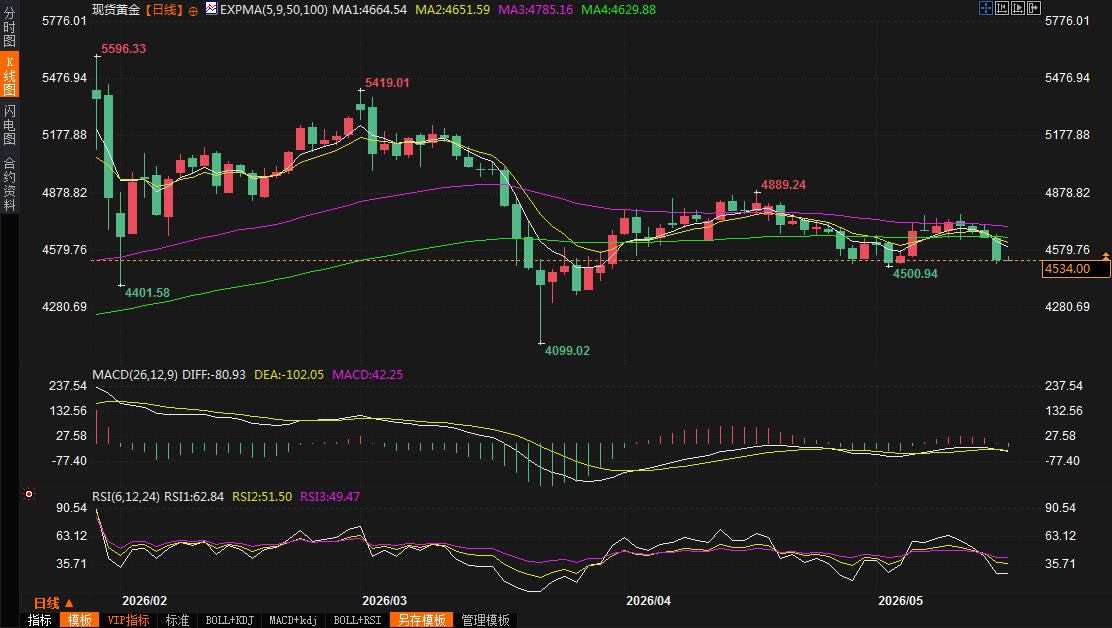
(Spot gold daily chart, source: FX678)
At 07:46 Beijing time, spot gold was trading at $4,534.73 per ounce.
Marex analyst Edward Meir pointed out that "there are two reasons for the sell-off in the (precious metals) market. First, the US dollar is performing quite strongly; second, we are not only seeing rising (US) (bond) yields, but also a global trend of rising yields."
Amid escalating geopolitical risks, gold, a traditional safe-haven asset, is competing with the US dollar and US Treasury bonds for safe-haven funds, with the latter clearly gaining more favor recently. On Monday (May 18) in early Asian trading, spot gold traded in a narrow range at low levels, currently hovering around $4537.09 per ounce.
Escalating geopolitical risks: Ceasefire agreement becomes a mere formality
The stalemate in the US-Iran conflict is far from over; on the contrary, the situation continues to escalate. UAE officials said on Sunday that a nuclear power plant in the country caught fire due to a drone attack; Saudi Arabia reported intercepting three drones that flew from Iraqi airspace. These incidents indicate that although hostilities during the conflict with Iran have significantly decreased since the ceasefire agreement took effect in April, drone launches from Iraq towards Gulf states such as Saudi Arabia and Kuwait continue.
A foreign policy advisor to the UAE president characterized the drone attack as a "terrorist attack," stating it represented a dangerous escalation of the situation. The International Atomic Energy Agency called for maximum military restraint near any nuclear power plant, while confirming that the Barakah nuclear power plant in the UAE was safe and that the attack did not result in any radioactive material leaks.
The diplomatic deadlock is equally worrying. According to Iran's Fars News Agency, the US, in responding to Iran's proposal, listed five key conditions, including Iran transferring 400 kilograms of enriched uranium to the US and allowing Iran to retain only one nuclear facility. The report emphasizes that even if Iran meets these conditions, the threat of an attack on Iran by the US and Israel will remain. Analysts point out that the US proposal is not aimed at resolving the problem, but rather at achieving political and military objectives that it failed to achieve during the war through negotiation.
Trump's tough stance on social media further escalated tensions: "Time is of the essence for Iran. They had better act quickly or they will have nothing. No time to lose!" According to Axios, Trump is expected to meet with his senior national security advisor on Tuesday to discuss military action against Iran. A senior spokesperson for the Iranian armed forces warned that if the United States again threatens or takes military action against Iran, US military assets and forces in the region will face a "new, offensive, unexpected, and storm-like response."
The Return of the Dollar: Yield Advantage Reshapes Capital Flows
The US dollar index rose for five consecutive trading days, climbing to 99.21, marking its biggest weekly gain in two months. This strong dollar performance is not accidental; it's driven by the continued surge in US Treasury yields. The 10-year US Treasury yield rose to 4.599%, hitting a near one-year high. What does this mean for gold investors? Simply put, the opportunity cost of holding gold is rising sharply. Since gold itself does not generate interest, investors' willingness to hold gold decreases significantly when bond yields climb.
More importantly, this round of yield increases is not unique to the United States; as Meir stated, it is a global trend. This means that US Treasury bonds, once considered "risk-free" assets, are now offering real positive returns, directly competing with gold, which yields zero. In this interest rate environment, capital flowing into dollar assets rather than gold becomes a rational and inevitable choice.
Middle East conflict reignites: The specter of inflation behind soaring oil prices
While gold investors were anxious about falling prices, the international oil market presented a completely different picture. Brent crude futures closed at $109.26 per barrel, up 3.35%; U.S. crude futures closed at $105.42 per barrel, a significant increase of 4.2%. Last week, Brent crude rose by a cumulative 7.84%, while U.S. crude surged by 10.48%.
The surge in oil prices stemmed directly from a sharp escalation of geopolitical risks. US President Trump issued a stern warning to Iran, stating that patience with Iran was running out and time was running out. Iranian Foreign Minister Araqchi responded forcefully, stating that Iran had no trust in the US and was prepared to return to the battlefield. This tit-for-tat exchange of words completely shattered market hopes for the restoration of normal traffic flow through the Strait of Hormuz, a vital global energy transport route.
A comment from an analyst at Commerzbank was telling: "The rhetoric between the US and Iran has become noticeably more confrontational again. Although the ceasefire remains in place, hopes for a swift reopening of the Strait of Hormuz have been dashed." Approximately one-fifth of the world's oil and liquefied natural gas are typically transported through the Strait of Hormuz. The continued disruption of this crucial waterway is triggering a chain reaction in global energy markets, with inflation being one of the most worrying byproducts.
Restructuring of Inflation Expectations: A Warning Signal for the Bond Market
The performance of the US bond market further confirms the growing concern about inflation. The yield on the 2-year Treasury note rose to 4.086%, the highest since March 2025; the yield on the 10-year Treasury note rose 14 basis points to 4.599%, the highest since May 2025; and the yield on the 30-year Treasury note even touched 5.131%, also the highest level in a year.
Mike Sanders, head of fixed income at Madison Investments, offered a very insightful analysis: "The bond market is finally realizing that energy prices may not see a quick resolution and decline, and we must factor in long-term inflation expectations into prices." This statement reveals the core shift in current market sentiment—previously, the market generally believed that the energy price increases caused by the Middle East conflict were temporary, but with the ceasefire agreement failing to be implemented and diplomatic efforts stalled, investors have had to reassess this assumption.
John Luke Tyner of Aptus Capital Advisors offered another perspective on the rising yields: the large-scale issuance of bonds by companies to fund AI-related spending, coupled with signs of accelerating US economic growth, has jointly driven up yields. This suggests that the current rise in yields reflects not only inflation expectations but also a recovery in real economic demand.
Interest rate hike expectations resurface: A major shift in Fed policy.
The continued rise in inflationary pressures is altering market expectations regarding the Federal Reserve's policy path. According to data from the Chicago Mercantile Exchange's FedWatch tool, the market now estimates a 49.5% probability of a rate hike of at least 25 basis points at the Fed's December meeting, compared to just 14.3% a week ago. This dramatic shift in expectations is one of the core drivers behind the strengthening dollar and the downward pressure on gold.
Remarks by New York Fed President Williams indicate that Fed officials are closely monitoring developments. He stated that given the uncertainty surrounding the Middle East war, the Fed currently sees no need to consider adjusting interest rate policy. However, he also acknowledged that monetary policy is already in a good position. Several other Fed officials have sent clearer signals: curbing inflationary pressures is the top priority, and if price pressures continue to intensify, the possibility of raising interest rates cannot be ruled out.
FXStreet senior analyst Joseph Trevisani's comments highlight the transmission mechanism between crude oil prices and inflation expectations: "If U.S. crude oil prices rise from $95 to $105, then many inflation expectations must be readjusted, and in fact, expectations are being readjusted." This readjustment of expectations is the underlying logic behind soaring bond yields, a stronger dollar, and pressure on gold.
The Divergence Between Wall Street and Main Street: The Cognitive Gap Between Professional Investors and Retail Investors
Kitco News' weekly gold survey reveals an interesting divergence among market participants. Of the 13 Wall Street analysts surveyed, only 2 expect gold prices to rise in the coming week, a mere 15%; while a whopping 10 analysts predict further declines, a staggering 77%. Wall Street sentiment has deeply succumbed to bearish territory, with professional investors generally pessimistic about gold's short-term prospects.
In stark contrast, Main Street investors remain bullish. In Kitco's online poll, 17 retail traders, or 59%, believe gold prices will rise in the coming week; only 4, or 14%, predict gold will lose ground further. This cognitive gap between professional and retail investors reflects differing understandings of the market's pricing logic for gold. Retail investors still tend to equate geopolitical risks with rising gold prices, while professional investors are more aware that, in the current interest rate and exchange rate environment, gold's safe-haven properties are being overshadowed by the US dollar and US Treasury bonds.
This Week's Outlook: A Critical Moment Amidst Data and Conflict
In the coming week, market focus will remain on the developments in the Middle East conflict and its impact on energy prices and bond yields. On the economic data front, the market will see key indicators including April pending home sales, the minutes of the March Federal Reserve monetary policy meeting, weekly jobless claims, the Philadelphia Fed manufacturing survey, April housing starts, and the May S&P Flash Sale Manufacturing and Services PMIs. The University of Michigan's final consumer sentiment index, released on Friday, will provide an important reference for the market's close next week.
However, the core variable dominating the gold market narrative is likely to remain the ongoing conflict in the Middle East and its transmission effects on oil prices and bond yields. As long as energy supplies from the Strait of Hormuz remain largely blocked, inflationary pressures will be difficult to alleviate, the shadow of interest rate hikes will continue to loom over the market, and the US dollar and US Treasury yields will continue to exert downward pressure on gold.
The coming week is crucial for gold investors. If the situation in the Middle East deteriorates further, causing oil prices to continue to surge, market expectations for interest rate hikes will be strengthened, and gold may face greater downward pressure. Conversely, if diplomatic efforts make a breakthrough, the Strait of Hormuz is expected to reopen, inflation expectations will cool, and the shadow of interest rate hikes will dissipate, gold may experience a retaliatory rebound.
(Spot gold daily chart, source: FX678)
At 07:46 Beijing time, spot gold was trading at $4,534.73 per ounce.
- Risk Warning and Disclaimer
- The market involves risk, and trading may not be suitable for all investors. This article is for reference only and does not constitute personal investment advice, nor does it take into account certain users’ specific investment objectives, financial situation, or other needs. Any investment decisions made based on this information are at your own risk.