Gold prices have fallen continuously amid inflation concerns and expectations of a Fed rate hike, awaiting stabilization.
2026-05-18 09:51:05
Gold prices (XAU/USD) continued to be under pressure during Monday's Asian trading session, falling back to around $4,500. While geopolitical risks in the Middle East continue to escalate, market concerns about inflation and rising interest rates are weakening safe-haven buying of gold, resulting in a generally weak performance in the precious metals market.

US President Trump reiterated his tough stance against Iran on Sunday, demanding "swift action" or face further consequences. Meanwhile, no significant breakthroughs were achieved between the US and major Asian powers on trade concerns and the Middle East issue, further fueling market risk aversion. However, unlike previous instances, this round of geopolitical risks did not comprehensively drive up gold prices; instead, it spurred a rapid rise in oil prices. Rising energy prices have reignited market concerns about potential global inflationary pressures, directly impacting investors' assessments of the Federal Reserve's policy path.
Marex analyst Edward Meir stated that major Asian powers have not provided significant assistance in easing the current situation, while rising oil prices are reinforcing the market's inflationary logic, which is a clear negative factor for the gold market. The rise in international oil prices has strengthened inflation expectations, becoming a major factor suppressing gold prices.
The current market logic is changing. Typically, geopolitical risks drive funds to safe-haven assets like gold. However, if geopolitical conflicts further push up energy prices, it could lead to a rebound in global inflation and prompt central banks to maintain higher interest rates. In a high-interest-rate environment, the attractiveness of gold, which does not offer interest income, will significantly decrease.
The United States has demanded that Iran abandon its nuclear program and reopen the Strait of Hormuz. Meanwhile, Iranian media reports indicate that the US has not offered any substantial concessions, and negotiations remain deadlocked. This suggests that the situation in the Middle East remains at risk of further escalation in the short term.
The Strait of Hormuz handles approximately 20% of global seaborne crude oil transport, and market concerns about continued supply risks are pushing up energy prices. As crude oil prices continue to rise, global investors are beginning to reassess the future path of inflation. Rising energy costs will not only affect transportation and manufacturing but could also potentially push up global consumer price levels again. Consequently, the market is gradually reducing its expectations for interest rate cuts by the Federal Reserve.
According to data from the CME Group's FedWatch tool, traders have largely ruled out a Fed rate cut this year, while bets on further rate hikes are rising. As a result, US Treasury yields remain high, and the US dollar index remains strong. The market has clearly lowered its expectations for a rate cut this year, and the high-interest-rate environment is suppressing gold buying.
Looking at market fund flows, some funds are shifting from the gold market to dollar assets. Due to rising dollar yields, investors are more inclined to allocate to high-yield assets rather than non-interest-bearing assets like gold, which is a significant reason for the recent continued pressure on gold prices.
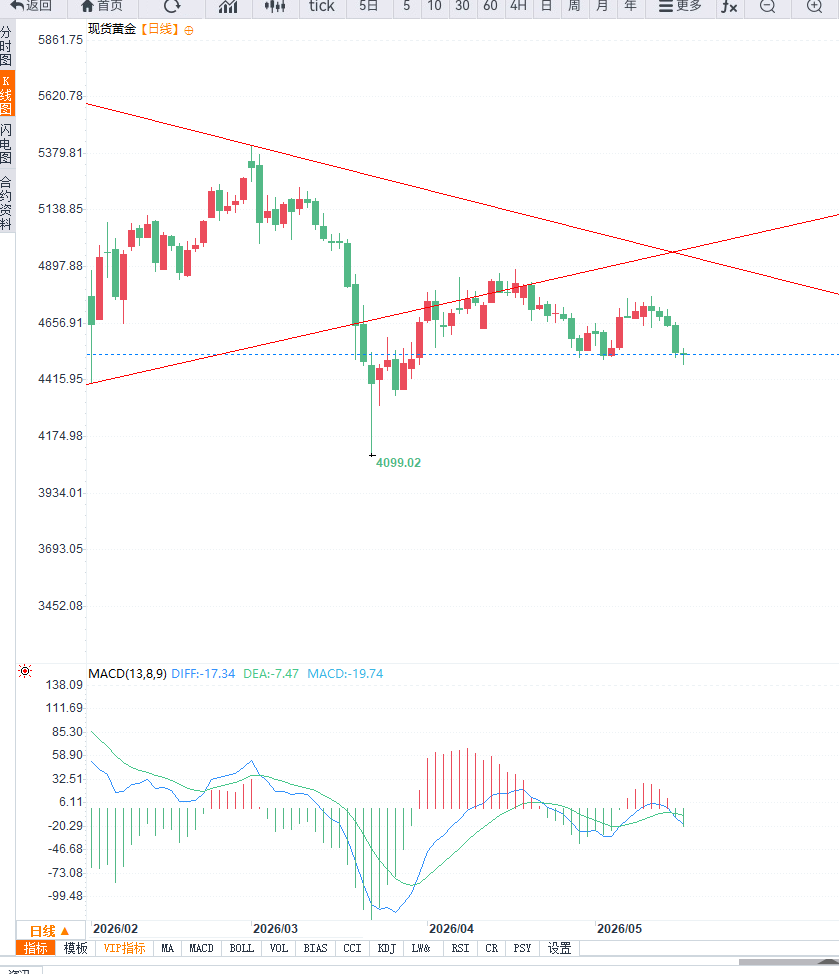
From a technical perspective, gold has broken below short-term moving average support on the daily chart, and the overall trend has shifted from a strong upward movement to high-level consolidation. A new key support area is forming around $4,500; if this level is breached, the market may further test the $4,480 to $4,450 range.
From the 4-hour chart, the short-term bearish momentum in gold has strengthened. The MACD indicator has entered below the zero line, indicating a bearish short-term market sentiment, while the RSI indicator continues to decline, suggesting that bullish buying is weakening. However, due to persistent geopolitical risks, gold still has some safe-haven support, and the market may maintain a highly volatile and oscillating pattern in the short term.
In addition, investors are also watching subsequent US inflation data and speeches by Federal Reserve officials. If future data shows a resurgence in US inflation, the market may further reinforce expectations of high interest rates, thereby continuing to suppress gold prices.
Editor's Summary:
The gold market is currently facing a dual struggle between "safe-haven support" and "high interest rate suppression." On the one hand, escalating tensions in the Middle East have increased market demand for safe-haven assets; on the other hand, rising oil prices have boosted inflation expectations and strengthened the likelihood that the Federal Reserve will maintain high interest rates, leading to a decline in gold's attractiveness. In the short term, interest rates and the US dollar are dominating gold price movements. If energy prices continue to rise, the Fed's policy shift may be further delayed, and gold may continue to face downward pressure. However, if geopolitical risks worsen further, safe-haven demand for gold may rebound.
US President Trump reiterated his tough stance against Iran on Sunday, demanding "swift action" or face further consequences. Meanwhile, no significant breakthroughs were achieved between the US and major Asian powers on trade concerns and the Middle East issue, further fueling market risk aversion. However, unlike previous instances, this round of geopolitical risks did not comprehensively drive up gold prices; instead, it spurred a rapid rise in oil prices. Rising energy prices have reignited market concerns about potential global inflationary pressures, directly impacting investors' assessments of the Federal Reserve's policy path.
Marex analyst Edward Meir stated that major Asian powers have not provided significant assistance in easing the current situation, while rising oil prices are reinforcing the market's inflationary logic, which is a clear negative factor for the gold market. The rise in international oil prices has strengthened inflation expectations, becoming a major factor suppressing gold prices.
The current market logic is changing. Typically, geopolitical risks drive funds to safe-haven assets like gold. However, if geopolitical conflicts further push up energy prices, it could lead to a rebound in global inflation and prompt central banks to maintain higher interest rates. In a high-interest-rate environment, the attractiveness of gold, which does not offer interest income, will significantly decrease.
The United States has demanded that Iran abandon its nuclear program and reopen the Strait of Hormuz. Meanwhile, Iranian media reports indicate that the US has not offered any substantial concessions, and negotiations remain deadlocked. This suggests that the situation in the Middle East remains at risk of further escalation in the short term.
The Strait of Hormuz handles approximately 20% of global seaborne crude oil transport, and market concerns about continued supply risks are pushing up energy prices. As crude oil prices continue to rise, global investors are beginning to reassess the future path of inflation. Rising energy costs will not only affect transportation and manufacturing but could also potentially push up global consumer price levels again. Consequently, the market is gradually reducing its expectations for interest rate cuts by the Federal Reserve.
According to data from the CME Group's FedWatch tool, traders have largely ruled out a Fed rate cut this year, while bets on further rate hikes are rising. As a result, US Treasury yields remain high, and the US dollar index remains strong. The market has clearly lowered its expectations for a rate cut this year, and the high-interest-rate environment is suppressing gold buying.
Looking at market fund flows, some funds are shifting from the gold market to dollar assets. Due to rising dollar yields, investors are more inclined to allocate to high-yield assets rather than non-interest-bearing assets like gold, which is a significant reason for the recent continued pressure on gold prices.
From a technical perspective, gold has broken below short-term moving average support on the daily chart, and the overall trend has shifted from a strong upward movement to high-level consolidation. A new key support area is forming around $4,500; if this level is breached, the market may further test the $4,480 to $4,450 range.
From the 4-hour chart, the short-term bearish momentum in gold has strengthened. The MACD indicator has entered below the zero line, indicating a bearish short-term market sentiment, while the RSI indicator continues to decline, suggesting that bullish buying is weakening. However, due to persistent geopolitical risks, gold still has some safe-haven support, and the market may maintain a highly volatile and oscillating pattern in the short term.
In addition, investors are also watching subsequent US inflation data and speeches by Federal Reserve officials. If future data shows a resurgence in US inflation, the market may further reinforce expectations of high interest rates, thereby continuing to suppress gold prices.
Editor's Summary:
The gold market is currently facing a dual struggle between "safe-haven support" and "high interest rate suppression." On the one hand, escalating tensions in the Middle East have increased market demand for safe-haven assets; on the other hand, rising oil prices have boosted inflation expectations and strengthened the likelihood that the Federal Reserve will maintain high interest rates, leading to a decline in gold's attractiveness. In the short term, interest rates and the US dollar are dominating gold price movements. If energy prices continue to rise, the Fed's policy shift may be further delayed, and gold may continue to face downward pressure. However, if geopolitical risks worsen further, safe-haven demand for gold may rebound.
- Risk Warning and Disclaimer
- The market involves risk, and trading may not be suitable for all investors. This article is for reference only and does not constitute personal investment advice, nor does it take into account certain users’ specific investment objectives, financial situation, or other needs. Any investment decisions made based on this information are at your own risk.